


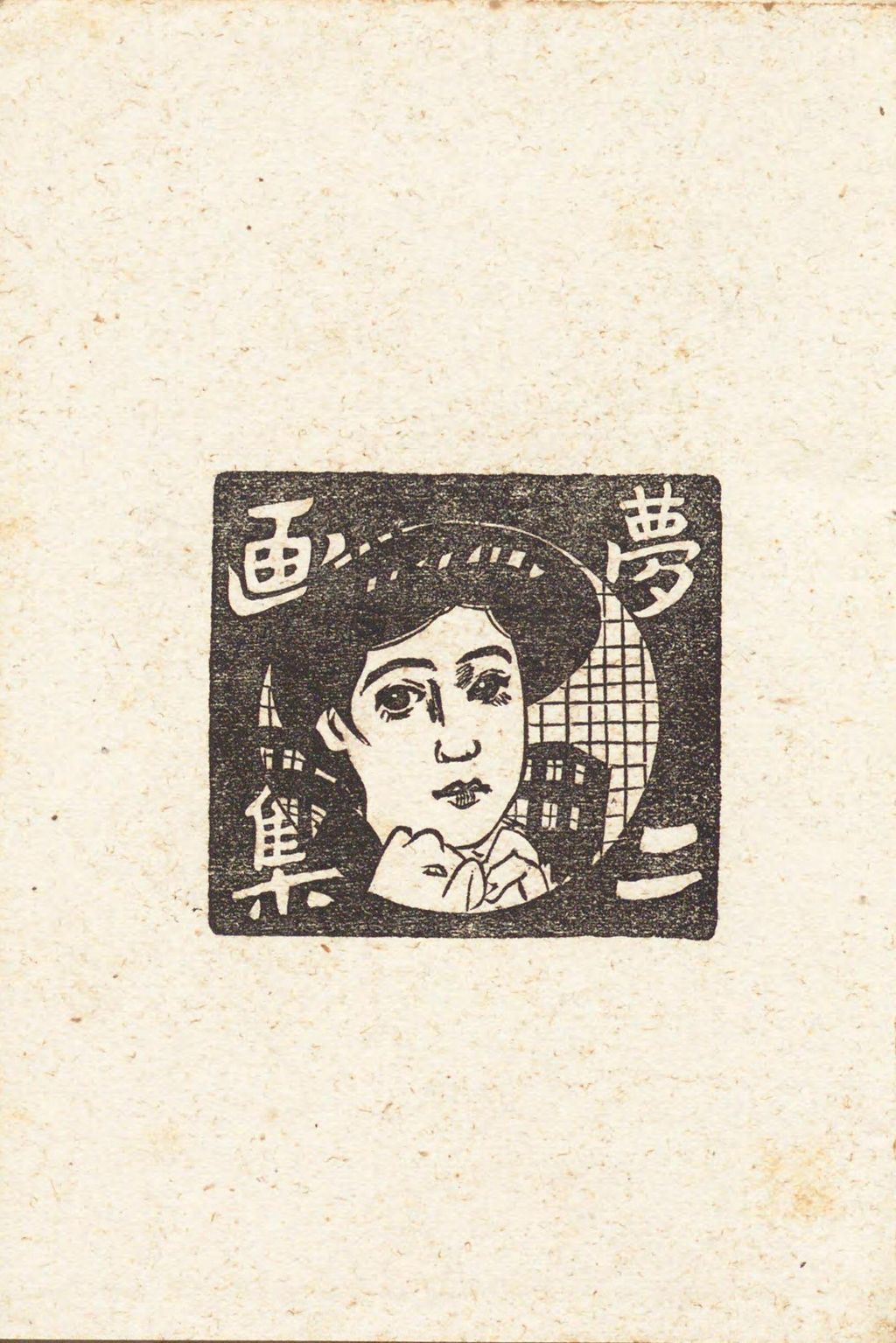
Takehisa Yumeji, selected page from a sixth edition of Yumeji Gashū. Not verified as a scan of the 1909 first printing. Source: NDL Image Bank, National Diet Library, Japan. Original item
 by Tom Gurney
Tom Gurney BSc (Hons) is an art history expert with over 20 years experience
Published on September 25, 2026 / Updated on September 25, 2026
Email: tomgurney1@gmail.com / Phone: +44 7429 011000
The life behind the name Yumeji
Takehisa Yumeji was born Takehisa Mojirō on 16 September 1884 in Honjō village, in Okayama Prefecture's Oku district. He died on 1 September 1934 at the Fujimi Kōgen Sanatorium in Nagano. Between those dates, he worked under a chosen name that appeared on newspaper drawings, books, exhibition posters, pictures, song sheets and things made to be handled at home. The route from a sake merchant's household to such a varied public life was neither a straight passage through an art academy nor the inevitable result of a single famous image. It crossed schools, city newspapers, shops, regional exhibitions, friendships and several changes of home. [1] [2] [3]
His biographies are unusually vulnerable to being compressed into a romance: “three women” and an enduring melancholy. The relationships with Kishi Tamaki, Kasai Hikono and Sasaki Kaneyo, called Oyo, did affect his life and artistic work. Each also had a life and role beyond standing for one supposed emotion in his paintings. Tamaki managed his shop; Hikono made and exhibited pictures; Oyo worked as a model before they shared a household. A dated letter, exhibition entry or account of a shop can tell us more than an unsupported claim that any unnamed figure on a magazine cover was one of them. In following the life, we will identify when a museum offers an interpretation and when a record establishes an event. [4] [5]
Contents
- The life behind the name Yumeji
- Life at a glance
- From Okayama and Kobe to the printed page
- Tamaki, family and the making of a public artist
- Minatoya, Hikono and a road through Kanazawa
- Oyo, earthquake and changes of home
- Haruna: a declared institute and a real journey
- Taiwan, illness and the last record
- Read the wisteria cover closely
- Books on Japanese Art
Even the ages printed in some museum timelines need care. They use kazoe-doshi, the traditional counted-age system, which begins with a person counted as one in the birth year. Yumeji's age shown as 51 in the year of his death is not his age calculated from the Gregorian birthday. The event dates are valuable; their age column should not silently become a Western-calendar age in a new biography. His birth name and the year in which “Yumeji” became a working name matter for the same reason: they show a public identity being made rather than inherited. [1] [2]
Life at a glance
- Life16 September 1884–1 September 1934
- Birth name and placeTakehisa Mojirō, Honjō, Okayama
- Career points1905 pen name; 1914 Minatoya; 1930 Haruna plan
- Final travelsUnited States, Europe and Taiwan
From Okayama and Kobe to the printed page
Yumeji's father Kikuzō kept a sake business in Honjō; the detailed Okayama chronology names his mother Yasuno and places him as the second son. The family story then moves quickly. In 1899 he went to Kobe to attend middle school while staying with an uncle, but left within months. His family moved to the Edamitsu district in Fukuoka in December. In 1901 he went on to Tokyo, and in 1902 entered Waseda Jitsugyō, a school oriented toward practical studies. The shifts are useful context for a young man who later made a living moving between print, commerce and painting. They do not, by themselves, prove a particular influence on his mature lines or faces. [1] [3]
The first published steps were modest pieces in media built for rapid circulation. The Okayama museum places a contribution in the Yomiuri Shimbun Sunday supplement on 4 June 1905 and a prize-winning submitted drawing, 《筒井筒》, in Chūgaku Sekai later that year. The latter is where it locates the first use of the name Yumeji. Kanazawa's chronology independently confirms the competition and pen name. Calling either contribution “his first painting” would replace the evidence about a printed drawing with a later category. A named magazine prize also does not mean he had already become the established designer of the 1920s. This was the opening of a public career, not its final style. [1] [2]
The National Museum of Modern Art, Kyoto has stressed the social and satirical side of this early print work. Yumeji contributed drawings and verse in progressive newspaper circles as well as material for general readerships. That range complicates a story in which the slender, wistful woman was his only subject from the start. The line could describe modern life critically or humorously before it decorated a sheet of music or a piece of fabric. Records of these early items tell us where an image was published and sometimes under which name. They rarely give us access to Yumeji's private motives. A biography should retain that difference and resist writing his politics backwards from every subsequent picture. [7] [8]
He left the advanced course at Waseda Jitsugyō in 1905. The absence of a fine-art diploma later made him easy to present as a purely “self-taught” outsider. That phrase is too absolute if it suggests no encounters with professional artists or no deliberate study. The museum chronology records that he sought advice on painting from Ōshita Tōjirō and Okada Saburōsuke in 1908; Okayama also records albums in which he pasted and studied Western reproductions. These facts support a more interesting picture: he did not complete an academy course, yet he looked deliberately at contemporary art and tested what he could use. The degree of particular Western artists' influence on any single design is a separate question requiring comparison, not a biographical shortcut. [1] [9]
Tamaki, family and the making of a public artist
In January 1907 Yumeji married Kishi Tamaki, born in Kanazawa and recorded formally as 他万喜. The marriage produced three sons. Their legal divorce followed in May 1909, yet museum records describe continuing periods of contact and shared or separate residence. A neat family timeline that moves from “wife” to “former wife” and drops her from the story after 1909 would therefore be wrong. Tamaki was also connected to the visual figure later called the “Yumeji beauty,” though no general relationship can prove the identity of every drawn woman. Her role in the shop Yumeji opened years later was active and commercial: the Kanazawa museum names her as its manager. [1] [4]
The naming of a visual style preceded its full commercial flowering. The National Diet Library finds “Yumeji style” in a Yomiuri Shimbun editorial diary of 28 May 1907. By 1910, it reports, his illustrations had appeared across approximately 45 newspapers and magazines. That speed of circulation made a recognisable look into something readers could discuss and emulate. It also multiplied the settings in which the pictures were seen: a drawing in a girls' magazine was encountered differently from an original painting at a gallery. This history belongs beside the marriage and early household, but it must not reduce Tamaki to an anonymous cause of fame. Images were made, printed, selected by publishers and consumed by people whose own choices we know only incompletely. [8] [4]
December 1909 brought Yumeji Gashū: Haru no Maki, his first book in the Okayama museum chronology. Kanazawa counts 57 authored books over his life while Okayama says about sixty; the precise total depends on how different issues and books are counted. What is secure is the change of scale: his drawings could now be gathered under his name and held as a book, not simply found for a day in a newspaper. The retained NDL illustration selected for this page comes from a sixth edition, which itself shows a continuing publication history. We cannot present that one scanned leaf as the literal appearance of the December 1909 first printing. Keeping editions apart is part of telling how his public life was sustained through repeated circulation. [1] [2] [6]
The resulting fame had a geography. Yumeji went to Kanazawa, Tamaki's home city, in 1910 and wrote to her while there, as Kanazawa's museum account describes. Later journeys would bring him back for exhibitions, poems and personal changes. In this earlier visit, a city outside Tokyo became part of the practical network through which an illustrator met readers and fellow makers. It helps explain why a life chart made only of Tokyo publications misses something important. Even before the best-known Kanazawa journey of 1917, he had reasons to travel connected to family and to a growing public. The letters belong to the relationship's documented history; they do not license a claim that a particular Kanazawa landscape was secretly about Tamaki. [4] [2]
From 23 November to 2 December 1912, Yumeji held his first large exhibition at the Kyoto Prefectural Library. The Okayama chronology lists 137 works including the oil painting 《初恋》. The location is important. A library and its visitors connected a person known from drawing and books to the presence of exhibited paintings. Kyoto's account of the later collector and printmaker Kawanishi Hide says that Kawanishi went to this exhibition from Kobe, copied Yumeji's small published drawings when young and later purchased works. The account is a museum's presentation of Kawanishi's reminiscences, so it documents a line of reception while reminding us that recollection is not an inventory of everything that happened in the room. [1] [10]
Yumeji was also writing a poem that would have an independent life. The first version of “Yoimachigusa” appeared in Shōjo in June 1912 under a different pen name; its more familiar form appeared in the 1913 book Dontaku. The song distributed through Senoo sheet music in September 1918 was composed by Tadasuke Ōno to Yumeji's words. Yumeji designed hundreds of Senoo covers, yet authorship still needs splitting into poem, music, printed cover and edition. “He wrote Yoimachigusa” is accurate for the words and misleading if read as credit for the melody. The career therefore includes collaboration as well as individual signatures. [1] [2] [11]
Minatoya, Hikono and a road through Kanazawa
Yumeji opened Minatoya in Tokyo's Nihonbashi district in October 1914. Kanazawa's chronology supplies the date 1 October and, crucially, Tamaki's work as shop manager. Its wares included things one wore, sent or carried: patterned papers, stationery, textiles and accessories, not simply reproductions to pin on a wall. This was a business in which design met daily decisions about colour and dress. It also put Yumeji's drawings into the hands of buyers who might never visit his paintings in an exhibition. The later 1919 Yumeji Envelope Patterns file is a surviving example of the broader idea; it was made for a printed paper product, not an unnamed original canvas. [1] [2] [12]
At Minatoya Yumeji met Kasai Hikono. The Kanazawa museum describes her as a keen picture-maker who brought drawings to show him; their closeness developed in the years after 1914. She joined him in Kyoto in 1917. That year they travelled through Hokuriku with his son Fujihiko and stayed in Kanazawa and at Yuwaku hot spring. The museum's record names a 66-day journey and a Kanazawa exhibition in which Hikono showed her own work under the name Yamaji Shino. That detail changes the shape of the biography. She was neither an unnamed face nor simply a tragic figure waiting outside the studio. A public exhibition entry establishes that she too made work. [2] [4] [5]
Yuwaku's later memorial account connects the couple's 1917 stay to Yumeji's 1919 illustrated poetry collection Yama e Yosuru. Its poetry is evidence of how he later shaped the memory of a journey; it does not make every person seen in a contemporary drawing Hikono. The distinction becomes especially important as her illness and subsequent death enter the story. Museum accounts report that tuberculosis separated them and date her death to 16 January 1920 in Tokyo. The Ikaho Memorial Museum holds letters that attest to a relationship sustained in writing. It describes the 1919 painting 《黒船屋》 in relation to their separation, while the original's documented date and present holding are firmer than a claim that its depicted woman has a proven identity. [5] [13] [14]
The 1917 trip had a professional dimension as well as a private one. The Kanazawa museum lists local literary contacts, an exhibition and a stay at Yuwaku; its wider account says Yumeji also sent writing to a regional paper. In April 1918 he mounted another Kyoto Prefectural Library exhibition, followed by a Kobe showing in May. That sequence makes clear why “muse and journey” alone is inadequate. The same period included public display of paintings, travel to an audience outside the capital and ongoing print or poetic work. The illness of his son Fujihiko during the Hokuriku journey, reported in Kanazawa's account, is another reason not to treat the trip as an uninterrupted idyll invented by later reminiscence. The evidence points to practical demands and health concerns alongside the remembered stay with Hikono. [1] [2] [5]
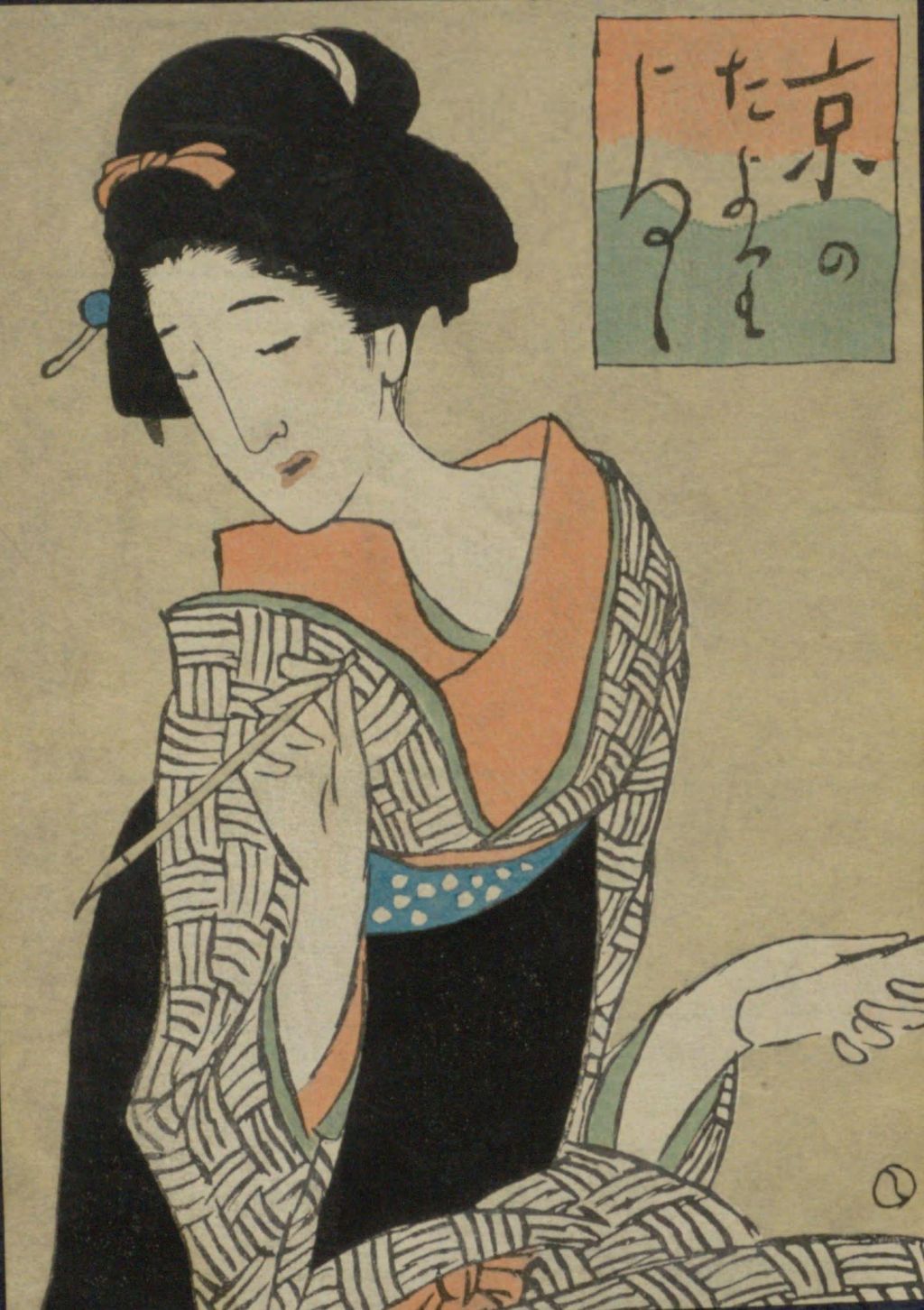
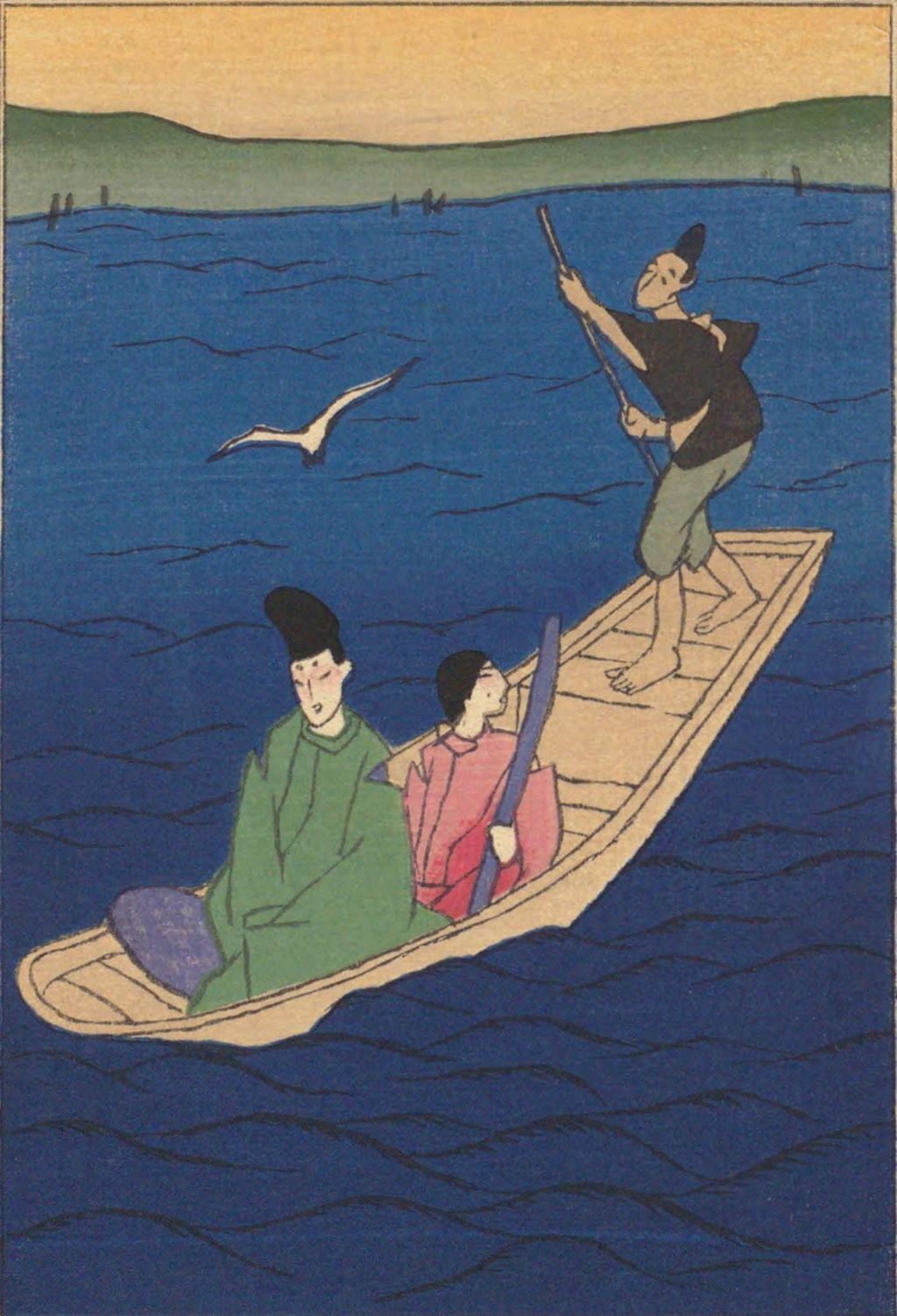
Yumeji's work did not pause while these events unfolded. The illustrated Shinyaku Eiri Ise Monogatari, published in 1917, contains drawings made to accompany a literary sequence. One NDL Image Bank selection shows the visual scale and manner of such a page. Its exact episode must be checked against the surrounding text before giving a scene name. That restraint is biographical as well as cataloguing discipline: it lets us see a period of book work alongside travel, relationships, music covers and exhibitions without claiming the plot of a story was a coded account of his own household. [15]
Oyo, earthquake and changes of home
Sasaki Kaneyo, who became known as Oyo, entered Yumeji's work as a model around 1919 according to Okayama and Kanazawa museum accounts. She and Yumeji later shared a household, placed by the Okayama chronology around 1921. The distinction between beginning to model and beginning to live together matters, as does her own name. She should not be described only as an echo of Hikono or as a general template for all women in his post-1919 pictures. The museums give a more specific course: they locate a shared domestic arrangement, the 1924 atelier-house and a separation in 1925. Kanazawa also records her family origins in Akita and her stays near Kanazawa as that relationship ended. [1] [4]
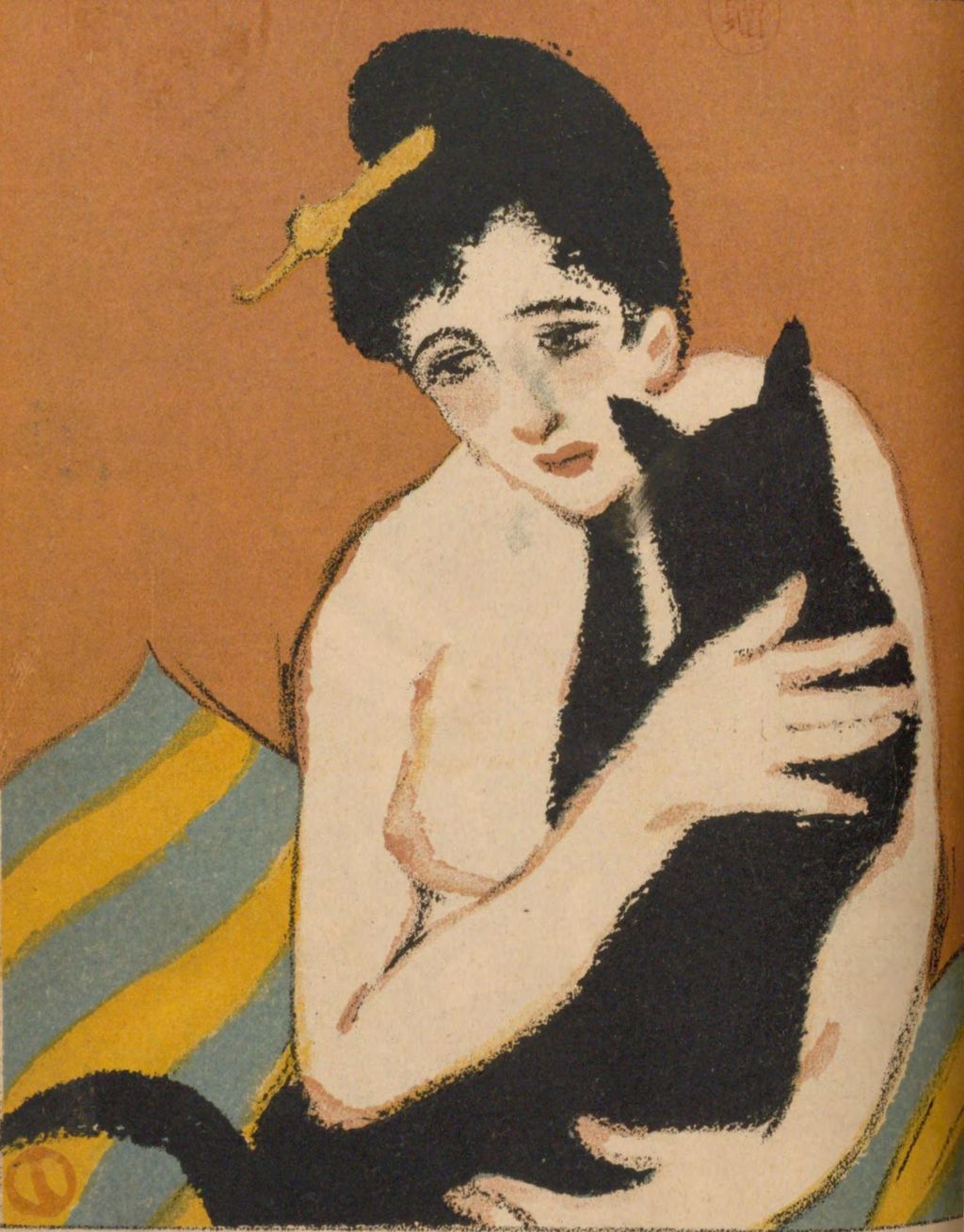
The 1921 cover of Shōsetsu Club selected for the paired artist home depicts a woman and a black cat. We can identify the issue and look at the arrangement, but the NDL record does not identify the woman. A biography invites precisely the tempting leap from a dated love story to a named model; here the leap should be resisted. The magazine, editor and readership were part of its life, and the figure's downturned attention to the cat may be analysed without claiming access to a sitter's private experience. This is one way the biography can improve the artwork account: it gives relevant temporal context and also shows where context stops. [16]
Plans for a broader design enterprise appeared in 1923. Yumeji and others, including the printmaker Onchi Kōshirō, announced Dontaku Zuan-sha in May. On 1 September the Great Kantō Earthquake disrupted the project. From 14 September, Yumeji published the illustrated Tokyo Sainan Gashin in Miyako Shimbun. This sequence is much more precise than saying that the disaster “changed his art” as a vague turning point. The plan's failure, the newspaper reporting and his continuing work each have dates and names. A future illustration of the disaster series would need a verified NDL or other rights-cleared file; the existence of an institutional mention does not clear a reproduction. [1] [2]
In December 1924 he completed an atelier-house, Shōnen Sansō, in the Matsubara area beyond central Tokyo. Museum accounts place Oyo and his sons there for a time. That concrete domestic project belongs between the collapse of the Dontaku proposal and later plans for a Haruna art institute. It also warns against a simple tale of the 1920s as decline: even if the mass fashion for “Yumeji style” changed, he continued to make spaces in which art, work and everyday life could meet. Oyo left the relationship in 1925. The more intimate account of the distress around their parting comes from the Kanazawa museum's retrospectively told history; its private details need attribution and restraint, not dramatic recreation. [1] [2] [4]
At the same time, Yumeji's experience moved into newspaper fiction and picture stories. Okayama's chronology records an illustrated serial, Misaki, in Miyako Shimbun beginning in August 1923, the 1924 serials Hiyaku Shisetsu and Kaze no Yō ni, and the autobiographical picture novel Shuppan in 1927. These are publications to be investigated as publications, not a transparent diary. The adjective “autobiographical” describes the form by which he offered readers a constructed self. It does not turn each character into a one-to-one portrait of Tamaki, Hikono or Oyo. The volume and sequence of the newspaper work also matter for a livelihood: after the earthquake and the failed Dontaku company, the public would still meet Yumeji through instalments that arrived repeatedly, not only through the occasional exhibition. [1]
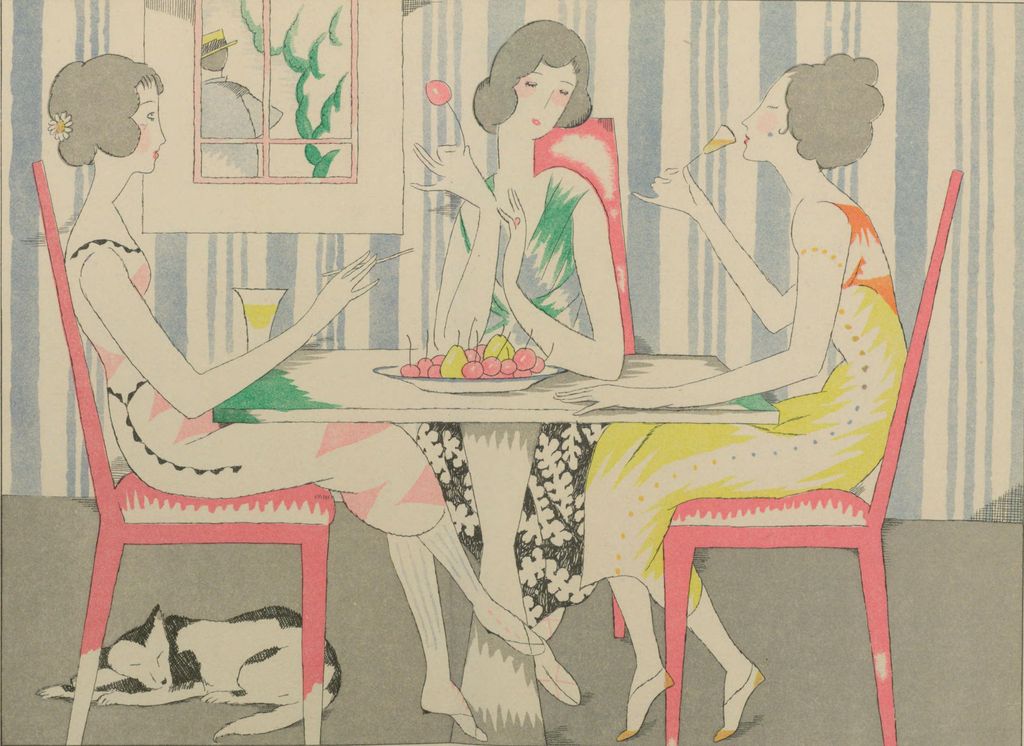
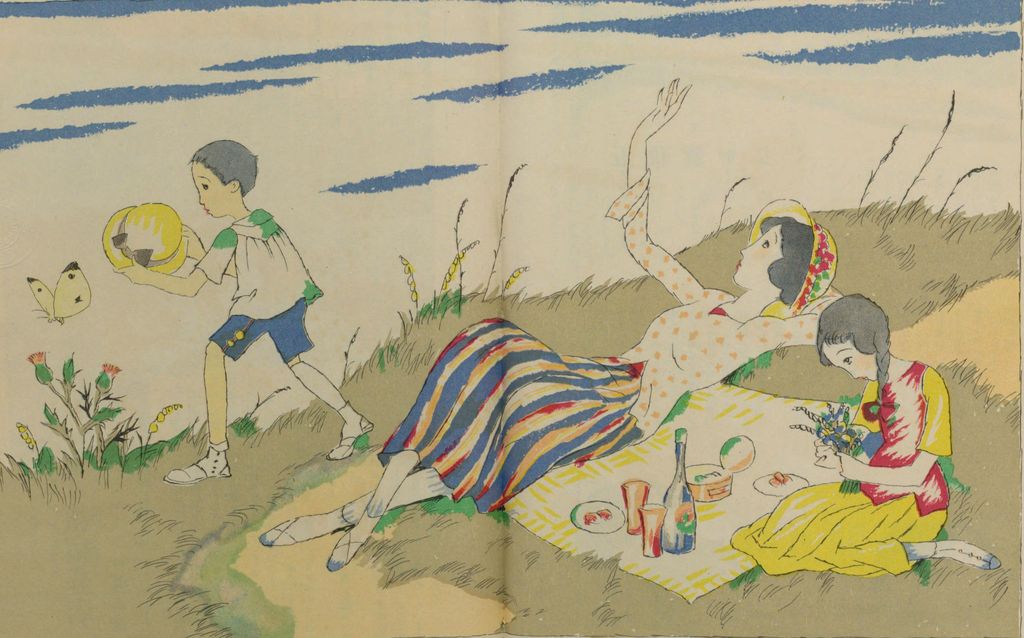
The published work also altered shape. A 1925 Mitsukoshi design, 《凉しき裝ひ》, puts three women into a patterned interior, with a dog beneath the chair. Another, 《野遊》, moves an equally social group outdoors. These are exact pages from different issues, not photographs of an identified house or a scene known to include Oyo. Their significance here is temporal: the artist who had written disaster dispatches and built an atelier-house was still supplying complex compositions to magazines and commercial publishers. A biographical narrative that stops at a muse's departure would erase this continuing work. [17] [18]
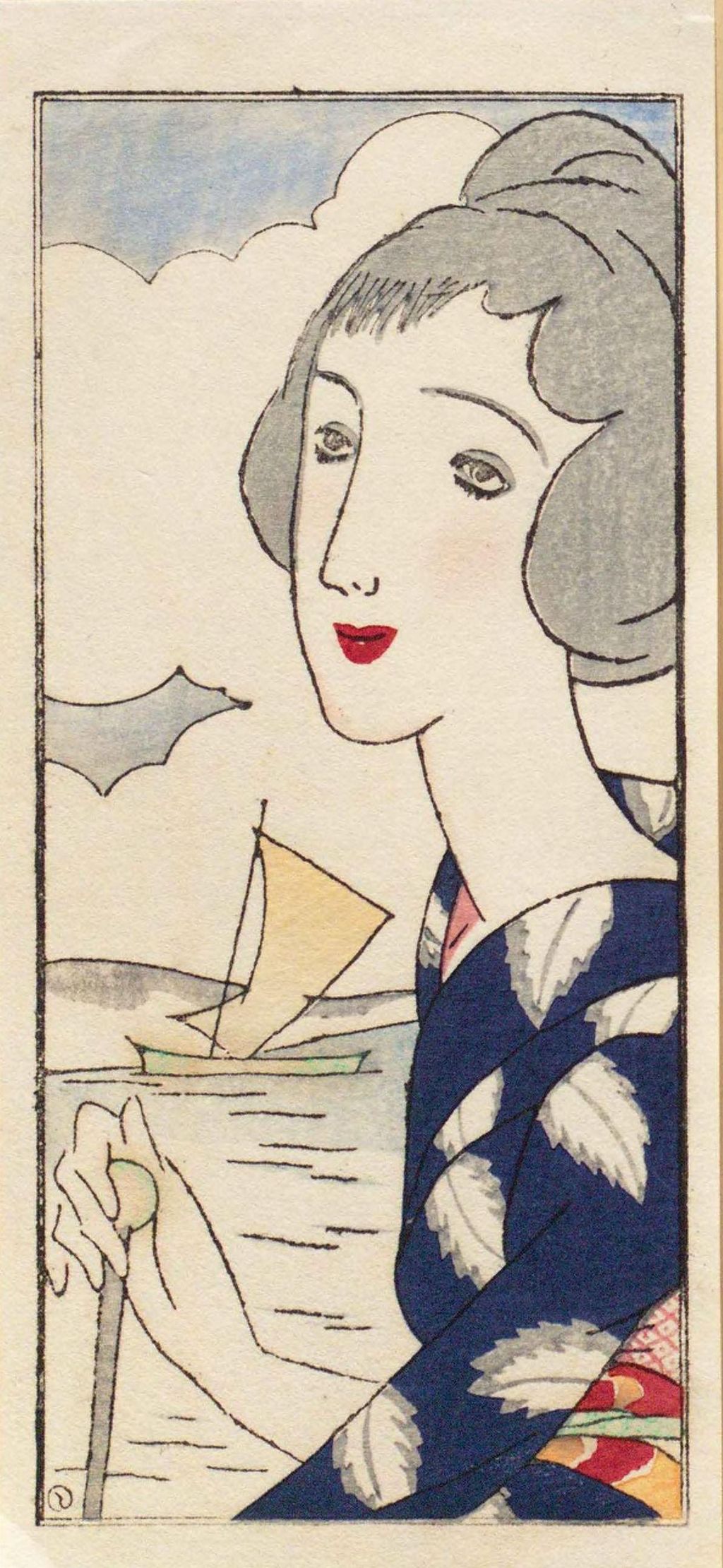
One later publication shows how his images continued to change hands. The upper volume of the 1927 Yumeji Jojōga Senshū reprints 《シーサイド》; its contents identify an original appearance in Fujin Graph in August 1924. Those are two dates for a design and a later object, not two competing estimates for the same event. The printed anthology also tells us that Yumeji's work could be selected, sequenced and reframed after its first appearance. In a life story, this matters because it is easy to connect a reproduced woman to the year on the later volume and then assign her to whichever relationship belonged to that year. The catalogue gives no such identity. It tells us about circulation, editing and the survival of a printed form. [27]
Haruna: a declared institute and a real journey
By May 1930 Yumeji publicly proposed the Haruna Mountain Art Research Institute. The plan addressed the relationship of art, hand production and ordinary life. The Ikaho Memorial Museum says that an atelier was made near Lake Haruna by the end of that year. Kyoto's museum account, however, makes clear that the institute itself was not realised. These statements are compatible once a workshop building, a declaration and a fully functioning school are not mistaken for the same thing. The ambition shows continuity with Minatoya and with the earlier Dontaku project, but it should not be retroactively described as a campus that enrolled students. [1] [3] [13]
He left Yokohama for the United States on 7 May 1931. The Okayama chronology gives a Honolulu stop, an exhibition at Carmel's Seven Arts Gallery that September, shows at UCLA and the Olympic Hotel in the Los Angeles area the following year, and departure from San Pedro on 10 September 1932. The March 1932 Olympic Hotel flyers reproduced in historical reporting offer a rare material check on one of these events. The dates tell us where he showed his work; they do not, alone, prove that an American audience understood it or that he saw the journey as a success. [1] [19]
The Los Angeles story gains depth when its Japanese American setting is kept visible. PBS SoCal's account of surviving flyers and family memories places Yumeji among patrons and artists in Sawtelle and Little Tokyo, including the Hashimoto family and photographer Toyo Miyatake. Miyatake made a 1932 portrait of him; Yumeji gave him the oil painting 《西海岸の裸婦》 before leaving for Europe. The Okayama Yumeji Art Museum now lists that painting among its holdings. This provenance is more interesting than a caricature of an artist simply “failing in America”: communities provided food, rooms, exhibition audiences and a route by which an original painting survived. Some details in the PBS story are recollection and later family history, so they belong beside the dated museum record rather than replacing it. None of the PBS portraits, flyers or museum image is cleared for copying into this article. [19] [20]
There is also a difference between the reception of separate Californian shows. The Carmel exhibition at the Seven Arts Gallery, according to later local historical reporting, did not produce the hoped-for sales. The Olympic Hotel exhibition was addressed primarily to a Japanese American audience; its surviving flyer identifies a specific place in Little Tokyo and a March 1932 date. Whether Yumeji regarded one group as more receptive than another should be tied to a letter or reported statement, rather than inferred from a calendar. The contrast nevertheless helps explain his actual working conditions: venue, language, networks and economic support changed as he moved from Monterey County to Los Angeles. The West Coast was not one undifferentiated stopover before Europe. [19]
He reached Hamburg on 10 October 1932 after travelling from California by way of the Panama Canal. The subsequent months took him through Europe and eventually to Berlin, where he taught Japanese painting at Johannes Itten's Itten-Schule in 1933. This was Itten's own school, founded after his Bauhaus work. It is inaccurate to say that Yumeji “joined the Bauhaus.” The National Museum of Modern Art, Kyoto preserves ten ink demonstration pictures and his 1933 instructional text Nihonga ni Tsuite, donated by the Itten family. This material record is more substantial than a casual name association. Research on the Berlin school also places the painter Mizukoshi Shōnan among its Japanese instructors and treats the exchange as two-way. The currently inspected scholarly abstract supports that institutional context; its full argument should be read before more detailed claims about Itten's theory are borrowed. [21] [22] [2]
Taiwan, illness and the last record
Yumeji returned to Japan on 18 September 1933. Soon afterwards he made a journey that short biographies often pass over: in late October he went to Japanese-ruled Taiwan. The Okayama chronology mentions a lecture and exhibition. Hirota Masaki's university study, working through contemporary newspaper evidence, places his arrival at Keelung on 26 October, a Taipei talk on 3 November, and a 3–5 November exhibition at the city's Police Hall. A Taiwan art-archive study of the same hall's earlier photograph independently notes that the building later hosted Yumeji's show. The exact title and reception of every work exhibited still require the contemporary exhibition list; the documented venue and dates are enough to establish the trip's seriousness. [1] [23] [24]
Hirota places this visit beside the official Taiwan art exhibition and asks how an artist shaped by foreign travel saw colonial power. That is a useful, explicitly argued historical interpretation. It should not be turned into direct access to Yumeji's private politics or the reason he accepted an invitation. The same article weighs a proposed connection between the trip and debts from overseas travel, but bases part of that assessment on a later newspaper study of a loan document. Until the underlying loan and Yumeji's own correspondence are examined, the article can report that a scholar has proposed it, not announce one settled motive. Its introductory “1831” date for the American departure also appears to be a printing error against the museum chronologies' 1931. The geographic sequence and the limits of the evidence both belong in this biography. [23] [1]
The setting of that exhibition calls for similar precision. Hirota notes that the Police Hall show ran for three days while the official Taiwan Art Exhibition occupied a much longer span and attracted substantial local attention. The venue was part of the Japanese colonial administration's built environment. A Taiwan art archive identifies it from a 1931 period photograph and confirms that Yumeji later showed there; the photographed room is not necessarily the exact room used for his exhibition. Such a picture could one day give readers an unusually concrete sense of place, but its old publication date does not itself establish commercial image rights. For now, the hall's role and the parallel local art scene can be explained with links and dates. [23] [24]
After he returned from Taiwan, Yumeji's health worsened. He entered the Fujimi Kōgen Sanatorium in January 1934 and died there on 1 September. Kyoto's museum account identifies tuberculosis. Okayama's chronology also names a final book-design commission published that April. Even in the year of his death, then, there is a traceable piece of professional work alongside the medical and family record. Death did not close the life of the images: the later collector Kawanishi Hide retained hundreds of works and documents, and Kyoto acquired his collection; publishers such as Ryūseikaku later played a role in restoring the artist's visibility. Each act of keeping, reprinting and exhibiting changed what later viewers could see. [1] [3] [10] [25]
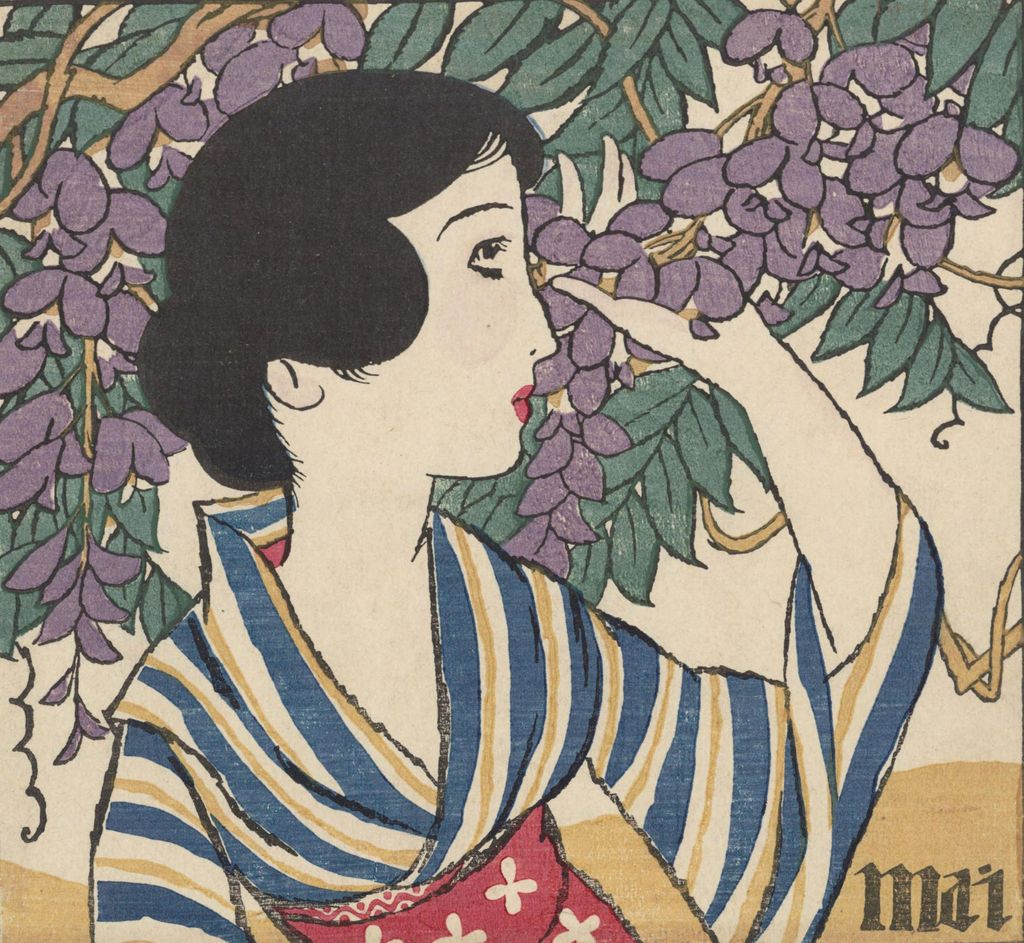
Read the wisteria cover closely
Choose a number to enlarge a detail from the retained high-resolution NDL image. Locate it in the whole cover, then read the explanation below.
Explained details
Face and hand
The wisteria comes between face and hand. Follow gaze and gesture without inventing a sitter’s identity.
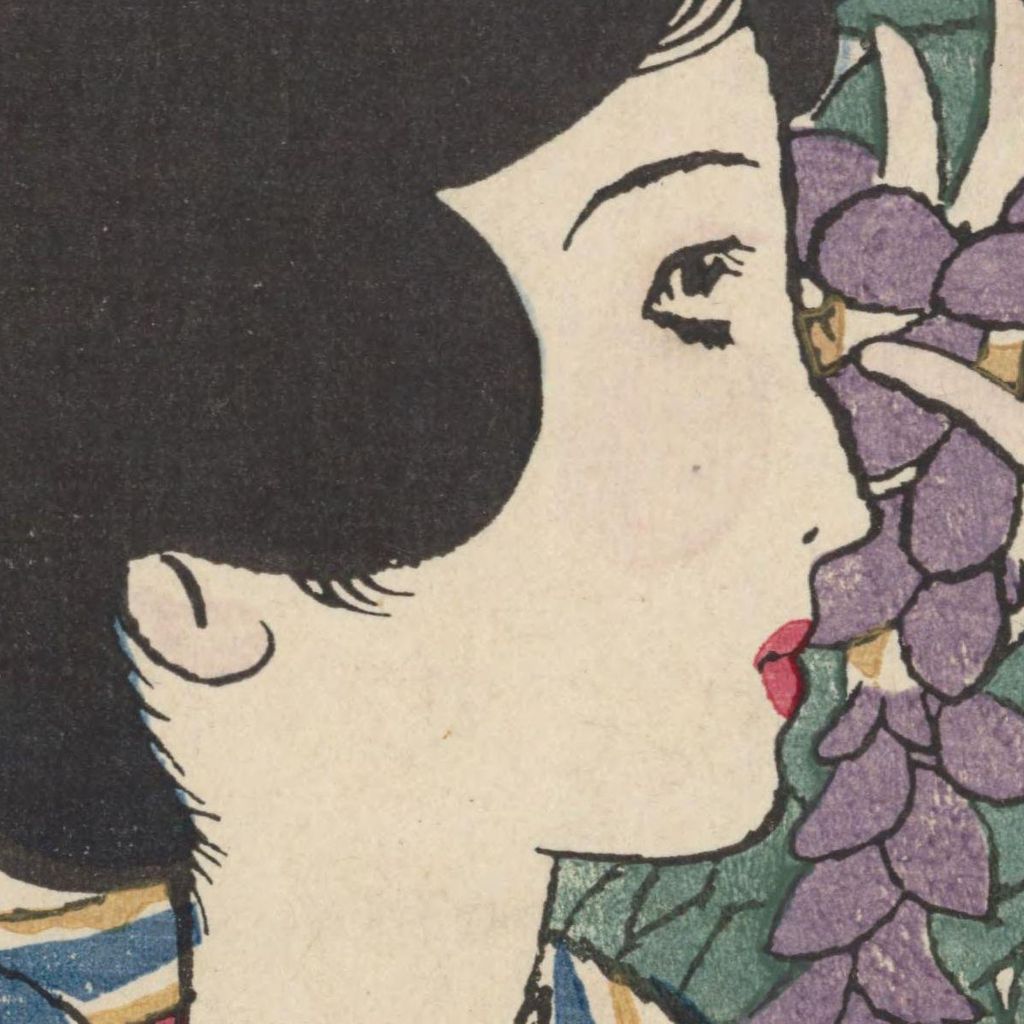
Source: NDL Image Bank, National Diet Library, Japan. Original item. Editorial crop and resize.
Wisteria
Purple blossoms and green leaves frame the hair, setting off the light face.
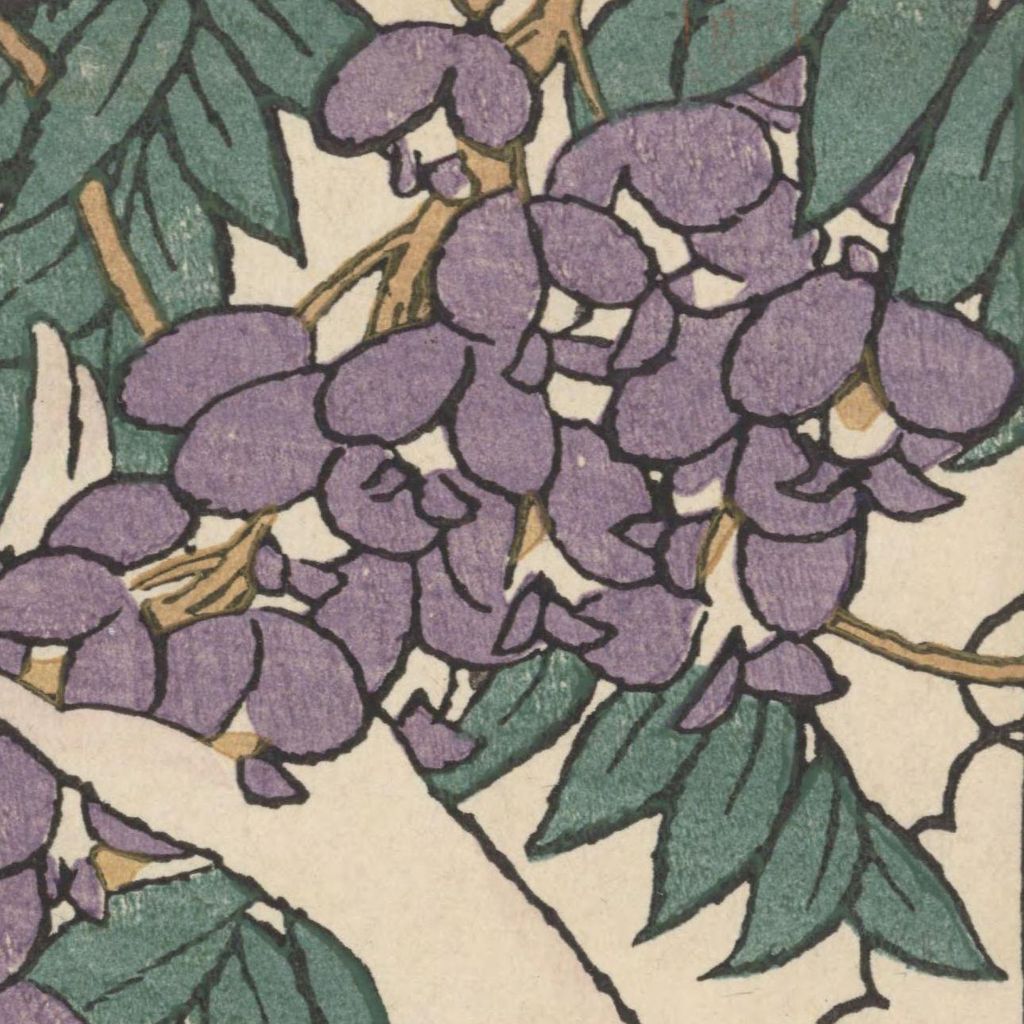
Source: NDL Image Bank, National Diet Library, Japan. Original item. Editorial crop and resize.
Striped fabric
Broad blue and white stripes answer the small colour patches of the flowers. Cropping to the face removes that design.
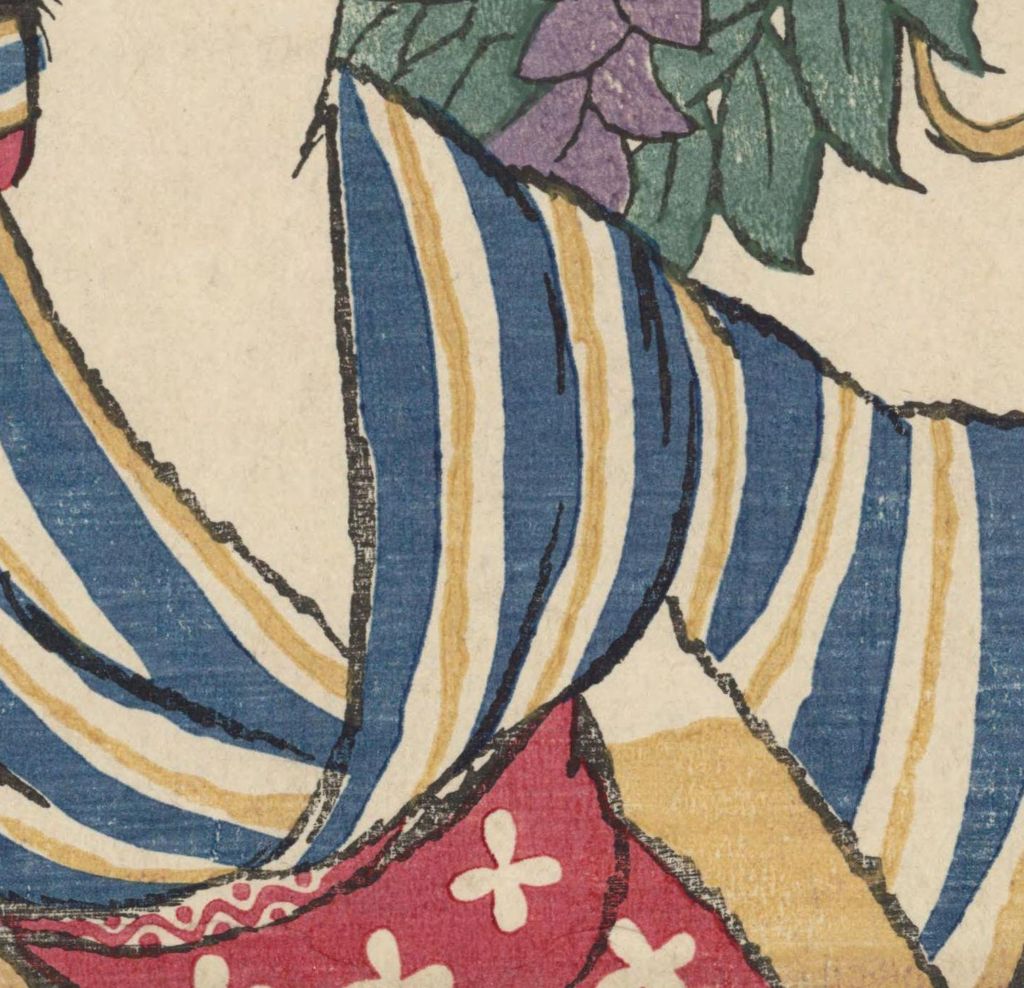
Source: NDL Image Bank, National Diet Library, Japan. Original item. Editorial crop and resize.
The strongest account of Yumeji's life therefore follows both people and objects. A 1905 published drawing proves a working name in print; the 1912 Kyoto exhibition confirms an ambition to be seen through original works; Tamaki's shop management and Hikono's own exhibited pictures alter a simple “muses” story; letters and the dates of books connect places without settling each painted sitter; the surviving Itten-school teaching text anchors Berlin; and a Taiwan exhibition in a particular colonial venue makes the last journey more precise. What remains uncertain should be marked as such. That is a fuller legacy than a single sad-eyed face or a colourful story of three romances can carry. [1] [4] [21] [23]
Frequently Asked Questions
He was born Takehisa Mojirō (竹久茂次郎) on 16 September 1884 in Honjō village, Oku district, Okayama Prefecture, now within Setouchi. “Yumeji” appears as a public working name in a 1905 magazine competition. The ages in several Japanese museum timelines use kazoe-doshi rather than modern birthday age. [1] [2]
He did not complete a formal art-academy programme. He studied at Waseda Jitsugyō, submitted drawings to papers and magazines, deliberately studied reproduced Western images and sought advice from professional painters. “Self-taught” is fair only if it describes a path outside a completed academy course, not a life without study or contact with other artists. [1] [9]
Tamaki was his legal wife, the mother of his three sons and later manager of Minatoya. Hikono made pictures, exhibited in Kanazawa under the name Yamaji Shino and died in 1920. Oyo, born Sasaki Kaneyo, modelled from around 1919, later shared a household with him and separated in 1925. A relationship does not establish the identity of every woman he drew. [4] [1]
He taught Japanese painting in Berlin in 1933 at Itten-Schule, the separate school founded by former Bauhaus master Johannes Itten. Kyoto's national museum holds ten demonstration ink works and Yumeji's teaching text from that school. Calling him a Bauhaus faculty member would misidentify the institution. [21] [22]
He left Japan in 1931, travelled in the United States, reached Europe in 1932 and taught in Berlin in 1933. After returning to Japan in September 1933, he made a short trip to Taiwan, with a lecture and Taipei exhibition in November. He entered a Nagano sanatorium in January 1934 and died there on 1 September. [1] [23]
Discussion
Compare dated records, surviving objects and later interpretations of Yumeji’s life.
Reader Insights
What changes when Tamaki’s management of Minatoya is included?
What does Hikono’s Yamaji Shino exhibition entry establish?
Which sources document California, Berlin and Taiwan, and where do they stop?
Join the Conversation
Share a documented example or reliable source below, keeping observation separate from inference.
References
- Yumeji Art Museum, “Footsteps of Takehisa Yumeji”. Detailed birth-to-death chronology; its printed ages are counted ages.
- Kanazawa Yuwaku Yumeji Museum, chronology. Independent institution's dated events, Kanazawa journey and shop role.
- The National Museum of Modern Art, Kyoto, Kawanishi collection exhibition. Biography and late institute/teaching distinction.
- Kanazawa Yuwaku Yumeji Museum, “Three women and Kanazawa”. Tamaki, Hikono and Oyo, their names, work and life dates.
- Kanazawa Yuwaku Yumeji Museum, the Yuwaku journey. 1917 route, 1919 poems, letters and later memorial interpretation.
- NDL catalogue, Yumeji Gashū, sixth edition, selected page and Image Bank gallery. Image Bank file
1901200_3is not established as the 1909 first printing. - The National Museum of Modern Art, Kyoto, 2024–25 collection essay. Early satirical work and later Itten-School context.
- National Diet Library Image Bank, “Yumeji style”. 1907 term, printed circulation and social/fashion reception.
- Yumeji Art Museum chronology and introductory study. 1908 painter visits and retained foreign-art scrapbook; used as an institutional account, not proof of exact visual borrowings.
- Kyoto national museum, Kawanishi collection chapter study. Kawanishi's retrospective testimony, collecting and surviving Berlin teaching materials.
- PTNA piano-music encyclopaedia, “Yoimachigusa”. Identifies the composer as Tadasuke Ōno; poem and sheet dates checked against museum chronologies.
- NDL, Yumeji Envelope Patterns, First Series, selected page and catalogue. Image Bank file
1182862_2. - Takehisa Yumeji Ikaho Memorial Museum, artist chronology and letters. Original 《黒船屋》, 1919 and local surviving correspondence; painting interpretations remain attributed.
- “Takehisa Yumeji: An Artist Who Defined His Era,” work guide. 1919 original painting holding and exact date of the May 1926 magazine cover.
- NDL, Shinyaku Eiri Ise Monogatari, 1917, selected page and catalogue. Image Bank file
1908145_17; literary episode not identified from an isolated image. - NDL, Shōsetsu Club 5(3), 1921, selected cover and catalogue. Image Bank file
1479984_1; model not named. - NDL, Mitsukoshi 15(6), 《凉しき裝ひ》 and catalogue. 1925, Image Bank
1524610_4. - NDL, Mitsukoshi 15(10), 《野遊》 and catalogue. 1925, Image Bank
1524614_13. - PBS SoCal, documented Los Angeles journey and surviving 1932 Olympic Hotel flyers. Distinguish documented flyers from later family recollection; no image permission inferred.
- Yumeji Art Museum, collection. Lists 《西海岸の裸婦》 among its original holdings; museum photograph not cleared.
- Kyoto national museum, Kawanishi collection and Itten-School material. Ten teaching ink works and the 1933 Nihonga ni Tsuite text donated by Itten's family.
- Kaneko Yoshimasa, “Relationship between Johannes Itten and some Japanese in Berlin,” Bulletin of Japanese Society for the Science of Design 50(6), 2004. Abstract inspected; full paper not claimed as read.
- Hirota Masaki, “Taiwan no Yumeji: Saigo no Tabi,” Quadrante 16 (2014), 63–76, NDL article catalogue. Full article read; contemporary-event discussion distinguished from its historical interpretations.
- Taiwan Modern Art Archives, 1931 Police Hall photograph study. Confirms Yumeji's 1933 exhibition in the hall; photo rights unverified.
- Chiyoda City, Ryūseikaku exhibition account. The publisher's role in posthumous Yumeji collecting and reception.
- NDL, Fujin Graph 3(5), selected cover and catalogue. Image Bank file
2799512_1. - NDL, Yumeji Jojōga Senshū, upper volume, selected 《シーサイド》 page. The 1927 anthology contents identify an August 1924 Fujin Graph appearance; Image Bank file
1688916_7.