


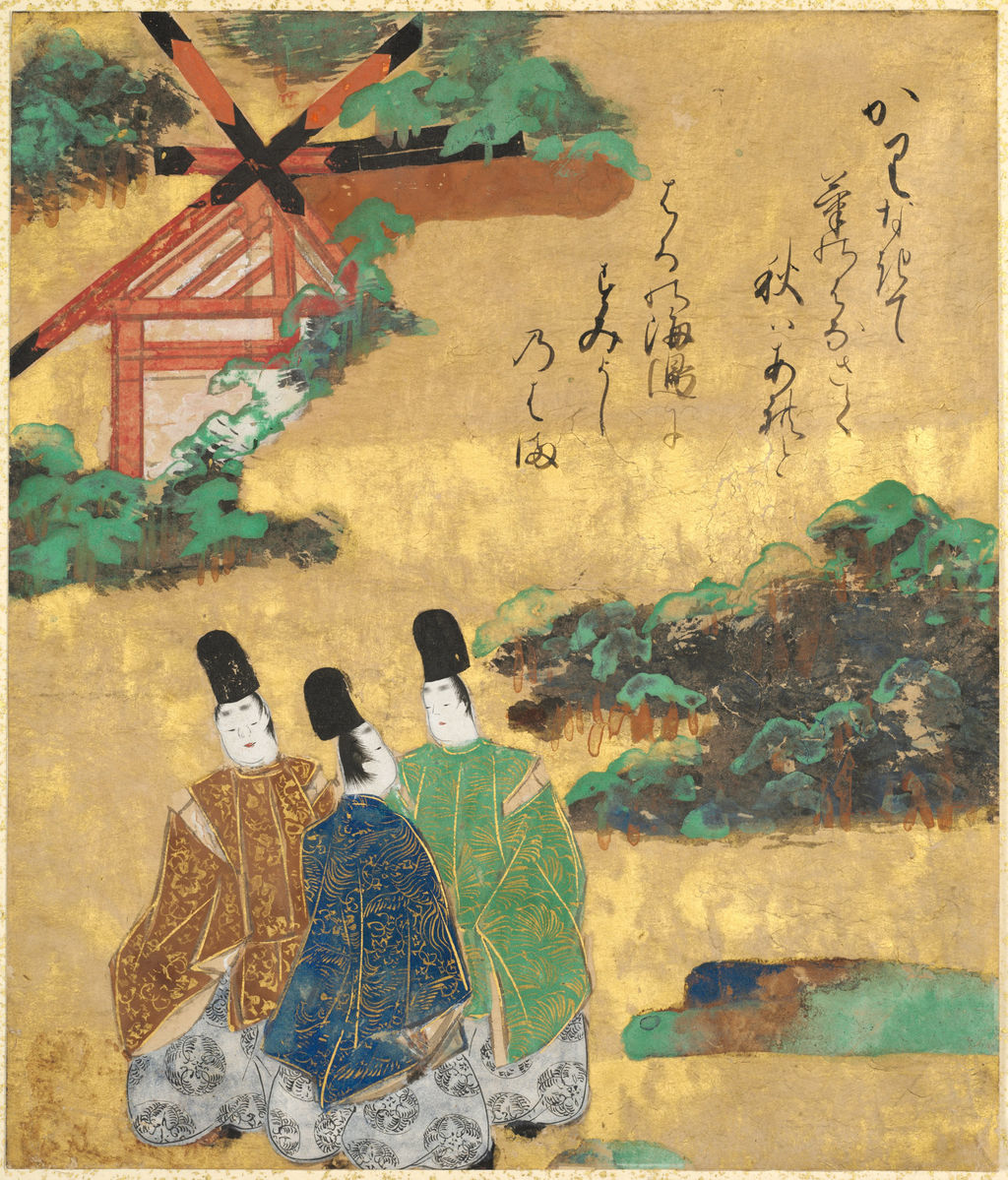
Tawaraya Sōtatsu, The Beach at Sumiyoshi from the Tales of Ise, c. 1634. Cleveland Museum of Art, 1951.398.
 by Tom Gurney
Tom Gurney BSc (Hons) is an art history expert with over 20 years experience
Published on June 19, 2020 / Updated on September 23, 2026
Email: tomgurney1@gmail.com / Phone: +44 7429 011000
A painter known through the things his workshop made
Tawaraya Sōtatsu (俵屋宗達) is associated with some of the most recognisable paintings of early seventeenth-century Japan. His own life remains surprisingly elusive. Neither a secure birth year nor a named teacher emerges from the checked museum record. The National Museum of Asian Art describes him as active in the first four decades of the 1600s and bases much of its account on the work of the Tawaraya shop in Kyoto. Kyoto National Museum calls his life dates unknown even while confidently cataloguing the famous Wind God and Thunder God Screens as his painting. A date range such as “c.1570–c.1640,” used in some object labels, is a catalogue convention; it should not be turned into an exact lifespan. The most useful first question is therefore what different surviving objects can show, and whose part in making them is actually identified. [1] [2] [3]
Sōtatsu headed a Kyoto business that made and sold decorated folding fans, poem cards and papers. Such objects could be carried, exchanged, written on, bound into albums or mounted on screens. A painting on one small surface might become part of a much larger arrangement. James T. Ulak's introduction to the Smithsonian's Sōtatsu: Making Waves catalogue makes the fan central to this story: its folding planes constrained a painter's composition, but the object also moved classical and religious stories from relatively secluded settings into urban circulation. That interpretation gives the workshop a practical scale. It did not simply execute a solitary master's large museum paintings; it made material for several kinds of viewing, reading and social exchange. [2] [1]
Contents
- A painter known through the things his workshop made
- The Tawaraya shop and the portable image
- Poetry was part of the picture
- Ink that pooled, and ink that described
- Gold, gods and the space between them
- What a studio attribution changes
- A changing reputation, not a straight line of disciples
- Books on Japanese Art
The visual habit that links those formats is not a single decorative motif. It is the ability to let a large area of paper or gold stay open, then make a silhouette, wash of ink or cluster of figures carry the event. A poem can occupy a substantial part of the same sheet. A bird can emerge from a few controlled strokes. A screen can turn the interval between two figures into part of the action. Some of these effects occur in works directly credited to Sōtatsu; others were made by the shop or by followers. Keeping that difference visible makes the history more interesting than calling every familiar Rinpa-like surface “a Sōtatsu.” [4] [5] [6]
At a glance
- ArtistTawaraya Sōtatsu (俵屋宗達)
- ActivityEarly 17th century; precise life dates unknown
- CentreKyoto
- FormatsFans, poetry paper, scrolls and screens
The Tawaraya shop and the portable image
Kyoto's recovering commercial life provided a setting for specialist crafts in the late sixteenth and early seventeenth centuries. Ulak places the Tawaraya fan shop on Gojō-dōri according to a contemporary fiction, and notes that both ready-made fans and commissions could be obtained. Fictional mention is evidence that a shop of this kind could be recognised by readers, but it is not a lease naming Sōtatsu as the tenant on a particular day. The Smithsonian chronology establishes the practical range of the business—fans, cards and decorated paper—more securely than it establishes the artist's personal address or family background. [2] [1]
The fan gave a maker a difficult geometry. It widened toward its rim and folded into angled sections; a scene had to remain legible when open while anticipating that some of it would disappear when carried closed. Courtly narratives, birds, flowers and episodes of war could be abbreviated to telling forms. More than one hand could prepare the paper, paint the subject, add a seal and assemble the object. A fan could later be remounted: seeing one in a museum screen does not necessarily show its first social use. This sequence matters to attribution because a completed screen can gather earlier small works by several makers. It also matters to the viewer, who may see a densely arranged surface where an original owner once unfolded only one fan at a time. [2] [8]
The screen of painted fans documented by the National Museum of Asian Art makes the workshop concrete. Its exhibition record describes forty-eight fans across a pair of eight-panel screens in the Museum of the Imperial Collections. A conservation study uncovered the name Tawaraya Tōshichirō on the reverse of one fan, connecting one Tatō seal to another painter working beside Sōtatsu. Eighteen fans bear that seal, and several have forms of the I'nen seal; their subjects include military tales, Tales of Ise episodes and birds and flowers. The Japanese cultural-heritage record describes a different pair at Tokyo National Museum: six-panel screens with sixty fan paintings, qualified as traditionally attributed to Sōtatsu. Their similar title makes the two sets particularly easy to confuse. They must not be merged into one illustrated work or used as interchangeable photographs. Both demonstrate how a mounted screen could give many portable images a new order and a new way to be seen. [8] [9] [26]
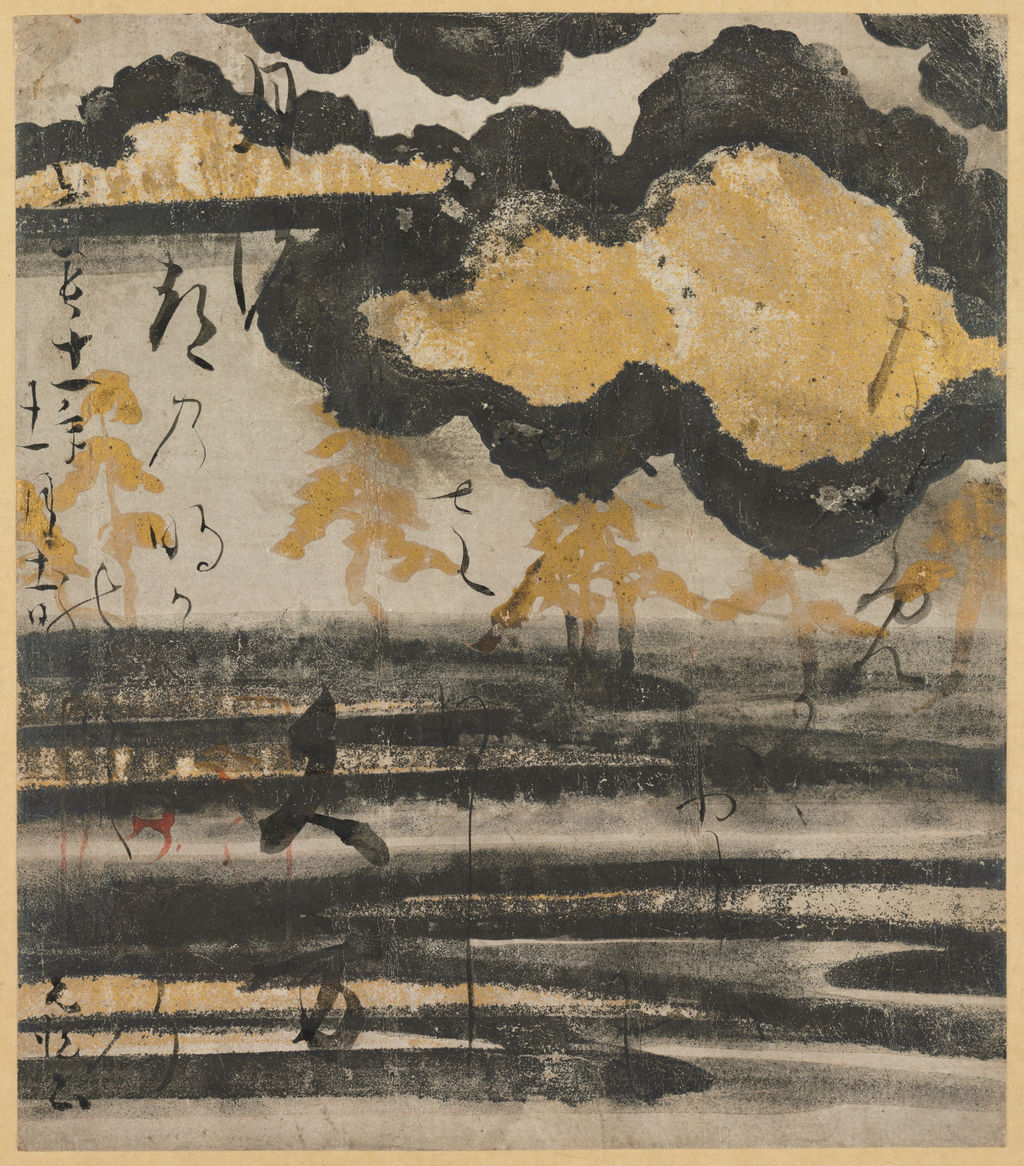
The screen itself is not reproduced here: the checked museum page is a research source, and an exhibition photograph is not automatically a commercial-use file. Cleveland's open-access poem card supplies a closer look at the scale on which the shop and its collaborators could work. It is one surviving card from a group associated with the retirement of the imperial regent Konoe Nobutada in 1606. The museum credits Sōtatsu with the decoration and Hon'ami Kōetsu with the calligraphy. Pine forms in the underpainting are neither empty wallpaper nor a caption for the written poem. Their broad shape and the handwritten marks occupy the same intimate surface, asking the viewer to see and read in alternating rhythms. [10] [1]
Poetry was part of the picture
Sōtatsu's collaborations with Kōetsu place painting and writing on a shared material rather than on separate illustrated and textual pages. Kyoto National Museum's Crane Scroll, accession A甲364, is a striking Japanese example. It is about 13.56 metres long. Cranes painted in gold and silver appear beneath the Thirty-Six Immortal Poets verses written by Kōetsu. The museum's Japanese description attends to how the birds fly, rest and gather along the length of the work. In a scroll, the composition is not presented all at once: a reader unrolls one span while another disappears. The pictured birds can therefore change pace along with the written lines. The object record names the distinct tasks of painter and calligrapher, but the resulting experience belongs to both. [11] [12]
The Kyoto record provides thirty photographs and a route to apply for images. Its image rights have not been cleared for this site, so it appears here through linked research rather than a copied plate. That limitation is also an editorial guardrail: a convenient Cleveland card should not be relabelled as a detail of Kyoto's crane scroll. It is a different object with its own date, size and institutional account. Cleveland has a much longer Kōetsu poem scroll with underpainting attributed to Sōtatsu; its exceptionally wide image also needs a deliberate scroll presentation or labelled detail crop. The museum's qualifier belongs in any caption. A collaboration is not a licence to treat all ink beneath Kōetsu's writing as direct Sōtatsu painting. [11] [13]
Two painted poetry sheets linked to The Tales of Ise show another way text and picture converse. Cleveland dates The Beach at Sumiyoshi to about 1634 and records the poem on the painting; the sheet is now mounted as an album leaf. The Met's Mount Utsu is also dated about 1634 and catalogued as a poem card mounted later as a hanging scroll. Its named place comes from a classical tale and poem, not from a trip documented for Sōtatsu. These works are small in their painted area yet broad in reference: a shore or mountain can bring a literary episode into a room through colour, figure and written line. Their different present mounts are part of their material lives. [7] [14]
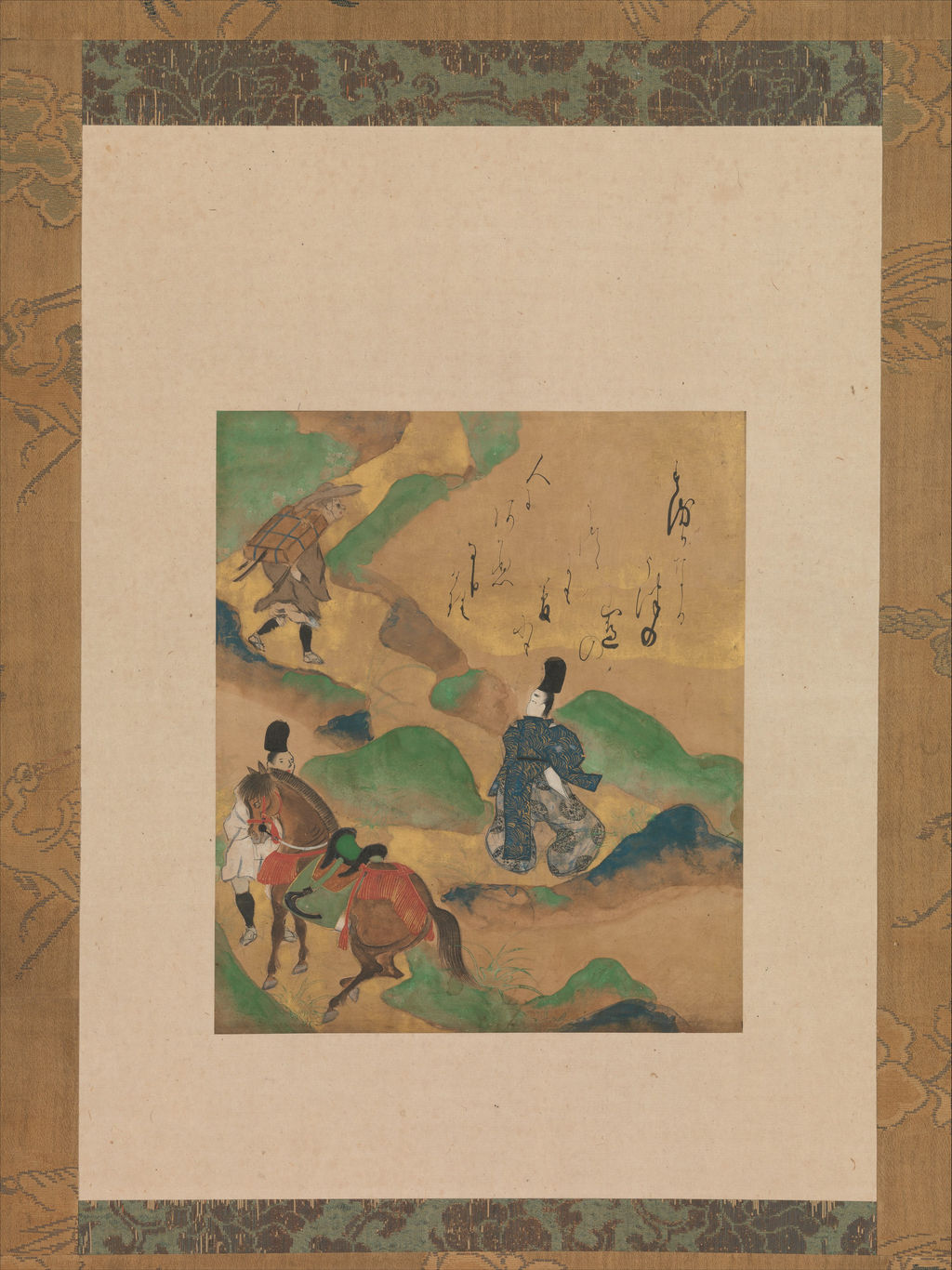
Reading these cards as a chapter of Rinpa need not make that later label a group name used by their makers. Kyoto National Museum describes Rinpa as a loose connection among Sōtatsu, the later Ogata Kōrin and Kenzan, and Sakai Hōitsu. They were not all members of the same workshop or alive together. The title derives from Kōrin's name, and the visual relationship was made and remade across generations. In Sōtatsu's working world, a card's collaborative painting and calligraphy had a more immediate identity than a future movement label. The label is useful for connecting the works, but the object should lead the explanation. [15] [2]
A story could be recognised from a few forms
The Tales of Ise is a sequence of brief episodes organised around poems. A painter did not have to tell the entire episode on one sheet. The courtly reader could supply the remembered story when a mountain path, a sea edge or a small group of travellers appeared. That is one reason The Beach at Sumiyoshi and Mount Utsu should be read as literary pictures, rather than topographical claims. The Metropolitan Museum of Art's account of Rinpa identifies Ise as a recurring source of seasonal and literary imagery, while the Smithsonian's checked exhibition material places Sōtatsu's painted and printed designs among the objects made for reading and writing. The painted sheet and the printed book belong to a shared world of classical reading, though one must not infer that either surviving card was copied from a particular printed page without a closer comparison. [27] [30] [7] [14]
That point changes how to look at a place name. Sumiyoshi was already charged with associations in the literary tradition; Mount Utsu, too, signals an episode of travel, memory and separation. The painted place is a prompt to recall a poem. A modern photograph of the named location could be useful in a separate geography feature, but it would not show what Sōtatsu saw or prove that he worked from observation there. On the art page, the more direct comparison is between the painted sign, the words and the later way the object was mounted. A reader who recognises the episode can mentally fill the open paper. A reader meeting it for the first time needs a short explanation of the literary cue, not a claim that this is an exact view of a surviving shore. [27] [7] [14]
The Genji tradition provided a different but related challenge: how to compress a long narrative into a screen scene. Tokyo National Museum's Sekiya screen depicts an encounter at a barrier between the processions of Genji and the woman once known to him as Utsusemi. The poem written by the courtier Karasumaru Mitsuhiro helps identify the chapter and narrows the likely date to between 1633 and his death in July 1638. Here written evidence does more than decorate an image; it identifies a scene and helps date a particular object. The Japanese cultural-heritage record calls this Tokyo screen traditionally attributed to Sōtatsu, so it cannot simply join the list of autograph paintings. A different National Treasure pair, Sekiya and Miotsukushi, belongs to Seikadō and is catalogued separately. The duplicate chapter title is an easy route to a wrong image or accession if the holding museum is dropped. [28] [29]
Ink that pooled, and ink that described
Gold-ground screens are only one part of Sōtatsu's work. The Met's White Heron is an ink hanging scroll, early seventeenth century, with a signature and seal the museum regards as persuasive evidence for his hand. The bird's outline is delicate but not weak; it seems to materialise from reeds and open paper. The museum contrasts this controlled brushwork with later school paintings that can look similar from a distance. The object makes attribution a visible problem: the ink strokes can be studied, yet the presence of signature and seal gives a different kind of evidence from a resemblance in subject. [4]
The Cleveland Museum of Art's The Bird's Nest Patriarch uses ink differently. A small monk sits in a tree on a largely unfilled scroll. Cleveland identifies a 1602 Chinese printed collection of Buddhist and Daoist figures as a source for the subject and explains how pools of wash build the monk and branches without tight enclosing outlines. The subject's origin is thus not solely a revival of Japanese court painting. Ulak's checked Smithsonian catalogue introduction likewise cautions against presenting Sōtatsu as an artist who looked only backward to domestic models; it brings Chinese and Korean precedents into its account of subject and technique. The comparison between these two ink paintings is more precise than a slogan about a uniquely Japanese decorative style. [16] [2]
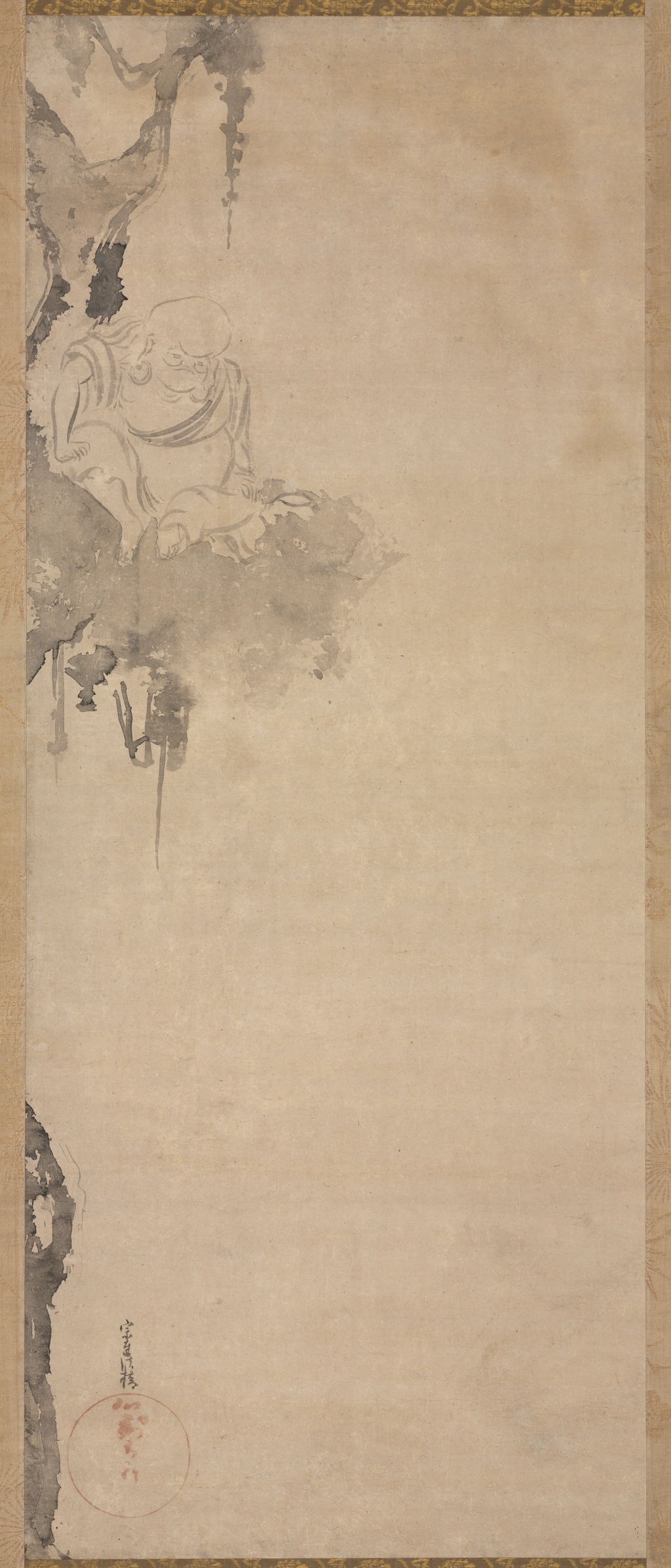
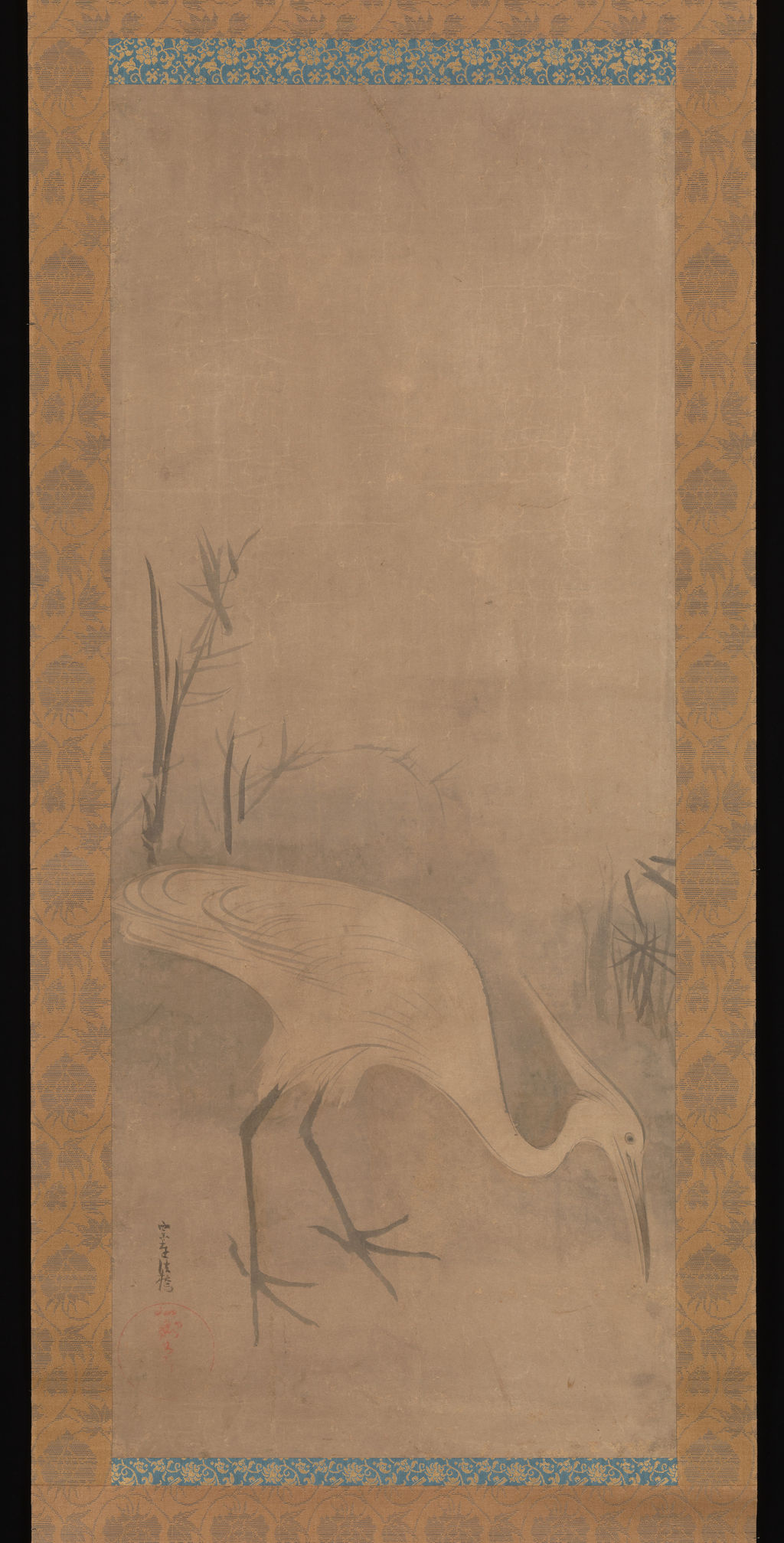
The British Museum describes tarashikomi as adding drops of ink to an area still wet with ink, allowing tones to pool. It is a useful way to look, not a magical fingerprint that assigns a picture to one person. Members of the Tawaraya shop and later artists could imitate or adapt such handling. Even two works credited directly to Sōtatsu need not use it in the same part of a surface. On The Bird's Nest Patriarch, the edge between a wet area and bare paper becomes especially expressive. On White Heron, line and a restrained wash carry a different visual task. A careful account describes exactly which visible passage it means, rather than pointing to any soft-edged mark and declaring that the artist invented a technique there. [5] [16] [4]
The Smithsonian exhibition names two other procedures alongside tarashikomi. In horinuri, traces of the drawn ink beneath applied colour remain visible; the museum contrasts this with painting that covers an outline completely. In kataoshi, repeated forms are stamped into prepared paper, often with differences in pressure and pigment that prevent the pattern from becoming mechanically flat. These descriptions belong to different jobs. Wet ink modifies the way a painted area develops, an uncovered outline tells a viewer something about the construction of a coloured figure, and a stamped ground gives a calligrapher a pre-existing rhythm to write across. A single finished work need not use all three. Looking for the procedure that is actually visible helps explain the craft of a specific object and avoids treating “Rinpa technique” as one undifferentiated recipe. [30]
This is clearest when comparing supports. A poem card is a prepared, handled sheet whose image can lie beneath later calligraphy. A hanging scroll must work vertically and reward close viewing as it is unrolled or displayed. The screen occupies a room and changes with the viewer's angle; its hinges can interrupt a painted form or intensify its movement. That does not mean Sōtatsu planned every surviving remount. The Met and Cleveland records explicitly identify cards later presented as hanging scrolls, and the fan screens gather separate objects into larger arrangements. The object's current name—“screen” or “scroll”—may describe the last stage of its life as well as the first. Captioning that format accurately is therefore part of interpreting composition, not a museum-record formality. [14] [10] [8]
Kyoto National Museum's Lotus Pond and Waterfowl is another direct Sōtatsu ink painting and a National Treasure. The museum catalogues two lotus stems and two water birds, rendered with a striking economy of ink. Its page provides research evidence for this side of his oeuvre, but not a cleared production photograph for this article. The title invites a trap: Tokyo National Museum has a different Lotus Pond and Waterfowl, TA-142, from the Chinese Southern Song period. A website search for “lotus waterfowl” might return either. The institution and accession must accompany the title before the image or description is reused. [17] [18]
Gold, gods and the space between them
The Wind God and Thunder God Screens are the best-known reason many readers arrive at Sōtatsu. Kyoto National Museum records a pair of two-panel screens on gold paper, each about 154.5 centimetres high and 169.8 centimetres wide, held by Kennin-ji. Neither signature nor seal appears on them, yet the museum treats the authorship as accepted. One god drives wind from a bag; the other beats drums. More than a yellow backdrop, the continuous gold changes how the interval is read. The gods occupy opposite sides, and the open field makes their energy seem to cross a space without a drawn landscape to measure it. This is a formal observation anchored in the exact Kyoto object, not a claim that Sōtatsu painted a photographable scene in the sky. [3]
The museum's image of those screens has no verified reuse permission for this site. Cleveland's CC0 God of Thunder can show a related figure, but only with a conspicuous correction: its record says studio of Tawaraya Sōtatsu, dated to the mid-1600s. Its curator notes an I'nen seal and a gold-dust ground, and says the lost companion Wind God screen has not been located. This Cleveland object is not one half of Kyoto's Kennin-ji pair. The different format, accession, attribution and missing pendant must remain attached to the image. Used properly, it lets a viewer examine how a workshop could reinterpret a powerful theme without turning that variation into Sōtatsu's own famous screen. [19] [3]
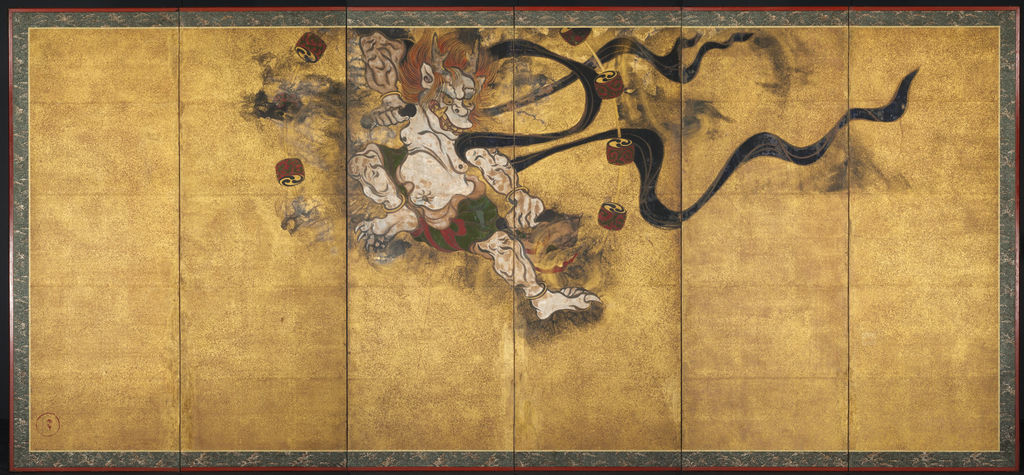
Kyoto National Museum's Rinpa exhibition placed Sōtatsu's screens beside later versions by Kōrin and Hōitsu. This comparison is illuminating only if the three objects remain separate. Kōrin's eighteenth-century version is held by Tokyo National Museum, while Hōitsu's nineteenth-century one belongs elsewhere. A repeated pair of figures does not mean a continuous family studio. It shows later artists studying a composition, selecting elements to retain and changing the balance of bodies, clouds and empty gold. The university study on the Sōtatsu and Kōrin versions cautions against accepting an overly neat chain of copying without studying the actual formal differences. The relation deserves its own object-based page when the exact production images and rights have passed review. [15] [20]
What a studio attribution changes
The open-access image pool makes it easy to overstate a famous artist's output. In the Met API, a search for Sōtatsu returns records where the artist's displayed name is his but a separate field says “Studio of,” “School of” or “In the Style of.” Cleveland's creator record likewise has a qualifier field separate from the person's name. The British Museum's Sōtatsu authority includes “claimed to be by,” “follower” and “formerly attributed to” objects among its related holdings. These are not fussy small-print categories: they answer a different question about who made the pictured surface. An image can be freely reusable while its authorship remains qualified. [21] [22] [5]
| Museum label | What it permits us to say | Example here |
|---|---|---|
| Directly credited | The institution attributes this particular work to Sōtatsu. Dating may still be approximate. | White Heron, Met 2018.853.13. |
| Studio of | A painter in the Tawaraya workshop or its orbit is credited; the object is not an autograph Sōtatsu work. | God of Thunder, Cleveland 2004.86. |
| Attributed to | Authorship is proposed with a stated reservation. | Cleveland's Kokin wakashū scroll 1972.67, not reproduced here. |
The I'nen seal is a good test of this discipline. Ulak's catalogue introduction explains that marks of this kind appeared on works Sōtatsu may have made, on workshop work and on later paintings continuing the style. A seal can point to a production network, but it cannot by itself decide whose hand laid every stroke. Conservation of the imperial Painted Fans screen even exposed Tōshichirō's name on one fan, alongside seals on others. The material object can reveal a collaboration obscured by an older single-artist title. In this sense, a qualifier is not a disappointment; it opens a more exact account of how a successful Kyoto workshop functioned. [2] [8]
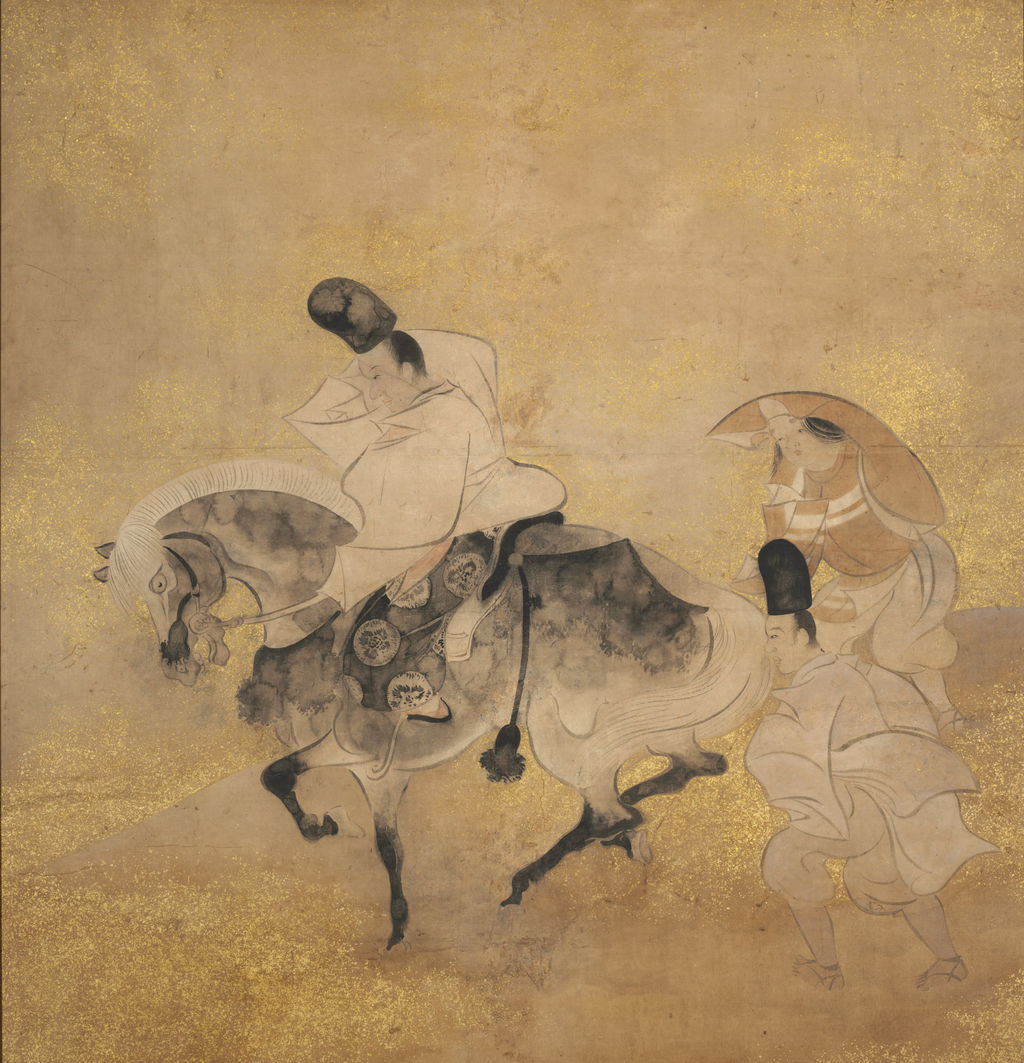
Cleveland's Crossing at Sano is described as a studio of Sōtatsu painting. Its rider and attendants cross a bridge in a scene associated with a poem by Fujiwara no Teika. The museum identifies a bridge on the Kino River in eastern Wakayama as the legendary crossing, but the work does not establish that either Sōtatsu or the studio painter visited it. The screen is mounted from a painted scroll, another reminder that today's museum format can follow a different first use. Its compact figures and gold-flecked field make a useful comparison with the directly credited Tales of Ise cards: classical literature could be invoked by shop work as well as by the master's named hand. [23]
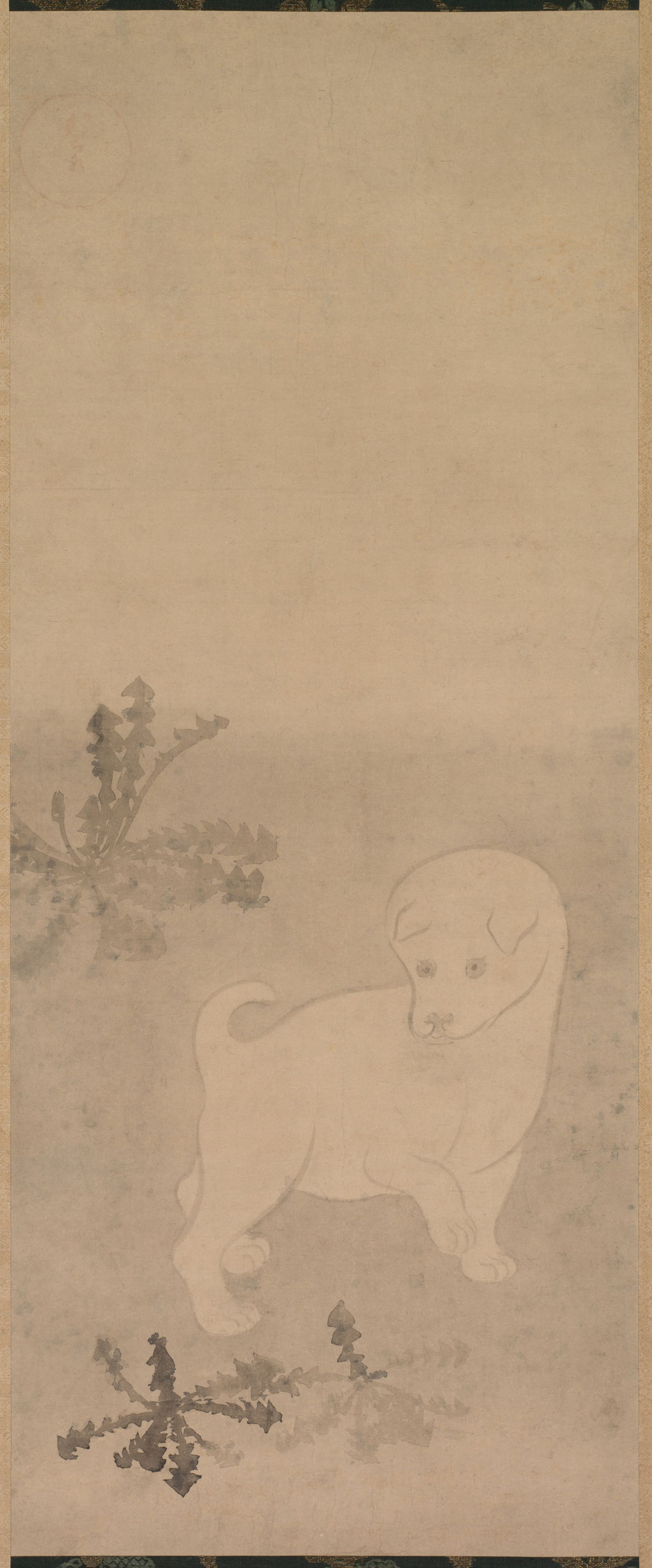
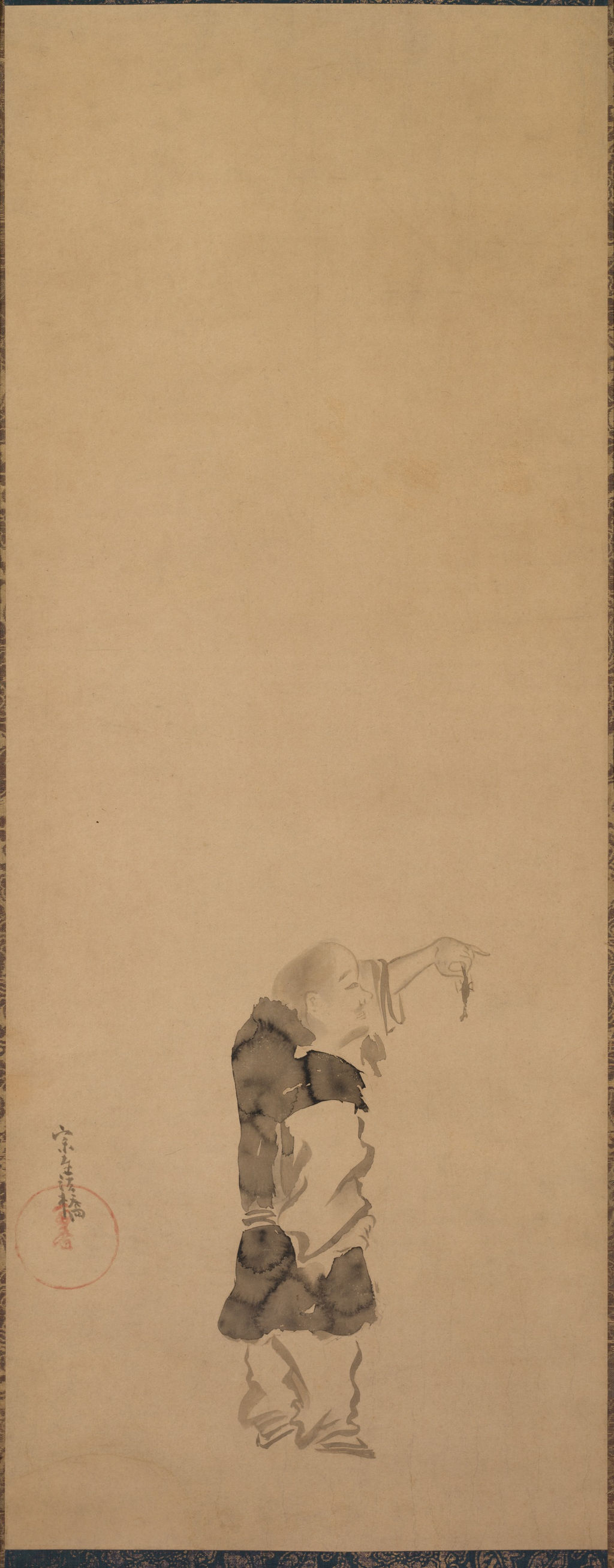
The workshop's range extended beyond gods and poems. Cleveland catalogues Puppy with Dandelions and Kenshu, Monk with Shrimp as studio of Sōtatsu. Each is an ink scroll with wide areas of unpainted support, but their subjects pull in different directions: an animal at the edge of a plant cluster and a monk with a small creature. Putting them near the directly credited Bird's Nest Patriarch helps a reader see a shared economy of line without pretending resemblance proves identity of hand. The exact catalogued maker is a studio, the date spans much of the first half of the century, and the subject is what the image actually shows. One could write a useful page about Sōtatsu's legacy from such objects; one could not use them to count two more personal commissions on an invented calendar. [24] [25]
A changing reputation, not a straight line of disciples
Sōtatsu's visual ideas outlived the man and shop. Kyoto National Museum uses Rinpa to connect his work to Kōrin, Kenzan and Hōitsu across generations. The distinction between transmission and direct training matters: Kōrin was born after Sōtatsu's early-seventeenth-century period of activity. A later artist could study a screen, copy motifs or adapt a way of placing forms without being a pupil who shared the older painter's workshop. The Wind God and Thunder God versions make that visible. So do later flower and wave pictures whose closeness to Sōtatsu sometimes affected museum attributions. [15] [1]
The modern reputation also changed the record. Ulak describes Charles Lang Freer's efforts to collect Sōtatsu at a time when the artist's corpus was still being identified. A 1913 exhibition in Japan helped bring critical attention to works associated with him, and later twentieth-century artists found Sōtatsu's large forms and open spaces newly compelling. These are episodes in reception, not evidence that a seventeenth-century maker intended an abstract modern style. The same catalogue warns that even the title Waves at Matsushima may put a later geographic identification on screens whose key subjects are waves and pine-covered shores. A vintage photograph of Matsushima would therefore create a false historical link unless a particular depicted site were demonstrated. [2]
The artist's overview is strongest when it keeps several scales in sight. A poem card can bring a classical story close enough to hold; a scroll can make cranes appear gradually along thirteen metres; a screen can make empty gold feel active between two gods; an ink bird can emerge from the restraint of a few strokes. The Tawaraya shop could produce and circulate images in more than one of these forms, while the exact hand behind a surviving object sometimes remains uncertain. To follow Sōtatsu is to pay attention both to the design and to the object record. The biography asks what the dated anchors—from the early sutra work to later commissions and the continuing workshop—allow us to say about the person who organised this practice. [1] [2] [3]
Frequently Asked Questions
Kyoto National Museum attributes the Kennin-ji pair to him and says the lack of signature or seal does not lead it to doubt that authorship. The Cleveland God of Thunder pictured here is a separate studio of Sōtatsu screen, not one half of the Kyoto pair. [3] [19]
He was an early figure whose work mattered greatly to later artists. “Rinpa” is a later name connecting makers across generations, including Kōrin and Hōitsu; it was not a single workshop that Sōtatsu founded under that name. [15]
The British Museum describes applying ink to an area that is still wet so tones pool together. It is a way to examine handling of wash, not sufficient evidence on its own that a painting is by Sōtatsu rather than his studio or a later follower. [5] [2]
Discussion
Look across Sōtatsu’s paper, scrolls and screens. Use these prompts to compare how the image changes with its format.
Reader Insights
On the 1606 poem card, where does the calligraphy take the lead and where does the painted pine take it back?
Compare the space around White Heron with the space around the studio Thunder God. What does each permit the figure to do?
Which details of the fan screens tell you that more than one maker or stage of mounting is involved?
Join the Conversation
Share a documented example or a reliable source below, keeping observation separate from inference.
References
- National Museum of Asian Art, Sōtatsu: Making Waves chronology, shop, activity, dated career anchors and unknown life details.
- James T. Ulak, “Introduction,” in Sōtatsu: Making Waves, Smithsonian Institution, 2015, printed pp.10–17; checked in full from the published PDF.
- Kyoto National Museum, Wind God and Thunder God Screens / 風神雷神図屏風, Kennin-ji-held pair, material, dimensions and attribution statement.
- The Metropolitan Museum of Art, White Heron, 2018.853.13, signed and sealed ink scroll.
- British Museum, Tawaraya Sōtatsu artist authority, tarashikomi and related-object qualifiers.
- Cleveland Museum of Art, God of Thunder (Raijin), 2004.86, studio attribution.
- Cleveland Museum of Art, The Beach at Sumiyoshi from the Tales of Ise, 1951.398, c.1634.
- National Museum of Asian Art, Painted Fans Mounted on a Screen, forty-eight fans, Tōshichirō inscription, seals and conservation findings.
- Museum of the Imperial Collections, Sannomaru Shōzōkan, 扇面散屏風, collection record for the fan screens.
- Cleveland Museum of Art, Poem-card from the Shinkokin wakashū with Design of Pine on a Beach, 1987.60, Sōtatsu/Kōetsu roles and 1606 date.
- Kyoto National Museum, Crane Scroll / 鶴下絵三十六歌仙和歌巻, A甲364, dimensions, materials and named makers; image application is separate.
- Kyoto National Museum, “A 400-year-old animation” / 400年前のアニメーション, Japanese interpretation of the scroll's sequence.
- Cleveland Museum of Art, Kokin wakashū scroll with pines along the shore, 1972.67, Kōetsu's calligraphy and attributed-to Sōtatsu underpainting.
- The Metropolitan Museum of Art, “Mount Utsu” from The Tales of Ise, 2015.300.88, painted poem card mounted as scroll.
- Kyoto National Museum, Rinpa: The Aesthetics of the Capital, Japanese exhibition account and separate Sōtatsu, Kōrin and Hōitsu objects.
- Cleveland Museum of Art, The Bird's Nest Patriarch, 1958.289, subject source and ink-wash analysis.
- Kyoto National Museum, Lotus Pond and Waterfowl / 蓮池水禽図, directly credited ink painting.
- Tokyo National Museum, Lotus Pond and Waterfowl, TA-142, the distinct Chinese work of a similar title.
- Cleveland Museum of Art, God of Thunder (Raijin), 2004.86, studio attribution, I'nen seal and missing companion.
- Kyoto City University of Arts, research summary on Sōtatsu and Kōrin Wind God and Thunder God screens, argument for empirical comparison rather than an assumed simple copy chain.
- The Met Open Access API, Red and White Poppies, 29.100.464,
artistPrefix: School of; compare direct objects 816200 and 52988. - Cleveland Museum of Art Open Access API, Crossing at Sano,
creators.qualifier: studio of; see its web record for full caption. - Cleveland Museum of Art, Crossing at Sano, 1949.554, subject, format and studio attribution.
- Cleveland Museum of Art, Puppy with Dandelions, 1992.382, studio attribution.
- Cleveland Museum of Art, Kenshu, Monk with Shrimp, 1992.388, studio attribution.
- Agency for Cultural Affairs, Screens with Scattered Fans / 扇面散屏風, Tokyo National Museum pair of six-panel screens with sixty fans, traditionally attributed to Sōtatsu; distinct from the Imperial Collections pair of eight-panel screens with forty-eight fans in the Smithsonian exhibition.
- The Metropolitan Museum of Art, “Rinpa Painting Style”, account of classical poetry, The Tales of Ise and The Tale of Genji as Rinpa subjects.
- Agency for Cultural Affairs, Sekiya Screen / 関屋図屏風, Tokyo National Museum object, traditionally attributed to Sōtatsu; dating from Karasumaru Mitsuhiro's calligraphy and signature.
- Agency for Cultural Affairs, Sekiya and Miotsukushi Screens / 源氏物語関屋及澪標図, distinct National Treasure pair held by Seikadō.
- National Museum of Asian Art, “Sōtatsu’s Methods: The Visibility of Craft”, exhibition descriptions of tarashikomi, horinuri and kataoshi.