


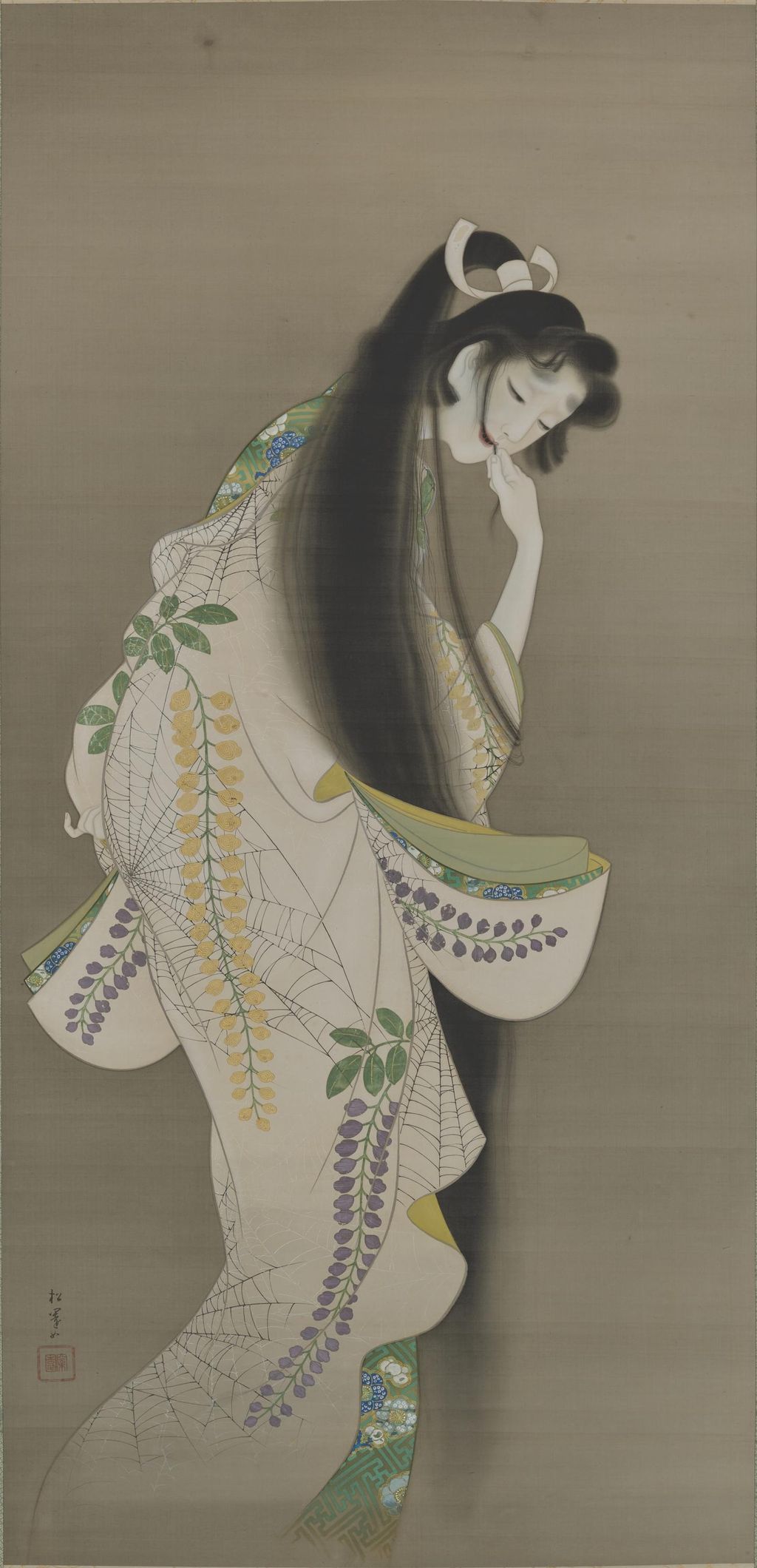
Uemura Shōen, Flame, 1918. Tokyo National Museum, via ColBase. Resized for web display. Object record.
 by Tom Gurney
Tom Gurney BSc (Hons) is an art history expert with over 20 years experience
Published on September 25, 2026 / Updated on September 25, 2026
Email: tomgurney1@gmail.com / Phone: +44 7429 011000
Uemura Shōen: the force inside a quiet figure
Uemura Shōen (上村松園, 1875–1949) painted women whose outward stillness often conceals an event. A reader pauses over a figure looking up at a rainbow, a woman occupied with a book, a dancer holding a moment of Noh movement, or a spirit whose eyes make jealousy visible. Fine contours, silk, elaborate costume and a controlled pose can make these paintings look immediately graceful. The longer one looks, the more different their subjects become. Shōen used the traditions of Kyoto painting to depict modern professional life, literary memory, theatrical gesture, anger and maternal intimacy. Her women are not variations on one decorative face. [1] [2]
The most unsettling example is Flame (《焔》), painted in 1918. The Tokyo National Museum identifies its long-haired figure as Lady Rokujō from The Tale of Genji. Shōen remembered taking the Noh play Aoi no Ue as a point of departure and asking the performer Kongō Iwao how the jealous spirit's eyes might be expressed. She then applied gold from the reverse of the silk at the eyes, drawing on what she learned about the Noh mask known as deigan. This is unusually concrete evidence of an artist turning performance knowledge into pictorial technique. It does not make every aspect of the painted woman's anger a transcription of a stage mask. [3] [4]
Contents
Shōen lived through a transformation in where Japanese paintings could be taught, judged and seen. She learned in Kyoto workshops, entered national exhibitions and became an artist whose work was discussed far beyond Kyoto. Her career is sometimes told only as the exceptional ascent of a woman in a male-dominated profession. That condition mattered: access to teachers and exhibitions was uneven, and the critical language around pictures of women was loaded. Yet the pictures demand more than a career milestone. Shōen's art shows a painter repeatedly deciding how much a line, a sleeve, a face or a setting must say, and how much the viewer should discover. [5] [6]
At a glance
- Life1875–1949
- BaseKyoto
- PracticeJapanese painting, figures and Noh subjects
- Key worksFlame, Jo no Mai, Looking up at the Rainbow, Mother and Child
A Kyoto practice with a national audience
Shōen was born in Kyoto and raised by her mother, Nakako, who supported the family through a tea business after her husband's death. In her later recollections, the painter made her mother's work and resolve central to her understanding of childhood. That testimony is evidence about how Shōen chose to remember her beginnings; it should not be turned into a tidy claim that every painted woman stands for Nakako. The painter entered formal art training young and studied with Suzuki Shōnen, then Kōno Bairei and Takeuchi Seihō. The teacher sequence, recorded by Japanese institutional chronologies, places her in a living Kyoto environment rather than in an isolated category called “women's art.” [5] [7]
Kyoto's Maruyama–Shijō inheritance encouraged close observation, fluent brushwork and attention to the relation of living figure to surrounding space. Shōen also studied earlier depictions of beautiful women, historical dress and the visual language of ukiyo-e. The term bijin-ga is useful for this part of her practice, but simply translating it as “pictures of beautiful women” can make the subject sound narrower than it was. Which kind of woman? From which period? At work, at leisure, on stage, in grief, or in a story? The differences shape a painting's posture, clothing, props and audience. Mie Prefectural Art Museum's Ichirō Mōri traces how Shōen repeatedly altered these choices across her career rather than guarding a single timeless formula. [6] [2]
She began to win recognition while still young. The National Diet Library's biographical record places an award at the Third Domestic Industrial Exposition in 1890; later she worked within the new national exhibition system. A large public exhibition could put Kyoto brush painting before critics and visitors from elsewhere in Japan. It also made choices about subject and style open to public judgment. An artist painting a woman in an old tale was not operating outside modernity; the modern exhibition and its critics determined how that inherited subject would be valued. A separate biography should trace the dated awards, societies and family circumstances in full. Here the key point is how a Kyoto-trained painter learned to make a figure hold its own in these new spaces. [8] [6]
Kaoru Kojima's University of the Arts London study usefully compares Shōen with other professional women, including Noguchi Shōhin, Ikeda Shōen and Shima Seien. They faced different routes to training and patrons; their shared -en name ending does not make them one artist or one school. Kojima reads the public display of painted women through the social expectations of the time. Her framework makes clear why it matters to identify who painted a work and where it was exhibited. It is an interpretation of the wider field, not a substitute for each object's museum record. [9]
The early work deserves more than a preface to the better-known mature paintings. Seattle Art Museum holds Summer Evening, made around 1900, an unusually tall image measuring 214.5 × 62.2 cm. Its exact record and published label let us place an early Shōen work in an American collection, although the photograph itself is not cleared for this site's production. The format is a useful question to carry forward: how can a figure occupy a scroll whose height so exceeds its width? Flame would later use a similarly strong vertical relation for a very different subject. The comparison concerns format, not a claim that the 1900 picture already contained the later spirit's psychology. [25] [3]
Her career unfolded amid different routes to recognition. Kyoto's own exhibitions and teacher networks gave her training and contacts, while the Bunten system offered a national stage. Mōri's account makes clear that a list of Bunten entries is a partial record of artistic activity: not exhibiting in a particular year cannot be read automatically as not painting. This matters especially when a famous work tempts us to narrate a crisis followed by recovery. An artist can develop sketches, seek models, study a play, work for other audiences or choose an exhibition venue without leaving a neat entry in one catalogue. The paintings and the dated documentary trail need to be held together; neither can stand in for the other. [6]
The modernity of her work is also visible in the question of source material. Historical hairstyles and robes required visual research; Noh subjects required understanding of a performed gesture; a contemporary model supplied a body that could be observed and revised. These are different kinds of study. Shōen's later explanation of changing the sleeves in Jo no Mai gives a rare glimpse of the revision itself. The artist considered one costume, saw that its shorter sleeves would not serve the painted movement, and changed the plan. Historical accuracy was one responsibility, but the visual life of the final work was another. [11] [12]
This way of working complicates the idea that a silk painting merely preserves a beautiful old Japan. Some of Shōen's subjects were drawn from the classical past, but a contemporary painter made them for viewers in a period of changing institutions, print culture and public debate. Her decision to combine an old courtly figure with observations from living performers was itself a modern act of selection. Even when a costume looks historically complete, a viewer can ask which part came from a source, which from a model, and which from the demands of the composition. The answers may remain incomplete. Her own essays give unusually rich clues, but they were written retrospectively and should be compared with surviving objects rather than treated as a transparent diary of every brushstroke. [11] [6]
Looking closely at Flame
In Flame, a tall vertical field encloses a figure who seems to pass through the space rather than sit inside it. Her dark hair streams and twists; the white garment appears light until the eyes return to its patterned surface. ColBase identifies wisteria and spider-web motifs. The face is refined and severe at once. It would be possible to stop at the familiar label of a jealous ghost, but Shōen's own account asks the viewer to look at the eye, the place where a tiny material intervention changes the force of the expression. From a normal viewing distance, its effect belongs to the figure as a whole; a detail photograph lets us inspect it without pretending to see the entire painting in one close-up. [3] [4]
The painted spirit has several origins. Lady Rokujō belongs to the eleventh-century Genji narrative; Aoi no Ue brought her pain and jealousy to the Noh stage; Shōen worked in 1918 with that long chain of interpretation. The Metropolitan Museum's Tale of Genji catalogue locates the work in the continuing visual life of this literary character. It is useful to recognize the tradition while looking at Shōen's particular choices. The long silk scroll, nearly two metres high, gives the apparition bodily scale. A summary of the plot cannot convey the difference between reading jealousy and confronting a painted presence. [10] [3]
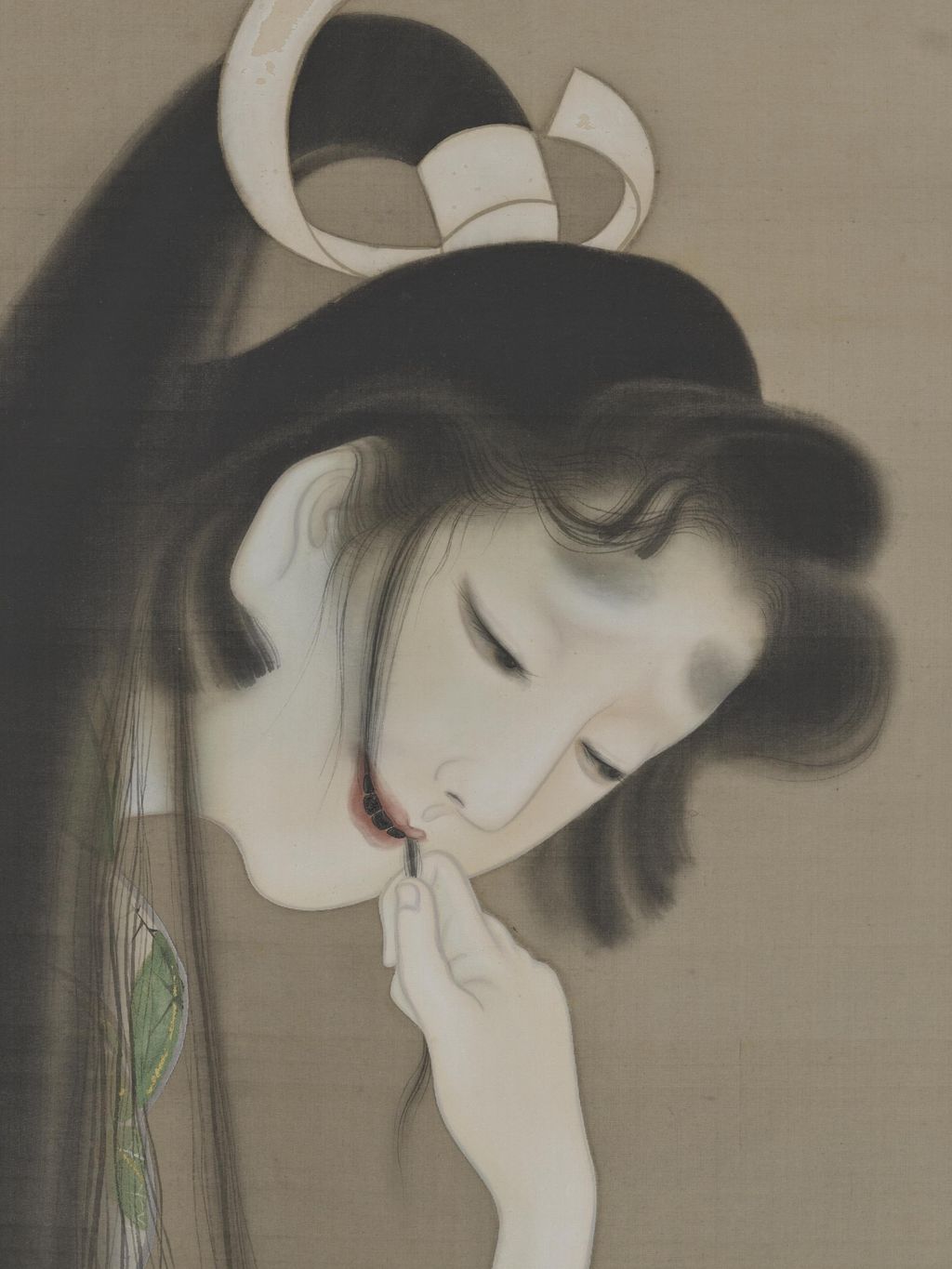
Look closely at Flame
Choose a number to compare the full painting with three ColBase details of the same object, A-11098.
Explained details
Eyes
Shōen recalled applying gold behind the eyes from the reverse of the silk after consulting a Noh performer. An ordinary JPEG is not technical analysis.
Source: ColBase, Tokyo National Museum. Object record. Detail resized for web display.
Robe and wisteria
Compare the sweep of hair with the fine wisteria lines on the robe; ColBase identifies the motif.
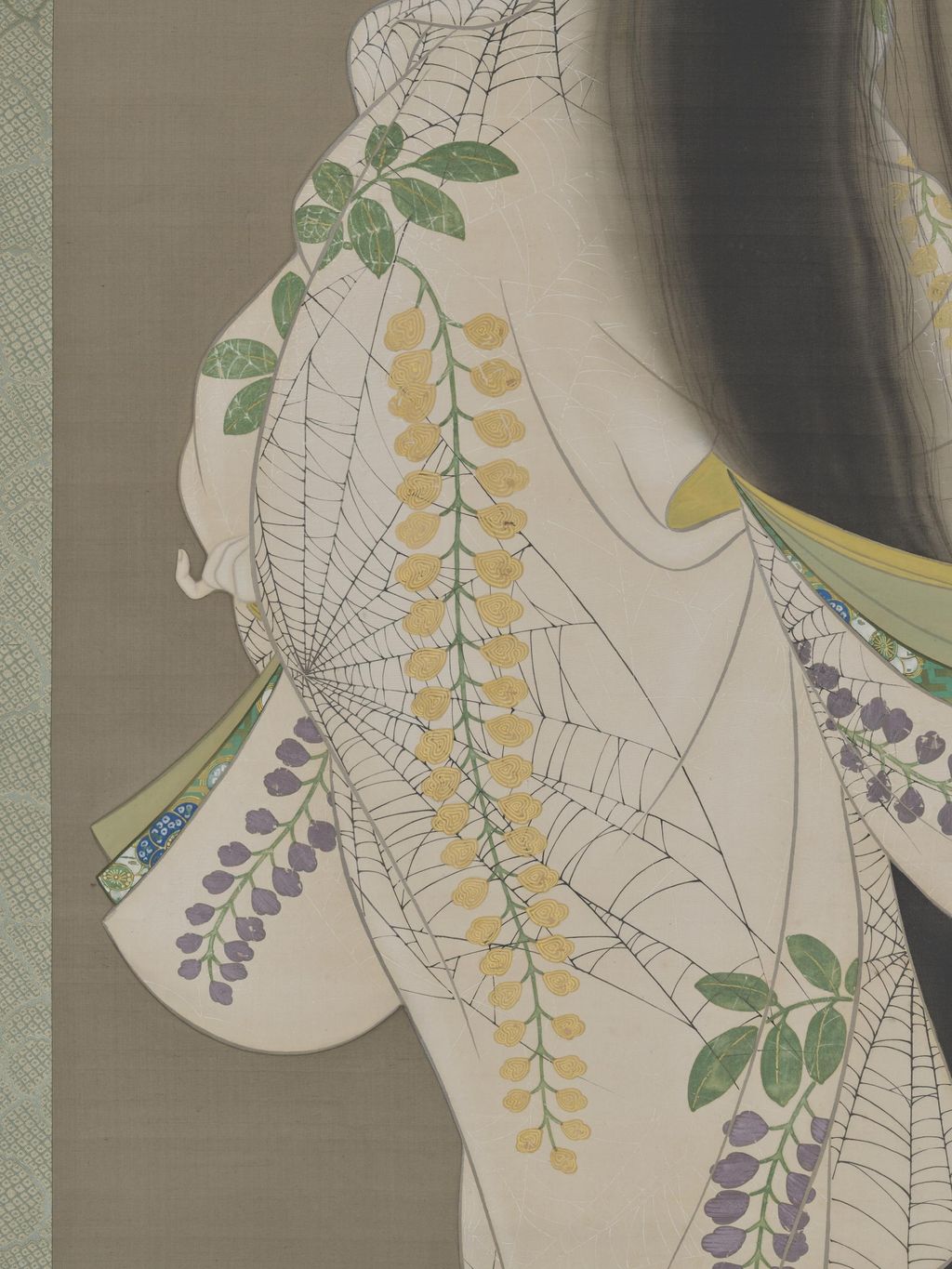
Source: ColBase, Tokyo National Museum. Object record. Detail resized for web display.
Spider web
The web is a garment motif. Return to the whole figure before assigning it a fixed psychological meaning.
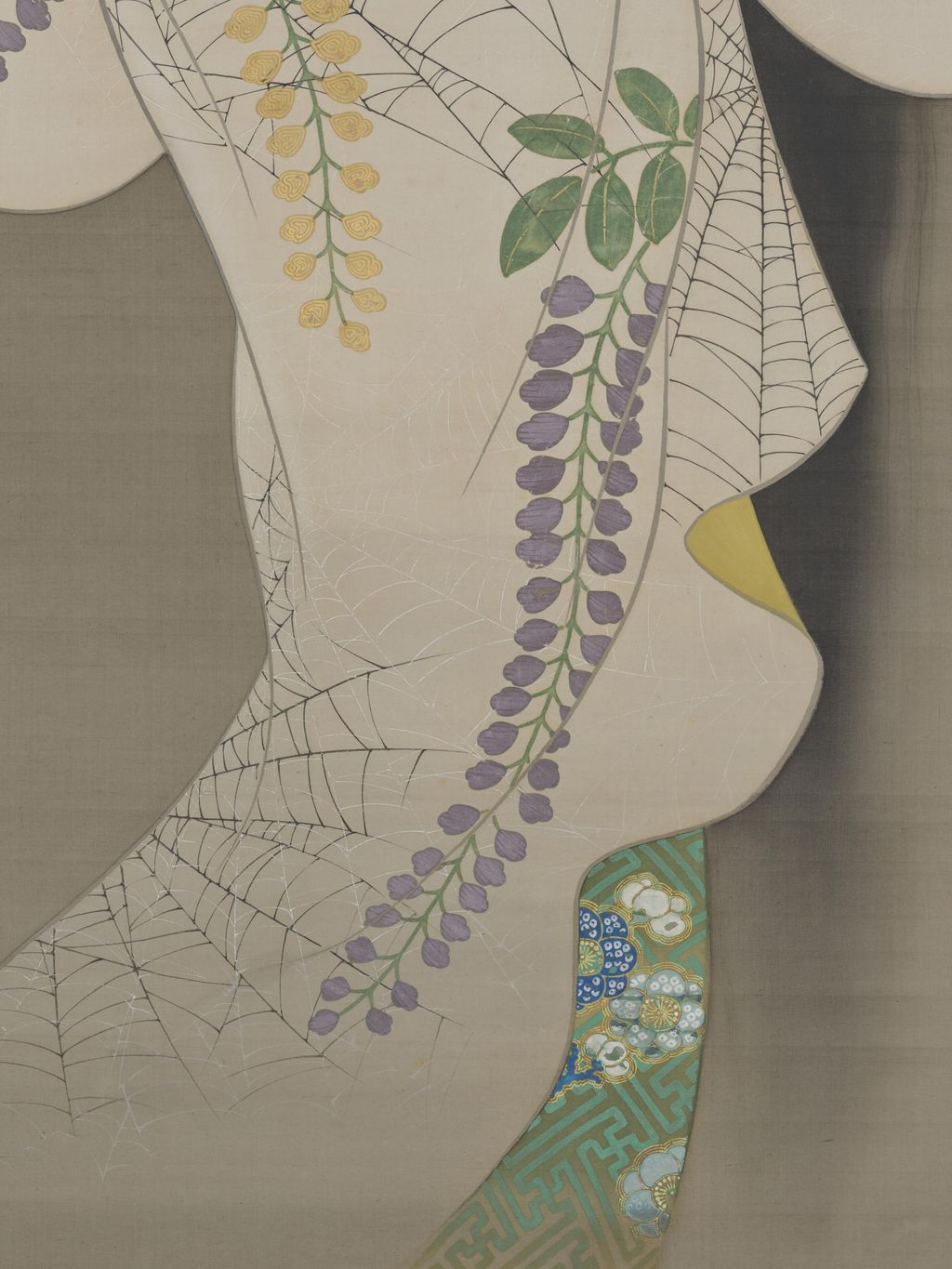
Source: ColBase, Tokyo National Museum. Object record. Detail resized for web display.
There is a danger in using an artist's remembered difficulty as a diagnosis of the picture. Shōen later wrote that Flame arose during a painful spell and that completing it brought relief. That is a valuable account of her own making. Mōri, however, cautions against treating her subsequent absence from one official exhibition as proof of a prolonged creative collapse: she stayed away in other years too. He also observes a suggestive visual resemblance between Flame and an earlier beauty painted by Soga Shōhaku, while explicitly withholding a claim of proven direct influence. Both cautions make the work more interesting. A painting may respond to a private difficulty, a centuries-old theatrical figure and earlier visual forms without any one of those sources being sufficient by itself. [11] [6]
The white garment should not be treated as a blank sign of purity. ColBase's identification of wisteria and web gives the viewer precise things to search for in its surface. A web can gather a tangle of lines across the robe while the streaming hair pulls outward; the flowers bring another motif into the field. These are visual observations, not a claim that each motif has a single fixed symbolic translation. In particular, the spider web can suggest entrapment to a present-day viewer, but the source record identifies the motif rather than supplying a one-word psychological key. A caption ought to keep those levels apart. The annotated popup can help by taking the viewer from the whole mounted scroll to the cloth's actual pattern, then back to the standing figure. [3]
The figure's height affects the reading too. At 190.9 centimetres tall, the painted silk approaches the scale of a standing person. A tiny online thumbnail makes the eyes prominent and turns the robe into an undifferentiated pale shape; a full-height view asks the body to follow the hair, hands and clothing down the scroll. That is why the page needs both an uncropped full figure and an enlarged, labelled detail. The two views answer different questions. The first shows how an apparition occupies vertical space; the second shows how Shōen treated a very small area of the face. Enlarging the face alone as the article's splash would exaggerate one feature and hide the formal problem that gives it force. [3]
Shōen's account of gold applied behind the eyes likewise has a useful limit. The essay gives the painter's described method and the Noh conversation that led to it. It does not, by itself, measure the gold's layer or explain every visible change in the surviving material. A site annotation should not imitate a conservation report that has not been consulted. It can say what Shōen says she did, show the exact museum detail and invite the reader to examine how the eyes alter the expression. That is already a richer encounter than repeating that the figure is “ghostly.” [4] [3]
Noh as a way of arranging movement
Shōen's interest in Noh was not a late decorative borrowing. In an essay on Noh subjects she described studying chant and the stories behind the performances. Noh offered her carefully timed gestures, distinctive costume forms and characters whose inner states were not announced by ordinary facial expression. In a painting, a whole sequence has to be concentrated into one posture. The viewer has no actor's next step to wait for. Shōen therefore had to make the weight of a sleeve, the placing of a hand and the direction of a face sustain attention within stillness. [12] [6]
Her 1936 Jo no Mai is the key example. The Agency for Cultural Affairs describes a young woman performing a Noh dance; Shōen's own account says she wanted a figure with inward resolve. She used several models, one of whom was her son Shōkō's wife Taneko, and revised the costume. The original married-woman design would have had shorter sleeves; the finished long sleeves gave the movement she sought. The picture is thus a designed statement about poise, not a spontaneous portrait of a single relative. Its exact owner is Tokyo University of the Arts. We can explain these decisions while a rights-cleared, high-resolution institutional image is sought; the present source image must not be silently lifted into production. [13] [14]
Kojima has shown that the 1930s reception of such figures could carry ideas of national womanhood and that a later critic read Shōen through wartime ideals. That is evidence of reception, not evidence that the painter created Jo no Mai with that critic's politics in mind. The distinction lets the reader hold several things true at once: the artist's documented formal decisions, the figure's visual authority, and the changing public uses of an admired image. A dedicated artwork page should explore that evidence in full once its image gate is cleared. [9] [13]
The ordinary description “a dancer” can understate the problem Shōen set herself. The word mai names dance, yet the painting cannot actually move. Its figure must suggest movement through the relation of foot, sleeve and body at one held instant. In her essay the painter speaks of inner firmness rather than merely perfect costume. The long sleeve is therefore more than an attractive extension of the silhouette: it gives visible space to a movement whose strength is restrained. That reading is grounded in the revision Shōen herself described, but the specific lines and colours of the painting still require a properly licensed reproduction for detailed analysis. In an artwork page, the first-person account and the institution's object record should be placed beside the picture, not used to make a missing image seem present. [11] [14]
There is a sequence of looking across these theatrical works rather than one fixed “Noh style.” Flame draws on a Noh telling of a literary woman's jealousy, and its tall isolated figure creates an encounter with an apparition. Jo no Mai uses the measured action of dance to give a contemporary young woman composure. Kinuta turns a story about a wife's audible act into an image of waiting. Each asks painting to carry something that performance distributes through time: emotional transformation, bodily movement or sound. Their dates, 1918, 1936 and 1938, also warn against treating them as a single short experiment. Shōen returned to the theatre over decades because it kept offering new pictorial problems. [3] [11] [15]
Kinuta (《砧》) shows another Noh possibility. Yamatane Museum dates this large silk painting to 1938, and its subject is a wife who beats cloth while waiting for a husband absent in the capital. Sound and longing motivate the theatrical scene, yet painting must create both without an actual noise. The museum records Shōen's analogy between the wife's grave presence and a portrait or a Buddhist image. The date matters. Some later scholarship prints 1937 for Kinuta, but the museum's exact object record and Tobunken's chronology agree on 1938. Its museum photograph is a research reference, not a production asset. [15] [5]
Pictures of contemporary attention
Not all Shōen figures belong to old stories. Kyoto City Kyocera Museum's Waiting for the Moon (《待月》), dated 1926, places an autumn-dressed woman near an architectural element that divides and measures the space. The museum describes an early-autumn atmosphere and the way the pillar organizes the composition. A visitor could read it as a scene of waiting, but the structure of the picture keeps the attention on duration: the figure remains in a moment between one event and another. This is not a theatrical ghost. It is a recognizable modern kind of inward occupation shaped with the same care Shōen brought to literary subjects. [16]
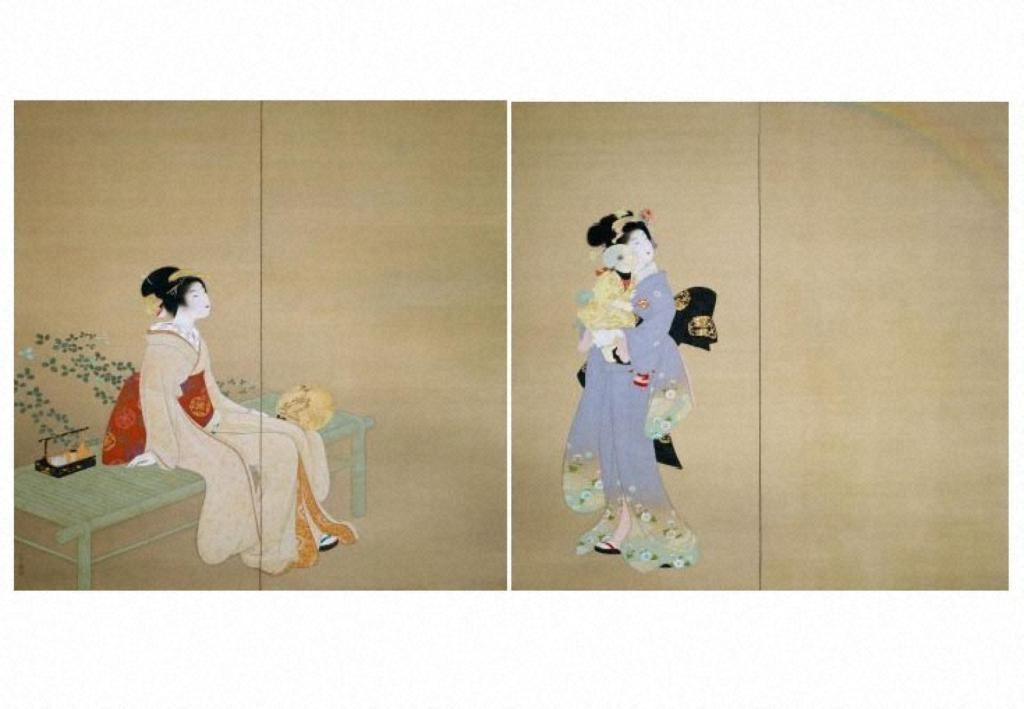
The National Museum of Modern Art, Kyoto's Looking up at the Rainbow (《虹を見る》) is dated 1932 in its exact union-catalogue record and takes the form of a pair of two-panel screens. The large format lets bodies, open space and the act of looking become one rhythm across panels. Its title directs the eye to an event beyond the women's immediate activity, but the viewer must still move across the screens to follow their attention. The record-bound catalogue download is 1024 × 709 pixels and carries a NoC-CR mark under the National Art Museums' current reuse terms. It is a usable supporting figure when credited to the holding museum and linked to the exact object; it is not a single flat painting or a detail from Flame. [17] [18]
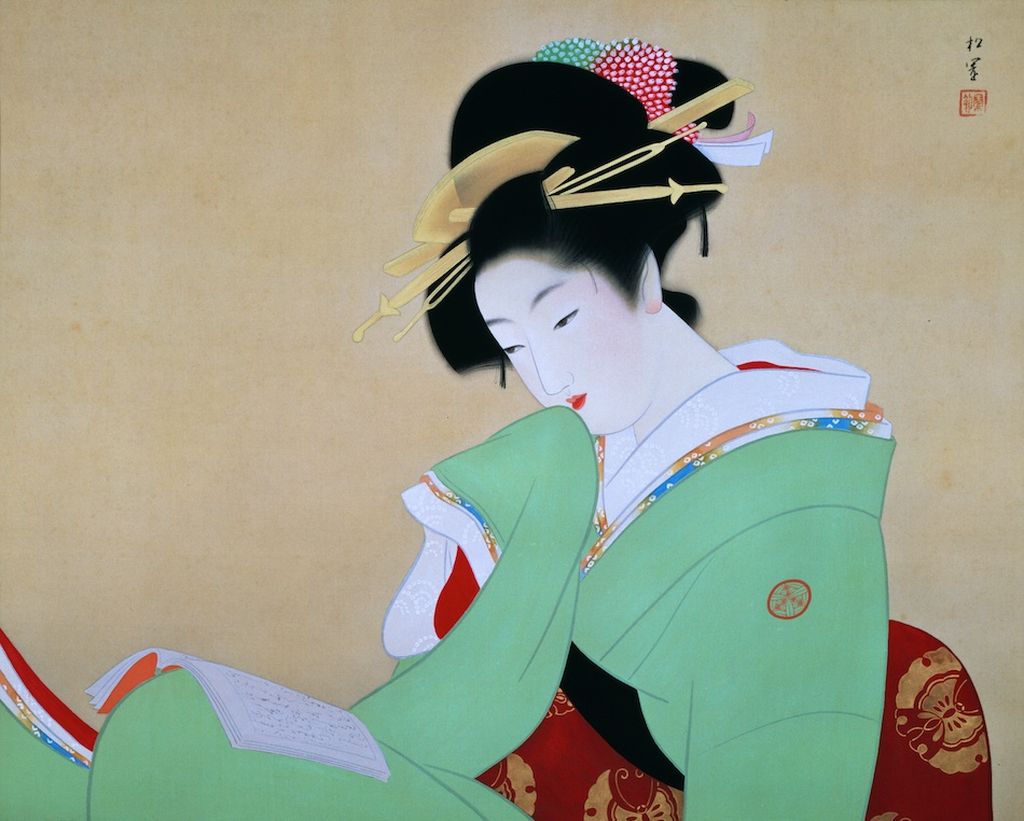
Tokyo Fuji Art Museum's Beautiful Woman Reading a Book (《美人観書》), dated about 1941, presents attention on a smaller scale. It measures 53 × 66 cm, much less than the tall silk of Flame. Rather than treat “beautiful woman” as a generic subject, compare what the figure does: reading gives the sitter an activity that need not involve the spectator. The book occupies her gaze; her presence is not exhausted by the fact that she can be looked at. The CC0 museum image is suitable for a supporting figure, although its 950-pixel original has been modestly enlarged for the site's 1024-pixel standard. The enlargement must stay documented and must not be mistaken for new source detail. [19]
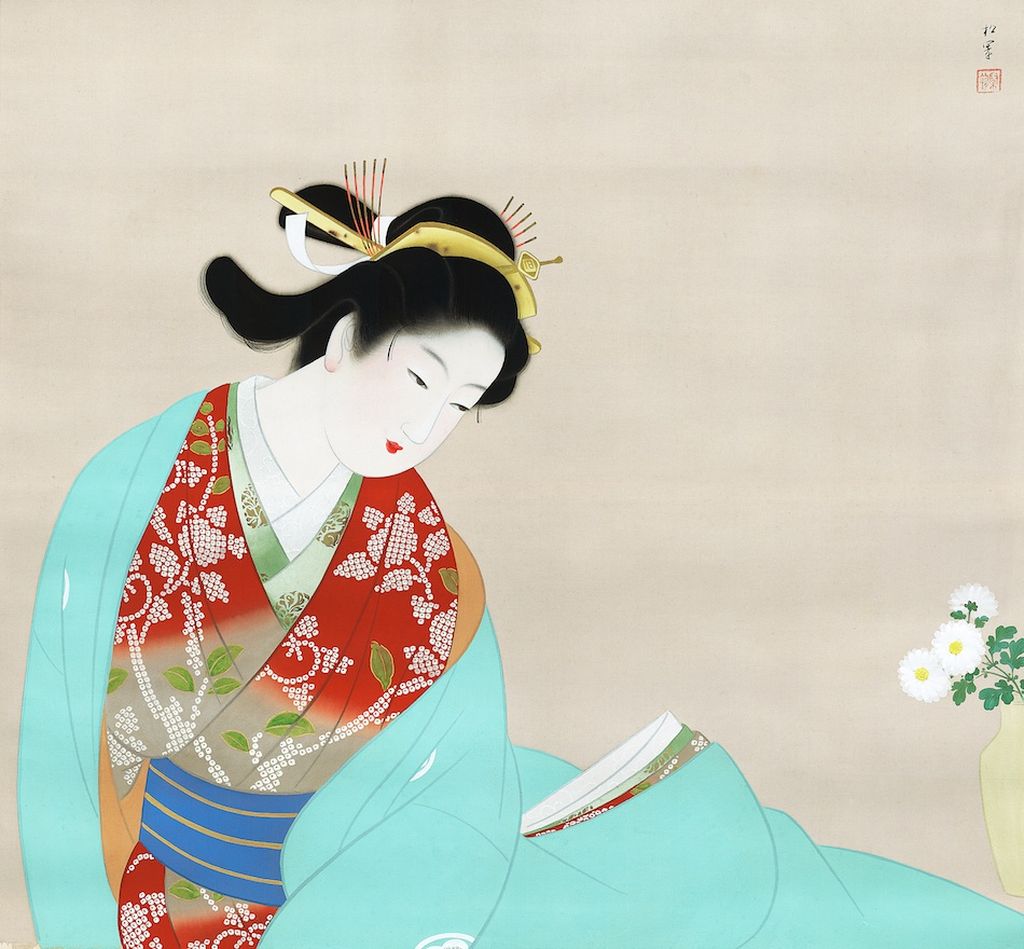
The same museum holds Making a Wish for a Long Life on Chrysanthemums (《菊寿》), dated 1939. Its title and flowers make an auspicious subject, but they also direct us back to the painter's interest in how a human figure performs an action within a carefully arranged field. Compare its relatively intimate 66 × 72 cm size with the command of the tall Flame. Scale changes how close a viewer feels to the woman. The two Tokyo Fuji paintings are distinct accessioned objects with separate dates, sizes and compositions; they are not interchangeable examples of “late style.” [20] [19]
Placed beside Rainbow, these two smaller works make a useful article sequence. The pair of screens spreads attention over a shared pictorial field; the book draws one woman's gaze down into a private task; the chrysanthemum title points to a ritual wish. This does not mean that one “expresses freedom,” another “introspection” and the third “tradition” in any settled symbolic code. It means their actions can be described before the page applies a period label. A viewer who notices where each woman's attention goes has a practical way into composition: what does she look at, what has she just done, and what in the picture allows the spectator to understand it? Object records give us the dates, titles and formats, while the comparisons are readings of the supplied images. [17] [19] [20]
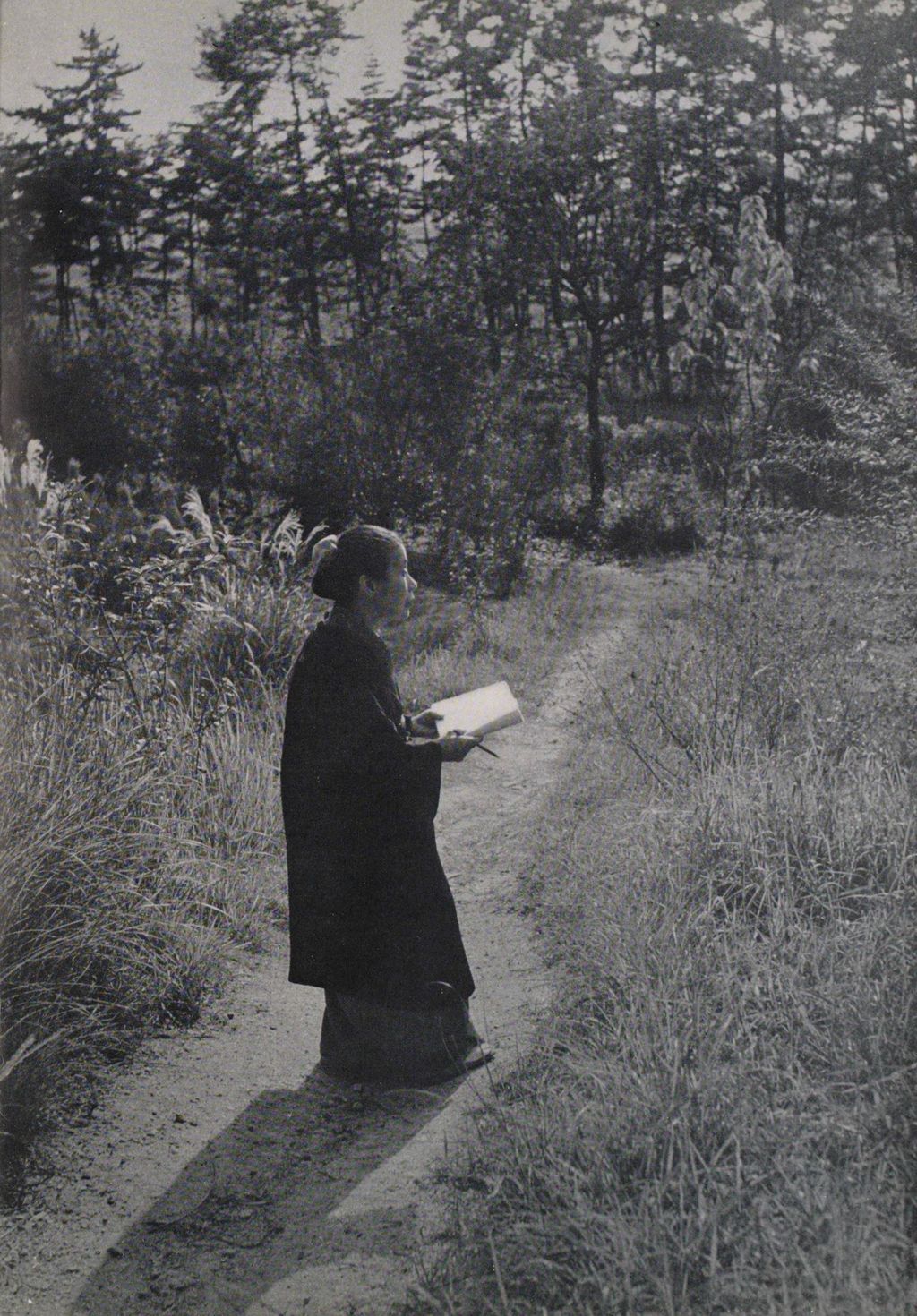
The photographs change the scale of the reader's encounter. A museum painting normally arrives without a record of the painter's working body. The NDL image of Shōen with a sketchbook makes that body visible, yet it does not explain the work that was being sketched, the identity of the landscape or the date of the outing. Used with a cautious caption, it can remind a visitor that a formally controlled silk painting began in observation, planning and repeated decisions. Used with an invented place name, it would turn an evocative picture into false evidence. The image's value is precisely that it shows the artist as a working person while leaving its undocumented details open. [8] [21]
A mother and child: identifying the right painting
The 1934 Mother and Child (《母子》) is one of Shōen's central works, but its title conceals an easy mistake. A different painting with that title was exhibited in Paris in 1900. The National Museum of Modern Art, Tokyo's 1934 work is accession JI0007, 168 × 115.5 cm; the museum-linked cultural-heritage essay explicitly says the earlier composition is different. These are two artworks, thirty-four years apart. Any illustration, chronology or internal link must identify which one it means. The available union-catalogue image of the 1934 painting is only 529 pixels wide, so it is not currently a 1024-pixel production figure. [22] [17]
Shōen's mother died in February 1934. A curatorial essay suggests that the later painting may carry a memorial feeling, and the artist herself wrote movingly of Nakako's labour and of her own recurring interest in mothers and children. The timing and testimony invite the reading, but they are different kinds of evidence: a documented death, a dated object, a later museum interpretation and the painter's broader recollection. None alone proves that the 1934 figures are literal portraits of Shōen and Nakako. What the work can show, once an exact image is available, is how a public painting gives the intimate subject of care a form that viewers beyond the family can recognize. [22] [23] [24]
This distinction also protects the painter's own voice. In her memorial essay she recalls practical work, the household and the support that allowed a child to pursue art. The memory is specific; it is not merely an abstract celebration of motherhood. The 1934 canvas belongs to a national museum and was assessed as a major artistic development, while the essay offers a later, personal account of Nakako. Bringing them together can illuminate a recurrent subject without collapsing two media and two moments into one declaration of intent. A future page should ask what the precise gestures and distance between the painted figures actually show, and then state which conclusions come from the object, which from the artist, and which from later interpreters. [23] [24]
The related 1900 title is a reminder that “major works” lists are not enough to build an article. A result for “Shōen mother and child” may point to the 1900 Paris exhibition, the 1934 national museum painting, a later printed reproduction or a photograph in an exhibition review. Those sources are not interchangeable. The accession JI0007 and the 1934 dimensions anchor the later work, while the cultural-heritage text identifies the earlier painting as a differently composed object. A future page should put those identifiers prominently next to its image and in its reference list. That would let a reader follow the evidence and prevent a biography, caption or affiliate book recommendation from quietly illustrating the wrong painting. [22]
How to look across her career
The eight-image plan for this article should make its limits visible. Flame provides the splash, eye detail and one explained annotation because its source file is genuinely high resolution; these are multiple ways to study one Tokyo National Museum painting. Rainbow and the two Tokyo Fuji works supply three further exact artworks. NDL photographs show the painter, not artworks; they give the reader a different kind of encounter with the maker. A fourth portrait image can close the essay if it adds useful period texture, but it should not be introduced just to reach an image target. More distinct works can be added when a museum supplies cleared high-quality files. [3] [17] [21]
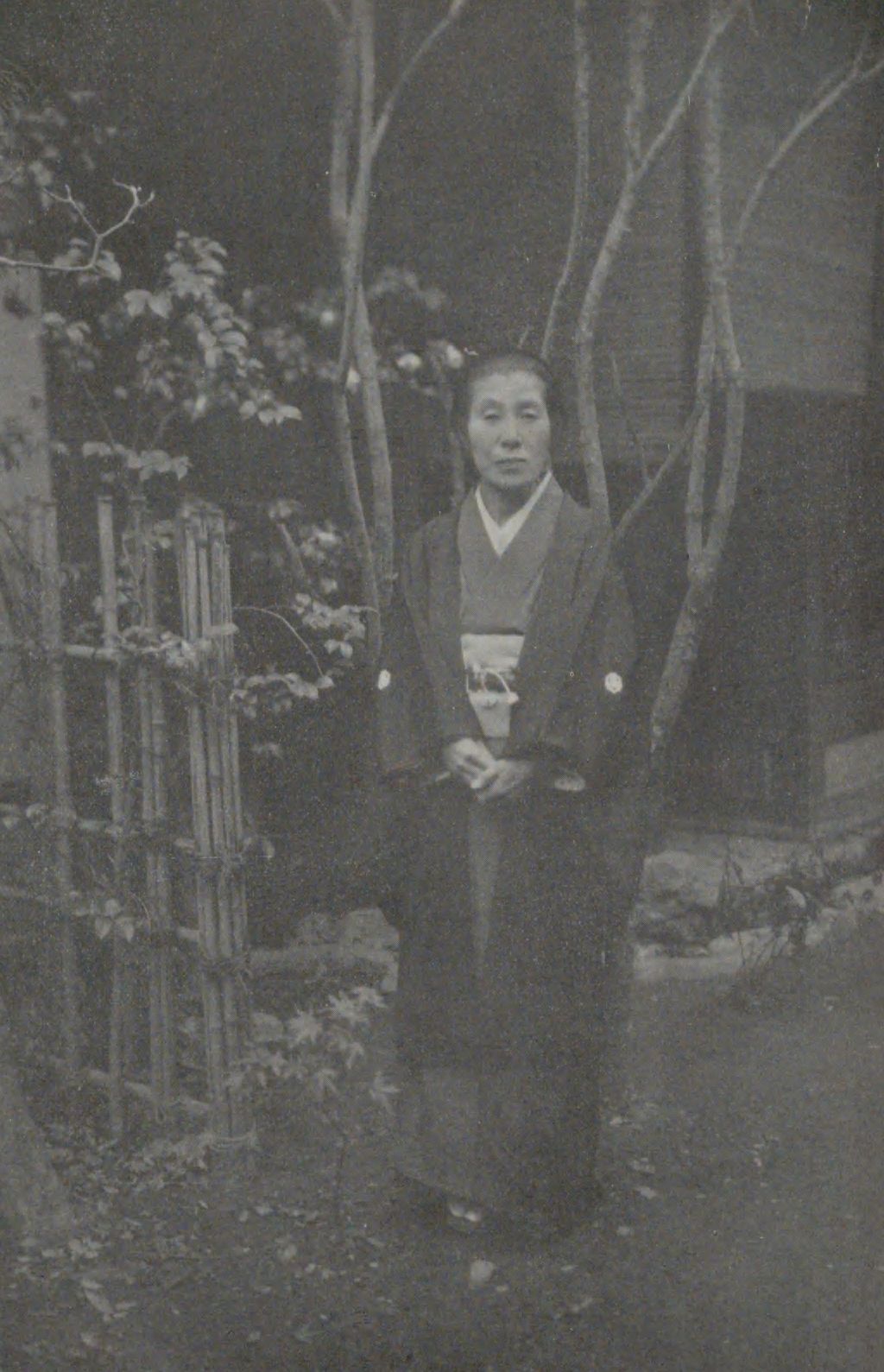
Shōen received the Order of Culture in 1948 and died the following year. Such an honour is a sign of national standing, but it is not an endpoint that explains the paintings backward. Her work remains most rewarding when the reader moves between distinct tasks: the nearly bodily apparition in Flame, the controlled motion of Jo no Mai, the concentrated attention of reading, the public scale of Mother and Child, and the opening across paired screens in Rainbow. The artist's own essays help us see how precisely she thought about line, movement and feeling; museum objects let us test those thoughts against dated paintings; later scholarship shows how viewers in different moments made other meanings from them. [5] [11] [9]
The separate biography should trace the working life behind these choices. Dedicated work pages for Flame, Jo no Mai and the correctly identified 1934 Mother and Child can take the evidence further, but they must follow exact object and image gates. For this introduction, the essential invitation is simple: stay with the figure long enough for her stillness to change. In a Shōen painting, composure can be the form of waiting, memory, self-possession or a feeling so intense that it has to be rendered through a minute change at the eyes. [3] [13]
Frequently Asked Questions
She made an exceptionally varied career in modern Japanese painting while working from Kyoto training and subjects that ranged from contemporary life to Noh and The Tale of Genji. Her importance lies both in her public professional path and in exact paintings such as Flame and Jo no Mai, whose controlled figures hold very different emotions and meanings. [5] [6]
Bijin-ga describes a major part of her output, but “beautiful women” is too broad a description of a jealous spirit, a Noh dancer, a reader, a waiting figure and a mother with a child. Their period settings, actions, scale and audiences differ. [6] [2]
Tokyo National Museum identifies her as Lady Rokujō from The Tale of Genji. Shōen remembered approaching the figure through the Noh play Aoi no Ue and consulting Kongō Iwao about the jealous spirit's eyes. The painting itself is Tokyo National Museum A-11098, dated 1918. [3] [4]
Shōen said Taneko, her son Shōkō's wife, was one of several models. She also changed the costume design to give the sleeves the movement she wanted. The result is a deliberately constructed image of a dancer, not a simple one-person portrait. [13]
No. The 1900 work was shown in Paris; the 1934 painting belongs to the National Museum of Modern Art, Tokyo and is catalogued as JI0007. Its museum-linked essay explicitly notes that the earlier composition is different. [22]
Discussion
Compare the artist’s recollections, exact object records and later interpretations.
Reader Insights
How do the eyes and garment motifs alter the way you read Lady Rokujō?
How did Shōen’s costume revision help a still image suggest dance?
Which object records distinguish the 1900 and 1934 works?
Join the Conversation
Share a documented example or reliable source below, keeping observation separate from inference.
References
- Kyoto City Kyocera Museum of Art, Uemura Shōen retrospective, 2021. Museum overview of life and nearly 100 exhibited works.
- Ichirō Mōri, “Uemura Shōen's Artistic Career and Its Significance as Modern Painting,” Mie Prefectural Art Museum, Japanese exhibition-catalogue essay.
- ColBase, Uemura Shōen, Flame / 《焔》, A-11098, Tokyo National Museum, 1918, colour on silk, 190.9 × 91.8 cm. Exact production-image record.
- Uemura Shōen, 《簡潔の美》, Aozora Bunko, text from 青眉抄・青眉抄拾遺 (Kōdansha, 1976). First-person account of Noh, Kongō Iwao and reverse-silk eye treatment.
- Tokyo National Research Institute for Cultural Properties, Uemura Shōen chronology. Cross-checked dates, training, exhibitions, honour and death; avoid its obvious 1902 era typo.
- Ichirō Mōri, Mie Prefectural Art Museum catalogue essay. Career, Bunten, Kyoto painting, costume, Noh and qualified stylistic comparisons.
- Uemura Shōen, 《母への追慕》, Aozora Bunko. The painter's published recollection of Nakako and her childhood.
- National Diet Library, “Uemura Shōen,” Portraits of Modern Japanese Historical Figures. Biographical outline and exact portrait source.
- Kaoru Kojima, The Image of Woman as a National Icon in Modern Japanese Art: 1890s–1930s, University of the Arts London PhD, 2006, vol. 1, section 5.4, pp.132–140. Scholarly interpretation of professional women painters and 1930s reception; object/date assertions independently checked.
- The Metropolitan Museum of Art, The Tale of Genji: A Japanese Classic Illuminated, 2019, catalogue no.63, pp.231–32. Book context for Lady Rokujō and Flame; checked catalogue location, not a production-image source.
- Uemura Shōen, 《作画について》, Aozora Bunko. First-person account of Flame, Jo no Mai, models and costume revision.
- Uemura Shōen, 《謡曲と画題》, Aozora Bunko. Painter's account of Noh chant and subjects.
- Uemura Shōen, 《作画について》, Jo no Mai passage. Primary account of intention, multiple models and sleeve changes.
- Agency for Cultural Affairs, Jo no Mai cultural-property record. Exact holding and object interpretation; image use separately gated.
- Yamatane Museum of Art, Kinuta collection record. 1938, colour on silk, 217.0 × 113.0 cm; Noh subject and museum interpretation.
- Kyoto City Kyocera Museum of Art, Waiting for the Moon, 1926, colour on silk, 193.2 × 92.8 cm. Text research only, image not cleared.
- National Art Museums Japan, Looking up at the Rainbow / 《虹を見る》, National Museum of Modern Art, Kyoto, 1932, pair of two-panel screens. Exact object and downloadable image.
- National Art Museums Japan, image-use terms, May 2026. Object-marked NoC-CR use with provider credit, link and edit disclosure.
- Tokyo Fuji Art Museum, Beautiful Woman Reading a Book / 《美人観書》, c.1941, 53.0 × 66.0 cm. Exact object, CC0 image.
- Tokyo Fuji Art Museum, Making a Wish for a Long Life on Chrysanthemums / 《菊寿》, 1939, 66.0 × 72.0 cm. Exact object, CC0 image.
- National Diet Library, portrait exhibition reuse terms. All portrait images stated public domain; source credit required.
- Agency for Cultural Affairs / National Museum of Modern Art, Tokyo, Mother and Child object essay. 1934 work, Nakako's February death and distinction from 1900 Paris composition.
- Uemura Shōen, 《母への追慕》. Artist's memory and reflections, not an object record for 1934 painting.
- Agency for Cultural Affairs, 1934 Mother and Child designation essay. Curatorial account of the work's place in her maternal imagery.
- Seattle Art Museum, Uemura Shōen, Summer Evening, c.1900, 214.5 × 62.2 cm, object 2009.70.11. Text/object research only; its photograph is not a cleared production image.