 by Tom Gurney
Tom Gurney BSc (Hons) is an art history expert with over 20 years experience
Published on June 19, 2020 / Updated on July 26, 2026
Email: tomgurney1@gmail.com / Phone: +44 7429 011000
Lady Writing a Letter with her Maid by Johannes Vermeer: Introduction
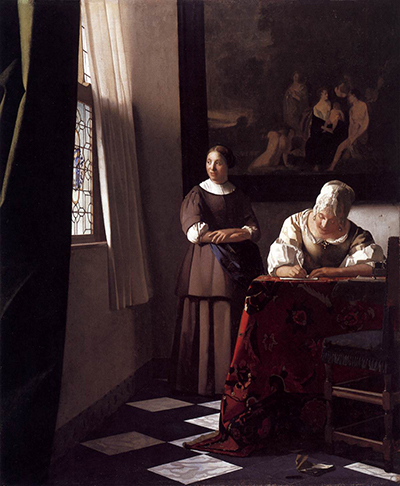
Johannes Vermeer’s Lady Writing a Letter with her Maid is one of his most refined late letter paintings. A woman sits at a table writing. Behind her, a maid stands by the window and looks outward. The room is quiet, but the painting is full of waiting, distance and withheld information.
The National Gallery of Ireland records the work under the title Woman Writing a Letter, with her Maid, by Johannes Vermeer, about 1670, oil on canvas, 71.1 by 60.5 cm, inventory number NGI.4535. [1] It entered the National Gallery of Ireland through the Beit Collection and is one of the most important Vermeer paintings in Dublin.
At a Glance
- ArtistJohannes Vermeer
- Common titleLady Writing a Letter with her Maid
- NGI titleWoman Writing a Letter, with her Maid
- DateAbout 1670
- MediumOil on canvas
- CollectionNational Gallery of Ireland, Dublin
- Inventory numberNGI.4535
- Key themesLetter writing, waiting maid, window, geometry, late style, communication
Contents
- Introduction
- At a Glance
- What the Painting Shows
- A Late Letter Painting
- The Maid at the Window
- Foreground Clues
- Geometry and Stillness
- The Letter and the Outside World
- Relation to Other Vermeer Letter Paintings
- The Beit Collection and Modern History
- Place in Vermeer’s Work
- Frequently Asked Questions
What the Painting Shows
The painting shows a woman seated at a table, absorbed in writing a letter. A maid stands behind her near the window, looking away from the writing figure and out toward the light. On the floor in the foreground lie a red seal, sealing wax and what has been identified as probably a letter-writing manual. [1]
Those details make the act of writing feel concrete. This is not a vague image of thought or romance. Vermeer gives the viewer the material world of correspondence: paper, sealing wax, manual, table, messenger and light.
The mistress and maid do not look at one another. That separation is central to the painting. The mistress is inward, concentrated on the letter. The maid is outward, aligned with the window and the world beyond the room. Between them lies the social and emotional space of written communication.
A Late Letter Painting
Vermeer returned to letters repeatedly. They allowed him to paint private communication without revealing its contents. A letter could suggest love, absence, secrecy, social obligation, travel or news, but it did not have to explain itself.
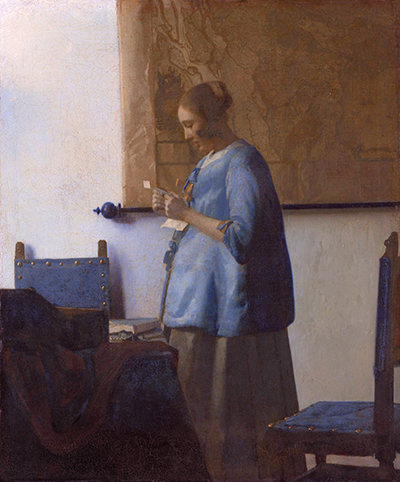
In Lady Writing a Letter with her Maid, the letter is still being composed. That makes the painting different from Woman in Blue Reading a Letter, where the reader is already absorbed in a message, and from Mistress and Maid, where a letter has just been delivered. Here, communication is being made in front of us.
The act of writing also slows the scene. The seated woman is not reacting suddenly. She is forming words. Vermeer turns that act into a visual structure of concentration and delay.
The Maid at the Window
The maid is one of the painting’s most important figures, even though she is not the one writing. She stands upright, waiting, looking out through or toward the window. Her stillness creates a counterpoint to the mistress’s activity.
It is tempting to read her expression too strongly, but the safer interpretation is structural. The maid connects the private room to the outside world. She may be waiting to carry the finished letter. She may simply be present as part of the household. Either way, her position makes the letter’s future movement visible.
The window strengthens that role. The mistress writes inside; the maid looks outward. The letter will eventually leave the interior and enter a wider network of people and places. Vermeer makes that movement implicit without showing it.
Foreground Clues
The foreground objects are unusually important. The National Gallery of Ireland highlights the red seal, sealing wax and probable letter-writing manual. [1] These are not decorative scraps. They clarify the subject and deepen the sense of process.
The red seal and wax point to closure and dispatch. A letter is not complete until it is folded, sealed and sent. The probable manual suggests that letter writing could be guided by convention, formula and social expectation. Personal feeling and social form meet on the table and floor.
This helps prevent the painting from becoming a generic image of a woman writing. Vermeer shows the mechanics of correspondence and the social ritual surrounding it.
Geometry and Stillness
The painting is one of Vermeer’s most ordered late interiors. The table, wall, window, standing maid and seated writer create a structure of verticals and horizontals. The room feels controlled, almost architectural.
That order does not make the scene cold. Instead, it gives emotional tension a disciplined form. The woman’s private act is held inside a carefully measured space. The maid’s stillness and the window’s light make the room feel suspended.
Vermeer’s late style often depends on this kind of restraint. Rather than multiplying narrative clues, he reduces action and lets geometry carry feeling. The result is a painting that seems quiet at first, but grows more complex the longer it is examined.
The Letter and the Outside World
The window is not merely a source of light. It marks the boundary between interior privacy and exterior communication. The maid’s gaze outward makes that boundary active. She appears to belong to the room, but her attention points beyond it.
This gives the painting a different emotional rhythm from A Lady Writing. In the Washington painting, the woman turns toward the viewer, interrupting the act of writing with a direct gaze. In the Dublin painting, the writer remains absorbed, while the maid becomes the figure of waiting and future movement.
The letter therefore holds several times at once: the present act of writing, the expected sealing of the message, the maid’s possible delivery and the absent recipient who may eventually read it.
Relation to Other Vermeer Letter Paintings
This painting is essential to Vermeer’s letter group. It connects with Woman in Blue Reading a Letter, A Lady Writing, The Love Letter, Mistress and Maid and Girl Reading a Letter at an Open Window. Each work treats written communication differently.
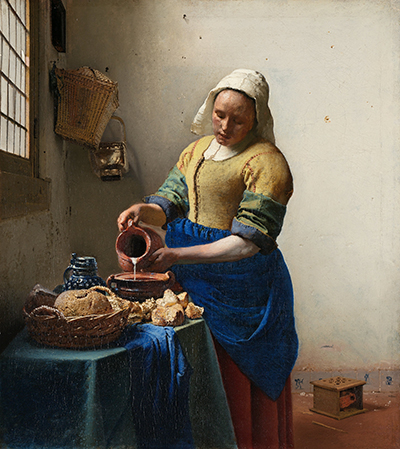
Girl Reading a Letter at an Open Window centres reading and revelation. Woman in Blue Reading a Letter turns reading into stillness. A Lady Writing brings the writer into contact with the viewer. The Love Letter frames message and music through a doorway. Mistress and Maid emphasises delivery. Lady Writing a Letter with her Maid is about composition and waiting.
Seen in that group, the Dublin painting is not just another letter scene. It is one of Vermeer’s clearest meditations on the social life of writing.
The Beit Collection and Modern History
The National Gallery of Ireland records the painting as presented by Sir Alfred and Lady Beit in 1987. [1] That provenance matters because it places the work within a modern collecting and public-museum history as well as within Vermeer’s seventeenth-century world.
The painting also has a dramatic modern history of theft and recovery, but that should not dominate the page unless supported by detailed institutional sourcing. Its primary importance remains artistic: composition, light, letter writing and the relation between mistress and maid.
That proportionality is important. Vermeer’s paintings often attract stories because they are rare, famous and valuable. Collection history matters where it clarifies the work, but the painting itself should remain at the centre.
Place in Vermeer’s Work
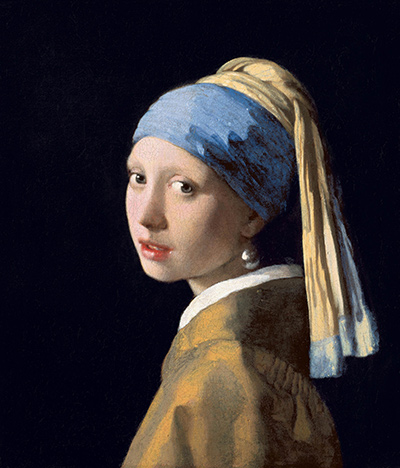
Lady Writing a Letter with her Maid is one of the key late works for understanding Vermeer’s treatment of communication. It is less immediately iconic than Girl with a Pearl Earring, but more complex as a composition of social roles.
The painting brings together several mature Vermeer concerns: women in interiors, controlled light, letters, servants, silence, geometry and absent figures. The absent recipient of the letter is never shown, but the whole painting is organised around that person’s implied existence.
It is also one of the strongest connecting works among Vermeer’s letter paintings. It links the Dublin Vermeer to the maid/mistress theme, the biography, the paintings catalogue and the wider story of Vermeer’s modern legacy.
Frequently Asked Questions
The painting is in the National Gallery of Ireland in Dublin. [1]
The National Gallery of Ireland uses the title Woman Writing a Letter, with her Maid. [1]
The National Gallery of Ireland dates the painting to about 1670. [1]
The National Gallery of Ireland identifies a red seal, sealing wax and probably a letter-writing manual in the foreground. [1]
It belongs to the same broad group as Woman in Blue Reading a Letter, A Lady Writing, The Love Letter, Mistress and Maid and Girl Reading a Letter at an Open Window, but it focuses specifically on the act of writing and the maid’s waiting presence.
Discussion
What feels most revealing about Lady Writing a Letter with her Maid: Vermeer's handling of light, the silence of the scene, the object details, the attribution history, or the way the painting fits within Dutch Golden Age art?
Reader Insights
Vermeer rewards slow attention. Begin with the main action, then move outward to light, edges, objects and the quiet spaces that hold the composition together.
Many of these paintings are small, but their meanings open through Delft, collecting history, technical study and comparison with related Dutch interiors.
Pair this article with the biography and one neighbouring Vermeer work to see how subject, light and attention shift across the artist's compact oeuvre.
Join the Conversation
Have a thought or observation about Lady Writing a Letter with her Maid? Share it below. Thoughtful responses may be added to this section as the Vermeer pages develop.
References
- National Gallery of Ireland, Woman Writing a Letter, with her Maid, Johannes Vermeer.
- Vermeer research notes on letter paintings and late interiors.
- Frick Collection, Vermeer’s Love Letters context, where relevant to the wider letter-painting group.