


 by Tom Gurney
Tom Gurney BSc (Hons) is an art history expert with over 20 years experience
Published on June 19, 2020 / Updated on October 19, 2026
Email: tomgurney1@gmail.com / Phone: +44 7429 011000
Bianca
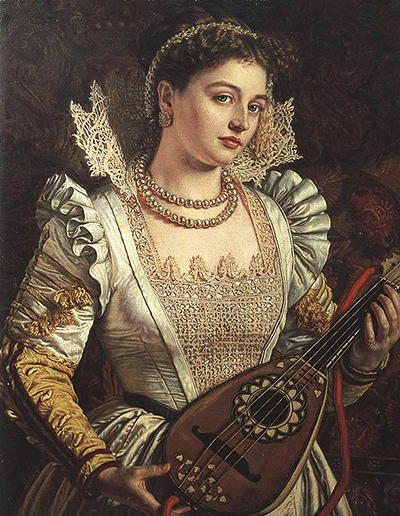
A young woman meets the viewer's gaze while holding a small plucked string instrument. Her pearl necklaces, pale embroidered dress, puffed sleeves and delicate lace make a bright shape against a dark interior. William Holman Hunt painted Bianca in Florence in 1868–69. The work belongs to Worthing Museum and Art Gallery. Its subject is Bianca, the younger daughter in Shakespeare's The Taming of the Shrew, presented alone rather than amid the play's quarrelling suitors. The museum's account of a 2024 loan identifies the Shakespearean character; the words once recorded on the picture's frame point to the play's music lesson. [1] [2]
A woman and an instrument
Hunt puts Bianca close to the front of the canvas. The instrument runs diagonally across her body. One hand supports it near the lower edge; the other rests near its neck. The line carries the eye from her gloved hand up to her face. She is neither performing for an audience nor taking part in a recognisable scene with other actors. The painting pauses before or after a note, leaving its imagined music to the viewer. Her direct but slightly turned gaze adds to this sense of an encounter rather than an illustration of a single dramatic instant.
At a Glance
- ArtistWilliam Holman Hunt (1827–1910)
- TraditionBritish Pre-Raphaelite art
- Work or subjectBianca
- ContextIllustrated paintings guide
- Further readingArtist biography
The close view also makes dress a substantial part of the subject. Narrow bands of ornament cross the bodice; gold-coloured fabric and lace interrupt the pale sleeves; pearls repeat the round shapes of the instrument's decoration. Against the dark background, even the finer threads catch light. These details do more than display the painter's skill. They place a contemporary sitter into a deliberately theatrical version of an earlier period. Hunt's precision makes the costume convincing as an image while leaving its status as costume visible.
The instrument is the clearest link to Shakespeare. In Act 3, Scene 1 of The Taming of the Shrew, two men approach Bianca disguised as tutors. Hortensio presses his claim to teach her music, calling her “the patroness of heavenly harmony.” Lucentio, disguised as a schoolmaster, argues for his own lesson. Bianca resists being treated as a pupil whose hours the two men can divide, saying she will learn as she pleases. A historical account of Hunt's painting records a frame inscription using Hortensio's description. The musical object in her hands therefore identifies a particular thread of the play without reproducing the room or the two tutors. [3] [4]
Bianca in The Taming of the Shrew
Bianca's position in the play is more complicated than the elegant solitary figure suggests. Her father, Baptista, refuses to allow her marriage before her older sister Katherine marries. Men compete for Bianca, and the apparent lessons become a means to gain access to her. Shakespeare gives her a voice in the music scene: she objects to the tutors' dispute over her time and chooses the order of their lessons. Hunt removes the argument from view, concentrating on the person over whom it is fought. That choice makes the painting readable as a portrait while still giving the instrument a dramatic purpose. [3]
Watch: William Holman Hunt
Begin with Hunt’s paintings, then place his work alongside two fellow Pre-Raphaelite founders.
William Holman Hunt Paintings
An overview of Hunt’s paintings from TheHistoryOfArt video archive.
Watch on YouTubeThe title can cause confusion because Shakespeare also wrote a Bianca in Othello. Some reproduced image records attach that other character to this painting. The Worthing Museum Trust explicitly names The Taming of the Shrew, and the frame wording belongs to its music lesson, so that is the supported identification here. The picture does not depict a scene from Othello, and the instrument is not evidence for such a reading. [2] [3]
The Florence sitter and Hunt's method
Hunt's own memoir supplies unusually direct evidence about the making of the picture. While he was in Florence, an American family let him paint one of its daughters as Bianca. He described beginning in tempera, laying out design, light and shade, then finishing in oil with amber varnish. This account is more exact than a simple “oil on canvas” label and helps explain the densely worked surface. It also establishes a difference between the sitter and the character: a woman living in nineteenth-century Florence posed for a figure from Shakespeare's imagined Italy. Hunt did not claim to have found a historical portrait of Bianca. [5]
Later accounts name the model Miss Lydiard and describe Hunt's attraction to her. The memoir itself identifies her as an American family's daughter without giving that surname in its short account of the painting, so the name should be read as a later biographical identification rather than a signature on the canvas. A contemporary visitor's reminiscence, published with scholarly notes, records Hunt telling the story of the original patron's failure to buy the picture and his own later rediscovery of it. Those are recollections of a conversation, valuable for the painting's reception but less secure than an accession record for a full ownership chain. [4] [5]
The work has been dated 1868–69 in a recent Italian exhibition's object list; Worthing's collection summary gives 1869. These labels need not describe different paintings. The first allows for work across two years, while the second presents a single completion year. The Italian exhibition lists an 88.3 × 66.8 cm oil on canvas and Worthing as lender. Hunt's description of his layered tempera and oil technique gives useful extra detail about its execution. [6] [1] [5]
Looking at Bianca today
The painting is an example of Hunt using literature to shape a single-figure image. Compared with the crowded confrontation in his Valentine Rescuing Sylvia from Proteus, another Shakespeare subject, Bianca gives the story through one woman and one object. Compared with Claudio and Isabella, it leaves the moral conflict and other characters outside the frame. The viewer can read it as a richly observed portrait first, then recognise the dramatic role through the instrument and frame words.
Worthing Museum identifies Bianca among the important paintings in its fine-art collection. Its loan to the 2024 Pre-Raphaelite exhibition in Forlì shows the work's continued role in presenting Hunt's art beyond Britain. The small local reproduction reveals the composition and costume, though it cannot convey every painted thread or the original frame. What remains clear at either scale is Hunt's decision to give Bianca presence of her own. She holds the instrument associated with the suitors' lesson, but no suitor appears to direct her. [1] [2]
Discussion
Look closely at Bianca, then compare your reading with the documented history.
Reader Insights
Which detail in Bianca most affects your reading?
How do the date, medium and collection records shape that interpretation?
What remains uncertain about this work or its history?
Join the Conversation
Share a close observation or a source-backed question about Bianca. The prompts above are starting points for discussion.
References
- Worthing Museum collection. View source.
- Worthing Museum Trust report. View source.
- Folger Shakespeare Library, The Taming of the Shrew , Act 3, Scene 1. View source.
- RACAR , account of Hunt and Bianca. View source.
- Hunt, Pre-Raphaelitism and the Pre-Raphaelite Brotherhood , vol. 2, p. 207. View source.
- Fondazione Cassa dei Risparmi di Forlì, 2024 exhibition press materials. View source.







