



 by Tom Gurney
Tom Gurney BSc (Hons) is an art history expert with over 20 years experience
Published on June 19, 2020 / Updated on October 19, 2026
Email: tomgurney1@gmail.com / Phone: +44 7429 011000
A Street Scene in Cairo: The Lantern Maker's Courtship
A young craftsman leans from his bench towards a woman at the edge of a crowded Cairo street. His green turban and red coat stand out against the timber and hanging lamps of his workshop. She wears a deep blue outer garment and holds a dark veil against the lower part of her face. His hand reaches towards her cheek and her wrist. Their exchange is framed by lanterns, cord, tools and a sleeping dog, while movement continues in the narrow street behind them. William Holman Hunt called the painting A Street Scene in Cairo: The Lantern Maker's Courtship. The version reproduced here is Birmingham Museums Trust's oil on canvas, accession 1962P68, begun during his 1854 visit and associated with the 1861 Royal Academy exhibition. [1] [2] [3]
The subject seems informal beside Hunt's monumental biblical paintings. Yet it belongs to the same period of searching. In Egypt and the Holy Land he studied people, clothing, buildings and landscapes, hoping observed particulars would make his art more convincing. Here he tries a contemporary street encounter rather than a scriptural event. The scene's bright colour and minute detail create an impression of immediacy, but the long interval between its start and exhibition reminds us that it is a composed and revised painting, not an instant record of a passing exchange. [4]
At a Glance
- ArtistWilliam Holman Hunt (1827–1910)
- TraditionBritish Pre-Raphaelite art
- Work or subjectA Street Scene in Cairo: The Lantern Maker's Courtship
- ContextIllustrated paintings guide
- Further readingArtist biography
What is happening between the two figures?
The lantern maker appears to seek a glimpse of the woman's face beneath her veil. Hunt later wrote that he had watched a similar encounter in Cairo and found in it more than a local custom: to him it suggested a broader human wish to know what is hidden. His recollection explains the painting's title and the emphasis on hands, eyes and fabric. It remains his account of what he saw and thought, recorded many years after the visit. It cannot tell us with certainty what the real people involved felt, or whether the painter's assumptions matched their understanding of the exchange. [4]
Look at how much the picture leaves open. The man's mouth seems to smile, but his hand presses towards a covered face, and his other hand holds the woman's wrist. Her eyes remain visible; the rest of her expression does not. A museum description reads both figures as happy with the meeting, pointing to her lifted foot inside a slipper as a sign of response. That is one possible interpretation of painted gestures. The image can also make a viewer conscious of the woman's limited room to withdraw. The best account distinguishes what is visible—the touch, veil, glance and raised foot—from a certain verdict on consent or emotion. [2]
Hunt organised the scene around this small uncertainty. The two figures occupy most of the height of the canvas, so their hands and faces become the first things we read. Yet neither is alone. The dangling lamps declare the man's trade; the street and passers-by place the meeting in public. The painter makes intimacy and exposure coexist. The workshop is partly sheltered, but it opens directly onto a busy route. That tension helps explain why an apparently ordinary exchange can hold the viewer's attention for longer than a simple genre anecdote.
A working place rather than a neutral backdrop
Several lanterns hang above and beside the young man. Some appear finished; other materials and tools rest on the bench. Hunt's title makes his occupation part of the story. The metal frames and suspended forms direct the eye back towards his hands, which are temporarily occupied with courtship rather than work. Their hard straight lines set off the soft drapery and curved human forms below them. The details make the workshop legible without requiring a reader to identify every implement at reproduction size. [2]
The sleeping dog beneath the bench is easy to miss. Its curled body rests at the bottom of a scene full of watching and touching. It is part of the street's everyday life, not necessarily an emblem with a single fixed meaning. The dog's stillness also gives the foreground a slower rhythm against the active hands above. Near it lie scraps, including a piece of orange peel noted in the collection description. Such things make the ground feel used. Hunt gives the street the minor leftovers of lived activity rather than sweeping it clean for a formal portrait. [2]
The backdrop continues beyond the couple. Buildings and people compress the narrow way into a busy vertical space. The scale of the canvas is modest, yet Hunt suggests a wider city through partial glimpses and overlapping forms. The background figures are not developed as independent portraits, so a reader should resist attaching definite identities or motives to them. Their role is to keep the lovers' meeting connected to a street with commerce and movement around it. The painter's attention to the foreground does not make Cairo empty.
Watch: William Holman Hunt
Begin with Hunt’s paintings, then place his work alongside two fellow Pre-Raphaelite founders.
William Holman Hunt Paintings
An overview of Hunt’s paintings from TheHistoryOfArt video archive.
Watch on YouTubeBirmingham Museums Trust also holds Hunt's Study of a Street Scene in Cairo[5], accession 1946P18, dated 1854. In this pencil sheet, projecting upper rooms and latticework give the lane its narrow shape, while much of the foreground remains lightly indicated. Set beside the finished painting, it lets us see Hunt examining a Cairo street as a subject in its own right. The museum titles it as a study connected with The Lantern Maker's Courtship; the sheet does not by itself prove that each painted building was copied directly from this one viewpoint.
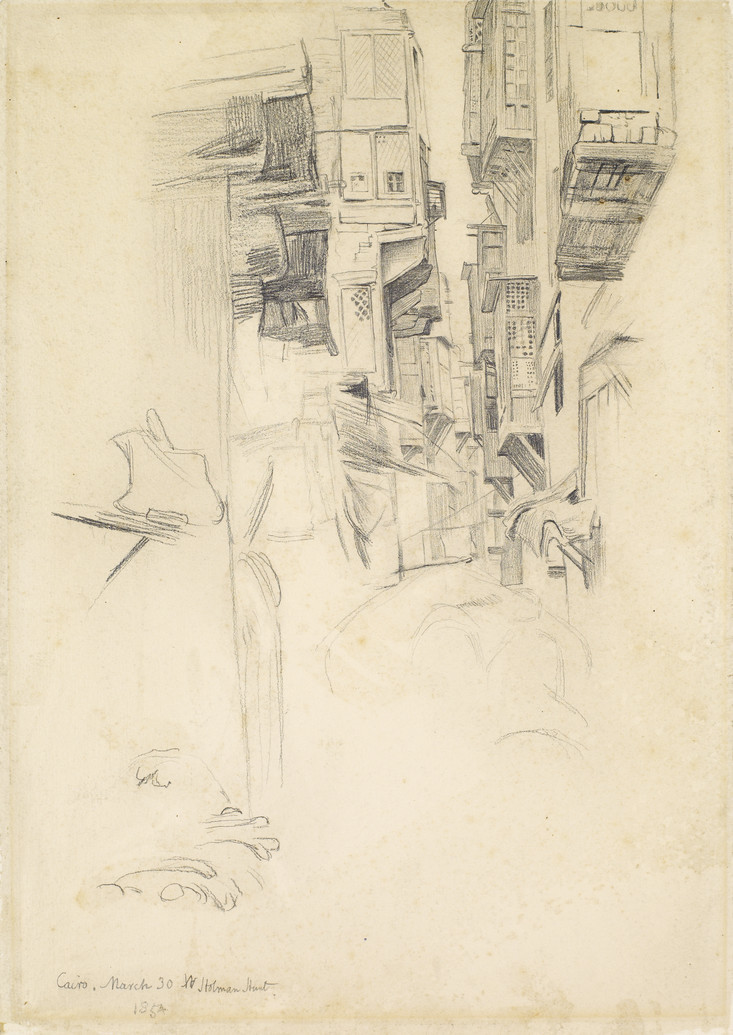
Study of a Street Scene in Cairo, 1854, Birmingham Museums Trust, 1946P18. Photo by Birmingham Museums Trust, licensed under CC0. [5].
Colour, texture and the veil
The red coat and blue garment give the picture its strong colour structure. The green turban forms a small, bright bridge between them. Hunt paints the white sleeve and pale cloth at the bench with care, allowing differences in weave and fold to remain visible. The woman’s veil is especially important because it is at once a piece of fabric and the object around which the narrative turns. A less carefully painted veil would reduce the exchange to a pantomime gesture; here its dark surface marks the boundary the young man wishes to cross.
The painting's surface records Hunt's Pre-Raphaelite preference for distinct objects and strong colour. It is tempting to call the result photographic, but photographs do not explain the carefully arranged relation of red, blue, green and black or the way every lantern, cord and scrap seems to support the central encounter. The apparent snap of a street moment is an effect produced through sustained painting. This distinction matters because the canvas was begun in Cairo but developed over later years before its public showing. [4] [2]
Hunt's Cairo encounter and its limits
Hunt's memoir presents the scene as something he observed from a partly hidden position. He wrote that the young man's curiosity about a veiled face suggested a subject with a meaning beyond the immediate incident. A letter written to his patron Thomas Combe on 26 April 1854, cited in later scholarship, also shows Hunt thinking about dress and custom while he was in Egypt. These are valuable sources for the artist's intention, but they are not direct testimony from the woman in the street. His account belongs to a British visitor interpreting an unfamiliar society through his own expectations. [4]
Modern scholarship places this viewpoint within Orientalism: the nineteenth-century European habit of presenting Middle Eastern societies as visually rich, mysterious and somehow outside historical change. Hunt made close studies from life, and his objects can be sharply observed. That does not free the scene from the conventions of its time. The veil becomes a sign of hiddenness and temptation for the painter, while the woman's perspective remains largely inaccessible. Reading the canvas today involves noticing both his skill in recording material detail and the unequal position from which he framed its human encounter. [4]
The tension is visible in the title itself. “Street Scene” promises a view of place and everyday life; “Courtship” supplies an interpretation of a relationship. We can verify lanterns, clothes, a narrow passage, touch and glance. We cannot verify from paint alone that this was a mutually welcome courtship, or that it accurately represents a general Egyptian custom. Hunt's chosen story gives the image its shape, while the figures' partly obscured expressions keep its outcome open.
Date, collection and a second painting
The Birmingham canvas measures about 54.8 × 34.7 cm. It is generally dated 1854–61, a range that encompasses the Cairo beginning and the 1861 exhibition. A contemporary sale history reports that it was begun in Cairo in spring 1854 and shown at the Royal Academy in 1861. A later biographical account says it became the property of the Birmingham collector William Kenrick. These records offer a coherent outline without proving the date of every brushstroke. [2]; [6] [3]
Hunt also made a closely related painting now at Manchester Art Gallery. That work, The Lantern-Maker's Courtship, is a smaller oil on panel, approximately 29.4 × 18.8 cm, accession 1917.266. Its visual likeness to Birmingham's canvas makes confusion easy, especially in small web images. These are different paintings. Their material, size and collection identify which is which even when a cropped reproduction makes their details hard to distinguish. [7]
The painting belongs beside Hunt's other work from his first Eastern journey, but its human subject is distinctive. The Finding of the Saviour in the Temple used close study in the service of biblical reconstruction. The Afterglow in Egypt developed a monumental image of a woman carrying the products of the land. A Street Scene in Cairo takes a brief interaction as its subject. It shows what Hunt could do with the same attention to cloth, light and place when the narrative was not sacred and the moral answer was less settled. [4]
For a first look, move from the lanterns down to the man's hands, across the woman's veil and eyes, and then back to the dog and the busy street. The details make the encounter vivid, but they do not close it. The work is most revealing when its apparent immediacy and its crafted ambiguity are seen together: Hunt gives the viewer an intensely observed scene while also asking us to accept his title, and his interpretation, of what took place.
Discussion
Look closely at A Street Scene in Cairo: The Lantern Maker's Courtship, then compare your reading with the documented history.
Reader Insights
Which detail in A Street Scene in Cairo: The Lantern Maker's Courtship most affects your reading?
How do the date, medium and collection records shape that interpretation?
What remains uncertain about this work or its history?
Join the Conversation
Share a close observation or a source-backed question about A Street Scene in Cairo: The Lantern Maker's Courtship. The prompts above are starting points for discussion.
References
- Birmingham Museums Trust image-bank object and CC0 image. View source.
- Victorian Web's Art UK-based object description. View source.
- 1912 Dictionary of National Biography, exhibition account. View source.
- Period Eye , Hunt's Cairo work and its later completion. View source.
- Study of a Street Scene in Cairo. View source.
- Memorials of Christie's , contemporary sale account. View source.
- Manchester Art Gallery object record. View source.


