 by Tom Gurney
Tom Gurney BSc (Hons) is an art history expert with over 20 years experience
Published on June 19, 2020 / Updated on October 19, 2026
Email: tomgurney1@gmail.com / Phone: +44 7429 011000
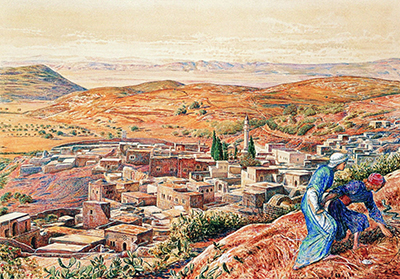
Distant View of Nazareth
A town of pale, tightly packed buildings fills the middle of a wide valley. Ridges rise beyond it, while a rocky slope comes close to the viewer at the right. William Holman Hunt's Distant View of Nazareth brings together a carefully described place and a small foreground incident. The Whitworth-crediting image record[1] dates the work 1860–61 and identifies its medium as watercolour and bodycolour on paper. It is held by the Whitworth, University of Manchester.
The town and the foreground
Hunt looks down on Nazareth from higher ground. The buildings step across the valley floor, forming a network of roofs, walls and narrow passages. Their pale colours are set against orange and brown slopes, then cooler, hazier hills on the horizon. The town is both the subject and a part of a larger landscape: its geometric forms are embedded in the contours of the land.
At a Glance
- ArtistWilliam Holman Hunt (1827–1910)
- TraditionBritish Pre-Raphaelite art
- Work or subjectDistant View of Nazareth
- ContextIllustrated paintings guide
- Further readingArtist biography
The picture does not have one even level of detail. At the front are plants, stones and strong colour contrasts. Across the middle, small repeated buildings make the settlement legible without giving every house the scale of a separate portrait. Farther back, the ridges flatten into bands. This progression creates distance while keeping a sense of the physical terrain. The long, low shape of the composition encourages the eye to travel from foreground across the town and onward to the hills.
Two small figures occupy the nearer slope on the right. Their blue and purple clothing breaks the earth-coloured pattern around them. Their presence changes the image from a detached panorama into a place where something is happening. The details of the incident are difficult to resolve in the inherited small reproduction. The image catalogue's keywords[1] include a snake, but they do not identify the people or specify a biblical passage. It is safer to describe a foreground encounter than to give the figures names the object record has not supplied.
Watercolour and bodycolour
This work is a watercolour with bodycolour on paper, according to the Whitworth-crediting catalogue. Bodycolour, an opaque form of water-based paint, can create more solid passages than transparent wash alone. The mixture suits the image's changing demands: a luminous sky and remote haze, close grasses and stones, and the concentrated colours of the figures. The available catalogue does not provide a technical examination, so a single visible mark should not be assigned to one medium with certainty from a small digital image.
The material matters because a commercial reproduction labelled “oil painting” describes the product offered for sale, not necessarily Hunt's original sheet. The object identified at the Whitworth is on paper. It belongs more naturally beside Hunt's other watercolours than in an account that treats all of his Holy Land images as oils. A watercolour can still be a considered, complex work rather than a preliminary sketch for a larger canvas.
Watch: William Holman Hunt
Begin with Hunt’s paintings, then place his work alongside two fellow Pre-Raphaelite founders.
William Holman Hunt Paintings
An overview of Hunt’s paintings from TheHistoryOfArt video archive.
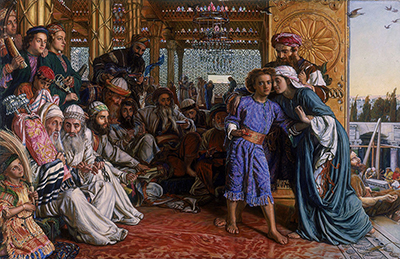
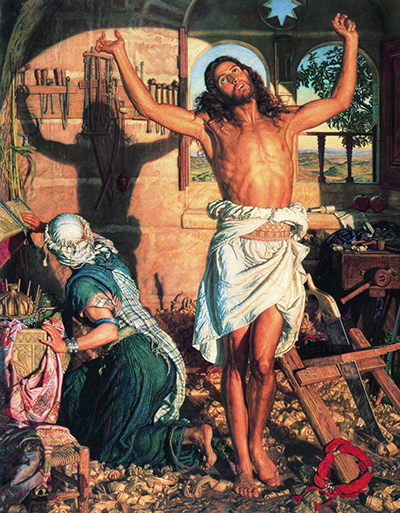
Watch on YouTubeThe date 1860–61 is the catalogue date for this sheet. It should not be confused with the dates of everything depicted or compared with it. Hunt's broader interest in the Holy Land provided material for religious paintings such as The Finding of the Saviour in the Temple and The Shadow of Death. Here, the cityscape is not a generic backdrop. Nazareth itself occupies most of the painted field, while the small foreground event asks the viewer to move between observed terrain and imagined narrative.
A view considered beside a photograph
A review of the 2016 exhibition Painting with Light[2] reports that Hunt's watercolour was placed beside James Graham's 1855 photograph of nearly the same view. The critic describes the photograph's corresponding foreground slope as empty and Hunt's as carrying figures startled by a snake. That pairing offers a useful way to look at the picture: the distant setting may appear closely observed, but Hunt has given the front of the landscape a human incident.
The comparison is evidence of how the two images were shown and interpreted in that exhibition. It does not establish that Hunt copied Graham's photograph, that the figures have a known identity, or that the watercolour was painted when the photograph was taken. The catalogue date remains 1860–61. The difference between a dated photograph and a dated watercolour is part of the story, since the two works use a similar viewpoint for different ends.
Place, story and related works
The title makes the location central: this is a distant view of Nazareth. Hunt's foreground figures bring a narrative charge, but the town is still visible enough to reward slow inspection. The viewer can follow the near plants and figures, the ordered cluster of buildings, the surrounding slopes and finally the light at the skyline. That movement holds together the picture's topographical interest and its suggestive human moment.
Nazareth also appears in titles of other Hunt works. The specialist account of On the Plains of Esdraelon above Nazareth[3] documents a separate subject and exhibition history. The shared place name does not make it another title for the Whitworth sheet. This page follows the wide town view shown above, dated 1860–61 and catalogued as watercolour and bodycolour on paper.
The small figures may draw the first glance because their colour is so vivid. The longer view opens behind them: Nazareth as a dense town within a broad landscape, not just a label attached to a biblical scene. Hunt's painting lets both scales coexist. Its documented medium, collection and date give a firm object identity; its foreground incident invites attention without requiring an invented certainty about every figure.
The 2016 exhibition comparison is also a reminder that close observation is not identical with copying a camera view. The reviewer described Hunt as compressing and clarifying the contours seen in Graham's earlier photograph, while giving the foreground a more dramatic role. That is the critic's reading of two works placed side by side, not evidence of Hunt's exact studio procedure. It suggests a useful question for this page: which parts of the town are being recorded as a place, and which relationships of scale and colour are arranged to guide the viewer? The answer need not be either pure documentation or pure invention. [2]
Discussion
Look closely at Distant View of Nazareth, then compare your reading with the documented history.
Reader Insights
Which detail in Distant View of Nazareth most affects your reading?
How do the date, medium and collection records shape that interpretation?
What remains uncertain about this work or its history?
Join the Conversation
Share a close observation or a source-backed question about Distant View of Nazareth. The prompts above are starting points for discussion.
References
- Whitworth-crediting image record. View source.
- review of the 2016 exhibition Painting with Light. View source.
- specialist account of On the Plains of Esdraelon above Nazareth. View source.