


 by Tom Gurney
Tom Gurney BSc (Hons) is an art history expert with over 20 years experience
Published on June 19, 2020 / Updated on October 19, 2026
Email: tomgurney1@gmail.com / Phone: +44 7429 011000
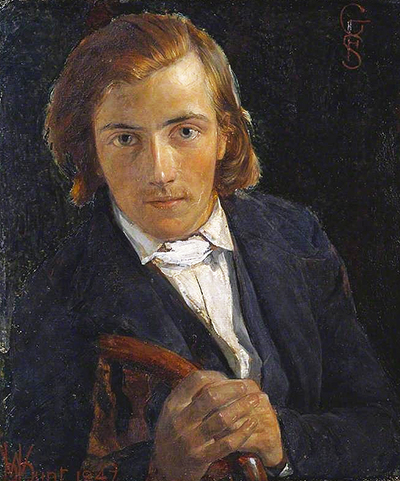
F. G. Stephens
William Holman Hunt painted Frederic George Stephens when both men were young and the Pre-Raphaelite Brotherhood had not yet been formed. The sitter faces the viewer, leaning forward over the back of a chair with his hands clasped. His pale face and white collar stand out against dark clothing and background. The small, direct portrait is dated 1847 and belongs to Tate, accession N04624. It is oil paint on mahogany, only 20.3 × 17.5 cm. The National Portrait Gallery's extended catalogue notes Hunt's monogram and a former reverse label that said it was painted in London during 1846–47. [1] [2]
This is a portrait of a future collaborator before his later reputation was fixed. Stephens went on to join the Brotherhood at the end of 1848, but his most sustained work was as an art critic and historian rather than as a painter. He wrote for its journal The Germ and later worked for the Athenaeum over decades. Knowing that later career helps identify the sitter, yet the painting should still be seen as an encounter between two artists in the 1840s, not as a formal portrait of an established critic. [3] [4]
At a Glance
- ArtistWilliam Holman Hunt (1827–1910)
- TraditionBritish Pre-Raphaelite art
- Work or subjectF.G. Stephens
- ContextIllustrated paintings guide
- Further readingArtist biography
A direct pose on a small panel
Hunt places Stephens close to the front of the picture. His forearms cross the chair back, drawing attention to the loosely clasped hands below the face. The pose avoids the distance of a conventional upright bust portrait: the sitter appears to lean into the viewer's space. The chair supplies a stable shape and gives him something to do with his hands. Its reddish-brown edge provides one of the warmer colours against the blue-black coat.
The head is lit enough to reveal the young man's features, but the surrounding darkness keeps the scene compact. Hair swept back from the forehead frames the face; the eyes look outward rather than away into a narrative setting. Hunt has given different degrees of finish to skin, hair, fabric and background. The formal white neckcloth and the informal lean sit together. The result makes Stephens recognisable without giving him an office, book or other symbol of his future profession.
The National Portrait Gallery describes the image as half length, front facing, hands clasped on the back of a kitchen chair. That description is a useful check against online reproductions with inconsistent filenames. The portrait is of Stephens by Hunt, not a self-portrait of Hunt and not a painting by Stephens. The small panel's accession N04624 is a more reliable identity anchor than a reused web image title. [1]
Before the Brotherhood
Stephens entered the Royal Academy Schools in 1844, where he met Hunt and John Everett Millais. The Brotherhood came together later in 1848, with Dante Gabriel Rossetti and other members. Hunt's 1847 portrait therefore records a connection from the preparatory years, before the seven men had a group name or the initials “PRB” to put on pictures. It is tempting to read every early mark as a fixed Pre-Raphaelite formula, but the chronology does not support that. The painting belongs to the circle's formation, not to an already codified movement. [3] [5]
Watch: William Holman Hunt
Begin with Hunt’s paintings, then place his work alongside two fellow Pre-Raphaelite founders.
William Holman Hunt Paintings
An overview of Hunt’s paintings from TheHistoryOfArt video archive.
Watch on YouTubeStephens attempted paintings of his own in the late 1840s and early 1850s. He eventually turned towards criticism, writing about the art and artists around him. The NPG says he became a regular contributor to the Athenaeum from 1861 and worked on histories and catalogues, including studies of prints. This later career changes how the portrait can be read: the sitter was not merely a decorative model in another artist's story. He became one of the people who explained, promoted and evaluated Victorian art in print. [3]
He also took part in Hunt's public presentation. Stephens wrote the 1860 pamphlet accompanying The Finding of the Saviour in the Temple. There, his words helped visitors interpret a painting that had taken Hunt years to finish. The early portrait and later pamphlet show two sides of a long relationship: Hunt once studied Stephens's face, and Stephens later shaped audiences' understanding of Hunt's work. That relationship was not permanent or untroubled; the NPG biography records a later rupture. Its exact causes need not be invented to recognise that the 1847 picture preserves an earlier closeness. [6] [7] [3]
The portrait's family history
A fragmentary label formerly on the back, recorded by the NPG, gives unusual information about the portrait's early life. It says the picture was given to Stephens's mother on 10 October 1855 and later passed from her to his son H. F. Stephens in 1871. The label was written by the sitter in 1872, according to the NPG catalogue. Such testimony gives a more personal path for the panel than an exhibition list alone. As with any later inscription, its dates are evidence from someone close to the work rather than an independent diary of every earlier transaction. [1]
The work eventually entered Tate. Tate’s collection data records a 1932 bequest by H. F. Stephens, consistent with the family route described by the NPG. The compact panel has since appeared in several exhibitions, including the Tate's 1984 Pre-Raphaelite show. A portrait first kept within a family thus became an object through which museums could tell the movement's origins. [2] [1]
This small panel shows the future critic without professional attributes. Its strength lies in the unforced chair pose and sustained attention to a familiar face. Compare it with Hunt's later portrait of Dante Gabriel Rossetti and William Blake Richmond's portrait of Hunt to see how artists in the circle pictured one another. The biography and paintings guide place these works within Hunt's career.
Stephens in other Brotherhood images
The NPG inventory records that Hunt represented Stephens again in a small 1850 pen-and-ink caricature in a letter, this time with Hunt himself. It also lists an untraced drawing of an early Pre-Raphaelite meeting, known through a later photograph of a copy by Arthur Hughes. These are documentary trails of separate works, not alternate views of the 1847 oil panel. The list also identifies Stephens as a model for Millais's Ferdinand Lured by Ariel of 1849–50. In that painting the sitter takes on a literary role and costume, a very different use of his face from Hunt's direct chair-back portrait. Together the records show how a young member of the circle could appear as friend, subject and model across different media. [1]
Discussion
Look closely at F.G. Stephens, then compare your reading with the documented history.
Reader Insights
Which detail in F.G. Stephens most affects your reading?
How do the date, medium and collection records shape that interpretation?
What remains uncertain about this work or its history?
Join the Conversation
Share a close observation or a source-backed question about F.G. Stephens. The prompts above are starting points for discussion.
References
- National Portrait Gallery, portrait inventory. View source.
- Tate collection data. View source.
- National Portrait Gallery, Stephens biography. View source.
- National Portrait Gallery person summary. View source.
- Art UK, Brotherhood chronology. View source.
- Huntington Library, 1860 Stephens pamphlet. View source.
- Landow on its exhibition purpose. View source.







