 by Tom Gurney
Tom Gurney BSc (Hons) is an art history expert with over 20 years experience
Published on June 19, 2020 / Updated on October 19, 2026
Email: tomgurney1@gmail.com / Phone: +44 7429 011000
The Haunted Manor
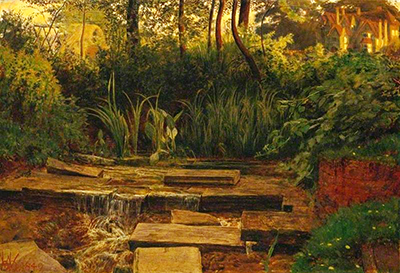
William Holman Hunt's The Haunted Manor makes an overgrown watercourse and a partly hidden building feel quietly uncanny. Stone slabs interrupt a shallow stream in the foreground. Behind them, reeds, bushes and trees nearly fill the view. Only high at the right do parts of a house emerge, its sunlit windows glowing through the foliage. The title suggests a ghostly story, but no ghost or human figure appears. The sensation comes from the ordinary landscape: the way the building is screened, the water darkens, and a warm light catches surfaces at the edge of visibility. Painted in 1849, the small oil on board, 23.3 × 33.7 cm, is now in Tate's collection, accession T00932. [1] [2]
Water, stone and vegetation
The composition begins at ground level with flat, angular stones. Some lie across the stream like abandoned steps; water passes between and around them. Their straight edges contrast with the more irregular line of reeds and undergrowth behind. Hunt invites the viewer to inspect that meeting of made and natural forms before discovering the house. The stones' exact former use cannot be proved from the reproduction alone. What matters visually is that they seem to have been left to the water and plants.
At a Glance
- ArtistWilliam Holman Hunt (1827–1910)
- TraditionBritish Pre-Raphaelite art
- Work or subjectThe Haunted Manor
- ContextIllustrated paintings guide
- Further readingArtist biography
Dense foliage occupies far more space than the building named in the title. Its mixture of slender stems, rounded leaves and dark masses creates a near barrier. The eye can find a way through the scene by following the water, but it does not reach a clear entrance or a welcoming path. The house appears beyond this screen, shifted to the upper right and glimpsed in pieces. Hunt makes it present without making it fully accessible. That visual withholding is one reason the image feels mysterious despite its very precise details.
The lit windows are the most concentrated warm accents near the building. They can be read as reflected sunset or late light rather than proof of a supernatural presence. The title encourages an imaginative response, but the picture leaves the cause of its “haunting” open. This distinction helps keep a close reading honest: Hunt painted luminous panes, shadowed vegetation and a secluded structure; viewers supply the possible story. A recent discussion of the painting likewise describes sunset reflected in the windows and the stream among discarded stones. [3]
Where was the view?
Accounts place the scene in Surrey, but the precise site is uncertain. It has been associated with Wimbledon Park or the Hogsmill River near Ewell. A later discussion notes that the circumstances of its making are not fully known and that an Ewell visit by Hunt has been proposed. Those are possibilities, not a confirmed map location for every stone and tree in the picture. The Tate identity and 1849 date are secure; the exact outdoor viewpoint should remain qualified until an archival source or authoritative collection catalogue settles it. [3] [4]
The uncertainty does not make the landscape generic. Hunt was attentive to the material character of a damp, wooded place, and the picture's sense of locality comes from that close observation. The stream is not an empty band of blue; it has an uneven bed and obstacles. The reeds rise from a particular-looking margin. Light reaches some leaves and misses others. The image gives a convincing experience of one view while leaving its present-day coordinates unresolved.
Watch: William Holman Hunt
Begin with Hunt’s paintings, then place his work alongside two fellow Pre-Raphaelite founders.
William Holman Hunt Paintings
An overview of Hunt’s paintings from TheHistoryOfArt video archive.
Watch on YouTubeAn early Pre-Raphaelite experiment
Hunt helped found the Pre-Raphaelite Brotherhood in 1848. In the following year he made this landscape and Cornfield at Ewell, another small Tate picture. Both show attention to visible nature, yet their effects differ. Cornfield opens across a broad, worked agricultural field; The Haunted Manor closes around a stream and concealed house. One lets the eye travel across a horizontal band of grain, while the other makes it search through a thicket. The contrast shows that close observation did not dictate a single mood or composition. [1]
The painting's small board also differs from the large public canvases for which Hunt became famous. Its compact size suits an experiment in the relation of detail and atmosphere: individual stones and stems can be studied, but they combine into something more unsettling than an inventory. This is a reading of the object, not an argument that the young Hunt had already fixed a later symbolic programme. A landscape can invite story without functioning as a code in which every plant must stand for a doctrine.
Its colour is part of that effect. Yellow-green light behind the trees gives the upper left a sense of air and distance, while the bank and water below remain dark brown and green. The warm red patch at the right edge and the pale stone planes keep the foreground from merging into one shadow. The house's illuminated windows echo those lighter patches, allowing the viewer to discover it after looking at the water. This route through the colour is subtler than a figure pointing towards the building. Hunt makes attention itself the means by which the manor comes into view.
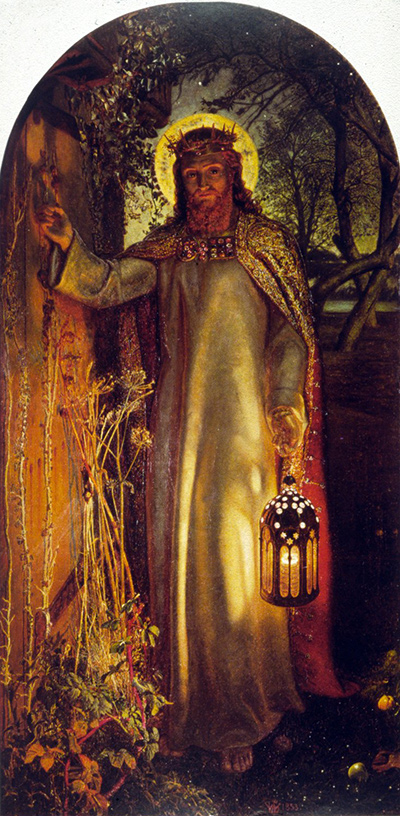
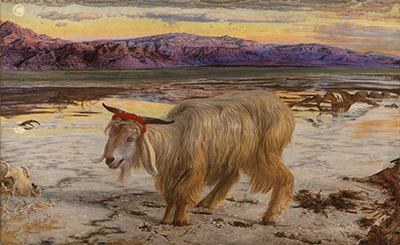
Hunt later painted much more conspicuous religious symbols in The Light of the World and made topography central to The Scapegoat. The Haunted Manor shows an earlier interest in making an actual-looking place carry emotional force. The vegetation's exactness makes the obscured building more, not less, strange. View it alongside the paintings guide and the biography for the changing scale and subjects of Hunt's work.
Looking across the early landscape group
Art UK's collection-based naturalism survey places The Haunted Manor beside Hunt's Cornfield at Ewell and John Everett Millais's Ophelia. The comparison is instructive without making the sites identical. Art UK records Millais painting the background of Ophelia by an Ewell stream, while the exact location of Hunt's manor remains disputed. Both pictures ask close attention to waterside growth, but Millais makes that setting part of a literary tragedy. Hunt leaves the stream without a figure or a named event. The difference shows how the same habit of studying nature could support a precise narrative in one work and an unresolved mood in another. [1]
The curation also sets Hunt's small 1849 boards among later and larger Pre-Raphaelite landscapes. That grouping is a guide to comparing methods, not proof that every work was painted entirely outdoors or followed a single doctrine. On Hunt's board, a few light passages lead from stones to leaves and finally to the elusive house. Its title gives the place an imaginative charge, while the visible forms keep the viewer grounded in a stream, masonry and trees. The picture remains compelling precisely because it does not resolve the imagined haunting into an illustrated incident.
Discussion
Look closely at The Haunted Manor, then compare your reading with the documented history.
Reader Insights
Which detail in The Haunted Manor most affects your reading?
How do the date, medium and collection records shape that interpretation?
What remains uncertain about this work or its history?
Join the Conversation
Share a close observation or a source-backed question about The Haunted Manor. The prompts above are starting points for discussion.
References
- Art UK, early landscape curation. View source.
- Victorian Web, Tate object caption. View source.
- Home Subjects, art and literature discussion. View source.
- Tate object record T00932. View source.