 by Tom Gurney
Tom Gurney BSc (Hons) is an art history expert with over 20 years experience
Published on June 19, 2020 / Updated on October 19, 2026
Email: tomgurney1@gmail.com / Phone: +44 7429 011000
The Holy City: the Dome of the Rock by Moonlight
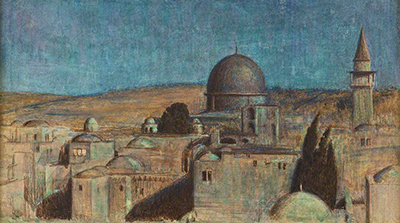
A great dome rises above clustered Jerusalem roofs while the sky changes from muted blue to a faint warm glow. The inherited image on this page matches the Bridgeman Images record[1] for William Holman Hunt's watercolour The Holy City: The Mosque As Sakrah by Moonlight. The agency dates it about 1854, records watercolour on paper, measures it at 20 × 35.3 cm and credits Gallery Oldham. A direct museum catalogue entry or accession number has not yet been verified, so the date and location are reported with that source limitation.
The name in the historical title refers to the Dome of the Rock, the landmark at the centre of the view. UNESCO's account of the Old City[2] names the monument and describes its seventh-century origins. “Mosque As Sakrah” is retained here as part of the work's recorded title, not offered as the preferred current name for the building. The painting is a view of a living city and an Islamic monument, even though Hunt also came to Jerusalem seeking places associated with Christian scripture.
At a Glance
- ArtistWilliam Holman Hunt (1827–1910)
- TraditionBritish Pre-Raphaelite art
- Work or subjectThe Holy City: the Dome of the Rock by Moonlight
- ContextIllustrated paintings guide
- Further readingArtist biography
A skyline built in layers
Look first at the low, nearly continuous band of rooftops. Small domes, pale walls and shadowed passages gather beneath the broad, darker cupola. The monument's round form is easy to identify, yet it occupies only part of the composition. Its prominence depends on the city around it: the closer buildings make a stepped route for the eye, and their small scale gives the central dome its weight. A slender minaret near the right edge supplies a second vertical accent.
The view is neither an empty architectural elevation nor a panorama in which every building receives the same attention. In the reproduction, windows and openings punctuate the lower half with tiny notes of light. Dark trees or foliage interrupt the pale masonry. These details keep the foreground active while the dome remains still. Hunt's framing lets the viewer sense Jerusalem as a dense network of buildings rather than a single sacred landmark isolated from its surroundings.
Colour carries much of the transition. Blue and violet in the upper sky meet warmer pink and grey near the horizon. The buildings below share those restrained tones; no hard daylight divides one wall from another. The title says “by Moonlight”, but the visible reproduction does not establish the moon's position or a precise hour. The effect is a subdued atmosphere in which forms emerge slowly. It is safer to describe what can be seen than to reconstruct an undocumented night session.
The wide, low format is part of this effect. At 20 × 35.3 cm in the agency's dimensions, the sheet is substantially wider than it is high. That span gives room for the buildings to continue on either side of the central dome. A tall, narrow view could have isolated the monument; Hunt's horizontal field makes the surrounding skyline essential to the subject. The modest physical size also asks for close viewing, where small shifts of wash and line can matter as much as the silhouette.
Watch: William Holman Hunt
Begin with Hunt’s paintings, then place his work alongside two fellow Pre-Raphaelite founders.
William Holman Hunt Paintings
An overview of Hunt’s paintings from TheHistoryOfArt video archive.
Watch on YouTubeHunt in Jerusalem
Hunt travelled east in 1854 to study places that he believed would inform his religious painting. His journey took him through Egypt and into Jerusalem and the Dead Sea region. Christie's account of three surviving Jerusalem drawings[3] includes a drawing inscribed June 1854, which anchors his presence in the city during the year proposed for this watercolour. It does not date this particular sheet to June, nor prove that the finished wash was made entirely outdoors.
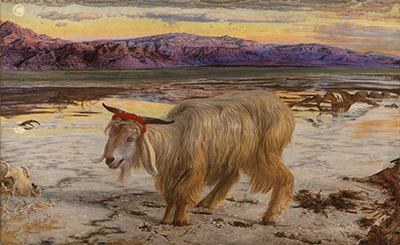
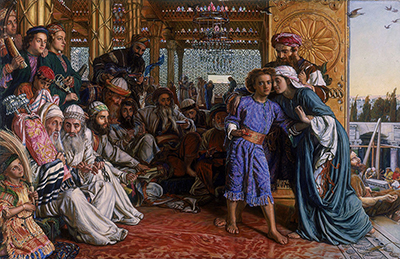
The journey also fed The Scapegoat and The Finding of the Saviour in the Temple. Those larger works use observed settings in constructed religious scenes. This sheet asks for a different kind of attention. Its main subject is the city's architecture and shifting light, with no biblical episode placed before the viewer. Smarthistory's account of the 1854 journey[4] explains Hunt's commitment to direct looking, but that general commitment does not reveal this watercolour's exact vantage point or sequence of studio work.
Hunt's Jerusalem views therefore need to be read as both observation and selection. He chose the skyline, the monument and the moment of changing colour. Viewers should also remember that the Dome of the Rock had its own continuing religious life, distinct from the Christian stories that motivated much of Hunt's travel. The sheet's quiet emphasis on the building allows that setting to remain visible in its own right.
A title shared by more than one study
The name can cause a catalogue mix-up. A published illustration list from Cambridge University Press[5] identifies another Hunt watercolour and bodycolour, The Mosque As Sakreh, Jerusalem, during Ramazan, dated 1854 and associated there with the Whitworth Art Gallery. That is not the Gallery Oldham moonlight image reproduced here. The Whitworth wording names a Ramadan setting; the present title names moonlight. Similar spellings of Sakrah or Sakreh point to the same monument, not necessarily to the same sheet.
The distinction matters because titles, owners and materials can travel separately through image catalogues. For this page, the strongest object-level evidence remains Bridgeman's record for the 20 × 35.3 cm Gallery Oldham-credited watercolour. A retail reproduction listing[6] repeats that credit, although its date display is inconsistent between the heading and a field marked “Undated”. The approximate c.1854 date is therefore useful context rather than a claim of precise execution.
Return to the image from the minaret at right to the broad dome, then down through the smaller rooftops. The composition gives each element a different scale and degree of light. In a small sheet, Hunt made an expansive city view without letting the celebrated monument erase its urban surroundings. The surviving reproduction permits that close look; the original paper, colour and present display access would require confirmation from Gallery Oldham.
UNESCO's account of Jerusalem's Old City places the Dome of the Rock among its many historic monuments and notes the city's importance to Judaism, Christianity and Islam. That broader setting helps explain why the watercolour should be introduced as a Jerusalem city view rather than as a detached illustration of Hunt's Christian projects. The nineteenth-century wording “Mosque As Sakrah” remains part of the recorded artwork title, while the modern landmark name helps readers identify what is pictured. Neither source gives Hunt's exact rooftop vantage point or the position of the moon. The art object and the living monument can be named accurately without treating a place shared by several traditions as merely a backdrop for one painter's journey. [2]
Discussion
Look closely at The Holy City: the Dome of the Rock by Moonlight, then compare your reading with the documented history.
Reader Insights
Which detail in The Holy City: the Dome of the Rock by Moonlight most affects your reading?
How do the date, medium and collection records shape that interpretation?
What remains uncertain about this work or its history?
Join the Conversation
Share a close observation or a source-backed question about The Holy City: the Dome of the Rock by Moonlight. The prompts above are starting points for discussion.
References
- Bridgeman Images record. View source.
- UNESCO's account of the Old City. View source.
- Christie's account of three surviving Jerusalem drawings. View source.
- Smarthistory's account of the 1854 journey. View source.
- published illustration list from Cambridge University Press. View source.
- retail reproduction listing. View source.