 by Tom Gurney
Tom Gurney BSc (Hons) is an art history expert with over 20 years experience
Published on June 19, 2020 / Updated on October 19, 2026
Email: tomgurney1@gmail.com / Phone: +44 7429 011000
Little Nell and Her Grandfather
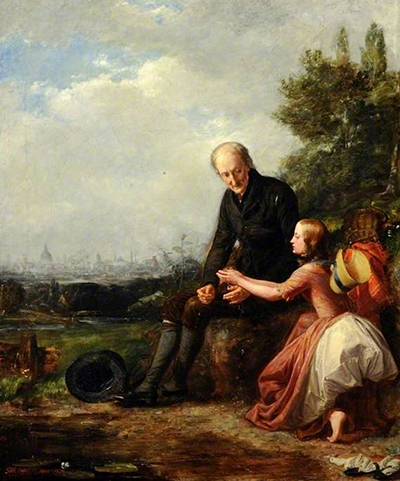
A young girl kneels beside an exhausted older man on a rise above London. She turns towards him, while he looks down at his hands. A dark hat lies on the ground, a small bundle rests by the girl, and the city's skyline recedes behind them. William Holman Hunt's Little Nell and Her Grandfather is an 1845 oil painting, 111.1 × 99 cm, now held by Sheffield Museums as VIS.21, according to its Art UK object record[1]. It takes its two travellers from Charles Dickens's The Old Curiosity Shop, but leaves the viewer room to read their immediate exchange.
A scene from Dickens
Dickens's novel appeared in Master Humphrey's Clock during 1840–41, as the Charles Dickens Museum's collection record[2] confirms. Nell and her grandfather leave London and become dependent on one another as they travel. In chapter 15[3], they pause in a field after passing beyond the built-up streets. Dickens describes a hill from which St Paul's may be seen above the city's smoke, and then shows Nell attending to the old man's needs. Hunt chooses this kind of moment: a pause, a view back, and a quiet act of care.
At a Glance
- ArtistWilliam Holman Hunt (1827–1910)
- TraditionBritish Pre-Raphaelite art
- Work or subjectLittle Nell and her Grandfather
- ContextIllustrated paintings guide
- Further readingArtist biography
The painting is an interpretation of the literary scene, not a map of the novel's journey. The dome rising from the distant buildings recalls Dickens's description of St Paul's, but the precise hill in either the book or painting is uncertain. An LSE study of Nell's route[4] discusses Parliament Hill as a plausible location while treating the route as a reconstruction. The distant city matters here because the pair have physically left it yet cannot simply erase what happened there.
Hunt sets the figures close enough for their hands and expressions to become the focus. Nell's pink dress and light sleeves stand out against the man's black coat. The girl is lower than he is, but she is the active figure: she kneels and reaches towards him as he sits with his shoulders bent. Their posture reverses an expected arrangement in which an adult confidently leads a child. In Dickens's story the grandfather needs Nell's practical help, and this visual exchange makes that dependency immediately legible.
Resting above the city
The foreground has little of the comfort of a furnished home. The hat is set aside near the man's feet; Nell's belongings seem gathered behind her; bare earth fills the strip nearest the viewer. These details suggest travel interrupted, rather than a planned outing. Hunt allows a wide area of sky over the two figures. Trees on the right shelter them partly, while the open view on the left keeps London present. The different spaces give the painting a gentle tension between temporary refuge and the distance still to go.
The old man's face and hands are more subdued than Nell's bright sleeves. His seated pose draws the eye downwards, but the girl's movement carries it back across the composition. Seen at small scale, the exact item or gesture between their hands is difficult to identify securely. What the reproduction does show is their attention to one another. A useful way to look at the picture is to move from Nell's outstretched arms to his hands, then out toward the dome and crowded roofs. The figures occupy a quiet foreground set against a much larger world.
Watch: William Holman Hunt
Begin with Hunt’s paintings, then place his work alongside two fellow Pre-Raphaelite founders.
William Holman Hunt Paintings
An overview of Hunt’s paintings from TheHistoryOfArt video archive.
Watch on YouTubeDickens's chapter gives Nell a specific sequence of care, including fetching water for her grandfather. The painting may call that passage to mind, yet it need not be treated as a literal illustration of a single sentence. Hunt combines a recognisable literary pair, the view of London and the signs of a journey into one still image. The scene makes viewers supply both what led to this pause and what the travellers will do next.
An early Hunt painting
The 1845 date places this work near the start of Hunt's public career and before the Pre-Raphaelite Brotherhood formed in 1848. The 1912 biographical account of Hunt[5] describes his early literary subjects and records a British Institution showing of Little Nell and Her Grandfather. A specialist artist reference[6] also records that showing, though the two sources differ on its exact year. The securely dated painting can be understood as an early literary work without forcing a disputed exhibition date into its story.
Hunt would later build elaborate scenes from Shakespeare, Keats, religious texts and closely observed settings. The Flight of Madeline and Porphyro and Rienzi show how literary material remained important as his practice developed. Little Nell has a simpler structure: two figures, a handful of travel objects and an encompassing landscape. It is more helpful to see the difference as a change across his career than to demand that this 1845 canvas already display every feature of his later pictures.
Dickens's story was illustrated by several artists. The Charles Dickens Museum's George Cattermole watercolour[2] places Nell and her grandfather inside the shop, while a serial engraving by Hablot Knight Browne[7] depicts the travellers resting outside. These are separate objects, with their own compositions and dates. Hunt's oil fixes on the relationship between child and grandfather against a broad view of the city they have left behind.
The Sheffield object
The Sheffield Museums-linked Art UK record[1] identifies the painting as accession VIS.21, a gift from J. G. Graves in 1935. Its 111.1 × 99 cm canvas is substantially larger than the inherited 400-pixel reproduction suggests. The record does not establish where within the museum service the original is displayed today, so this page makes no promise about seeing it on a current visit. The reproduction is useful for reading the composition, even though it cannot settle every small detail of the hands or surface.
Look first at the contrast between the girl's movement and the man's fatigue. Then notice how the hat, bundle and bare ground turn their meeting into a pause on a longer journey. Finally, let the eye travel toward St Paul's in the distance. Hunt's painting holds together Dickens's public city and the pair's private need for care, at a moment when leaving one place has not yet meant finding another.
Discussion
Look closely at Little Nell and her Grandfather, then compare your reading with the documented history.
Reader Insights
Which detail in Little Nell and her Grandfather most affects your reading?
How do the date, medium and collection records shape that interpretation?
What remains uncertain about this work or its history?
Join the Conversation
Share a close observation or a source-backed question about Little Nell and her Grandfather. The prompts above are starting points for discussion.
References
- Art UK object record. View source.
- Charles Dickens Museum's collection record. View source.
- chapter 15. View source.
- LSE study of Nell's route. View source.
- 1912 biographical account of Hunt. View source.
- specialist artist reference. View source.
- serial engraving by Hablot Knight Browne. View source.