


 by Tom Gurney
Tom Gurney BSc (Hons) is an art history expert with over 20 years experience
Published on June 19, 2020 / Updated on October 19, 2026
Email: tomgurney1@gmail.com / Phone: +44 7429 011000
Morning Prayer
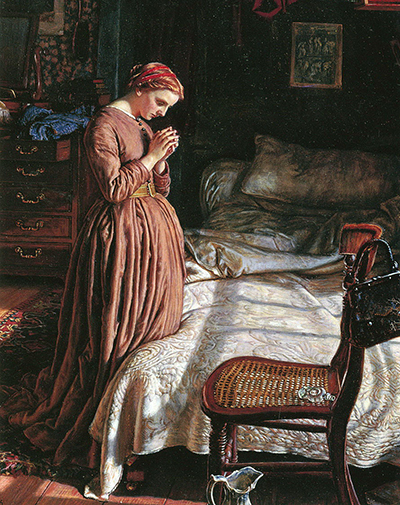
A young woman kneels at the side of an unmade bed, her hands clasped close to her face. She is still in the privacy of a bedroom, before the ordinary tasks of the day have begun. William Holman Hunt's painting is called Morning Prayer in the artist's own illustrated memoir and in later scholarship. Some older listings call this picture “Morning Hunt”, but that is not a documented title for the pictured work. Hunt's small interior is best approached through the quieter action it actually shows: a woman pausing to pray. [1] [2]
A private act in an ordinary room
The woman is to the left of the bed rather than at its centre. Her bowed head, lowered eyelids and joined hands make the prayer legible without a book or a visible church setting. A striped head covering frames her face, while the long dress extends toward the floor. Hunt places her against dark furniture and wall, then gives the bed linen an expanse of pale, rumpled light. The visual contrast makes the figure and the place of rest feel connected: she has risen into a moment of devotion while the room still bears the signs of sleep.
At a Glance
- ArtistWilliam Holman Hunt (1827–1910)
- TraditionBritish Pre-Raphaelite art
- Work or subjectMorning Prayer
- ContextIllustrated paintings guide
- Further readingArtist biography
At the front stands a cane-backed chair. Clothing or fabric hangs over it; a small jug sits near its legs on the floor. These things have no need to function as fixed religious emblems. They persuade us that this is a used bedroom, not a stage stripped for a moral lesson. Hunt's detailed painting rewards a second look at the bedcover, wooden drawers, wall picture and jug. Each object locates the prayer in daily life. The intimate setting is part of the work's force: the viewer encounters an action that is usually unseen by anyone outside the room.
The woman does not look out at us. Her inward attention contrasts with our position as observers. That relation can be uncomfortable as well as tender: the picture allows a spectator into someone else's private space. Hunt leaves her words unheard and does not specify what she asks or thanks God for. He shows the physical form of devotion while withholding its private content. The title directs our understanding, but the image itself stops short of explaining her mind.
Light, fabric and enclosure
The pale bedcover catches the strongest light. It folds across the mattress and drops toward the floor, interrupting the dark verticals of the surrounding furniture. The woman's reddish dress also stands out against the room, though its colour is quieter than the white sheets. Hunt uses these contrasting areas to guide the eye from the bed to the praying figure and back. The light does not need to be assigned a precise source, such as a particular window outside the frame, to do this compositional work.
The limited space matters. A large landscape could turn prayer into an emblem of human smallness before nature; this room makes it a habit performed among familiar possessions. The pictured objects also complicate any easy contrast between spiritual and material life. Devotion occurs beside the bed, chairs, fabric and vessel, not beyond them. Hunt's close description makes the everyday visible at the same time as the religious act.
Watch: William Holman Hunt
Begin with Hunt’s paintings, then place his work alongside two fellow Pre-Raphaelite founders.
William Holman Hunt Paintings
An overview of Hunt’s paintings from TheHistoryOfArt video archive.
Watch on YouTubeThe reproduction is small, so details that are clear in a larger image or the original may be harder to settle here. It is safer to say that a framed picture hangs above the bed than to identify its subject without a reliable catalogue record. Likewise, the folds and dark shapes around the chair can be described as clothing or cloth without assigning each garment to the kneeling woman. The strongest reading rests on what the image makes clear: the posture, bed and lived-in domestic setting.
Why the title changed
Recent research by Elena Cooper found that an 1867 copyright registration by Agnew & Sons used the title Devotion for the painting now known as Morning Prayer. The change is informative. “Devotion” names a broad state or virtue; “Morning Prayer” names a more specific action and time. Neither tells us the woman's identity or the content of her prayer. Both draw a viewer towards the same kneeling figure. The record shows how a painting's name could shift as it was sold, reproduced and discussed. [2]
Cooper's study also reports 1867 copyright transfers involving Joseph Morby and Agnew & Sons. These entries establish a history of reproduction rights. They should not be treated as a complete chain of physical ownership of the painting. The distinction is useful for Hunt, whose pictures circulated through prints and photographs as well as through exhibitions and sales. Morning Prayer reached audiences in several forms; the illustration in the painter's memoir is one record of that afterlife. [2] [1]
Date and surviving records
The painting's exact date is less settled than its subject. A nineteenth-century Christie, Manson & Woods sale catalogue for Sir John Fowler's collection, dated 6 May 1899, listed Morning Prayer as an 1866 work on panel, measuring 9¼ × 7 inches. A later illustrated caption instead gives 1859 and calls the medium canvas. These disagree on both date and support. The 1899 catalogue is a valuable historical object description, but it does not by itself prove every later account wrong. For now mid-1860s, often dated 1866 is a more candid description than a falsely precise date. [3] [4]
The 1899 catalogue shows that the painting was offered within Fowler's collection at that time. It does not settle its present location. A handwritten note by the lot in the surviving scan should not be converted into a buyer attribution without a corroborating sale result. We can follow the title and image with more confidence than we can follow every move of the object. That limitation is especially important for a small painting whose reproductions have circulated under more than one date and name.
Return to the woman's clasped hands after looking around the room. Hunt made the act of prayer identifiable, then surrounded it with a bed that has just been used and objects that will be used again. The title's history and uncertain date belong to the painting's documentary life. Its central image remains simple and particular: a person at the beginning of a day, absorbed in a private act while the visible world waits around her.
Discussion
Look closely at Morning Prayer, then compare your reading with the documented history.
Reader Insights
Which detail in Morning Prayer most affects your reading?
How do the date, medium and collection records shape that interpretation?
What remains uncertain about this work or its history?
Join the Conversation
Share a close observation or a source-backed question about Morning Prayer. The prompts above are starting points for discussion.
References
- Hunt, Pre-Raphaelitism and the Pre-Raphaelite Brotherhood , revised 1914 illustration. View source.
- Elena Cooper, Burlington Magazine accepted manuscript. View source.
- Christie's 1899 Fowler sale catalogue, lot 57. View source.
- Victorian Web, conflicting illustrated caption. View source.







