


 by Tom Gurney
Tom Gurney BSc (Hons) is an art history expert with over 20 years experience
Published on June 19, 2020 / Updated on October 19, 2026
Email: tomgurney1@gmail.com / Phone: +44 7429 011000
New College Cloisters: John David Jenkins
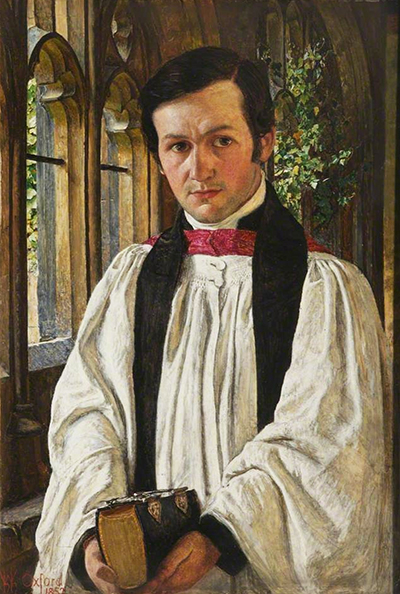
John David Jenkins stands in a Gothic passage holding a dark, gilt-edged book. Light catches his white sleeves and surplice; black clerical garments form a long shape down the middle of the picture. Through the arches at his side, we glimpse daylight, while ivy grows behind his head. This is William Holman Hunt's New College Cloisters, a portrait painted in 1852 and now held by Jesus College, Oxford. The college's history of its portraits[1] names Jenkins, identifies the setting and explains why his clothing and the architecture mattered to its first viewers.
The setting and the sitter
The title names a real place: the cloisters of New College, Oxford. Jenkins was a clergyman and had served as a scholar and Fellow at Jesus College. The college history says he was chaplain at New College, making the setting closely connected to him. Hunt does not place him against a neutral studio wall. The pointed openings and stonework give the figure a setting with a distinct religious past, while the light beyond them keeps the narrow passage from feeling enclosed. [1]
At a Glance
- ArtistWilliam Holman Hunt (1827–1910)
- TraditionBritish Pre-Raphaelite art
- Work or subjectNew College Cloisters: John David Jenkins
- ContextIllustrated paintings guide
- Further readingArtist biography
Jenkins's face is carefully observed. He looks directly out, with dark hair and a composed, questioning expression. Hunt has not made him simply an emblem of a church movement; the figure has the alert presence of an individual sitter. At the same time, the portrait's surroundings and dress tell us what public role Jenkins occupied. The tension between personal likeness and chosen signs is central to the picture. We meet a young man, then begin to read the clothing and architecture around him.
The photograph used here shows the painting's compact vertical format. Within that narrow space Hunt balances the almost symmetrical white sleeves against the asymmetry of arches, stone and greenery. The hands and book anchor the lower part of the composition. The red at the neck adds a small warm accent among white, black and grey. Each area is sharply distinguished, but the figure remains firmly within the space rather than pasted over it.
Vestments, Bible and Gothic architecture
Jesus College reads the black cassock, white surplice, academic hood and tippet as the robes favoured by the Tractarian movement within Anglicanism. The tippet is the long black clerical silk visible down Jenkins's front. The gilt-edged Bible he holds is, in the college's account, another sign of Tractarian taste for ornament in worship. These are more than attractive textures for Hunt to paint: they made Jenkins's High Anglican identity legible in the 1850s. [1]
The Gothic cloister contributes to that reading. The college connects New College's architecture and pre-Reformation associations with the Tractarians' interest in the earlier English church. Stone arches repeat behind Jenkins and lead the eye into depth; their historical character gives the young clergyman a setting larger than his own moment. The portrait therefore does not need an invented dramatic action. Standing in this place, dressed as he is and holding the book, Jenkins conveys a set of convictions through concrete details.
Watch: William Holman Hunt
Begin with Hunt’s paintings, then place his work alongside two fellow Pre-Raphaelite founders.
William Holman Hunt Paintings
An overview of Hunt’s paintings from TheHistoryOfArt video archive.
Watch on YouTubeIvy frames the right side of his head. It also softens the masonry and gives the portrait a living element. Jesus College explains that ivy could signify friendship in Victorian flower language, connecting sitter and artist, and that some scholars read its persistence as an allusion to Tractarian endurance within the Church of England. These interpretations belong to the college's account; a viewer can first see what the plant does pictorially, joining the dark background to Jenkins's head and giving a small burst of green beside the stone. [1]
The college suggests a further meaning for that friendship: fellowship with other Christians who condemned Tractarians as supporters of Rome. In this reading, ivy joins a disputed religious identity to an appeal for continued attachment within the church. It is a more specific claim than calling the plant a general symbol of loyalty. The portrait does not prove that every viewer in 1852 would have read it that way; it shows how a small natural detail could carry several meanings in the circle for which Combe commissioned the work. [1]
Commission and later life
Thomas Combe commissioned the portrait. His widow Martha Combe bequeathed it to Jesus College in 1893, long after Jenkins's death. The college's account puts this painting within both an Oxford religious circle and the history of its own portrait collection. It is not a portrait of a later officeholder made after his career was established; it captures Jenkins at an early point, in the year Jesus College assigns to the painting. [1]
Jenkins's life extended well beyond this cloister. The Dictionary of Welsh Biography[2] records that after his ordination in October 1852 he went to the Cape of Good Hope and then Natal, where he served for several years. Back in Oxford, he devoted attention to railway workers and became known for that work. In 1870 he became vicar of Aberdare, where he died in 1876. These events help identify the man, but they came after Hunt painted him. The picture shows a young clergyman in the Oxford setting associated with his early ministry.
Read the portrait from his face to the Bible, then across the white sleeves to the arches and ivy. Hunt's exactness makes each object available for close looking, while the college's records connect those visible things to a particular person, place and religious debate. The result is both a likeness of John David Jenkins and a deliberately situated image of his beliefs in 1852.
Combe's involvement also connects this Oxford portrait to Hunt's wider circle of religious patronage. He owned the original Light of the World, which Martha Combe later gave to Keble College; she separately left the Jenkins portrait to Jesus College. The two works address religion in different ways: one presents Christ at a symbolic door, while the other places a named clergyman in robes and an identifiable Oxford cloister. Their separate college destinations and subjects matter as much as their shared patrons. Following them together shows how a family's support of Hunt could result in distinct pictures with distinct later public histories. [1] [3]
Discussion
Look closely at New College Cloisters: John David Jenkins, then compare your reading with the documented history.
Reader Insights
Which detail in New College Cloisters: John David Jenkins most affects your reading?
How do the date, medium and collection records shape that interpretation?
What remains uncertain about this work or its history?
Join the Conversation
Share a close observation or a source-backed question about New College Cloisters: John David Jenkins. The prompts above are starting points for discussion.
References
- The college's history of its portraits. View source.
- Dictionary of Welsh Biography. View source.
- Keble College, Light of the World. View source.







