


 by Tom Gurney
Tom Gurney BSc (Hons) is an art history expert with over 20 years experience
Published on June 19, 2020 / Updated on October 19, 2026
Email: tomgurney1@gmail.com / Phone: +44 7429 011000
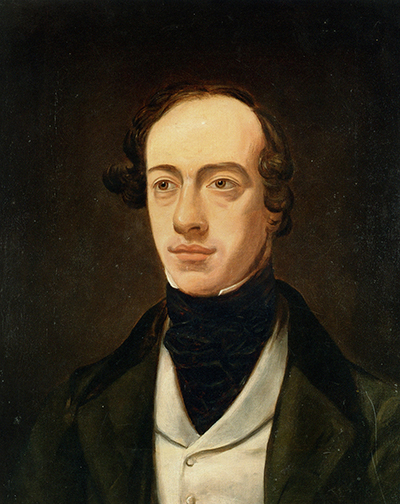
Portrait of William Pink
A young man faces us against a nearly black background. His light waistcoat and face emerge from the dark coat and high black cravat, with no room or possessions to identify him. This is William Holman Hunt's Portrait of William Pink, an early work probably made around 1842–43. The 2008 Sotheby's catalogue[1] reproduces the same image as this page and provides the fullest accessible account of the object, its old label and its family history.
What can the portrait tell us?
Hunt concentrates on Pink's head and upper body. The face is smooth and carefully lit, with the eyes meeting the viewer's direction but not fixing us in a theatrical stare. Dark curls frame a high forehead. A narrow line of white collar separates the flesh from the black cloth at the neck. Below it, the pale waistcoat creates a second light area and gives the sitter a stable triangular shape. The plain background offers no setting to compete with these features.
At a Glance
- ArtistWilliam Holman Hunt (1827–1910)
- TraditionBritish Pre-Raphaelite art
- Work or subjectPortrait of William Pink
- ContextIllustrated paintings guide
- Further readingArtist biography
The portrait is restrained beside Hunt's later pictures crowded with meaningful objects. Here the clothing, pose and exact facial features have to do the work. Light picks out the bridge of the nose and the planes around the eyes, while the cheeks and chin turn gently towards shadow. These are observations a viewer can make from the reproduction; they do not by themselves establish Pink's character, profession or relationship to the artist. The painting gives a likeness, not a written biography.
Sotheby's describes its material as oil on canvas laid on panel. That wording matters because it records the present construction, rather than simplifying the work to either a canvas or a panel alone. The catalogue also discusses its condition, but the small image here is not a reliable basis for judging old repairs. The useful visible point is how Hunt sets the face and light waistcoat against a deep brown-black field. From a distance, the sitter is immediately legible; closer viewing brings out the small adjustments in the eyes, mouth, hair and cravat.
Pink's identity and the date
An old label attached to the reverse identifies the sitter as William Pink, calls him Hunt's cousin, and says the portrait was painted “about 1842.” Sotheby's transcription[1] is valuable documentary evidence for the work's traditional identification. It is a label on the back of the picture, however, not a dated signature on the painted surface. The catalogue judges that Hunt may have painted Pink in 1842, or more likely 1843. Describing the work as c.1842–43 preserves that uncertainty.
The same catalogue cites art historian Judith Bronkhurst, whose catalogue raisonné lists the painting as number 8 in volume I. Her assessment, as Sotheby's reports it, is that this was almost certainly Hunt's earliest surviving portrait commission. The wording is careful: it does not mean Hunt had never drawn or painted another person's likeness. Sotheby's notes that portraits of Old Hannah and Henry Pollard have been lost. What survives can suggest a beginning without providing a complete record of every work the young artist attempted.
Watch: William Holman Hunt
Begin with Hunt’s paintings, then place his work alongside two fellow Pre-Raphaelite founders.
William Holman Hunt Paintings
An overview of Hunt’s paintings from TheHistoryOfArt video archive.
Watch on YouTubeWho was William Pink beyond the name on the label? Bronkhurst proposed that he was a man recorded in an 1840s London directory as a moulder and figure maker at 31 Mary Street, Hampstead Road. Sotheby's reports the proposal rather than a conclusive match. It also describes a family Bible kept by descendants, which records a William Pink born on 22 January 1809 to James and Elizabeth Pink and christened at New Broad Street Independent Chapel. These sources give a plausible historical person to investigate. They should not be turned into a confident occupational or family story that the surviving portrait cannot prove by itself. [1]
Before the Pre-Raphaelite Brotherhood
This was a young Hunt's work. Born in 1827, he would have been in his mid-teens if the c.1842–43 dating is right. The National Portrait Gallery's Hunt biography[2] places the founding of the Pre-Raphaelite Brotherhood in 1848, several years later. The portrait therefore belongs to an earlier stage of his practice. It need not be squeezed into the later movement's name to be interesting: its close attention to a single face already shows an artist testing how much a portrait can convey through looking.
That chronology also guards against reading later fame back into the sitter. The picture was made before The Light of the World and The Awakening Conscience, both shown in 1854. Pink was not posing for the celebrated elder artist known from those works. The sparse format and direct likeness invite us to see what the young painter could do with an individual in front of him, a dark ground and a limited range of dress colours.
Provenance and what remains unknown
Sotheby's traces the portrait by descent through Pink's family to Simon Webb of Macclesfield. It then lists a Phillips sale in Chester on 21 June 2001 and a private collection in the work's subsequent provenance. The Sotheby's listing is from 2008. These records establish parts of the painting's journey after Hunt made it; they do not establish who owns it or where it is displayed today. [1]
The old reverse label, the family record and Bronkhurst's research make this more than an anonymous early portrait. At the same time, each source has a different force: the label names the sitter and a rough date; the Bible supplies possible family information; a directory suggests an occupation; the auction record traces recent ownership. Looking at the painted face, we can appreciate Hunt's concentrated attention while keeping those documentary layers distinct.
Compare Pink's dark-background likeness with Hunt's self-portrait at about fourteen. Both belong to the painter's early-1840s work and bring a face forward with a limited range of colour. But the Ashmolean image includes the young artist at an easel, while Pink's portrait makes no visible claim about the sitter's trade. That difference cautions against reading the proposed directory occupation into the picture itself. It also gives the old reverse label a precise role: it helps name the man, whereas the light, pose and clothing show how Hunt chose to portray him. [1] [3]
Discussion
Look closely at Portrait of William Pink, then compare your reading with the documented history.
Reader Insights
Which detail in Portrait of William Pink most affects your reading?
How do the date, medium and collection records shape that interpretation?
What remains uncertain about this work or its history?
Join the Conversation
Share a close observation or a source-backed question about Portrait of William Pink. The prompts above are starting points for discussion.
References
- 2008 Sotheby's catalogue. View source.
- National Portrait Gallery's Hunt biography. View source.
- Art UK, Ashmolean self-portrait. View source.







