


 by Tom Gurney
Tom Gurney BSc (Hons) is an art history expert with over 20 years experience
Published on June 19, 2020 / Updated on October 19, 2026
Email: tomgurney1@gmail.com / Phone: +44 7429 011000
Sir Richard Owen
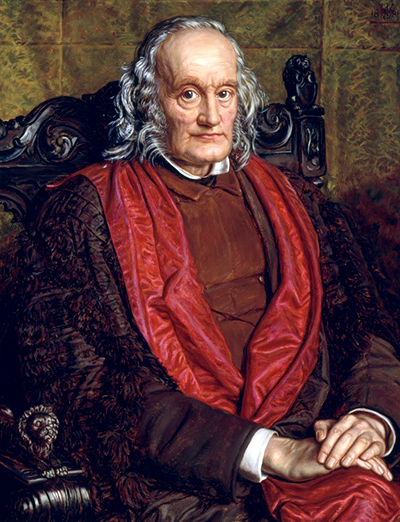
Sir Richard Owen sits forward in a carved armchair, his hands brought together before him. A dark gown covers much of his body, while brilliant red fabric behind the chair gives the portrait its strongest colour. Hunt painted the naturalist in 1881, the year the British Museum's new natural history building opened in South Kensington. A 1935 notice in Nature[1] identifies the sitter, artist and date, and says Owen wore Hunter's gown for the portrait. The painting is associated with the Natural History Museum, London, where Owen had played a decisive part in establishing the institution.
Looking at the portrait
The face is the centre of attention. Light falls across Owen's forehead, nose and white hair, while the dark gown makes his head appear still brighter. His posture is formal but not rigid. The hands meet low in the picture, forming a second point of focus that keeps the seated figure from becoming only a head against a backdrop. The chair's carved arm and the folds of cloth give Hunt several contrasting surfaces to paint: skin, hair, wood, dark fabric and red drapery.
At a Glance
- ArtistWilliam Holman Hunt (1827–1910)
- TraditionBritish Pre-Raphaelite art
- Work or subjectSir Richard Owen
- ContextIllustrated paintings guide
- Further readingArtist biography
The gown signals Owen's connection with the Hunterian Museum at the Royal College of Surgeons. The Natural History Museum's account of Owen's papers[2] says he began as an assistant to William Clift there and later succeeded him as conservator. Dress here is therefore part of the sitter's professional identity. Hunt also lets the viewer meet Owen as a particular older man, with a composed expression and a direct, appraising gaze. The contrast between the scarlet cloth and the restrained figure brings ceremony into the picture without turning the sitter into an anonymous emblem of science.
The portrait rewards attention to the space around Owen. A dark vertical area closes the composition behind his head; the brighter wall and red drapery separate the figure from that background. His body occupies most of the canvas, with little room for laboratory equipment or scientific specimens. Hunt relies on likeness, posture and gown to convey authority. That choice makes this a portrait of the person who helped build an institution, rather than an illustration of a particular scientific discovery.
Owen and the museum
Owen was a comparative anatomist and palaeontologist whose career ran across much of the nineteenth century. The Natural History Museum[2] calls him a leading figure in those fields and notes that he coined the word dinosaur. Its archive also records his campaign for a separate museum of natural history. The building opened to the public on 18 April 1881; Owen's portrait was painted in that same year. These two dates connect the picture with an institutional change he had long advocated, although the portrait itself does not show the new museum.
The title attached to Owen's office needs care. He was superintendent of the British Museum's Natural History Departments, serving from 1856 to 1884, according to Nature's 1935 account[1]. The notice says he had substantial influence over the new building's planning and allocation of rooms, and was in charge when it opened. It also points out that the familiar description of him as the museum's “first director” is technically inaccurate. His documented role as superintendent is substantial enough without changing its name.
Watch: William Holman Hunt
Begin with Hunt’s paintings, then place his work alongside two fellow Pre-Raphaelite founders.
William Holman Hunt Paintings
An overview of Hunt’s paintings from TheHistoryOfArt video archive.
Watch on YouTubeOwen's scientific reputation was formidable and contested. The Museum's account notes both his contributions to comparative anatomy and his strong opposition to Darwin's explanation of natural selection. That debate belongs to the history of science; Hunt's portrait does not visibly take a side in it. Its emphasis falls instead on Owen's presence and professional standing at a moment when the collections he championed gained a purpose-built home.
Exhibition and later history
The Dictionary of National Biography account of Owen[3] records that Hunt's portrait was exhibited at the Grosvenor Gallery in 1881. This places it before a contemporary art audience, as well as within the history of the museum with which Owen is now associated. Hunt is best known for elaborate literary and religious pictures, yet this work shows his powers of observation directed to an individual sitter.
The painting reached the museum decades later. In 1935, Nature reported that Hunt's son Cyril B. Holman-Hunt had bequeathed the portrait to the trustees of the British Museum. It had been in the possession of the artist's daughter, Mrs Joseph, and was temporarily on loan to the Athenaeum before the transfer. The notice described it hanging near the entrance to the Natural History Museum's Central Hall at that time. That is a record of its 1935 placement, not a promise that visitors will find it in the same position today. [1]
Look again at Owen's face after following this history. The portrait belongs to the year of the museum's opening, but its long route into the collection was shaped by Hunt's family. The gown, seated pose and vivid red backdrop make Owen's professional status visible; the observed features and quietly joined hands keep the man himself in view.
One portrait among many likenesses
The National Portrait Gallery's specialist inventory identifies Hunt's oil as a work exhibited at the Grosvenor Gallery's summer exhibition in 1881, with catalogue number 44. It also lists portraits of Owen by other artists, as well as drawings, photographs, busts and a later statue. This wider record matters because Owen's familiar public image was not made by Hunt alone. The museum portrait has a particular combination of seated body, Hunterian gown and red setting; another likeness or a sculpture should not be used to infer details absent from Hunt's canvas. [4]
The inventory is also a reminder that art and institutional commemoration moved at different speeds. Hunt's picture was available to a Grosvenor audience in the year the new natural history building opened, yet the 1935 notice documents its arrival at the museum more than fifty years later. The portrait could represent Owen's professional authority before it became part of the museum's own display of its past. Its later placement near the Central Hall was one stage in that history, while a current visitor would need the museum's latest information to know where it is displayed now. [4] [1]
Discussion
Look closely at Sir Richard Owen, then compare your reading with the documented history.
Reader Insights
Which detail in Sir Richard Owen most affects your reading?
How do the date, medium and collection records shape that interpretation?
What remains uncertain about this work or its history?
Join the Conversation
Share a close observation or a source-backed question about Sir Richard Owen. The prompts above are starting points for discussion.
References
- 1935 notice in Nature. View source.
- Natural History Museum's account of Owen's papers. View source.
- Dictionary of National Biography account of Owen. View source.
- National Portrait Gallery, Owen portrait inventory. View source.







