 by Tom Gurney
Tom Gurney BSc (Hons) is an art history expert with over 20 years experience
Published on June 19, 2020 / Updated on October 19, 2026
Email: tomgurney1@gmail.com / Phone: +44 7429 011000
Study of a Head
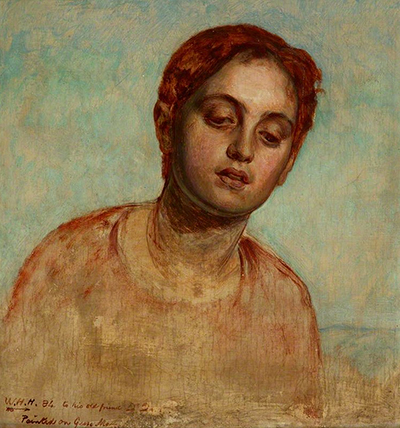
A young woman lowers her gaze against a pale blue-green ground. Her reddish hair is gathered close to her head, and the upper part of a light garment emerges from quick-looking strokes of cream and warm brown. William Holman Hunt's Study of a Head is a concentrated picture rather than one of his crowded biblical scenes. Art UK's collection record dates it to 1884, identifies its medium as oil on panel, gives its size as 33.5 × 30.7 cm, and places it at Manchester Art Gallery under accession 1920.6. The gallery purchased it from Leicester Galleries in 1920. [1]
A face without a named story
The title gives us a subject type, not a sitter. The Art UK record does not name the woman. Her downcast eyes and turned head can suggest thoughtfulness, fatigue or reserve, but the picture offers no action that would decide among those readings. There is no book, landscape or narrative prop to locate her in a particular role. That openness is part of the work's character: the viewer returns to the face and to the way it has been painted rather than following an illustrated story.
At a Glance
- ArtistWilliam Holman Hunt (1827–1910)
- TraditionBritish Pre-Raphaelite art
- Work or subjectStudy of a Head
- ContextIllustrated paintings guide
- Further readingArtist biography
The head inclines to one side, and the neck leads into a body that is only broadly established. Hunt gives the face more exact definition than the garment below. The dark eyes, lips and shadow under the chin are held against looser passages at the shoulders. This difference in finish creates a hierarchy of attention. The picture invites us to study the relation of features and expression, while the clothing and background keep the sitter present without competing for equal detail.
Reddish hair sets the strongest colour note. It forms a compact mass around the brow and ears, then meets the cooler ground. The face is neither a single flat flesh tone nor an idealised oval: light and shadow vary across forehead, cheek and throat. Even at reproduction size, these modulations help distinguish the young woman as a person observed closely. The panel's pale backdrop leaves room around her head but does not carry the eye away to another place.
What a “study” can tell us
Calling a work a study often suggests an artist experimenting with an expression, pose or colour relationship. Here the uneven finish makes that idea plausible. The lower area is much less fully worked than the head, so we can see a difference between the painter's sustained attention to the face and his abbreviated description of clothing. The effect is not the same as carelessness. A study can preserve the act of selecting what matters most for this attempt.
Yet the title does not prove that the panel prepared a known finished painting. The available collection-linked record does not connect it to a larger work, and no such relationship should be invented merely because Hunt made complex finished pictures elsewhere. The study can be considered on its own terms: an image that holds close looking and incomplete surroundings in balance. Its open edges allow the sitter's expression to remain the centre of attention.
Watch: William Holman Hunt
Begin with Hunt’s paintings, then place his work alongside two fellow Pre-Raphaelite founders.
William Holman Hunt Paintings
An overview of Hunt’s paintings from TheHistoryOfArt video archive.
Watch on YouTubeThis also makes it different from Hunt's named portraits. In Stephen Lushington, the judge sits with a book and furniture, and the National Portrait Gallery documents the family commission. In The Birthday, the sitter's identity and occasion are supported by the owning museum. For Study of a Head, comparable evidence is not supplied by the accessible object listing. The comparison shows how much a title and provenance can add to a picture, and how carefully they must be kept separate from what paint alone can tell us. [2] [3]
Collection identity and a common confusion
Manchester Art Gallery also holds another work titled Study of a Head by Alphonse Legros. It is an 1879 oil on canvas depicting Charles Napier Hemy. The duplicate title is a reminder that a generic name cannot establish an artwork's identity by itself. Hunt's 1884 oil on panel is the red-haired young woman shown here; the Legros work must not be folded into its history. [1] [4]
Some informal reproductions attach a personal name to Hunt's young woman. Without a collection record or reliable provenance for that claim, the responsible description is still an unnamed sitter. That restraint leaves the portrait open rather than empty. We can attend to the lowered gaze, the warm hair against the cool ground and the different degrees of finish. Those visible choices are enough to show Hunt exploring how a face can carry the weight of a picture, even when its story remains unknown.
Marks at the edge of the picture
The inherited reproduction shows dark writing at the lower left edge of Hunt's panel. The small web image is not clear enough to transcribe every word with confidence. It would be especially unsafe to turn a guessed reading into the sitter's name or a dedication. The collection-linked Art UK entry supplies the accepted title, date, medium and accession, but does not give a verified transcription in the evidence available here. A closer examination of the original or a museum record of its inscriptions would be needed before the writing could change this page's account of whom Hunt painted. [1]
Even without a transcription, the writing changes how the lower edge is seen. The head is worked with finer modelling; the shoulders and garment become broad, light passages; then the script sits against the pale paint near the bottom. It is a visible mark made within the object rather than a modern caption added beneath a reproduction. This sequence encourages looking at the panel as a made surface with decisions about finish and presentation. It does not prove that the words were added at the same moment as the face or that they explain the image's purpose. Such questions belong to object examination, not to inference from a small photograph.
The gallery acquired the panel in 1920, decades after its 1884 date. That interval tells us there is a later collecting history to investigate, but the recorded purchase from Leicester Galleries is only one documented step. It does not by itself identify the first owner, the circumstances of the sitter's visit or the reason the panel was offered for sale. Keeping those gaps visible is more useful than borrowing a story from another work titled Study of a Head. The 1884 Hunt panel can be approached through its particular face, colour, support and collection number while those biographical questions remain open. [1]
Discussion
Look closely at Study of a Head, then compare your reading with the documented history.
Reader Insights
Which detail in Study of a Head most affects your reading?
How do the date, medium and collection records shape that interpretation?
What remains uncertain about this work or its history?
Join the Conversation
Share a close observation or a source-backed question about Study of a Head. The prompts above are starting points for discussion.
References
- Art UK, Manchester Art Gallery object record. View source.
- National Portrait Gallery, Lushington record. View source.
- Fine Arts Museums of San Francisco, The Birthday. View source.
- Art UK, Legros object 205411. View source.