William Holman Hunt.jpg)
 by Tom Gurney
Tom Gurney BSc (Hons) is an art history expert with over 20 years experience
Published on June 19, 2020 / Updated on October 19, 2026
Email: tomgurney1@gmail.com / Phone: +44 7429 011000
The Festival of St Swithin
In The Festival of St Swithin (The Dovecot), William Holman Hunt makes pigeons and a garden shelter the subject of an ambitious oil painting. A bird perches on the roof's peak; others crowd the ledges and openings below. Behind them, trees and a heavy sky set the scene for unsettled weather. The 73 × 91 cm painting belongs to the Ashmolean Museum, Oxford (WA1894.5). Art UK's Ashmolean-supplied record dates it 1865–66, while a later exhibition-loan record uses the wider 1866–75 span. Both point to a work begun in Hunt's mid-1860s London years, though the published dating of its later handling is not uniform. [1] [2]
Pigeons in their own architecture
The shallow roof cuts across the picture, making a stage for birds seen at different heights and angles. The top pigeon presents its back and long tail, while birds along the lower edge turn, settle and tuck themselves close to the structure. Hunt asks us to inspect the difference between feather, metal, wood and foliage. Light catches the roof's ridges and the soft folds of plumage; the dark trees behind make the birds' pale and reddish forms more distinct. No human figure is needed to explain the action. The occupants of the dovecote are enough.
At a Glance
- ArtistWilliam Holman Hunt (1827–1910)
- TraditionBritish Pre-Raphaelite art
- Work or subjectThe Festival of St Swithin (The Dovecote)
- ContextIllustrated paintings guide
- Further readingArtist biography
The view is also deliberately crowded. A bird can overlap another, while the roof takes up much of the central field and leaves a relatively narrow strip of garden beyond. This is not an aerial inventory of a dovecote. It is a close view from near the level of the birds, so the structure feels like a lived-in place rather than background decoration. Even at the inherited image's small resolution, the difference between the alert bird above and those sheltered under the roof gives the composition a rhythm of exposure and cover.
A Sotheby's catalogue essay locates the dovecote in the back garden of Hunt's Tor Villas home at Campden Hill, London. A separate Sotheby's record for an unfinished portrait places Hunt at 1 Tor Villa in spring and summer 1866 and says he was then working on The Festival of St Swithin before travelling east again. That provides a firmer marker for the painting's early work, though it does not resolve the later 1866–75 catalogue range. Hunt studies a familiar urban garden with the same determination to register particular surfaces and creatures that he brought to distant landscapes. [3] [4]
The Ashmolean-supplied description in Art UK's full record adds a family collaboration: Hunt designed the composition for his sister Emily to paint. They began in 1865; she stopped, and he completed it the following year. The same account says Hunt bought the differing pigeons and the dovecote, and considered this his most highly finished picture. It does not tell us which surviving passages Emily painted or whether later retouching occurred. Her part in starting the work should be acknowledged without assigning a particular bird or patch of sky to her hand. [1]
Watch: William Holman Hunt
Begin with Hunt’s paintings, then place his work alongside two fellow Pre-Raphaelite founders.
William Holman Hunt Paintings
An overview of Hunt’s paintings from TheHistoryOfArt video archive.
Watch on YouTubeRain, a saint's day and a title
The name St Swithin, also spelled Swithun, belongs to a traditional English weather saying: rain on the saint's day was popularly taken to foretell a long run of wet days. The Met Office explains the proverb as weather lore rather than a reliable rule. In Hunt's title it gives the looming sky and sheltering birds a playful seasonal frame. The picture does not show a church celebration or a human festival; the gathering is the pigeons'. The title makes everyday bird behaviour feel like an event. [5]
The weather is part of the looking, not a diagram of the proverb. Dimming light sits over the trees, and the birds seem to cluster around the roof. A near-contemporary biographical account called the work a lifelike study of pigeons in rain. Another contemporary critic admired the rendering of wetness and feather colour while judging the subject slight for an artist of Hunt's reputation. Those responses are evidence of how viewers then framed the picture; they do not require us to agree that a garden scene was less serious than a religious canvas. [6] [7]
A public picture from a private garden
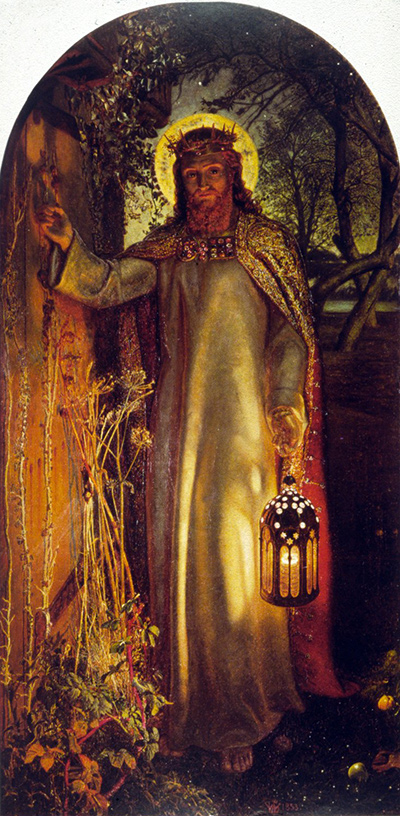
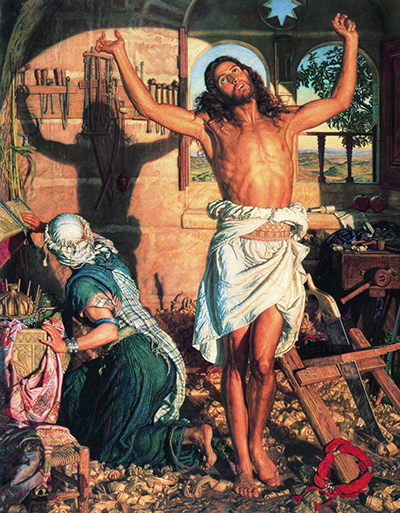
Hunt exhibited The Festival of St Swithin at the Royal Academy in 1867, alongside Il Dolce Far Niente. Its display made a small domestic subject available to the same viewers who knew him for biblical narratives and morally charged scenes. The contrast is instructive. In The Light of the World or The Shadow of Death, carefully studied materials carry an explicit religious story. Here material accuracy and the title's weather allusion carry the visual interest without a central human action. [6]
The picture's later Oxford home connects it with a group of Hunt works associated with the Ashmolean and its nineteenth-century supporters. Art UK records its bequest by Martha Combe in 1893, while the museum accession is WA1894.5. An official exhibition-loan declaration confirms the oil-on-canvas medium and accession; Art UK's full record supplies the dimensions and shorter date range. The wide composition gives the pigeons room to gather across the roof, but its close viewpoint still lets each bird register. The catalogue date difference is best kept visible: the original subject and public exhibition belong securely in the 1860s, without requiring every later layer of paint to have been finished in one season. [2] [1]
The lasting pleasure of the work is its exactness without stiffness. Hunt's birds are neither anonymous dots in a landscape nor characters in a fable. They turn, crowd and shelter on a structure made for them, while the changing sky gives their movements urgency. The painter who travelled to test biblical imagery against observed places could also find a demanding subject outside his own window. The Festival of St Swithin lets us see that range at the scale of feather, roof and summer rain.
Discussion
Look closely at The Festival of St Swithin (The Dovecote), then compare your reading with the documented history.
Reader Insights
Which detail in The Festival of St Swithin (The Dovecote) most affects your reading?
How do the date, medium and collection records shape that interpretation?
What remains uncertain about this work or its history?
Join the Conversation
Share a close observation or a source-backed question about The Festival of St Swithin (The Dovecote). The prompts above are starting points for discussion.
References
- Art UK, Ashmolean work record. View source.
- Quebec government exhibition-loan record. View source.
- Sotheby's, Hunt and the Campden Hill pigeon-house. View source.
- Sotheby's, portrait associated with 1 Tor Villa. View source.
- Met Office, St Swithun's Day weather lore. View source.
- Dictionary of National Biography, Hunt entry. View source.
- contemporary review in The London Quarterly Review. View source.