


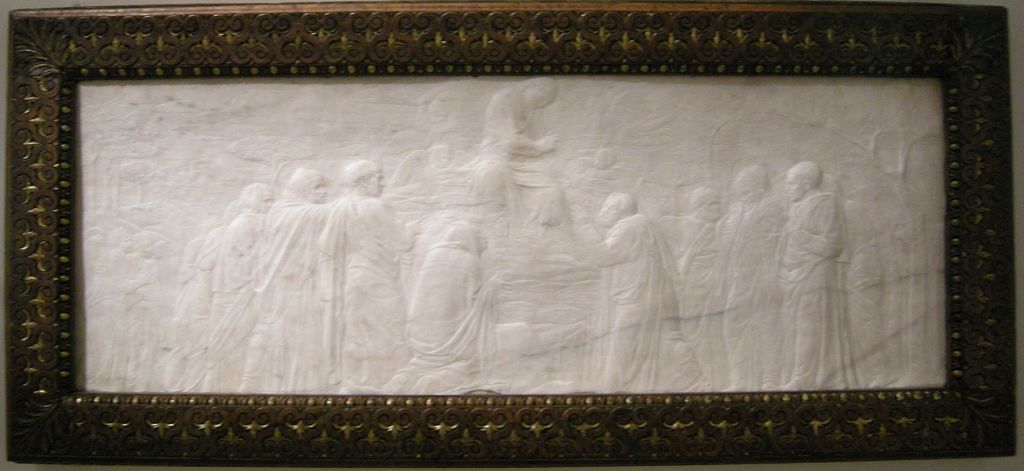
Donatello’s marble Ascension relief in the Victoria and Albert Museum. Sailko. Image source. CC BY-SA 3.0. Resized for the web.
 by Tom Gurney
Tom Gurney BSc (Hons) is an art history expert with over 20 years experience
Email: tomgurney1@gmail.com / Phone: +44 7429 011000
Christ bends out of a bank of clouds to pass a set of keys to Peter. One hand reaches down with the keys while the other rises in blessing. Below him, Mary kneels with her cloak gathered around her, close enough to the exchange to stretch her hand towards it. The people on either side turn towards the centre. Behind them, hills carry the eye out as far as a city that can be difficult to see until the light falls across the stone. [1] [2]
Donatello carved this relief in Florence around 1428–30. The marble measures about 41 centimetres high by 114 centimetres wide and is now in the Victoria and Albert Museum in London, where its museum number is 7629-1861. The stone extends almost three times as far across as it does upwards, yet the main action is a movement up and down through the centre. To see how carefully Donatello fitted it into this strip of marble, start with the small space between Christ's hand and Peter's. [1]
The promise and the departure
The keys come from Matthew 16:13–20. In the district of Caesarea Philippi, Jesus asks his disciples who they believe he is. Simon answers that he is the Messiah, the Son of the living God. Jesus names him Peter, speaks of the rock on which he will build his Church and promises him the keys of the kingdom of heaven. Matthew gives this promise in words. Donatello makes the keys an object that can pass from one hand to another. The exchange gives visible form to the authority entrusted to Peter. [3]
The Ascension belongs to a later moment, after Christ's death and resurrection. In Luke 24:50–53, Christ leads his followers out towards Bethany and blesses them as he is taken up into heaven. In Acts 1:6–12, the disciples watch as a cloud takes him out of sight. Two men in white then address them as they look upwards. The cloud in the relief and the raised hand of blessing bring the details that Luke and Acts tell separately into the same view. Mary appears among the earthly witnesses. Acts names her among those gathered in prayer after they return to Jerusalem. [4] [5]
Peter reaches for the keys while Christ is already above him, seated within an almond-shaped enclosure of clouds. The folded body, bowed head and extended arm keep Christ involved in the earthly gathering even as he rises away from it. The two gestures give the departure a direction and a purpose. Christ's blessing extends to the assembly while the keys draw one person into an especially close relation to him. The carved keys are small enough to miss on a first glance, so Peter's lifted face and the meeting of the hands carry much of the story. [1] [2]
The figures on the hillside
Mary and Peter establish the interval in which the action takes place. Peter, on the viewer's right, lifts his face and arms towards Christ. Mary, on the viewer's left, looks across and upwards. Her seated son and Peter present faces in strongly marked profile or near profile. Mary offers a slimmer glimpse of a face inside her hood. In the photograph of the centre, the line of her nose and chin emerges from the folds like a much smaller echo of the outlines of his face above. Her hand opens against the quieter surface of the stone, where spread fingers can register even though their edges cast little shadow. The cloak falls in long curves across her back and onto the ground, giving her kneeling body a breadth and weight that the face alone scarcely suggests. [1] [2]
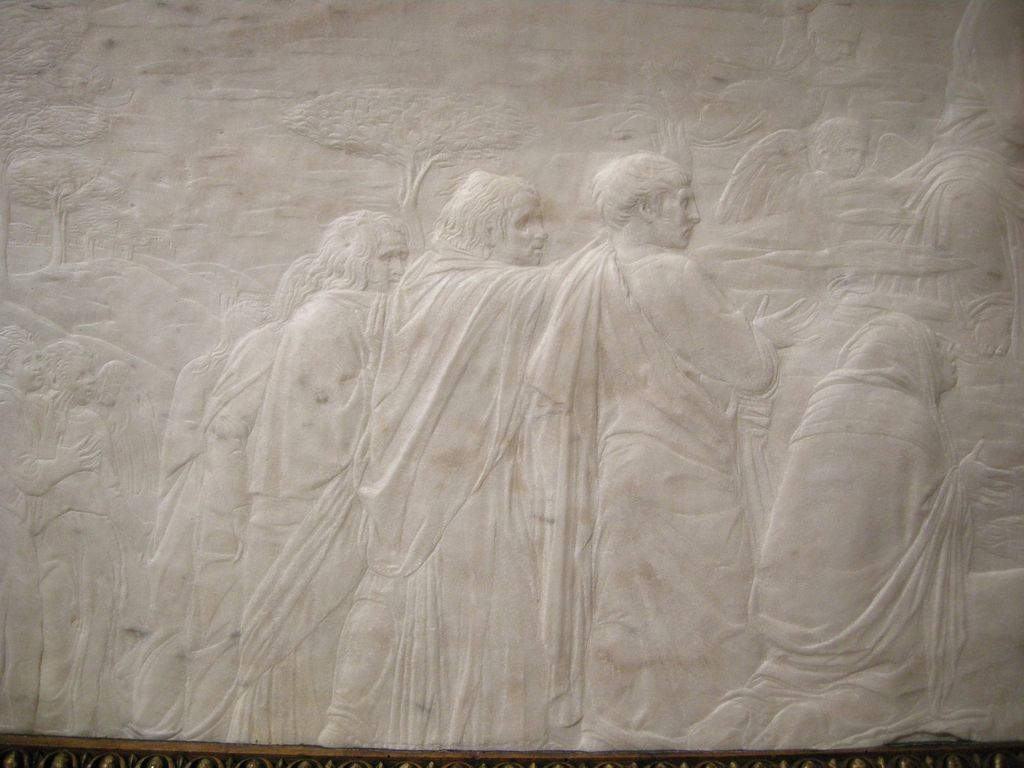
The left part of the relief, where the overlapping figures emerge from shallower carving behind them. Sailko. Image source. CC BY-SA 3.0. Resized for the web.
To the left of Mary, the nearest apostle turns towards the scene, opening a hand as he watches. Several heads beyond him sit progressively lower and project less distinctly. Two of the more distant faces are partly screened by the intervening figures. Seen from the left edge of the panel, this passage leads from heads that only begin to separate from the surface to a shoulder and back that seem to stand clear of it. Peter's companions to the right form another group, with faces and bodies turned at different angles. An outer figure with a hand up near his face stands within a tight run of folds. Such gestures let the eye move through the company slowly on the way to the most consequential gesture at its centre. [1] [2]
The winged figures at the far left provide another way into the space. They stand close together, one with an arm around the other. Their smaller scale and shallower carving set them behind the larger people beside them. Donatello keeps reducing the strength of the shapes as the hills and trees recede. Look past the pair of angels for the tiny line of buildings identified by the museum as Jerusalem. The city gives a scale to the hill country and a point of reference within the story. It is a place the figures could return to once they have turned away from the sky. [2] [5]
Annotated Details from Ascension and the Keys
Select a number to jump to a detail of the sculpture.
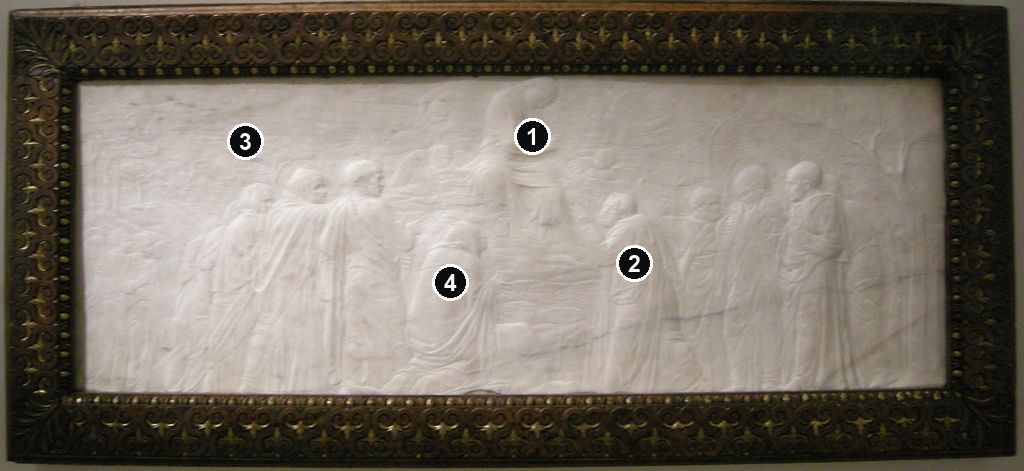
Details from ASCENSION AND THE KEYS
Open a detail image to examine the surface more closely.
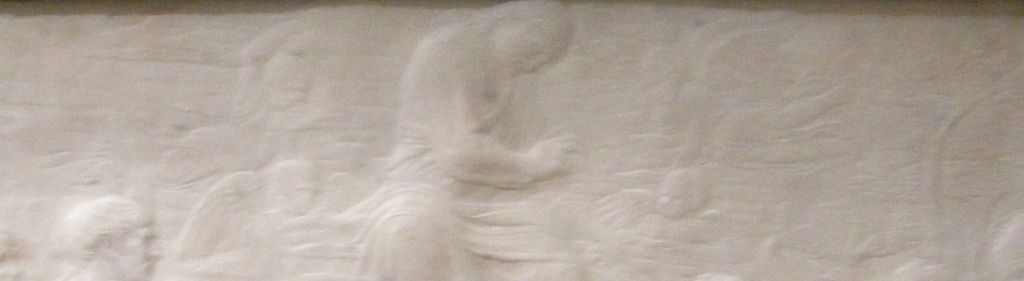
Christ above the central group
Christ bends toward the people beneath him. His head and folded drapery emerge above the low bands of cloud.
Peter reaching towards Christ
Peter lifts his face and reaches towards Christ. Broad folds in the foreground carry more shadow than the faint strokes of the relief’s distant setting.
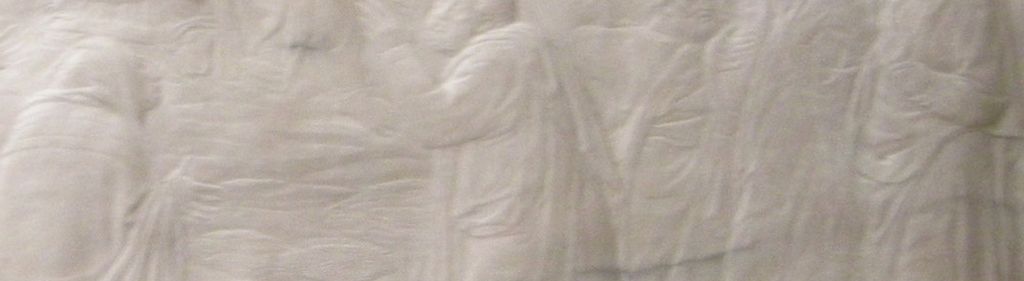
The distant setting
The suggestion of buildings and terrain is faint above the group on the left. Subtle differences in relief depth allow the background to recede as the light moves across the surface.
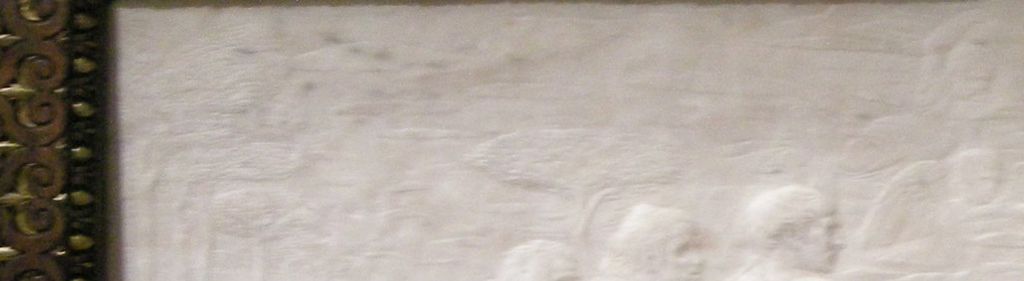
Mary opposite Peter
Mary’s hood and curved drapery mark the opposite edge of the space below Christ. In shallow light, the overlapping folds are easier to distinguish from the terrain.
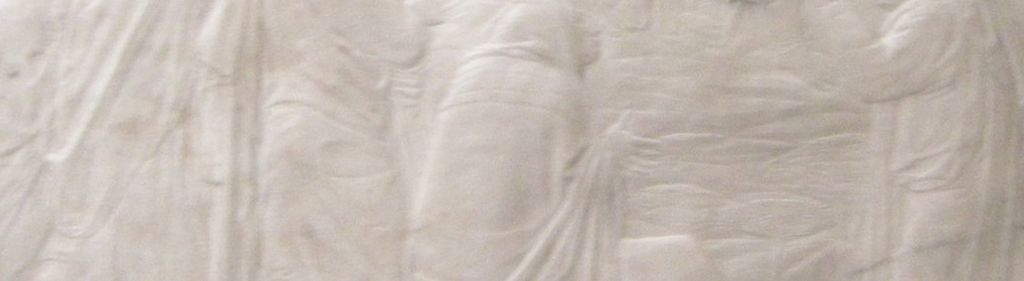
Annotated photograph and detail crops. Sailko. Image source. CC BY-SA 3.0. Resized, annotated and cropped from the original photograph.
How Donatello carved the clouds
Several kinds of depth are at work across the panel. A shoulder that overlaps another figure tells us immediately which body is closer. Heads decrease in size and project less as they recede. Behind them, the trees and city depend on thin lines and minute changes of surface. Above the heads, these same means describe layers of air. One angel's wing catches light on the ridges of the feathers before the figure sinks into horizontal bands of cloud. Other angelic figures are harder to follow. Portions emerge boldly and then dissolve into lines that could be read as either the edge of another cloud or part of a body. The amount of an angel Donatello lets us see becomes a measure of how much cloud lies in front of it. [1] [2]
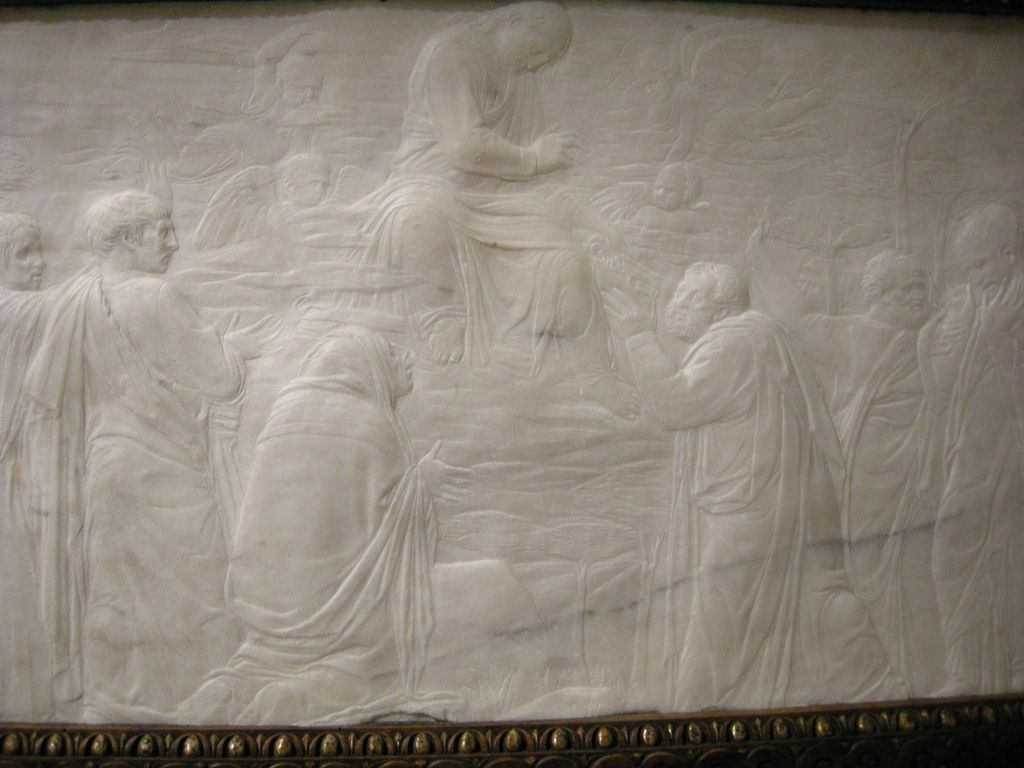
The right part of the relief, with the surface gaining depth from lightly incised lines and shadows. Sailko. Image source. CC BY-SA 3.0. Resized for the web.
Rilievo schiacciato, or flattened relief, describes the range of tiny differences in level that make this possible. The projecting parts of Christ's face cast enough shadow to make the tilted head legible. The ridges and depressions of the sleeve describe the bend in the arm. At a distance of only a few centimetres across the marble, there can be lines so slight that their shadows disappear with a change of lighting. Frank Fehrenbach notes that Vasari likened a flattened relief to the impression on a coin. The comparison makes sense of the way a whole figure fits into so little physical depth. A design of this complexity also demands the successive removal of marble, with little scope to put any of it back once a shallow plane has been lowered. [6]
The sculptor's Feast of Herod made for the baptismal font in Siena offers a comparison. In that bronze, built architecture gives the eye edges it can follow back into the space. In the London marble, layers of cloud are less easy to measure. Sumie Shibata points out that the positions of bodies in an atmosphere of cloud and haze stay less definite than the positions of bodies in the constructed setting of the Feast. Here that difference is especially apt. The figures on the ground can cast shadows and block one another from sight. A fold of cloud can bring Christ almost within reach or make part of an angel disappear. The space between heaven and earth is felt through these changes in what can be seen. [7]
Moving the light across the marble
Raking light strikes across a surface at a low angle. The raised edge of a shallow cut then throws a thin shadow onto the marble beside it. If the light falls more nearly head on, the same cut can be difficult to distinguish. The effect of moving the light depends on the direction of the carving too. Light from the left or right can pick out upright boundaries, while light from above or below has a greater chance of bringing out shallow lines that run horizontally. The horizontal cloud bands and the upright folds in the apostles' clothing give an eye looking at this relief several different kinds of surface to test. [6] [8]
The V&A used reflectance transformation imaging, usually shortened to RTI, to show this effect. Its photography team made 72 high-resolution exposures from a fixed camera position, moving the light around the relief. The interactive viewer combines the photographs to simulate shifts in illumination as the viewer chooses a direction. In the museum's comparison of light from above and below, the projection around Christ's face changes how strongly it appears to stand out. In the framed photographs the frame casts its own shadow at the top, where Christ's head is close to the edge. These differences are worth looking for alongside the fine engraving at the horizon. One alters the presence of the figure you saw immediately. The other can reveal an entire part of the landscape you missed. [8] [9]
Even in the gallery, shifting your own position can help you pick up an edge or lose a distracting reflection. Fehrenbach connects this experience of looking to a passage in Lorenzo Ghiberti's writings on optics, in which very fine sculpture eludes the eye in overly strong or weak light and becomes readable again when conditions or the position of the viewer change. The digital viewer lets us vary a single condition that would ordinarily be fixed in a gallery. The direction and intensity of light in Donatello's first installation remain unknown. [6] [8]
Watch the sculpture in context
Curator Peta Motture looks closely at the shallow relief under changing illumination.
Victoria and Albert Museum. Curator Peta Motture looks closely at the shallow relief under changing illumination. Watch on YouTube.
A Florentine palace and two possible settings
The V&A identifies the marble with an Ascension by Donatello listed in the Medici palace inventory made in 1492, after the death of Lorenzo the Magnificent. The description, transcribed by Alison Wright, places the work in the chamber of the great hall and calls it mezzo rilievo, or half relief. The same inventory uses similar language for other very shallow carving. Its terms tell us something about the way an inventory compiler sorted works in that household, while the surface itself supplies the evidence of how thinly Donatello carved. The chamber gives the relief a known setting by the late fifteenth century. The person who commissioned the panel and the place for which it was carved remain open questions. [1] [10]
In his 1591 guide to Florence, Francesco Bocchi describes a chamber facing north in the house of Francesco and Lorenzo Salviati. Among the works he admired there was a marble in low relief by Donatello. He identified the subject by the giving of the keys and singled out Peter's responsive movement and the devotion in the kneeling Mary's pose. The details give the Salviati reference particular weight. The earlier inventory named the Ascension. Bocchi described the action in the space immediately below it, where a few small gestures direct attention to the human response. [11]
An older proposal placed the marble on the altar of the Brancacci Chapel in Santa Maria del Carmine, Florence. The wall paintings there tell episodes from Peter's life and omit the giving of the keys. A second point of comparison is a Florentine Ascension play put on at the Carmine. Art historian Natalia Vavilina discusses a description of the 1439 performance in which Christ hands Peter large gilded keys before his ascent. That performance provides an independent example of the two episodes being joined in Florence. The V&A's current catalogue describes the chapel proposal as largely rejected. The shared subject and the gap in the painted cycle help explain its appeal. [1] [12]
The museum gives more weight to the possibility that the panel belonged below the statue of Peter at Orsanmichele. There is a precedent at the same building. A shallow marble scene of George and the dragon ran beneath Donatello's Saint George, as the Bargello's display of both pieces shows. A relief under Peter would likewise place an episode from the saint's life below a single standing figure. Such a location would put the carving in the path of people passing in the street and expose it to changing daylight. The comparison establishes a plausible format, while the commission and first installation of the Ascension itself remain undocumented. Domestic viewing also suits the close attention that the fine carving asks of us and that the Medici inventory and Salviati account suggest it received. [1] [10] [13]
From the Campana collection to South Kensington
The relief entered London's South Kensington Museum, now the V&A, in 1861 with works from the group known as the Gigli-Campana collection. Curator Whitney Kerr-Lewis traces the acquisition to the museum's negotiator, John Charles Robinson. In his history of the Campana collection, the French scholar Salomon Reinach identifies number 7629 among the pieces from the Campana holdings. The accession gives the surviving marble a secure place in the history of the London collection. The published descriptions of the Medici, Salviati and Campana holdings give us points in its history separated by long intervals. [1] [14] [15]
Plaster casts soon gave audiences outside London a way to study the composition. The Italian national catalogue records an English cast exhibited at the Bargello for the Donatello centenary in 1887. A separate cast in the Fitzwilliam Museum, Cambridge, is credited to Enrico Cantoni and was acquired from South Kensington in 1894. These casts repeat the disposition and shallow modelling of the figures in another material. On the original marble, the folds and faint passages have to be read alongside the stone's own tones and marks. Even the present wooden surround has a history of its own. The V&A currently considers it probably nineteenth-century, possibly made with reused carved sections, so its appearance offers limited evidence about how the work was framed in Florence. [1] [16] [17]
Photography opened another way to see the relief almost as soon as it arrived in London. Robinson commissioned C. Thurston Thompson to photograph works in the museum for his 1862 publications. Readers of the general catalogue saw an engraving made from the photograph of the Ascension. The more expensive photographic supplement carried an albumen print. As Geraldine A. Johnson shows, a contemporary reviewer found the engraved apostles grotesquely exaggerated. The engraving caught the turning bodies, but heavy lines around their cloaks and faces gave gestures a force that the soft transitions of marble tend to temper. Comparing those early reproductions with a view of the panel under changing illumination brings us back to what makes it so hard to reproduce in a single image. The same stone can make a gesture emphatic or barely visible as the shadows shift. [18] [8]
Donatello sculpture directory
| Name | Date | Medium and record |
|---|---|---|
| Marble David | 1408–09, adapted 1416 | Carved Carrara marble Catalogue. |
| Saint John the Evangelist | c. 1409–15 | Carved marble Catalogue. |
| Saint Mark | 1411–13 | Carved Carrara marble Catalogue. |
| Saint George and its dragon relief | c. 1415–17 | Marble statue and marble relief Catalogue. |
| Marzocco | c. 1417–20 | Carved sandstone Catalogue. |
| Saint Louis of Toulouse, Florence | 1418–25 | Gilt bronze and mixed media Catalogue. |
| Pazzi Madonna | c. 1420s | Marble relief Catalogue. |
| Reliquary Bust of Saint Rossore | c. 1420s | Gilt bronze Catalogue. |
| The Prophet Jeremiah | 1420s–30s, disputed | Marble Catalogue. |
| Zuccone | c. 1420s–30s | Marble Catalogue. |
| Feast of Herod, Siena | 1420s | Gilded bronze relief Catalogue. |
| Ascension with Christ Giving the Keys to Saint Peter | c. 1428–30 | Marble relief Catalogue. |
| Cantoria | 1433–39 | Marble and mosaic Catalogue. |
| Amor-Atys | c. 1435–40 | Partly gilded bronze Catalogue. |
| Bronze David | c. 1435–40, disputed | Partly gilded bronze Catalogue. |
| Gattamelata | Installation agreement, 1453 | Bronze and stone Catalogue. |
| Santo altar | Mid-fifteenth century | Bronze and limestone ensemble Catalogue. |
| Chellini Madonna | Given in 1456 | Partly gilded bronze tondo Catalogue. |
| Penitent Magdalene | c. 1453–55 (Opera) | Poplar, stucco, pigments and gold Catalogue. |
| Judith and Holofernes | Late 1450s–early 1460s | Bronze with surviving gilding Catalogue. |
| Pulpit of the Passion | Late work and later assembly | Bronze reliefs, Donatello and collaborators Catalogue. |
| Bust traditionally called Niccolò da Uzzano | Fifteenth century | Painted terracotta, attribution disputed Catalogue. |
| Prato Cathedral exterior pulpit | Commissioned 1428; carved 1430s | Marble reliefs, Donatello and Michelozzo Catalogue. |
| Cavalcanti Annunciation | c. 1433–35 | Gilded sandstone and terracotta Catalogue. |
| Crucifix at Santa Croce | Early fifteenth century | Painted wood Catalogue. |
| Madonna of the Clouds | c. 1425–35 | Marble relief Catalogue. |
| Old Sacristy Doors | Fifteenth century | Two paired bronze doors Catalogue. |
| Resurrection Pulpit | Late work and later assembly | Bronze reliefs, Donatello and collaborators Catalogue. |
| Brancaccio tomb | 1420s | Donatello, Michelozzo and assistants, mixed materials Catalogue. |
| Saint John the Baptist, Venice | 1438 | Polychromed and gilded wood Catalogue. |
| Sacrifice of Isaac | Early fifteenth century | Donatello and Nanni di Bartolo, marble Catalogue. |
| Madonna of Via Pietrapiana | Mid-fifteenth century | Terracotta Catalogue. |
| Miracle of the Mule | Mid-fifteenth century | Gilded bronze panel for the Santo altar Catalogue. |
| Padua Crucifix | Mid-fifteenth century | Cast bronze Catalogue. |
| Dancing Spiritello, Bargello | Fifteenth century | Bronze Catalogue. |
| Young Prophet from the Porta della Mandorla | c. 1404–09 | White marble, attributed to Donatello Catalogue. |
| Prophet or Apostle from the Duomo north tribune | Early fifteenth century | White marble, possibly Donatello Catalogue. |
| Beardless Prophet | 1415–18 | White marble Catalogue. |
| Sibyl and Prophet of the Porta della Mandorla | 1422 | Carved marble heads for the portal Catalogue. |
| Faith, Siena baptismal font | 1420s | Gilded bronze figure Catalogue. |
| Hope, Siena baptismal font | 1420s | Gilded bronze figure Catalogue. |
| Feast of Herod, Lille | c. 1430 | Carrara marble relief Catalogue. |
| Piot Madonna | c. 1440–60 | Polychrome terracotta with glass and wax inlays Catalogue. |
| Carafa Horse Head | c. 1456–58 | Cast bronze Catalogue. |
| Pazzi Madonna workshop version, Louvre | c. 1450 | Polychrome gesso, Donatello’s workshop Catalogue. |
| Pazzi Madonna tondo, Rijksmuseum | c. 1425–50 | Plaster and stucco, after Donatello Catalogue. |
| Sprite | c. 1430–40 | Bronze, sculptor or metalsmith close to Donatello Catalogue. |
Discussion
Look again at the images and ideas explored in Ascension and the Keys. These editorial prompts invite your observations.
Reader Insights
Which gesture first draws you into the exchange between Christ and Peter?
What becomes easier to see when the light moves across the marble from the side?
Join the Conversation
Share a detail, comparison or question about Ascension and the Keys below.
References
- Victoria and Albert Museum, The Ascension with Christ giving the Keys to Saint Peter, collection record O93255, 7629-1861, including measurements, physical description and object history. View source.
- Victoria and Albert Museum, Donatello and the Making of Art 1400–1500, gallery guide transcript for Donatello's Ascension Relief. View source.
- United States Conference of Catholic Bishops, New American Bible, Matthew 16:13–20. View source.
- United States Conference of Catholic Bishops, New American Bible, Luke 24:50–53. View source.
- United States Conference of Catholic Bishops, New American Bible, Acts 1:6–14. View source.
- Frank Fehrenbach, “Rilievo schiacciato. Donatello and the Forces of Sculpture,” in Neville Rowley, ed., Donatello. Inventor of the Renaissance, 2022, pp. 59–67. View source.
- Sumie Shibata, “Mantegna's Pictorial Expression of the Space: An Analysis on ‘Illusive Projecting Motifs’,” Journal of the Japan Society of Design 35, 1996, pp. 43–56, especially p. 53 and fig. 13 (Japanese). View source.
- Tom Windross, “Photographing the Ascension,” Victoria and Albert Museum, 10 February 2023. View source.
- Victoria and Albert Museum, “Explore Donatello's Masterpiece: ‘The Ascension’,” with the interactive illumination study. View source.
- Alison Wright, “‘Sculptural Values’: Reading Fictive Relief in Late Fifteenth- and Early Sixteenth-Century Italy,” in Donal Cooper and Marika Leino, eds., Depth of Field: Relief Sculpture in Renaissance Italy, 2007, pp. 224–25 and nn. 4–6 for the 1492 Medici inventory. View source.
- Francesco Bocchi, Le bellezze della città di Fiorenza, Florence, 1591, pp. 185–86, transcription by Fondazione Memofonte. View source.
- Natalia Vavilina, “Sacred Performances and the Council of Ferrara–Florence,” Art Studies, 2013, nos. 3–4, pp. 354–77, especially pp. 368–69 (Russian). View source.
- Musei del Bargello, Donatello and the Dawn of the Renaissance, gallery itinerary for the Saint George and its relief. View source.
- Whitney Kerr-Lewis, “Donatello in London: A South Kensington Story,” in Neville Rowley, ed., Donatello. Inventor of the Renaissance, 2022, pp. 105–17, especially pp. 105–07. View source.
- Salomon Reinach, Esquisse d'une histoire de la collection Campana, p. 32, identifying the relief as no. 7629 (French). View source.
- Istituto Centrale per il Catalogo e la Documentazione, record ICCD5191996 for the plaster cast exhibited at the Bargello in 1887 (Italian). View source.
- The Fitzwilliam Museum, The Ascension with Christ Giving the Keys to St. Peter, plaster cast M.5-1894. View source.
- Geraldine A. Johnson, “‘To know them thoroughly you must have their photographs’: Photographing Donatello in the Nineteenth and Early Twentieth Centuries,” Sculpture Journal 34, no. 2, 2025, figs. 3–4. View source.
- Victoria and Albert Museum, Donatello’s David. View source
- Opera del Duomo, Donatello and the Opera del Duomo. View source
- Ministero della Cultura, David with the Head of Goliath, Bargello bronze. View source
- Save Venice, Donatello’s Equestrian Monument to Gattamelata. View source
- Opificio delle Pietre Dure, L’ultimo Donatello. View source
More DONATELLO Sculptures
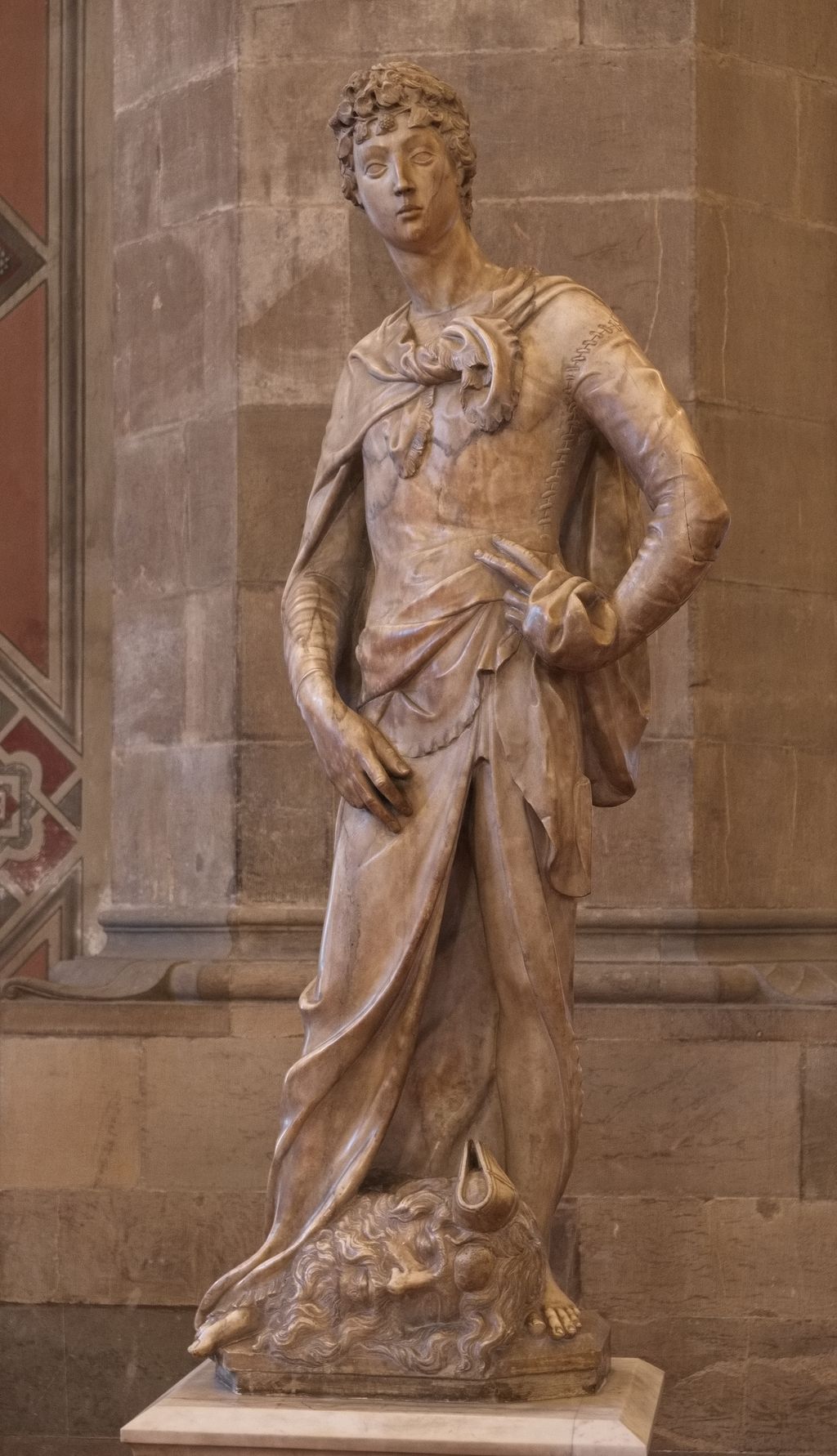
Marble David
Armin Kleiner. Image source. CC BY-SA 4.0. Resized for the web.
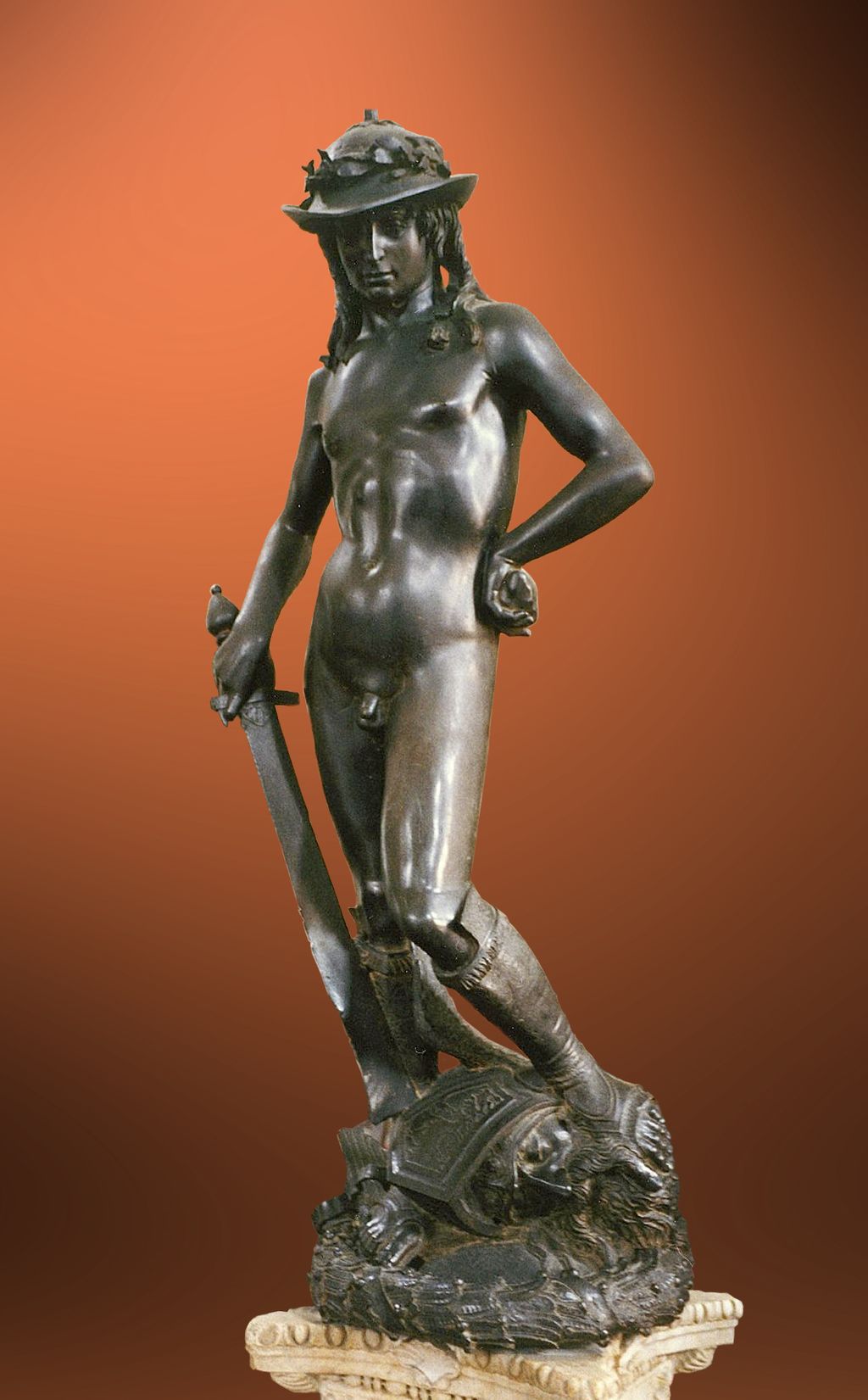
Bronze David
Patrick A. Rodgers. Image source. CC BY-SA 2.0. Resized for the web.
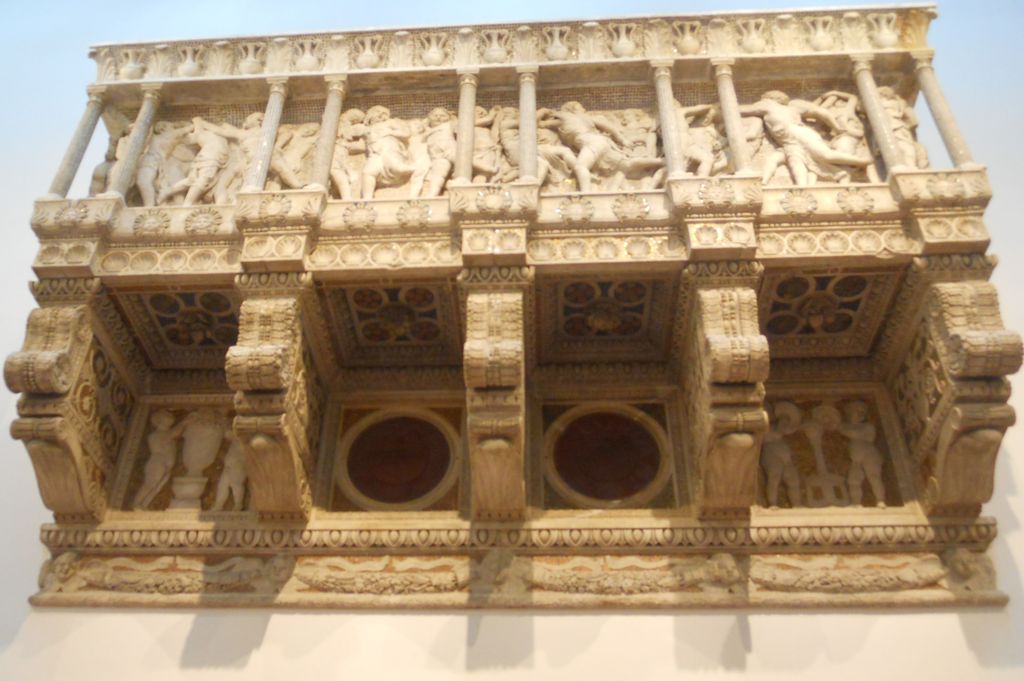
Cantoria
Erik Drost. Image source. CC BY 2.0. Resized for the web.
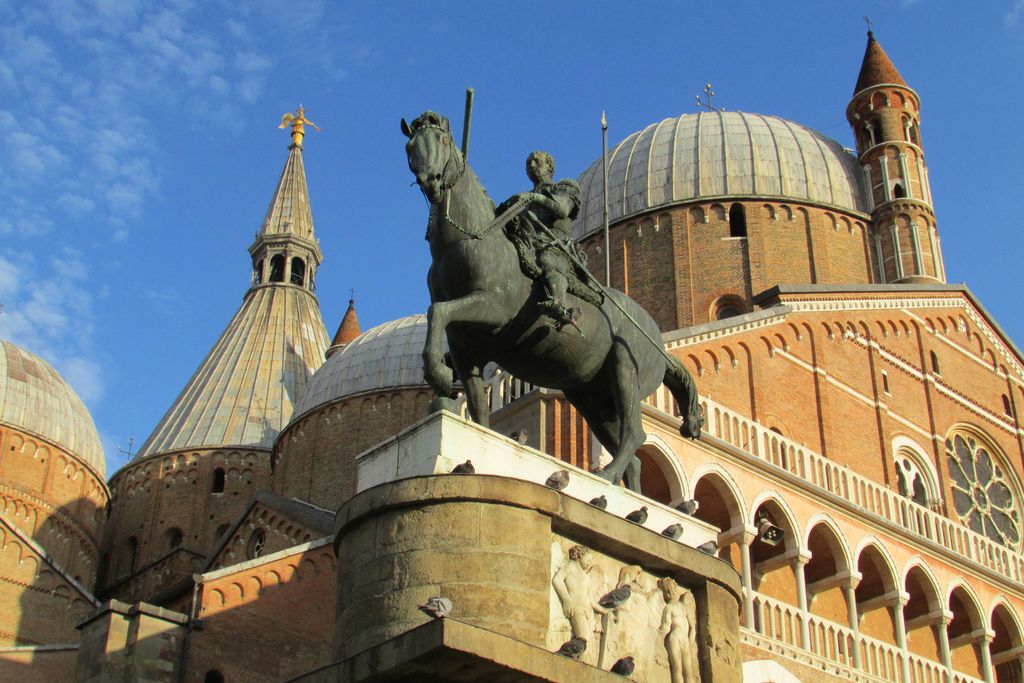
Gattamelata
Chris Light. Image source. CC BY-SA 4.0. Resized for the web.
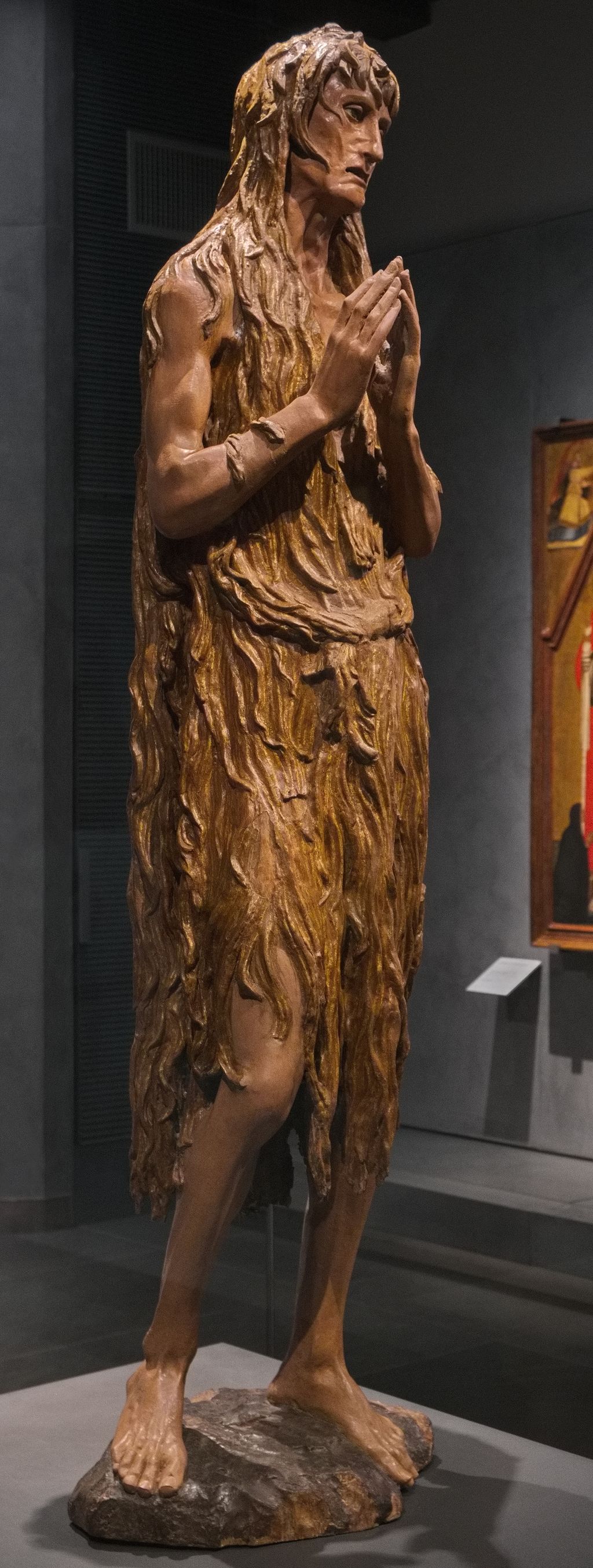
Penitent Magdalene
Armin Kleiner. Image source. CC BY-SA 4.0. Resized for the web.
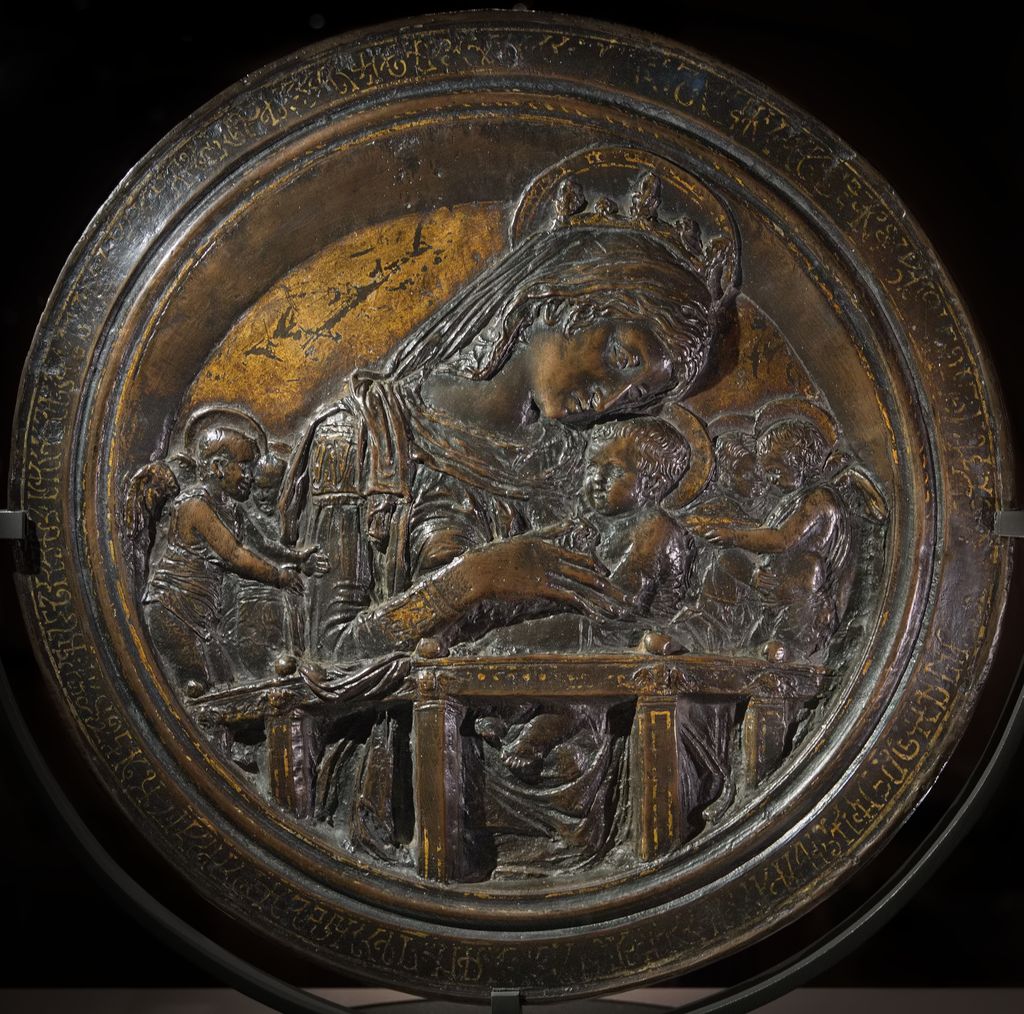
Chellini Madonna
Armin Kleiner. Image source. CC BY-SA 4.0. Resized for the web.
