 by Tom Gurney
Tom Gurney BSc (Hons) is an art history expert with over 20 years experience
Published on June 19, 2020 / Updated on July 5, 2026
Email: tomgurney1@gmail.com / Phone: +44 7429 011000
Introduction
Death in the Sickroom is one of Edvard Munch's most important paintings about family grief. Painted in 1895, it returns to the death of his sister Sophie, who died of tuberculosis in 1877 when Munch was a teenager. But the painting is not a straightforward documentary scene. It is a memory image, made nearly twenty years later. [1] [4]
That difference matters. The subject is Sophie's death, but the emotional centre is the surviving family. Munch does not show a single dramatic deathbed moment. He spreads grief across a room, separating each figure into a private zone of silence. [2]
At a Glance
- Artist: Edvard Munch
- Title: Death in the Sickroom
- Date: 1895
- Subject: Family gathered around the remembered death of Sophie Munch
- Theme: Illness, death, memory and family grief
- Cluster role: Companion to The Sick Child and the illness/death route
Why This Painting Matters
Death in the Sickroom matters because it expands the illness subject beyond The Sick Child. In The Sick Child, Munch concentrates memory around the dying Sophie and the close relation at the bedside. In Death in the Sickroom, he widens the scene to show what death does to a family. [3]
The painting is also important for understanding the Frieze of Life. Munch's cycle was not only about love and anxiety. Illness and death were central. This work turns family memory into a modern image of psychological isolation. [3] [2]
Memory, Not Reportage
The event behind the painting is Sophie's death in 1877. Yet Munch painted the work in 1895, and the figures are generally understood as remembered or reimagined from a later perspective rather than recorded exactly as they appeared at the deathbed. [1] [4]
That makes the painting more powerful, not less truthful. It shows how memory rearranges grief. The room becomes a mental space where different times meet: the actual death, the later painter, and the surviving family members as emotional presences. [2]
Looking Carefully
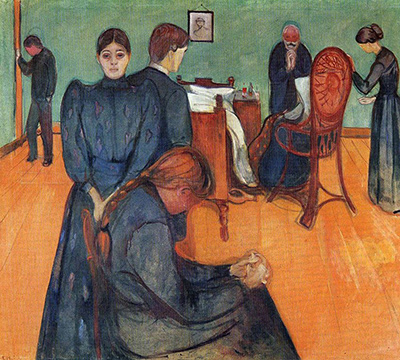
The room is full of people, but no one seems able to reach anyone else. Figures stand or sit apart, avoiding contact. Their bodies face different directions, and their attention is divided between the sickbed, the floor, the viewer and their own inwardness. [2]
Sophie is visually recessed, near the bed or high-backed chair. She is the cause of the gathering, but she is not the strongest visual presence. Munch makes the survivors carry the image. [1]
The colour and structure reinforce the mood. The floor and walls divide the room into stark planes. The figures are dark, still and compressed by the interior. Grief is not shown as theatrical gesture, but as separation inside shared space. [3]
The Family in the Room
The painting's great insight is that a family can be together and still be alone. Each figure occupies a separate grief. The father, aunt and siblings are not joined by a clear line of comfort. Instead, they form a broken constellation around absence. [4]
This is one reason the painting should be read beside The Sick Child. The earlier motif focuses on the sickbed encounter. Death in the Sickroom asks what remains after the encounter: memory, silence, distance and the burden carried by those who survive. [3]
Comparison Works
These illness and death routes were checked against the local Edvard Munch sitemap during production. [6]
- The Sick Child is the essential comparison. Both works return to Sophie's death, but The Sick Child compresses the scene into a charged bedside relation while Death in the Sickroom expands grief into a family group. [3]
- Child and Death and Girl and Death continue the illness/death route, showing how Munch returned to death as a human relation rather than only an event. [1]
- Biography matters because Munch's family history of tuberculosis, bereavement and anxiety shaped the emotional ground of these works. [4]
- Themes places this painting in the wider illness, death and memory route of the Munch cluster. [6]
Things You Might Miss
- Sophie is central to the subject, but visually recessive. [1]
- The survivors are the real carriers of the painting's emotional weight. [2]
- The room is crowded but emotionally disconnected. [3]
- The painting is a memory image, not a literal scene painted from life. [4]
- The work broadens the illness route from one sick child to an entire family system. [6]
Interpretation
Death in the Sickroom is a painting about grief after the fact. Munch does not ask us to witness death as spectacle. He asks us to look at the living as they stand around absence. [2]
That makes the painting one of his most important statements about memory. The past is not gone; it reorganises the room, the family and the painter's own sense of self. In this way, Death in the Sickroom belongs with The Sick Child as one of the foundations of Munch's art of illness, death and remembered feeling. [5]
FAQs
The painting refers to the death of Munch's sister Sophie, who died of tuberculosis in 1877. [4]
Munch painted Death in the Sickroom in 1895, nearly twenty years after Sophie's death. [1]
Both works return to Sophie's illness and death. The Sick Child focuses on the sickbed encounter; Death in the Sickroom expands the memory into a family group. [3]
No. It is better understood as a later memory image, where the family and room are arranged to express remembered grief. [2]
References
- Gerd Woll, Edvard Munch: Complete Paintings, London: Thames & Hudson, 2009.
- Patricia G. Berman, ed., Edvard Munch: The Modern Life of the Soul, Museum of Modern Art, 2006.
- Arne Eggum, Edvard Munch: The Frieze of Life, 1993.
- Sue Prideaux, Edvard Munch: Behind the Scream, Yale University Press, 2005.
- eMunch, Edvard Munch's Writings: The English Edition, accessed 5 July 2026.
- TheHistoryOfArt.org, Edvard Munch sitemap and local internal-link validation, checked 5 July 2026.