 by Tom Gurney
Tom Gurney BSc (Hons) is an art history expert with over 20 years experience
Published on July 5, 2026July 5, 2026 / Updated on July 6, 2026
Email: tomgurney1@gmail.com / Phone: +44 7429 011000
Introduction
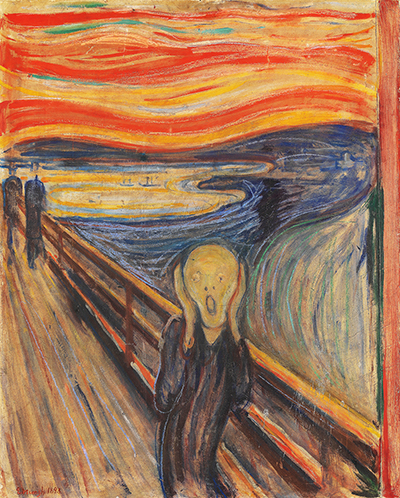
Edvard Munch's art is often reduced to anxiety because The Scream is so famous. Anxiety is central, but it is only one route through his work. Munch returned again and again to love, illness, death, self-portraiture, modern city life, repetition and the instability of the body under emotional pressure. [1] [5]
This page is a guide to those routes. It is designed to connect the Munch cluster rather than replace the individual painting pages. Read it as a map: each theme below points toward the works where Munch tested that subject most powerfully. [8]
At a Glance
- Artist: Edvard Munch
- Page type: Cluster themes hub
- Main routes: Anxiety, love, illness, death, self-portraiture, printmaking and modern life
- Best starting pages: The Scream, Despair, Anxiety, The Sick Child, Separation, The Kiss, Vampire, Madonna and Dance of Life
Why Themes Matter in Munch
MUNCH presents Munch as a modern artist whose career stretched from the 1880s until 1944 and moved across painting, printmaking, drawing, photography and film. That long practice matters because Munch's art is built on recurrence. He did not make one image of anxiety, one image of love or one image of death. He repeated and varied motifs until they became a visual language. [1] [2]
The Frieze of Life is the clearest framework. It brought together images of love, anxiety, sickness and death as connected human experiences. Even when a work was not fixed permanently inside a single sequence, the Frieze helps explain Munch's method: individual paintings speak to one another. [4]
Anxiety and Modern Life
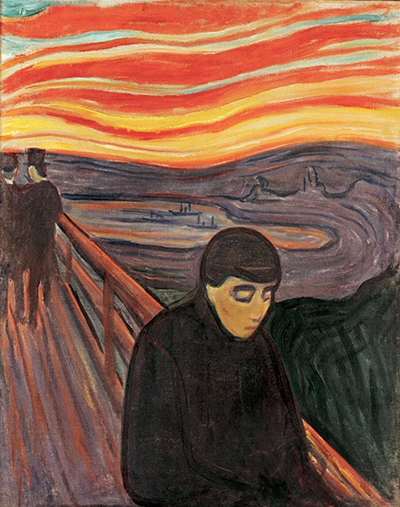
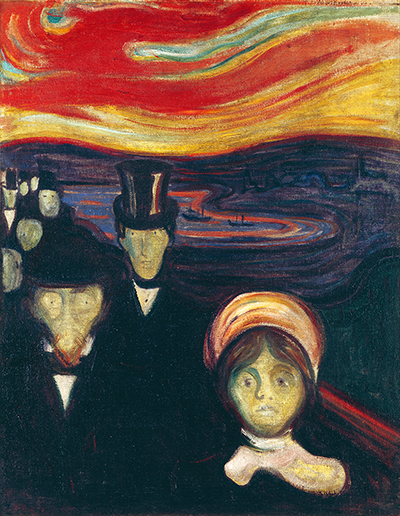
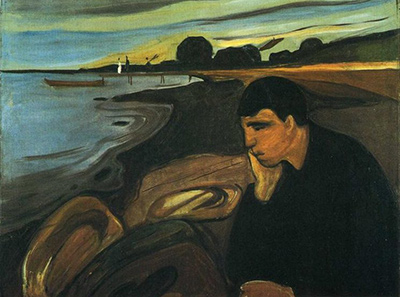
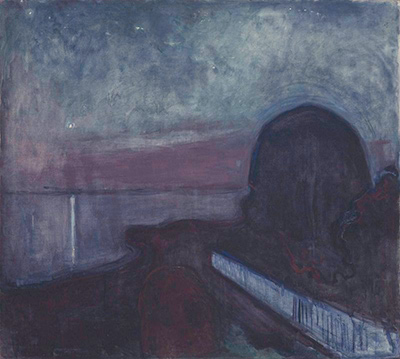
The anxiety route begins with Sick Mood at Sunset: Despair and Despair, then moves through The Scream and Anxiety. These works share more than mood. They repeat red skies, roads, railings, fjord landscapes and figures under pressure. [6]
Evening on Karl Johan Street adds the modern city. Instead of one figure facing the landscape, a crowd faces the viewer. Anxiety fuses those two routes: the red-sky landscape of The Scream and the mask-like crowd of Karl Johan Street. [5]
Love, Desire and Separation
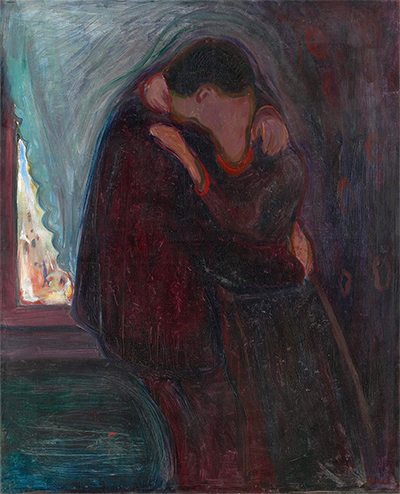
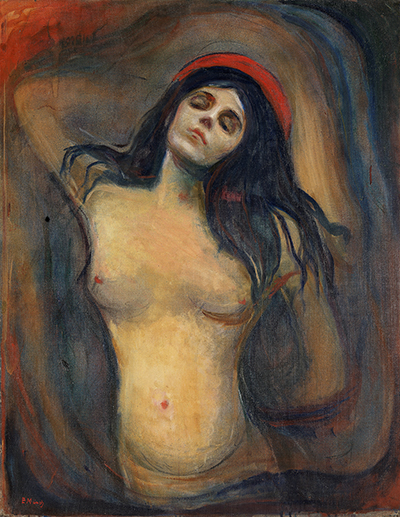
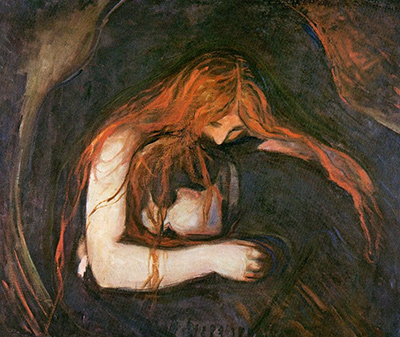
Munch's love images are not simple romances. The Kiss imagines union as fusion, where two bodies lose their boundaries. Separation shows the opposite: distance, pain and lingering attachment. Vampire darkens the embrace into an ambiguous image of tenderness, possession and surrender. [4] [5]
Madonna and Dance of Life widen the theme. Madonna brings love, sexuality, birth and death into one charged figure. Dance of Life sets love inside a wider rhythm of youth, desire, ageing and mortality. [4]
Illness, Death and Memory
The Sick Child is the central illness image in Munch's art. It draws on the death of his sister Sophie and on a broader attempt to make memory, grief and painted surface inseparable. Death in the Sickroom extends the theme from the individual sick child to the surviving family gathered around absence. [3] [5]
These works matter because they show that Munch's emotional art began before the famous Scream motif. The Sick Child helped establish his belief that painting should carry inner experience through surface, colour and form. [6]
Self-Portrait and Identity
Munch repeatedly used his own image as a testing ground. Self-Portrait Between the Clock and the Bed, painted near the end of his life, places the ageing artist between time, rest, memory and the room of his own paintings. [3] [5]
Together, these works show that Munch's self-portraits are not simple likenesses. They ask what it means to appear as a body under emotional, social and mortal pressure. [7]
Repetition, Prints and Versions
Munch's repeated motifs are not signs of creative exhaustion. They are part of his method. He returned to The Scream, Madonna, Vampire, Separation and other subjects in paintings, drawings and prints, altering format, colour, medium and emotional pitch. [2] [3]
Printmaking made this repetition especially powerful. Lithographs and woodcuts allowed Munch to circulate images widely while continuing to vary them. The prints page should be read beside the painting pages because the same motifs often live in several media. [1]
Video Guide
This selected video from TheHistoryofArt.org offers useful visual context before the detailed analysis continues.
Style: Symbolism, Expressionism and Beyond
Munch belongs partly to Symbolism and is often treated as a pioneer of Expressionism, but his work should not be flattened into a movement label. His style changes across the decades. What remains consistent is the way visible things - faces, rooms, roads, beds, shorelines, hair, sky - become carriers of inner pressure. [1] [5]
That is the real stylistic thread. Munch does not simply distort reality for effect. He builds images in which external form and internal state become difficult to separate. [7]
Recommended Reading Route
- Start with The Scream, then read Despair, Sick Mood at Sunset: Despair and Anxiety. That gives the anxiety route. [8]
- Move to Separation, The Kiss, Vampire, Madonna and Dance of Life. That gives the love and death route. [8]
- Read The Sick Child and Death in the Sickroom for illness, grief and memory. [8]
- Finish with Self-Portrait Between the Clock and the Bed for identity and mortality. [8]
FAQs
His major themes include anxiety, love, separation, sickness, death, self-portraiture, modern city life, repetition and the body's response to emotional pressure. [4]
No. MUNCH places him in relation to Symbolism and Expressionism, but his work changes across decades and media. Movement labels are useful only if they do not flatten the variety of his practice. [1]
The Frieze of Life was Munch's way of organising images around connected human experiences such as love, anxiety, sickness and death. [4]
References
- MUNCH, "Edvard Munch (1863-1944)," official artist page, accessed 5 July 2026.
- MUNCH, "Catalogue Raisonne / About the Collection," accessed 5 July 2026.
- Gerd Woll, Edvard Munch: Complete Paintings, London: Thames & Hudson, 2009.
- Arne Eggum, Edvard Munch: The Frieze of Life, 1993.
- Patricia G. Berman, ed., Edvard Munch: The Modern Life of the Soul, Museum of Modern Art, 2006.
- Reinhold Heller, Edvard Munch: The Scream, London: Allen Lane, 1973.
- eMunch, Edvard Munch's Writings: The English Edition, accessed 5 July 2026.
- TheHistoryOfArt.org, Edvard Munch sitemap and local internal-link validation, checked 5 July 2026.