 by Tom Gurney
Tom Gurney BSc (Hons) is an art history expert with over 20 years experience
Published on June 19, 2020June 19, 2020 / Updated on July 6, 2026
Email: tomgurney1@gmail.com / Phone: +44 7429 011000
Vampire by Edvard Munch: Love, Pain and a Dangerous Title
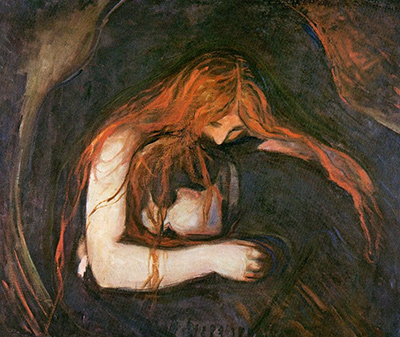
Edvard Munch's Vampire is one of his most memorable love-and-death images, but its title is already an interpretation. The motif was originally known as Love and Pain. The later title Vampire came from the way viewers read the woman bending over a man's neck, her red hair spreading across him like a living force. [1]
The best-known versions belong to Munch's 1890s work. Standard catalogues describe multiple painted versions between 1893 and 1895, with a major MUNCH version often given as an 1895 oil on canvas measuring 77.5 x 98.5 cm. The motif also moved into print, notably through Vampyr II. [1]
The page therefore has to do two things at once. It should respect the common title Vampire, because that is how most readers know the work, while also restoring the older and more ambiguous frame of Love and Pain. [7]
Seen carefully, the painting is not just a supernatural scene. It is a compressed image of intimacy as tenderness, exhaustion, possession, consolation and danger. The power of the work lies in the fact that none of those readings completely cancels the others. [5]
At a Glance
- Artist:Edvard Munch
- Common title:Vampire
- Original title:Love and Pain
- Main period:1893-1895
- Medium:Oil on canvas; also woodcut/print versions
- Known MUNCH version:1895, approx. 77.5 x 98.5 cm
- Cluster route:Love, possession and death
Contents
- Vampire or Love and Pain?
- Looking Carefully
- The Red Hair
- What the Painting Is Not
- Versions and Prints
- The Frieze of Life
- Meaning and Interpretation
- Things You Might Miss
- Timeline
- Comparison Works
Vampire or Love and Pain?
The title problem is the doorway into the painting. If we begin with Vampire, the woman immediately becomes a predator and the man a victim. If we begin with Love and Pain, the image becomes harder to settle. It may show erotic dependence, grief, consolation, surrender or emotional wounding. [7]
The vampire reading was attached through contemporary interpretation, especially by Stanislaw Przybyszewski. Later accounts also preserve Munch's resistance to a purely melodramatic reading: he stressed that the image showed a woman kissing a man on the neck. [7]
That does not mean the vampire title is wrong or useless. It became historically important because it names what many viewers feel in the picture: the embrace is intimate, but it may also drain, bind or overwhelm. [6]
The best title policy is therefore double: use Vampire because it is the common title, but keep Love and Pain visible because it protects the painting's ambiguity. [1]
Looking Carefully
The composition is simple: a man bends or sinks forward while a woman bends over him, her mouth at or near his neck. The figures are locked together in a dark, compressed embrace. Their bodies form one heavy mass. [1]
The man is dark-clothed and passive. His face is lowered, almost hidden, and his body seems to accept the embrace rather than resist it. That passivity is one reason the image has so often been read as submission or surrender. [6]
The woman is defined most strongly by her hair. It is bright, red and spreading, not a detail of portraiture but the dominant visual force. It flows over the man, soft and beautiful but also binding. [5]
The painting's uncertainty comes from the fact that the same pose can be read in opposite ways. Is she kissing, comforting, consuming or feeding? Is he loved, exhausted, held or trapped? Munch keeps those possibilities active at the same time. [6]
Video Guide
This selected video from MUNCH offers useful visual context before the detailed analysis continues.
The Red Hair
The red hair links Vampire directly to Separation. In Separation, the woman's hair stretches across distance and binds the man after she departs. In Vampire, hair becomes closer, heavier and more enveloping. [5]
That hair is also what turns a kiss into a myth. Without it, the painting might be read as a simple embrace. With it, the woman seems to possess the man pictorially, surrounding his head and body with colour and line. [6]
This does not require a simple anti-woman reading. Munch's imagery often stages love from a male perspective, and that perspective can fear, idealise and mythologise women. A responsible reading should name that structure rather than treating the painting as neutral fact about love. [5]
The hair is therefore both beautiful and dangerous. It is attraction made visible, but also attachment that may become entanglement. [6]
What the Painting Is Not
The painting is not best handled as a coded illustration of a literal vampire story. The title is historically important, but the image was powerful before it became a gothic label. Starting with Love and Pain keeps the viewer alert to tenderness, dependence and suffering as well as danger. [7]
It is also not a straightforward moral verdict on women. Munch's love imagery often places the male figure in pain and the female figure in a charged, mythic role, but the strongest reading treats this as part of a Symbolist visual language rather than as simple biography or simple misogyny. [5]
Versions and Prints
Munch developed the motif in several painted versions in the 1890s. Woll's catalogue is the key source for the versions, including works in MUNCH and other collections. This matters because Vampire is a motif, not only one fixed object. [1]
The woodcut Vampyr II is especially important. The National Gallery of Art's Munch print context helps show that printmaking was central to Munch's modern practice, allowing motifs to be repeated, simplified and varied. [4]
In print, the red hair and dark embrace can become even more graphic. The motif's power depends on simplified contrast: red hair, bowed man, enveloping female figure, dark ground. [4]
This is why the future Munch prints hub is essential. Vampire, like The Scream and Madonna, became stronger through repetition across media. [3]
The Frieze of Life
MUNCH records that in the 1890s Munch developed major motifs including The Scream, Vampire, Puberty and Madonna. It also records that in 1902 he presented The Frieze of Life, a group of images about major human experiences. [2]
Vampire belongs to the love/death route of that cycle. It sits close to The Kiss, Separation, Madonna and Dance of Life. It is the moment where embrace becomes consumption or possession. [5]
That placement keeps the image from being reduced to a gothic anecdote. It is part of Munch's sustained effort to turn love, anxiety, desire and death into repeatable modern motifs. [2]
Meaning and Interpretation
The strongest reading begins with ambiguity. The image can look like comfort, erotic surrender, maternal care, predation or emotional exhaustion. Munch's greatness here is that the image does not settle into one of those meanings. [5]
Love and Pain is a crucial phrase because it refuses a simple moral division. The woman is not only the vampire and the man not only the victim. The painting shows a bond in which tenderness and injury are difficult to separate. [7]
The vampire title, meanwhile, tells us something about reception. Viewers and writers saw danger in the embrace, and that reading became part of the work's historical identity. The title is not original innocence corrupted by later myth; it is part of the painting's life in culture. [6]
The eMunch archive is useful here because Munch's surviving writings show how often he treated love, pain and artistic necessity as linked rather than separate categories. The painting should be read in that broader written and visual field, not as an isolated gothic anecdote. [8]
This is why the page should avoid making the painting only a confession, only a misogynistic fantasy, or only a vampire scene. It is more powerful as an image of love as a state where care, desire, dependence and pain become almost impossible to separate. [5]
Things You Might Miss
- The original title matters. Love and Pain keeps the image more ambiguous than Vampire alone. [7]
- The woman's mouth is near the neck. That detail explains why the vampire reading became so persuasive. [6]
- The hair does the work. Red hair binds the man and turns the embrace into a visual force. [5]
- The man is passive. His lowered body changes the embrace from simple romance into surrender or exhaustion. [6]
- The motif became a print. Vampyr II shows how Munch translated the image into graphic form. [4]
- It belongs beside Separation. Both works use women's hair as a sign of attachment, but in very different emotional registers. [5]
Timeline
- 1893-1895 - Munch develops painted versions of the motif later known as Vampire. [1]
- 1895 - Munch creates the related print Vampyr II. [4]
- 1902 - Munch presents The Frieze of Life as a connected cycle. [2]
- 1916-1918 - Munch returns to the motif in later painted variants. [1]
Comparison Works
The first comparison is Separation. There, hair binds across distance; here, hair envelops the man in an embrace that can feel tender or predatory. [5]
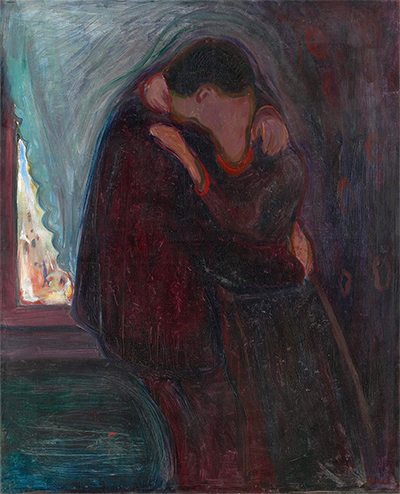
The second is The Kiss. Both paintings show closeness as a threat to individuality. The Kiss fuses two faces; Vampire bends one figure over another in a darker, more unequal embrace. [6]
The third route moves through Madonna and Dance of Life, where erotic imagery, generation and death become parts of the same cycle. [5]
Finally, compare it with Eye in Eye, a quieter attraction image. Together they show how Munch could move from encounter to fusion, possession and separation. [5]
FAQs
No. The motif was originally known as Love and Pain. Vampire became the dominant title through contemporary interpretation and later reception. [7]
It shows a red-haired woman bending over or kissing a dark-clothed man at the neck. The pose can be read as tenderness, possession, exhaustion or predation. [1]
Both works use women's hair as an active sign of attachment. In Separation hair binds across distance; in Vampire it envelops the man in a close embrace. [5]
Yes. Vampyr II is an important print version of the motif, and printmaking was central to Munch's repeated-image practice. [4]
Yes. It belongs to Munch's love/death route within the wider Frieze of Life, alongside works such as The Kiss, Separation, Madonna and Dance of Life. [2]
References
- Gerd Woll, Edvard Munch: Complete Paintings, London: Thames & Hudson, 2009.
- MUNCH, Edvard Munch, accessed 4 July 2026.
- MUNCH, Our Collection, accessed 4 July 2026.
- National Gallery of Art, Edvard Munch Master Prints, Washington, DC, 2010.
- Patricia G. Berman, ed., Edvard Munch: The Modern Life of the Soul, New York: Museum of Modern Art, 2006.
- Reinhold Heller, Edvard Munch: Life and Work, Munich: Prestel, 1993.
- "Kiss and Tell," The New Yorker, 20 January 1997, accessed 4 July 2026.
- eMunch, Edvard Munch's Writings: The English Edition, accessed 4 July 2026.