


 by Tom Gurney
Tom Gurney BSc (Hons) is an art history expert with over 20 years experience
Published on August 12, 2026 / Updated on August 12, 2026
Email: tomgurney1@gmail.com / Phone: +447429011000
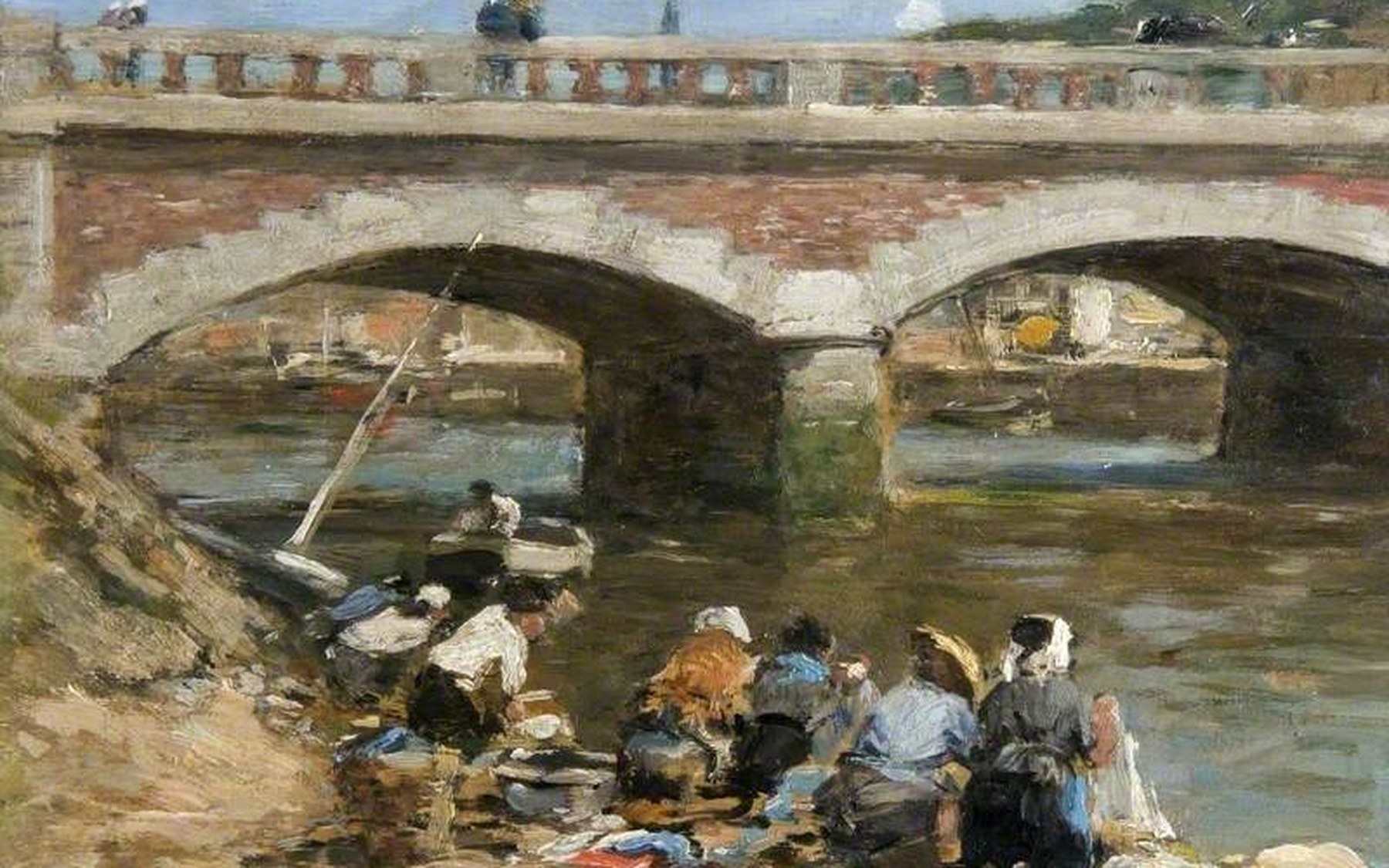
Eugène Boudin, Washerwomen on the Banks of the River Touques, c. 1885; public-domain image via Wikimedia Commons. Cropped for TheHistoryOfArt.org. · Image source
The first exhibition after reopening
The Burrells' Legacy: A Great Gift to Glasgow was the first temporary exhibition held at The Burrell Collection after its major refurbishment and March 2022 reopening. More than 100 objects and archive records traced the collection from Sir William and Constance, Lady Burrell's private life to the 1944 civic gift, the long search for a building and the continuing work of the Burrell Trustees.
The final official archive dates are 27 August 2022 to 25 February 2024. That extended run replaces shorter information associated with early publicity. The exhibition has ended, but its page remains useful because it explained the museum itself through evidence that is not always visible in the permanent galleries: annotated books, architectural competition entries, rarely shown works on paper and objects reunited from gifts to both Glasgow and Berwick-upon-Tweed.
The subtitle, A Great Gift to Glasgow, gave the show a celebratory frame. Its stronger achievement was to show that the gift was a process rather than one ceremonial moment. Collecting continued after 1944; the terms and location of a permanent home had to be negotiated; architects had to translate the collection into a building; and trustees later supported acquisitions, conservation and research.
From private rooms to a civic collection
At Hutton Castle, objects were part of the Burrells' daily environment. Paintings, ceramics, glass, pewter, furniture and carpets occupied domestic rooms rather than museum cases. The exhibition used that history to explain how the Burrells' experience of living with art influenced their ideas about display. Intimacy, natural light, landscape and the relation between decorative and fine art would later matter to the purpose-built museum.
The 1944 donation to Glasgow gave public form to decades of private collecting. It also created a problem of scale and responsibility. A collection spanning Chinese ceramics, medieval stained glass and textiles, sculpture, ancient objects and French painting could not simply be installed in an available room. It required conservation conditions, study, access and an architecture capable of holding very different materials together.
The exhibition's selection reflected that breadth. A Ming dynasty jar could sit within a history of Chinese collecting; a late medieval Swiss work such as The Wandering Housewife could represent the European holdings; Eugene Boudin's Washerwomen on the Banks of the River Touques connected the gift to nineteenth-century France. Their purpose was not to form a greatest-hits display, but to show how the Burrells' knowledge and tastes affected the future museum.
Collecting after the Glasgow gift
William Burrell did not stop acquiring objects once the 1944 agreement was made. The official exhibition history notes that ancient civilisations had rarely been a focus before the gift. He then sought to make the collection more representative of world history, adding ceramics, jewellery and art from Greece, Egypt and ancient Mesopotamia.
A mosaic floor fragment showing a vividly coloured cockerel gave that later phase a memorable anchor. Made around the turn of the first millennium and bought by Burrell in 1954, it had decorated a wealthy Roman villa. The object connects ancient craft to twentieth-century collecting, while its post-gift purchase demonstrates that the public collection was still taking shape.
Books were part of the process. Burrell's personal library contained more than 1,000 volumes, many extensively annotated, and was given to the city after Constance's death. In the exhibition, those books made research visible. Burrell compared, recorded and learned; the breadth of his later acquisitions did not emerge from taste alone.
This history also asks a critical question. Making a collection more geographically representative is not the same as creating a complete or neutral world history. Objects entered European markets through particular systems of excavation, trade and ownership. The exhibition showed Burrell expanding his frame, while current museum research must continue to examine how individual works travelled.
The other great gift: Berwick-upon-Tweed
The Glasgow donation was not the Burrells' only civic gift. In 1949 they gave 42 paintings to Berwick, helping establish the Berwick Art Gallery, and later donated more than 300 decorative-art objects including Chinese and Japanese porcelain, Venetian glass and pewter. The town was close to Hutton Castle and part of the couple's local life.
The Burrells' Legacy reunited some of this material with the Glasgow collection for the first time in a generation. Loans from Northumberland allowed visitors to compare works that had once shared domestic space but entered different public institutions. Japanese Imari porcelain from Berwick, not represented in the Glasgow holdings in the same way, appeared alongside Japanese woodcuts and other works on paper.
The reunion changed the story from “a collector gave everything to one city” to a more distributed legacy. Glasgow received the largest and most internationally recognised gift, but Berwick preserved another part of the Burrells' collecting and local philanthropy. The separation also shows how civic collections create new identities for objects. A vase in Berwick and a vase in Pollok may share a former owner while serving different institutions, audiences and regional histories.
Searching for the museum site
The collection waited decades for a permanent home. Various locations were considered during the early 1950s, but the Burrells' wish for a countryside setting and the practical demands of a large museum made the search difficult. William died in 1958 without seeing the building.
The decisive opportunity came when Dame Anne Maxwell Macdonald gave Pollok House and its estate to Glasgow in 1966. Pollok Country Park offered landscape, distance from the industrial city and enough space for purpose-built architecture. It also remained within Glasgow, enabling the city to meet the spirit of the Burrells' wishes without placing the museum beyond realistic public reach.
The site was not merely a blank piece of land. The eventual design had to respond to woodland, changing light and the scale of the existing estate. The exhibition's plans and archive documents showed how Glasgow Corporation, architects, trustees and others converted a collector's conditions into a public project.
The 1970 architectural competition
An architectural competition launched in September 1970 and received 242 entries. That scale reveals how significant and difficult the commission appeared. The archive preserves a striking range of responses, including proposals for three linked cow-shaped structures and an underground museum beneath five glass domes. These designs are best understood as evidence of the brief's imaginative pressure, not as a list of finalists.
Barry Gasson, Brit Andresen and John Meunier were announced as the winning team in March 1972. Their proposal used natural materials and views toward the park to join collection and landscape. A low building, glazed galleries and integrated historic fragments allowed the museum to feel both modern and responsive to the objects.
The long development continued through the decade. On 3 May 1978, the Burrells' daughter Silvia marked the beginning of work on site. The museum finally opened in 1983. Architectural plans in the exhibition helped visitors understand that the building's apparent calm was the result of competition, revision, funding, construction and years of negotiation.
Objects that explained a legacy
The exhibition's named highlights crossed periods and media. Utagawa Kunisada's Shoki the Demon Queller and Japanese ceramics connected Glasgow and Berwick material. The Wandering Housewife introduced late medieval imagery. Boudin's washerwomen represented the French art that made Burrell an important modern collector. The Roman mosaic cockerel stood for the expansion into ancient history after the gift.
These objects did more than illustrate chronology. They showed how collecting choices influenced architecture and display. Fragile works on paper need rotation and low light; stained glass benefits from an architectural relationship with illumination; carpets and tapestries demand large surfaces and careful environmental conditions; sculpture needs room around it. The museum brief grew from the material demands of the collection as much as from the donors' preferences.
The Trust and a collection that still grows
The Sir William Burrell Trust was established after William's death and continues to advise, fund acquisitions and support conservation and research. Its presence in the exhibition prevented the word “legacy” from referring only to the past. The collection did not stop in 1944 or 1983.
Two recent acquisitions made that point. The Trust acquired Camille Claudel's L'Implorante in 2021, making the Burrell the first public collection in the United Kingdom to acquire that work and, according to the museum, adding the first sculpture by a woman to the collection. Claudel's figure also extends a French sculpture route otherwise strongly associated with Rodin.
Joseph Crawhall's A Mallard Rising completed a different collecting story. Burrell bought eleven Crawhall works at a 1935 sale but missed the watercolour he most wanted. Nearly seventy-seven years later, the Trustees acquired it. The purchase should not be retroactively credited to William, but it demonstrates how documentary knowledge of his interests can inform a modern acquisition.
The Trust also supported the recent refurbishment, including new galleries and the visible store, and helped fund this inaugural exhibition. Acquisition, conservation, research, architecture and public access are therefore parts of one continuing responsibility.
How the exhibition changes a museum visit
The exhibition has ended and its loans have returned, but its interpretive route remains useful. In the permanent galleries, look for evidence of domestic display, the relationship between object material and building design, and labels that distinguish William's lifetime acquisitions from later additions. Use the museum's family, hidden-history and making displays to broaden the donor narrative.
Architectural archives also change the way the 1983 building is seen. Glazing, natural materials and the woodland relationship are not simply pleasant features; they answer a demanding brief shaped by the collection and the Burrells' ideas. The 2022 refurbishment then became another chapter in that architectural history rather than a fresh start.
For current planning, consult the museum page and the Glasgow art guide. This archive should not be read as a live exhibition listing. Its value is to preserve the objects, documents and comparisons through which the museum told its own creation story after reopening.
How to use this page
Because The Burrells' Legacy: A Great Gift to Glasgow has ended, the page should function as an archive record and a route into related artists, works and venues. The most reliable fixed details are the venue, dates, broad subject, media and official source link. The interpretive notes help place the exhibition in art-historical context: what kind of show it is, why it may matter, and which artists or topics are worth exploring next.
It is marked as a major exhibition in this guide, so it should be useful for readers choosing between several possible museum visits.
Looking notes
For a visitor, the most useful approach is to look for patterns rather than isolated highlights. With William Burrell, Constance Lady Burrell, 1944 gift, Berwick gifts, Pollok Country Park, museum architecture, Sir William Burrell Trust, collecting history, ask how the exhibition frames the subject: as biography, period survey, focused theme, collection display or reassessment. With media such as painting, sculpture, ceramics, stained glass, textiles, works on paper, architectural drawings, archive material, pay attention to changes of scale, surface, lighting, material and display sequence, because those details are often lost in online listings.
The guide avoids over-specific claims where the public source does not yet support them. If a museum has not published a full object list, it is better to stay clear about what is confirmed than to imply certainty.
Who it is best for
The Burrells' Legacy: A Great Gift to Glasgow is most likely to help readers who are already interested in William Burrell, Constance Lady Burrell, 1944 gift, Berwick gifts, Pollok Country Park, museum architecture, Sir William Burrell Trust, and collecting history, but it may also be useful for visitors building a wider route around The Burrell Collection in Glasgow. If time is limited, use this page to decide whether the subject fills a gap in your knowledge, whether it connects to artists you already follow, and whether the official venue information makes the visit practical.
_-_Washerwomen_on_the_Banks_of_the_River_Touques_-_35.46_-_Burrell_Collection.jpg)