by Tom Gurney
Tom Gurney BSc (Hons) is an art history expert with over 20 years experience
Published on August 12, 2026 / Updated on August 12, 2026
Email: tomgurney1@gmail.com / Phone: +447429011000
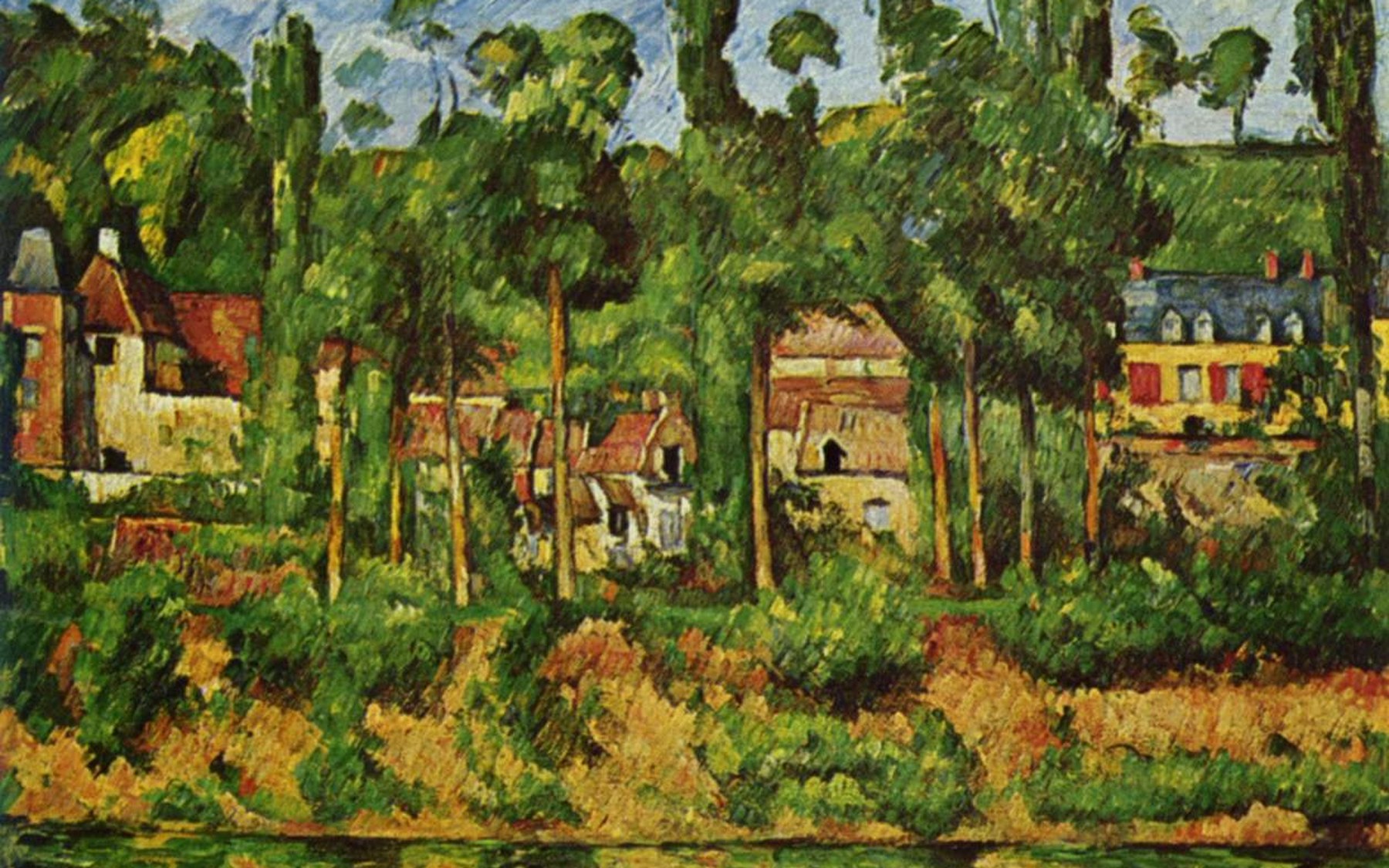
Paul Cézanne, Le Château de Médan, c. 1879–1880; public-domain image via Wikimedia Commons. Cropped for TheHistoryOfArt.org. · Image source
Current and upcoming exhibitions
These exhibitions are placed high on the page because they are the clearest reason to plan a visit around this museum now.
Why the Burrell Collection is different
The Burrell Collection is both a museum and the outcome of a long argument about how art should be seen. Its approximately 9,000 objects range across about 6,000 years, yet the collection was assembled principally by one Glasgow shipping merchant, Sir William Burrell, and given to the city with his wife, Constance, Lady Burrell. Chinese ceramics, medieval stained glass, tapestries, Islamic carpets, ancient sculpture, arms and armour, furniture, silver and nineteenth-century French painting sit together because they formed one collector's changing field of attention, not because a later museum committee set out to build an encyclopedic survey.
That personal origin gives the museum unusual coherence and unusual complications. Burrell could be exacting, informed and remarkably adventurous. He bought across categories that many collectors treated separately and sought objects for their quality, material presence and usefulness within his own surroundings. His wealth came from shipping and investment, however, and the museum now asks visitors to consider the colonial commodity networks and unequal labour conditions that accompanied that business. The best way to understand the Burrell today is therefore neither as a neutral treasure house nor as a simple monument to one man. It is a civic collection whose beauty, history, architecture and sources of wealth need to be read together.
The purpose-built museum in Pollok Country Park is central to that experience. When it opened in 1983, it translated the Burrells' wish for a countryside setting into a low, light-filled modern building closely tied to woodland. A major refurbishment, redisplay and access project closed the museum in 2016 and brought it back in March 2022 with more public space, access to all three floors, a visible stores route and a wider range of interpretive voices. The result won Art Fund Museum of the Year in 2023. Awards are not a substitute for looking, but that recognition points to what makes a visit valuable: the collection, the building, the park and the revised interpretation work together.
William and Constance Burrell
William Burrell was born in Glasgow in 1861 and entered the family shipping business with his father and brother. The museum's history describes an early appetite for art: as a schoolboy, he used money intended for a cricket bat to buy a painting. The anecdote has the neatness of a foundation story, but the longer chronology matters more. Burrell collected for more than seventy-five years, learning through dealers, exhibitions, correspondence, travel and the repeated experience of living with works. By 1900 he was already respected for late Gothic and early Renaissance European art, tapestries, stained glass and late nineteenth-century French painting.
His business success made that activity possible. Burrell was not only spending inherited money. Shipping, the sale and purchase of vessels and carefully timed investments created the fortune that allowed him to buy on an exceptional scale. His collecting also coincided with a period when medieval art, Chinese ceramics and French painting were moving through an international market shaped by changing aristocratic fortunes, archaeological extraction, dealers and the growth of museums. A work that feels perfectly settled in Pollok today may have crossed several countries and ownership systems before Burrell acquired it.
Constance, Lady Burrell, must not be reduced to a name attached at the moment of donation. The collection was given by William and Constance together in 1944, and their life at Hutton Castle in the Scottish Borders forms part of the museum's interpretive story. Rugs, furniture, paintings, glass and sculpture were not held as an abstract museum inventory there; they were placed in rooms, handled, rearranged and folded into domestic life. The refurbished museum's Hutton Castle display uses that fact to help visitors imagine the collection before Pollok, while also making space for the family's staff and for the practical work that maintained such a home.
The 2022 redisplay extends the family story beyond the married couple. It brings forward William's mother, Isabella, and his sister Mary, whom the museum identifies as important to the family business and to the formation of his collecting. Their presence complicates the familiar image of the solitary male connoisseur. The collection unquestionably reflects William Burrell's eye and persistence, but its social history includes women, business partners, household employees, dealers, makers, previous owners and the many people whose labour moved goods and art across the world.
Collecting across categories
Burrell's strengths as a collector become clearest when the categories are allowed to speak to one another. He did not build only a paintings collection with a few decorative objects around it. The museum's own overview gives Chinese art and medieval European art equal prominence with French painting. More than 200 tapestries, extensive stained glass, arms and armour, carpets, embroidery, ceramics, silver and furniture create a material world in which surface, weight, colour and workmanship matter as much as artist names.
That breadth affects how a visitor should look. A painted portrait can be compared with a sculpted head, a piece of armour with the body it was designed to protect or display, and a carpet with the room in which it was once used. Medieval stained glass changes with daylight, while a pastel by Edgar Degas depends on fragile particles resting on paper. A Chinese vessel carries information through clay, glaze, firing, shape, inscription and use. The Burrell is especially good at making the physical life of art hard to ignore.
The collection also records changes in Burrell's interests. He was an important buyer of French art and acquired more than twenty works by Degas, yet later collecting pushed further into Chinese art and other fields. The 1944 gift did not end his attention. The inaugural post-refurbishment exhibition, The Burrells' Legacy: A Great Gift to Glasgow, explains that after committing the collection to the city, he continued acquiring material intended to make its historical and geographic range more representative. The museum is therefore not a frozen snapshot of one youthful taste. It is the record of decades of looking, reassessment and opportunity.
No single route can cover all of this fairly. A first visit is better organised around a handful of questions. How does a maker turn a difficult material into an image or useful object? How did Burrell's domestic display differ from the museum's current one? Which histories are visible in labels and which require further research? Why were some categories considered worthy of close connoisseurship while the makers of others remained anonymous? Those questions keep the collection alive and prevent the most famous names from swallowing everything around them.
The 1944 gift to Glasgow
William and Constance gave the collection to the City of Glasgow in 1944. The formal agreements were made in the spring of that year, and the gift came with strong ideas about where and how the objects should be housed. The art was not meant to be crowded into a smoky industrial centre. A countryside setting, away from damaging atmospheric conditions and with space around the works, was part of the Burrells' vision.
Those conditions were understandable as conservation and display principles, but they made a permanent home difficult to find. The collection was far too large and varied for a conventional house museum, while the required setting had to be accessible enough for the public and capable of supporting a purpose-built institution. William Burrell died in 1958 without seeing the final museum. The long gap between gift and opening is not a footnote; it is one of the defining chapters of the institution.
The gift was also a statement about public education. The museum's history links Burrell's decision to his belief in free access to learning and to Glasgow's civic life. That ideal has survived in the permanent collection's free admission, even though special exhibitions may be ticketed. It also places responsibility on the city. A gift of this scale requires conservation, research, public interpretation and a building capable of protecting materials with very different needs. Glasgow Life now manages the Burrell as part of the city's museums on behalf of Glasgow City Council.
The collection's civic status changes the ethical question too. Once a private collection becomes public, inherited descriptions and silences can be re-examined. Provenance, labour, colonial trade, gender, conservation and access are no longer matters only for a collector and his advisers. The museum's obligation is to make the material available while also making its histories more legible. The revised galleries and learning trails are best understood as one phase in that continuing responsibility.
Shipping, colonial commodities and hidden histories
The source of the Burrell fortune should be described precisely. Burrell & Son was established after slavery was abolished in the British Empire in 1834. That means it is wrong to say that William Burrell's company operated slave ships during the legal British transatlantic trade, and the museum does not claim that William or Constance personally owned enslaved people. It is equally wrong to treat the later shipping economy as detached from colonial exploitation.
The museum's own Burrell's Hidden History trail explains the connection. Burrell shipping carried commodities produced within colonial systems, including sugar transported directly to Glasgow by the family's Clyde Line. The wealth of merchants and trading partners had been shaped by slavery and empire, and British control continued to structure Caribbean economies after emancipation. The trail uses a sugar bowl and other objects to make those relationships visible: a refined household object can be connected to plantation labour, shipping, consumption and the unequal distribution of profit.
The same trail addresses the company's employment of Chinese sailors. Foreign sailors could be hired under different legal and wage conditions from white British workers, receiving lower pay and less food. It states that Burrell & Son employed a significant share of Chinese sailors working on British ships and recounts protest aboard the Strathyre, where crew members jumped overboard rather than continue in poor conditions. The history belongs inside a museum page because it changes the way "shipping success" should be understood. Commercial ingenuity and connoisseurship existed alongside labour inequality and racialised employment.
Other objects open further histories. An embroidered panel showing a young African page raises questions about children taken from their families, coerced domestic service and the use of Black figures as markers of status in European households. Pollok Country Park itself was formerly associated with the Stirling-Maxwell family, whose wealth included Caribbean plantations and compensation paid to slave owners after abolition. These are distinct histories, and they should not be folded carelessly into a single accusation. Their proximity shows why place, collection and city history need to be interpreted together.
The decolonial trail is not an erasure of the collection's beauty, nor a declaration that a short set of labels has resolved its past. It is an invitation to look at who made, moved, sold, used and profited from objects. Visitors can value a Chinese vase, a French painting or a Persian carpet while asking how it travelled and which economic structures made its purchase possible. The museum is strongest when those questions are allowed to remain present rather than being confined to a separate moral appendix.
Finding a home in Pollok Country Park
The eventual site emerged from another major civic gift. In 1966, Dame Anne Maxwell Macdonald gave Pollok House and its estate to Glasgow. The parkland south of the city offered the countryside setting the Burrells had wanted while remaining part of Glasgow. It also created the possibility of reading the new museum with the landscape rather than placing it as an isolated object on an urban street.
An architectural competition was launched in September 1970 and drew 242 entries. The surviving proposals ranged from serious modern museum schemes to highly speculative forms; The Burrells' Legacy later displayed archival designs that imagined linked cow-shaped structures or an underground building beneath glass domes. Such proposals reveal the difficulty of the brief. The architects needed to protect a diverse collection, accommodate reconstructed historic fragments and create a public museum that did not dominate the park.
The winning design is associated with Barry Gasson, John Meunier and Brit Andresen. It was commissioned in 1972 and took more than a decade to reach its public opening in 1983. The long development should discourage the idea that the building was a simple container produced after the collecting was complete. Its organisation, materials and relationship with the woods became a new interpretation of the collection.
The museum opened to major public attention and received more than a million visits in its first year, according to the institution's history. Its significance for Glasgow is often described in terms of culture-led regeneration. That claim can become too tidy if it suggests one museum transformed a post-industrial city by itself, but the Burrell did help establish a pattern of large civic cultural projects and brought an international collection into a landscape setting that visitors had to seek out.
The 1983 building and the park
The original building works through restraint. Its profile stays comparatively low against the woodland, and long areas of glazing make trees, weather and seasonal light part of the galleries. Rather than approaching art through a monumental staircase and sealed sequence of rooms, visitors repeatedly encounter views out. Stone, timber, glass and carefully controlled natural light create a setting that can feel domestic in scale even when the objects are large.
Historic architectural fragments are integrated into the museum, giving doorways, windows and stonework a new structural life. This approach echoes the way objects had inhabited Hutton Castle, but it is not a reconstruction of that house. The building creates transitions between intimate rooms, larger display areas and glazed routes. A medieval portal or stained-glass panel is experienced as part of an architectural sequence, while sculpture can be seen against the landscape.
The park relationship is more than scenery. The Burrells wanted art to be encountered away from the polluted industrial atmosphere associated with central Glasgow, and the building translates that conservation concern into a visitor experience. Woodland provides changing colour and movement outside the glass. The slow approach through Pollok Country Park separates the visit from a conventional city-centre museum day.
That setting also requires realistic planning. The museum is several miles south of central Glasgow, and a visit should not be squeezed between tightly timed stops elsewhere. Pollok House, park walks and the wider estate can extend the day, but the collection itself is large enough for a substantial visit. The practical reward for allowing time is that the building's quiet transitions and views become part of looking rather than an obstacle between famous objects.
Chinese art: material, dynasty and scale
The Burrell describes its Chinese holdings as among the largest and most comprehensive in Europe. That institutional claim is useful as an indication of scale, but a visitor benefits more from looking at how individual objects carry history. Ceramics can be read through body shape, clay, glaze, firing, painted decoration and the social settings for which they were made. Sculpture introduces ritual, belief, patronage and workshop practice, while small jades reward close attention to carving and symbolic form.
A Hongwu-period Meiping Vase from the early Ming dynasty is one of the museum's Top 30 highlights. Its five-clawed dragon, cloud forms and inscription make it more than an elegant blue-and-white vessel. The object opens questions about imperial symbolism, technical control at Jingdezhen and the way a vase can carry wishes for longevity. Its present museum status also sits at the end of a much longer history of making, use, discovery, trade and collecting.
The life-size Figure of a Luohan, dated 1484, works differently. It has bodily presence, an identified maker's inscription and a relationship to a larger group of temple figures. Seen in a glass-walled building in Scotland, it asks a visitor to imagine the architectural and religious context from which it came. That gap between original setting and current display should not be treated as a failure; it is a reason to use labels and digital interpretation carefully.
Chinese ceramics were one of Burrell's most sustained later interests, and the collection allows comparison across long periods rather than a single dynasty. A first visit should resist trying to memorise every reign and technical term. Choose a few contrasting forms: an early vessel, a strongly coloured glaze, a blue-and-white piece and a sculptural figure. Compare how surface and shape carry meaning, then look for information about where Burrell bought each work and how current scholarship describes its date or use.
Medieval Europe in glass, textile and metal
Medieval art is another defining strength. Stained glass, tapestries, sculpture, embroidery, arms and armour create an unusually broad route through objects made for churches, courts, houses and bodies. Their survival is often fragmentary. A glass panel may be one part of a dispersed window, a textile may have been cut or repaired, and a sculptural fragment may have lost the architectural framework that gave it meaning.
The stained-glass image of Princess Cecily, made about 1483-84 for Canterbury Cathedral, is a useful anchor. It once belonged to a royal window representing the family of Edward IV and Elizabeth Woodville. In Pollok, the panel can be studied close to eye level and against natural light, but the visitor should also imagine its original height, surrounding figures and sacred architecture. Its clarity today rests on both medieval craft and modern conservation.
The so-called fragment from the Temple Pyx, dated to about 1140-50, demonstrates how interpretation changes. Once thought to form part of a pyx, it is now understood as possibly belonging to a book cover, shrine or reliquary. A museum label that exposes that uncertainty is more informative than one that hides it. Attribution and function are research questions, not permanent facts fixed at the moment of acquisition.
Tapestries transform the scale of the route. The official overview records more than 200, placing the Burrell among important international collections in the field. These textiles were expensive, portable and architecturally powerful. They could warm walls, organise ceremonial space and display wealth through wool, silk, dye and labour. Look for changes in weave, colour and repair, and remember that many named subjects were produced by workshops whose individual makers remain unrecorded.
Arms and armour add another relationship between beauty and power. Highly finished metalwork can be technically dazzling while remaining connected to violence, rank and performance. The shield associated with Henry VIII and Jane Seymour, for example, belongs to courtly representation as much as defence. The current galleries' thematic approach can help visitors place such objects beside portraits, textiles and furniture rather than treating armour as an isolated specialist category.
Islamic carpets and the Wagner Garden Carpet
The Islamic collection is especially strong in carpets. The refurbished museum can show objects that spent long periods in store, including the Wagner Garden Carpet, a seventeenth-century Persian work described by the Burrell as one of the three earliest surviving garden carpets. Its design sets plants, animals and ordered paths within an imagined garden, connecting textile pattern to ideas of enclosure, abundance and paradise.
The carpet's scale and fragility shaped its history. William Burrell bought it in 1939 and used it at Hutton Castle, yet it was rarely shown after the museum opened. Conservation and lending restrictions limited exposure. A loan to the Metropolitan Museum of Art during the Pollok refurbishment placed it within galleries of Islamic art and encouraged a wider reading of garden imagery. Its return to long-term display is therefore one of the clearest benefits of the new environmental and gallery conditions.
Do not stop with the famous carpet. The Islamic carpet displays include a Persian arabesque carpet and a Mughal fragment with composite or grotesque animals, allowing comparison between geometric order, vegetal ornament and invented creatures. The collection also contains ceramics and architectural material, including a wall tile carrying part of a Quranic verse. These objects connect writing, belief, architecture and surface in ways that a paintings-led tour might miss.
Carpets also make the Burrells' domestic use of art unusually visible. At Hutton Castle, valuable textiles could lie beneath other carpets or furnish bedrooms and drawing rooms. That use differs from today's museum presentation, where low light, barriers and interpretive media foreground preservation. Neither setting is neutral. One emphasised private possession and atmosphere; the other turns the textile into a public object of study.
Ancient objects and the afterlife of collecting
The collection's ancient material stretches the museum beyond the medieval and modern categories for which Burrell was best known. The Warwick Vase, a monumental Roman marble vessel associated with Hadrian's Villa at Tivoli, is the most recognisable example. Excavated in the eighteenth century, restored and assembled for a European aristocratic market, it reached the Earl of Warwick before entering the Burrell Collection.
Its appeal lies partly in size and theatricality, but its history also demonstrates that an "ancient" object can contain modern interventions. Restoration supplied missing elements and adapted archaeological fragments to later expectations of classical wholeness. Looking at the vase means looking at Roman carving, excavation, eighteenth-century collecting, restoration and twentieth-century transfer together.
Egyptian, Greek and Mesopotamian material entered Burrell's attention more strongly around the period of the gift. The collection's post-refurbishment interpretation uses these objects to discuss the widening of his ambitions, while avoiding a false impression that the ancient holdings form a complete history of those civilisations. A selective group can still illuminate funerary practice, trade, bodily representation and the modern market for antiquities.
Provenance is especially important here. Where was an object found, under what legal and political conditions did it leave, and how securely can its ownership be traced? The current page cannot answer those questions object by object, but visitors should look for them. The visible stores and digital collection resources make it easier to understand that catalogue records continue to develop after objects enter a museum.
Degas and nineteenth-century French art
For many visitors, the nineteenth-century French holdings provide the most familiar names: Edgar Degas, Édouard Manet, Paul Cézanne, Auguste Rodin, Gustave Courbet and Jean-François Millet. Burrell bought French art when British reactions to Impressionism and related movements were still mixed, and his Degas holdings became the largest assembled by a single British collector. The 2024 exhibition Discovering Degas brought all 23 works from the Burrells' original Degas collection together with loans, demonstrating how much information remains when a familiar artist is examined through collecting history.
The Red Ballet Skirts, a pastel of dancers waiting and adjusting themselves at the edge of performance, is a strong first object. Degas turns repetition, strain and offstage behaviour into an image that resists the glamour of a finished spectacle. Pastel gives vivid colour and immediacy, but its powdery surface is vulnerable, which helps explain why works on paper require careful lighting and rotation.
Portrait of Edmond Duranty presents a different Degas. The critic and novelist sits surrounded by books, compressed within a narrow study. It can be read as a portrait of intellectual labour, a friendship and a modern interior. Compare it with dancers or racecourse subjects and the artist's range becomes clearer: Degas was interested not in one theme but in bodies and attention under particular social conditions.
Manet's paintings introduce modern urban life and the instability of looking. Women Drinking Beer can be approached through pose, class, public leisure and the conventions used to represent women in the city. The central galleries explicitly connect works to themes such as the male gaze, allowing the museum to question older descriptions that treated women as passive subjects without examining the viewer's position.
Cézanne brings structure and uncertainty to landscape, while Rodin's The Thinker offers one of the collection's most recognisable silhouettes. Familiarity can make such an object hard to see. Walk around it, notice the compression of torso and limbs, and compare the sculpture's physical tension with the popular idea of calm contemplation. The Burrell is most rewarding when famous works are used as gateways into close looking rather than endpoints for recognition.
Closing the museum and rethinking it
By the twenty-first century, the 1983 building needed substantial work. Environmental performance, water-tightness, glazing, services, access and the amount of publicly usable space all required attention. The museum closed in October 2016. During the closure, objects travelled to exhibitions in Britain and abroad, enabled in part by changes to the collection's lending framework, while the Pollok building underwent a project reported at approximately £68 million.
John McAslan + Partners led the architectural and landscape refurbishment, working with the listed original rather than replacing it. Roof, glazing and cladding were upgraded; power, heating and lighting systems were renewed; and the building became more stable and energy efficient. The completed project was reported as achieving BREEAM Excellent, a notable outcome for refurbishment of a listed museum with demanding conservation conditions.
The visible transformation is spatial. Visitors can now access all three floors. A central hub with stairs and lifts improves orientation, two additional entrances include level access, and new upper galleries and lower-ground spaces increase the public route by more than a third. The Stores Experience lets visitors see how objects not currently displayed are housed and cared for, making collection management part of the museum rather than a hidden backstage function.
Event developed the visitor experience and displays across the building. The project was informed by consultation with more than 15,000 people, according to Glasgow Life. That figure matters because the redesign was not framed only as an expert conservation exercise. Schools, community groups and local visitors contributed to questions of access, interpretation and what the museum should feel like.
The Burrell reopened to the public on 29 March 2022. The building still reads as the 1983 museum, but circulation, environmental control, public space and interpretation have changed substantially. That balance is one of the project's achievements: it treats modern architecture as heritage while refusing to freeze the visitor experience in the early 1980s.
A redisplay built around stories and access
The new displays do not follow a single chronological march. Some galleries remain grounded in collection categories, while central spaces use themes such as fashion, books, kindness, refugees, slavery and the male gaze. This approach can bring distant objects into productive conversation, although it also asks visitors to move between object history and contemporary interpretive themes. The best labels make that movement explicit rather than suggesting that one theme explains an object completely.
Digital interpretation is extensive. Films, games, reconstructions and close-looking tools create multiple routes into fragile or complex works. The immersive Hutton Castle space helps explain domestic display; making-focused sections draw attention to tools and technique; and conservation material shows how technical study changes attribution or understanding. More than one hundred pieces of digital interpretation were noted by Art Fund when the museum won its 2023 award.
Access is treated through the building and the content. The central lift and level entrances address movement, while BSL, captions, multiple community languages, large text and family trails expand the ways information is encountered. The official visitor page records wheelchairs, a hearing loop, quiet space and changing-places facilities. These provisions can change, so readers with specific requirements should consult the live access information before travelling.
Interpretive access also means acknowledging people previously left out. The redisplay makes the female Burrells more visible, supports LGBTQ+ and decolonial trails and includes community voices. Such work should be judged as ongoing museum practice. It does not make the collection's difficult histories disappear; it makes them easier to research, challenge and discuss in public.
Museum of the Year 2023
Art Fund named the Burrell Collection Museum of the Year in July 2023. The award carried a £120,000 prize and was decided by a panel that considered the collection, renovation, accessibility, interpretation and community involvement. The judges particularly noted the relationship between the building and Pollok Country Park, the sensitive refurbishment and the way digital displays opened new routes into the objects.
The title should be kept in proportion. It recognised a particular period of work and does not mean that the Burrell has no unresolved research, access or ethical questions. Its value for a visitor is as independent confirmation that the 2022 reopening changed more than surfaces. The project joined architecture, conservation, collection redisplay and public engagement at a scale that affected how the entire museum works.
Attendance also indicates a strong public response. The museum reported more than half a million visitors in the first year after reopening and its millionth visitor in February 2024. Those figures are striking for a museum outside the city centre, but the quieter achievement is that repeat visits now make sense. Only part of a 9,000-object collection can be displayed at once, rotations alter the highlights and temporary exhibitions create new ways into the permanent holdings.
How to plan a first visit
Allow at least half a day if this is your first visit. The Burrell is not a compact highlights room, and reaching Pollok Country Park takes longer than walking between central Glasgow museums. The official site provides current bus, train, shuttle, cycling, driving and parking information. Check it shortly before travelling because park access, timetables and charges can change.
A practical first route begins with the building. Notice how the entrance, stone fragments, glazing and woodland establish the museum's scale. Then choose two collection strengths rather than attempting every gallery at equal speed. Chinese art and medieval Europe make a strong pair because they reveal Burrell's eye for material and craft. Follow with the central galleries for French art and thematic interpretation, then visit the Islamic carpets or ancient objects according to interest.
Use the lower-ground Stores Experience near the end rather than treating it as an optional extra. It explains why a large collection cannot all be on view and how conservation, documentation and rotation shape what visitors see. If a temporary exhibition is open, decide in advance whether it should replace one permanent route; adding it to an already exhaustive plan can turn the visit into a race.
The permanent collection is currently free, while some special exhibitions may be ticketed. The museum provides food, seating, family facilities and step-free routes, but exact hours and services remain live information. Visitors coming for one named Top 30 object should also check the museum's warning that rotations mean not every highlight is always displayed.
Pollok Country Park can extend the visit through woodland, gardens and Pollok House, but weather and walking distance matter. A calm museum-and-park day is usually more satisfying than trying to add several distant Glasgow venues. For wider planning, use the Glasgow art guide to separate the Pollok route from a city-centre or West End museum day.
A collection still being interpreted
The Burrell Collection rewards confidence and doubt at the same time. Its objects demonstrate the confidence of a collector who believed he could recognise quality across cultures and periods. The modern museum introduces doubt by showing how attributions change, how objects leave original settings, how private wealth is produced and how inherited display systems privilege some stories over others.
That tension is productive. Princess Cecily can be admired as stained glass and understood as a surviving fragment of royal and ecclesiastical power. A Meiping Vase can be studied for its glaze and dragon while prompting questions about imperial production and international collecting. A Degas pastel can be moving while the exhibition history reveals how British taste was formed. The Wagner Garden Carpet can offer extraordinary pattern and colour while its movement from Persia to Hutton Castle and Pollok remains part of the work's modern biography.
The museum's 2022 form gives visitors more tools for these readings than the building offered before closure. It also leaves space for future scholarship. Provenance research, community interpretation and object rotation will continue to change what is known and shown. That is the best reason to regard the Burrell not as a completed monument to a collector, but as a public collection whose meanings are still being made in Glasgow.
Sources and further reading
Use these official museum pages, object records and exhibition sources to check details and keep exploring.
- Fast Facts
Headline collection and gift facts - The Collection, the gift to Glasgow and the charity that cares for it
Core institutional history - About the refurbishment
Refurbishment scope - Galleries and Displays
Redisplay and interpretation - The Burrell Collection in Glasgow reopens following major refurbishment
Dated reopening and architecture source - The Burrell Collection Top 30 Highlights
Representative object route - Central Galleries
Current thematic display route - Islamic Carpet Displays
Islamic collection route