by Tom Gurney
Tom Gurney BSc (Hons) is an art history expert with over 20 years experience
Published on August 12, 2026 / Updated on August 12, 2026
Email: tomgurney1@gmail.com / Phone: +447429011000
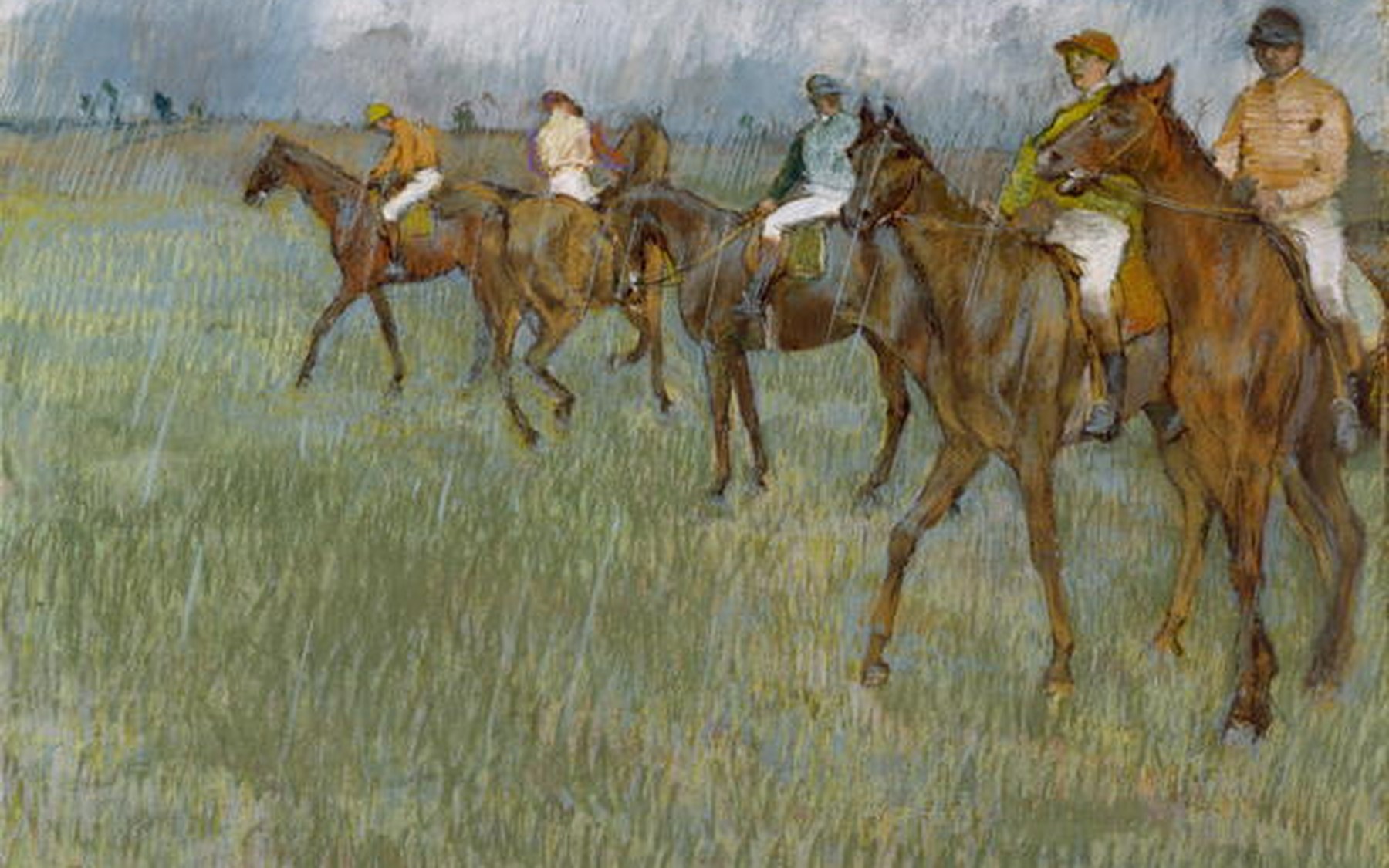
Edgar Degas, Jockeys in the Rain, 1886; public-domain image via Wikimedia Commons. Cropped for TheHistoryOfArt.org. · Image source
Why this exhibition mattered
Discovering Degas: Collecting in the Time of William Burrell brought together all 23 works from the Burrells' original Degas collection for the first time, placing them beside 28 further paintings, works on paper and sculptures borrowed from 13 collections in Britain and Europe. Two additional Degas works from the wider Glasgow Museums collection extended the local context. Held at The Burrell Collection from 24 May to 30 September 2024, it was the museum's first major international exhibition after its 2022 reopening.
The scale alone was not the main achievement. Sir William and Constance, Lady Burrell acquired Degas over roughly forty years, building the largest group by the artist formed by a single collector in Britain. Reuniting that holding made their decisions visible. Visitors could follow subjects, media and dates across a collection normally divided by display needs and works-on-paper rotations, then use loans to test what the Burrells bought against what they left out.
The exhibition also shifted attention from ownership to collecting practice. Letters, a 1911 purchase book, annotated records and transport receipts showed Burrell researching, acquiring and lending works. This archival material placed connoisseurship inside a network of dealers, museum directors, exhibitions and other collectors. Degas became a route into the formation of British taste for modern French art.
Reconciling the official object counts
The Burrell's archive page describes “around 30” loans and “more than 20” works from the Burrell collection. Its dated opening release is more exact: all 23 works from the original Burrell Degas collection appeared with 28 additional loans from 13 national and international collections. The release separately identifies two Degas works from wider Glasgow Museums holdings.
One promotional sentence in the same material refers to more than seventy works, but the published itemisation does not explain that basis. This archive uses the auditable 23-plus-28 breakdown and keeps the two additional Glasgow works separate rather than converting inconsistent publicity language into a false checklist total.
Burrell as an early Scottish Degas collector
Burrell began buying Degas when British responses to Impressionism and related French art remained unsettled. The artist's modern subjects, unusual viewpoints and lack of conventional flattery could appear radical. Burrell's interest was sustained rather than opportunistic: the holdings span much of Degas's career and move between painting, pastel and drawing.
Woman Looking Through Field Glasses, about 1869, was identified by the museum as the first Degas painting Burrell bought that remained in the collection. The subject is characteristic of Degas's interest in looking: the woman's optical device directs attention beyond the picture while partly concealing her face. A work like this makes collecting history tangible. It is not simply “an early Degas”; it marks an early decision in Burrell's long relationship with the artist.
The exhibition did not present him as the only perceptive British buyer. Its wider context included Glasgow shipbuilder William McInnes and women collectors such as Elizabeth Workman and Rosalind Maitland. Van Gogh's portrait of the Glasgow dealer Alexander Reid helped place dealers and intermediaries within that network. These figures complicate the familiar story in which French modernism travels to Britain only through London institutions.
Degas beyond the Impressionist label
Degas participated in the Impressionist exhibitions, but his practice never fits comfortably into a narrow idea of painting outdoors in broken colour. Drawing remained fundamental. He worked across oil, pastel, printmaking and sculpture, repeatedly returning to bodies in movement, performance, labour and private routines. The Glasgow exhibition used this variety to show why his work could attract a collector interested in both disciplined draftsmanship and modern subjects.
Unexpected viewpoints are part of that modernity. Figures are cropped, seen from above, placed at the edge of a composition or caught between actions. The influence of Japanese woodcuts offered one context for these arrangements, but the results are not simple borrowings. Degas used spatial imbalance to make looking feel active and sometimes uncomfortable.
The loans were especially useful where Burrell's own purchases left gaps. Art Fund noted that he did not collect Degas sculpture, despite owning important French bronzes by Rodin. Borrowed sculptures therefore did more than add variety. They showed modelling, found materials, movement and the posthumous casting history that cannot be understood through paintings and pastels alone.
Ballet without sentimentality
Ballet remains the most recognisable Degas subject, but the exhibition resisted treating dancers only as graceful performers. The Red Ballet Skirts, about 1900, shows figures waiting, stretching or adjusting themselves at the edge of performance. The strain and repetition of work remain visible beneath the vivid colour. Degas's backstage access allowed him to study rehearsal, fatigue and preparation as well as spectacle.
Loans such as Before the Performance and studies related to The Fourteen-Year-Old Dancer expanded that route. The famous dancer sculpture is important partly because it was the only sculpture Degas exhibited during his lifetime and because its original combination of wax, fabric and human hair challenged the boundaries of conventional sculpture. Studies and later bronzes can preserve the pose while changing the object's material and historical status.
The useful question is therefore not whether Degas loved ballet, but what the subject allowed him to test. Repeated poses reveal balance and exertion; stage light produces unnatural colour; wings and rehearsal rooms create compressed spaces; and the relation between spectators, patrons and young dancers introduces social power. Close looking should leave room for both formal experiment and the conditions of performance.
Racehorses, modern Paris and labour
Racecourses gave Degas another language of bodies under tension. Jockeys in the Rain, Jockeys Before the Race and a bronze Horse Trotting brought different media to speed, anticipation and controlled movement. The subject also belonged to modern leisure, money and spectatorship. Horses and riders are not isolated anatomical studies; they occupy a social world organised around training, betting and display.
L'Absinthe, loaned by the Musee d'Orsay, provided a darker image of Parisian modernity. Its two figures sit close together yet appear psychologically distant. When the picture was shown in Britain in the nineteenth century, its subject and lack of moral reassurance provoked hostility. In the Burrell exhibition it gave historical substance to the question of how British viewers learned to accept Degas.
A rare loan of Woman Ironing from Liverpool widened the account beyond ballet and leisure. The laundress joins Degas's sustained attention to repetitive labour and bodily fatigue. It also complicates any idea that his women belong only to entertainment or private bathing. Modern life in these works includes work, exhaustion and class.
Portraits, bathing and the politics of looking
The pairing of Degas's portraits of the critics Edmond Duranty and Diego Martelli was one of the exhibition's most useful comparisons. The two works had been intended as companions but had not been seen together for decades. Duranty appears surrounded by books in the Burrell painting, while Martelli offers a related study of intellectual presence and compressed space. Together they show Degas constructing modern portraiture through setting and viewpoint rather than ceremonial pose.
Works of women bathing and dressing raised more difficult questions. Pastels and charcoal drawings such as Woman in a Tub and After the Bath gave Degas opportunities to study turning, reaching and balance, but they also place the viewer in relation to private bodies. The official interpretation acknowledged the long debate over voyeurism and misogyny rather than resolving it with a single answer.
A responsible reading must hold formal and social questions together. Degas's cropping, colour and repeated study of movement are genuinely experimental. The women represented are also observed within a culture of gendered access and looking. The archive remains useful because the exhibition invited that tension rather than presenting “modernity” as an automatically progressive value.
Loans as an art-historical argument
The 28 loans came from institutions including the Musee d'Orsay, Tate, the Courtauld, the National Gallery, National Galleries of Scotland, the Barber Institute, the Walker Art Gallery, the British Museum and others. The Weston Loan Programme with Art Fund supported the borrowing. That mechanism matters for a local-authority museum: it allows a strong permanent holding to be tested against works that usually remain elsewhere.
Good loans create comparisons that one collection cannot supply on its own. Sculpture revealed a medium Burrell did not buy. L'Absinthe exposed the controversy around modern subjects. The Martelli portrait completed a pair. Rarely lent works such as Woman Ironing extended the subject range. The result was not a generic “best of Degas” assembled by reputation, but an argument shaped around one collector's choices and omissions.
The archive inside the exhibition
Receipts and purchase books can look modest beside major paintings, yet they changed the visitor's understanding of the collection. A 1911 record showed Burrell documenting acquisitions and research. Correspondence linked him with dealers and museum figures in Glasgow, London and elsewhere. Transport receipts showed that privately owned works were lent and circulated before the 1944 civic gift.
These materials replace the myth of instinctive connoisseurship with evidence. Burrell looked, read, negotiated, recorded and compared. Markets and relationships shaped what was available. The exhibition's archive section therefore belonged to its central argument: collecting is a historical practice that can be reconstructed and questioned.
How to use the archive page now
The exhibition has ended and should not be used for current travel planning. Its value is as a record of a display that cannot be recreated easily. The 23 original Burrell works have returned to the museum's normal rotation, while loans have gone back to their collections. Individual works may not always be visible because paper and pastel require careful conservation.
Visitors to the Burrell can still use the exhibition's questions. Look for The Red Ballet Skirts, Portrait of Edmond Duranty and other Degas works when displayed, then compare them with Manet, Cezanne and Rodin. The Glasgow guide places the museum within a realistic Pollok Country Park visit rather than presenting this closed exhibition as a current event.
How to use this page
Because Discovering Degas: Collecting in the Time of William Burrell has ended, the page should function as an archive record and a route into related artists, works and venues. The most reliable fixed details are the venue, dates, broad subject, media and official source link. The interpretive notes help place the exhibition in art-historical context: what kind of show it is, why it may matter, and which artists or topics are worth exploring next.
It is marked as a major exhibition in this guide, so it should be useful for readers choosing between several possible museum visits.
Looking notes
For a visitor, the most useful approach is to look for patterns rather than isolated highlights. With Edgar Degas, William Burrell, Constance Lady Burrell, British collectors, Impressionism, ballet, racehorses, modern Paris, collecting history, ask how the exhibition frames the subject: as biography, period survey, focused theme, collection display or reassessment. With media such as painting, pastel, drawing, sculpture, archive material, pay attention to changes of scale, surface, lighting, material and display sequence, because those details are often lost in online listings.
The guide avoids over-specific claims where the public source does not yet support them. If a museum has not published a full object list, it is better to stay clear about what is confirmed than to imply certainty.
Who it is best for
Discovering Degas: Collecting in the Time of William Burrell is most likely to help readers who are already interested in Edgar Degas, William Burrell, Constance Lady Burrell, British collectors, Impressionism, ballet, racehorses, modern Paris, and collecting history, but it may also be useful for visitors building a wider route around The Burrell Collection in Glasgow. If time is limited, use this page to decide whether the subject fills a gap in your knowledge, whether it connects to artists you already follow, and whether the official venue information makes the visit practical.