by Tom Gurney
Tom Gurney BSc (Hons) is an art history expert with over 20 years experience
Published on July 14, 2026 / Updated on July 16, 2026
Email: tomgurney1@gmail.com / Phone: +447429011000
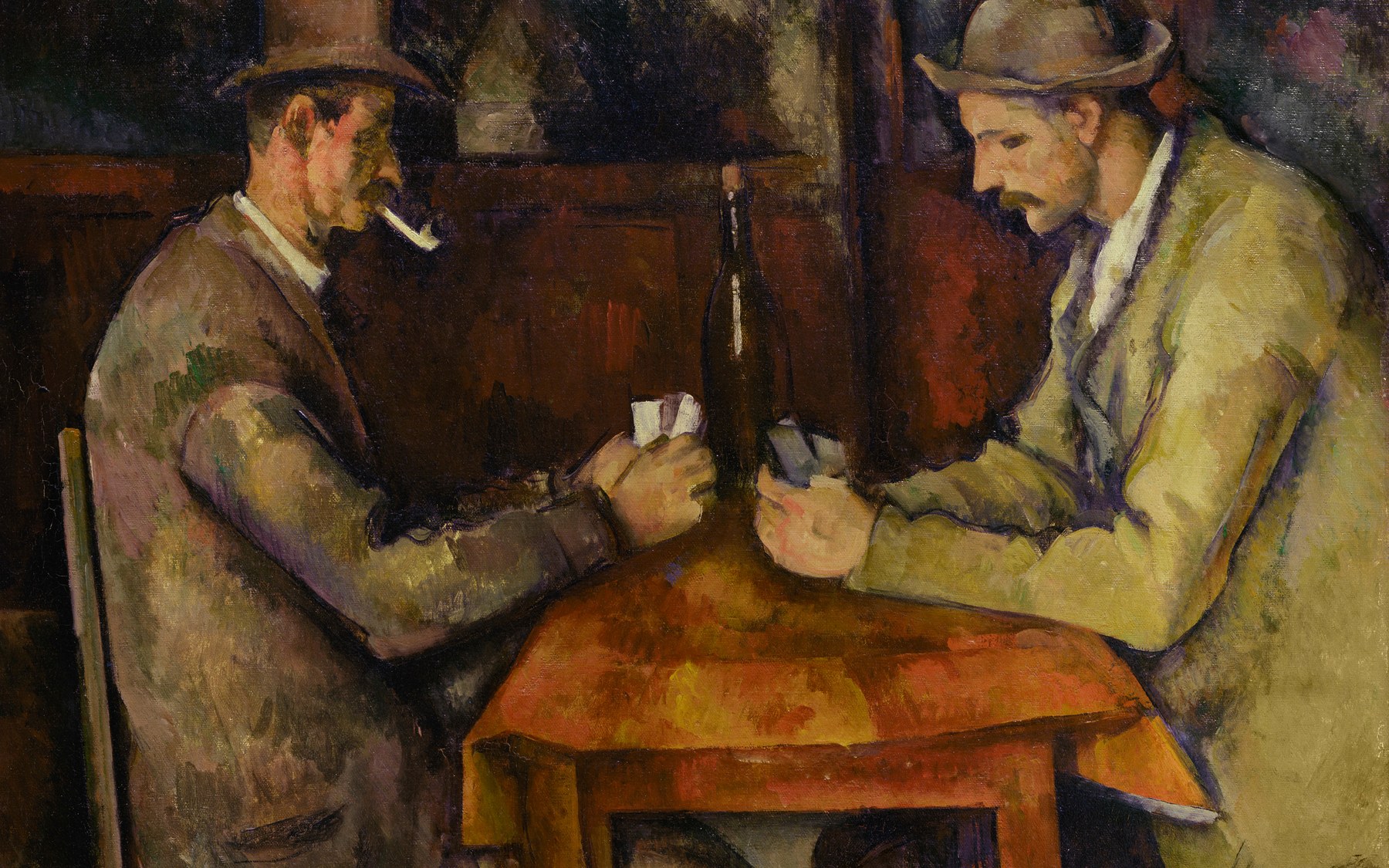
Les Joueurs de cartes, par Paul Cézanne.jpg by Paul Cézanne; Public domain via Wikimedia Commons. Cropped for TheHistoryOfArt.org. · Image source
What to expect
Cezanne and Us is an upcoming exhibition at the Grand Palais in Paris, scheduled from 23 September 2026 to 17 January 2027. It appears in the Musée d'Orsay programme as an off-site exhibition, with the Grand Palais listed as the venue. The official Orsay page describes a major co-production by Grand Palais-Rmn, the Centre Pompidou and the public institution of the Musée d'Orsay and Musée de l'Orangerie. That institutional mix is a clue to the exhibition's ambition: this is not only a Cezanne display, but a history of how Cezanne became Cezanne.
The exhibition aims to present Paul Cezanne's body of work through his artistic legacy, using what Orsay calls a concise, ongoing dialogue. Its subject is reception as much as production. How was Cezanne seen, bought, misunderstood, mythologised, exhibited, absorbed by modern artists and later reinterpreted? The page therefore belongs in the guide as a serious exhibition-history record, not just another famous-name listing.
Orsay's description begins with the artist in relative seclusion in Aix, when some people reportedly wondered whether he really existed, and moves toward the twentieth-century Cezanne myth: the idea of Cezanne as a founding father of pictorial modernity. The exhibition asks which Cezanne was being received at each moment. Was he an Impressionist outsider, a Symbolist touchstone, a structural modernist, a painter for collectors, a model for avant-garde artists, or a problem that later artists kept returning to?
Why it matters
The strongest reason to go is that Cezanne is one of those artists whose importance can become too easy to repeat. He is routinely placed between Impressionism and modern art, but that formula can make the actual history feel inevitable. Cezanne and Us appears to work against that inevitability. It follows the milestones through which Cezanne's reputation was built: private collectors, artist-buyers, Père Tanguy, Ambroise Vollard's first monographic exhibitions, the Caillebotte bequest to the Musée du Luxembourg, the Autumn Salon and major international exhibitions.
That reception history matters because modern art is made not only in studios. It is made by dealers, collectors, critics, exhibitions, bequests, state museums, reproductions, studio myths and later artists looking back. Cezanne's paintings changed painting, but the public idea of Cezanne was also constructed. A Grand Palais exhibition can make that construction visible, especially when it alternates historical re-creations with rooms where works confront one another more directly.
The official page also makes a useful correction. It says the exhibition views Cezanne less through the history of Impressionism than through the emerging Symbolist movement, with Maurice Denis's Hommage à Cezanne as a key reference. That is important because Cezanne is often explained through formal reduction and the road to Cubism. A Symbolist and reception-history angle can open a broader story: admiration, myth, spiritual seriousness, artistic brotherhood, collecting culture and the transformation of one painter into a modern ancestor.
What to look for
Begin with the phrase "Cezanne as seen by." It suggests that the exhibition is not asking visitors to see a single pure Cezanne, stripped of later interpretation. Instead it asks how different people and moments produced different versions of him. A collector's Cezanne may differ from a dealer's Cezanne. A Symbolist Cezanne may differ from a Cubist Cezanne. An interwar Cezanne may differ from a postmodern Cezanne. The same painting can become evidence for several histories.
Then look for exhibition re-creation. If the display reconstructs historical presentations, ask what that changes. Seeing works in relation to Vollard, the Autumn Salon, the Musée du Luxembourg or international exhibitions can make the paintings feel less timeless and more contingent. A work's meaning can shift when it moves from studio to dealer wall, from private collection to state museum, from avant-garde reference point to canonical masterpiece.
Pay attention to Sainte-Victoire, still life and figure painting as recurring testing grounds. Cezanne's mountain, apples, bathers and portraits are familiar motifs, but in this context they can become problems inherited by later artists. What did subsequent painters take from him: geometry, weight, doubt, colour structure, repeated motif, resistance to finish, or the idea that painting could rebuild visible reality from within?
The international afterlife is another route. Orsay's page says the exhibition follows Cezanne's national and international reception, from the European avant-garde of the 1910s to interwar and contemporary art, including lyrical abstraction, hard-edge painting and postmodernism. That makes the exhibition unusually broad. It is about influence, but not in a simple line. Influence can mean reverence, argument, simplification, rejection, parody, continuation or theft of authority.
How it fits Grand Palais and Paris
This page adds the Grand Palais as a new Paris venue in the guide while keeping the source relationship clear: Cezanne and Us is part of the Orsay/Orangerie programme but is shown off-site at the Grand Palais, in Galleries 3 and 4. That matters for practical planning. A reader who assumes everything listed by Orsay happens inside the Musée d'Orsay could go to the wrong building. This page should make the venue distinction plain.
The exhibition strengthens the Paris and France clusters because it connects several institutions rather than one museum only. Grand Palais-Rmn supplies the major exhibition venue and production context; Centre Pompidou brings modern and contemporary art history; Orsay and Orangerie bring nineteenth-century and early modernist depth. Cezanne is exactly the kind of artist who benefits from that combined lens because his reputation crosses Impressionism, Symbolism, modernism and contemporary reception.
For readers, the page is a useful bridge between temporary exhibition planning and evergreen art history. It can later connect to Cezanne, Impressionism, Symbolism, Cubism, Maurice Denis, Ambroise Vollard, the Caillebotte bequest, artists' collecting, exhibition history and the idea of movements forming across international boundaries. It also fits the future-feature plan around movement timelines and influence across borders.
Image and rights note
The underlying Cezanne works are historic because he died in 1906, so public-domain routes may be possible. The official Orsay page uses La Montagne Sainte-Victoire au grand pin with a Courtauld credit, and Grand Palais, Orsay, Centre Pompidou, lender and press images may carry separate usage terms. Later sections of the exhibition may include modern or contemporary responses with higher rights caution. This page remains image-free until a reviewed source and credit route is selected.
How to use this page
Because Cezanne and Us is upcoming, the page should help a reader decide whether to plan a future trip or watch for reviews and final venue details. The most reliable fixed details are the venue, dates, broad subject, media and official source link. The interpretive notes help place the exhibition in art-historical context: what kind of show it is, why it may matter, and which artists or topics are worth exploring next.
It is marked as a major exhibition in this guide, so it should be useful for readers choosing between several possible museum visits.
Looking notes
For a visitor, the most useful approach is to look for patterns rather than isolated highlights. With Paul Cezanne, Aix-en-Provence, Cezanne myth, pictorial modernity, Père Tanguy, Ambroise Vollard, Caillebotte bequest, Musée du Luxembourg, Autumn Salon, Maurice Denis, Hommage à Cezanne, Symbolism, European avant-garde, postmodernism, ask how the exhibition frames the subject: as biography, period survey, focused theme, collection display or reassessment. With media such as painting, landscape painting, still life, modern painting, exhibition history, reception history, historiography, collection history, pay attention to changes of scale, surface, lighting, material and display sequence, because those details are often lost in online listings.
The guide avoids over-specific claims where the public source does not yet support them. If a museum has not published a full object list, it is better to stay clear about what is confirmed than to imply certainty.
Who it is best for
Cezanne and Us is most likely to help readers who are already interested in Paul Cezanne, Aix-en-Provence, Cezanne myth, pictorial modernity, Père Tanguy, Ambroise Vollard, Caillebotte bequest, Musée du Luxembourg, Autumn Salon, Maurice Denis, Hommage à Cezanne, Symbolism, European avant-garde, and postmodernism, but it may also be useful for visitors building a wider route around Grand Palais in Paris. If time is limited, use this page to decide whether the subject fills a gap in your knowledge, whether it connects to artists you already follow, and whether the official venue information makes the visit practical.