by Tom Gurney
Tom Gurney BSc (Hons) is an art history expert with over 20 years experience
Published on July 14, 2026 / Updated on July 16, 2026
Email: tomgurney1@gmail.com / Phone: +447429011000
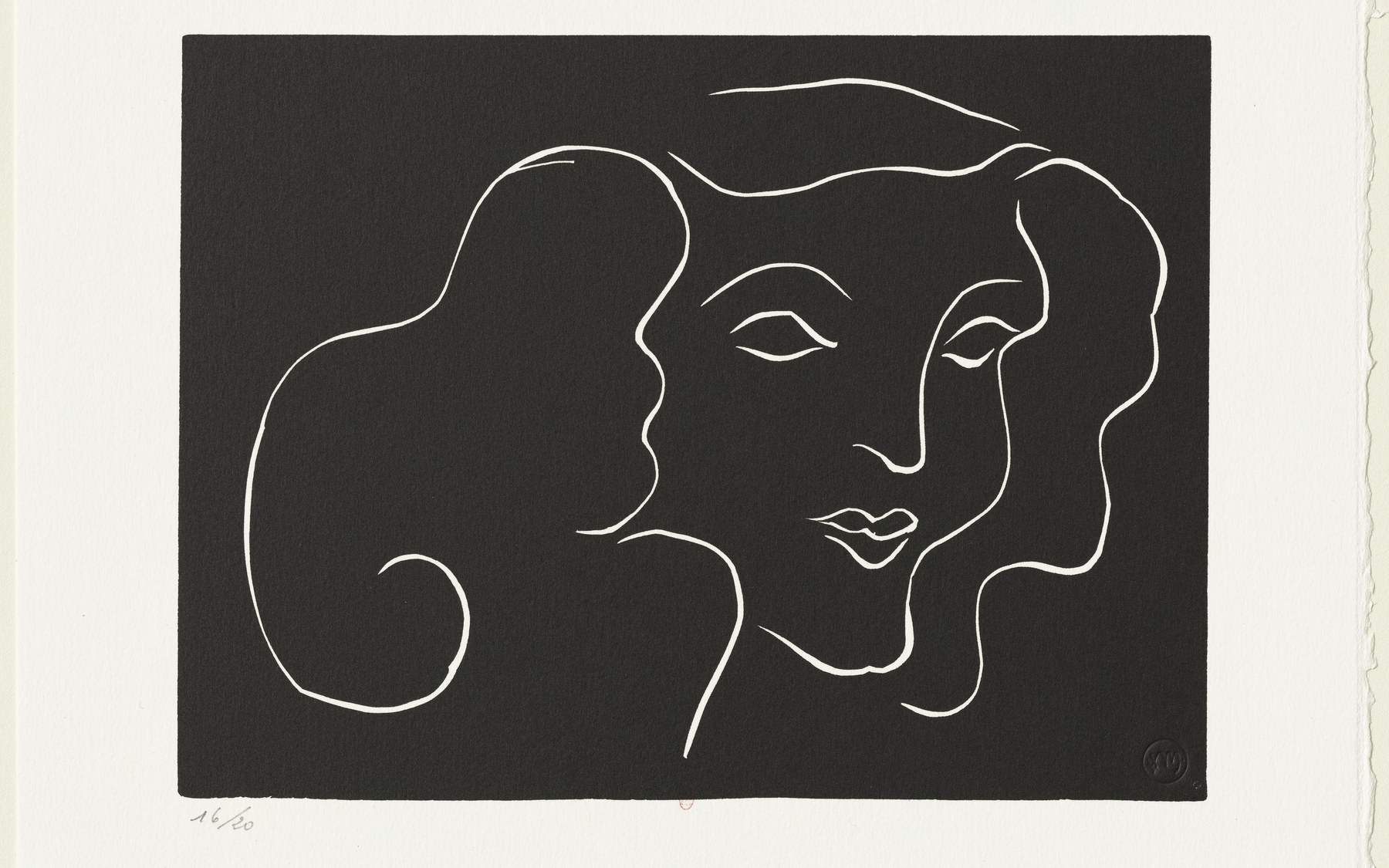
Visage souriant de trois-quarts - estampe - Henri Matisse - btv1b525251360.jpg by Matisse, Henri (1869-1954). Graveur; Public domain via Wikimedia Commons. Cropped for TheHistoryOfArt.org. · Image source
What to expect
Matisse: 1941-1954 was a Grand Palais exhibition in Paris, shown from 24 March to 26 July 2026. Because it has now closed, this page is an archive record rather than a current visit-planning page. It remains important because the exhibition treated the last years of Henri Matisse not as a quiet epilogue, but as one of the most inventive periods of his career. Grand Palais described the show as a journey through the artist's final creative years, when cut-out forms, pure colour and a more expansive decorative language transformed his work.
The scale was substantial. The official Grand Palais page states that the exhibition brought together more than 300 works: paintings, drawings, illustrated books, cut-out gouaches, textiles and stained glass. It drew on the Centre Pompidou collection and major international loans, with the participation of the Musée Matisse Nice. That range matters because late Matisse is often reduced to a few famous blue cut-outs. The exhibition instead presented a multi-disciplinary practice in which painting, drawing, books, textiles, chapel design and paper cut-outs remained deeply connected.
The date range, 1941 to 1954, is not incidental. It covers the years after Matisse's major operation and the period in which he found a new way of working while physically constrained. Rather than treating illness as a simple biographical explanation, the page should help readers see the art-historical result: a late style built from simplification, brightness, scale, rhythm and the ability to make colour carry form.
Why it mattered
The strongest reason to preserve this record is that the exhibition made late style feel active. Matisse was nearly eighty when he elevated cut-out gouache into an autonomous visual language. The cut-outs can look effortless in reproduction, but they were the outcome of decades of painting, drawing, composition and decorative thinking. Grand Palais's account stresses that painting remained at the heart of his approach, far from being replaced by cut-outs. That is the crucial point: the scissors did not cancel painting; they changed what painting could become.
The exhibition also mattered because it gathered major ensembles that are rarely easy to see together. Grand Palais names the Intérieurs de Vence series from 1947-48, the album Jazz, the Thèmes et variations drawings, brush-and-ink works, elements from the Chapelle de Vence programme, monumental panels including La Gerbe and Acanthes, and great cut-out figures such as La Tristesse du roi, Zulma, La Danseuse créole and the Nus bleus. The value was cumulative. Visitors could follow a studio language across media rather than isolating one masterpiece.
The Grand Palais setting was also important. A large temporary exhibition venue can give late Matisse the physical scale his work needs. Cut-outs depend on room, distance, wall, interval and movement. They are not simply images on paper. They can behave like murals, stage sets, gardens, windows, fabrics or architectural colour. A strong exhibition can therefore make the visitor feel how decorative ambition became spatial ambition.
What to look for in the archive record
Begin with the relation between drawing and cutting. Matisse's famous phrase about drawing with scissors is useful, but it can become too neat. A cut-out is not just a drawing without pencil. It is a line made by separating coloured paper from the sheet, a contour produced through the body, hand pressure, speed and correction. The edge becomes the drawing. Colour and shape arrive together.
Then look for the continued presence of painting. Grand Palais explicitly warns against imagining that cut-outs supplanted painting. The late interiors, brush drawings and colour works show Matisse still thinking as a painter: about surface, figure, ground, window, room, ornament and light. The cut-outs intensify those concerns by removing modelling and letting shape and colour do more work.
Jazz is a key bridge because it is an illustrated book, a sequence, a printed object and a theatre of colour. It links the late cut-out language to performance, circus, music, typography and reproduction. That makes it especially useful for future improvement pages on sketchbooks, printmaking, mixed media, books as artworks and the movement between private studio experiment and public publication.
The Chapelle de Vence material opens another route. Stained glass, vestments, ceramics, architectural space and sacred function show Matisse working beyond the portable artwork. The chapel was not simply decoration added to a building. It was a total environment in which line, colour, light and ritual came together. Seeing chapel elements beside cut-outs and paintings can make the late work feel less like a style and more like a complete visual system.
How it fits Grand Palais and Paris
This page strengthens the new Grand Palais venue page by giving it a major archived twentieth-century anchor alongside the upcoming Cezanne and Us. Together, those two records make the venue useful immediately: Cezanne supplies reception history and the genealogy of modern painting, while Matisse supplies late style, colour, cut-outs and the material breadth of modern art.
For Paris planning, the exhibition has ended, so readers should not use this page for tickets or opening hours. Its value is retrospective and connective. It helps explain why the Grand Palais can matter for the guide even when it is not a collecting museum in the same sense as Orsay or the Louvre. It hosts large temporary exhibitions that can temporarily gather loans, reconstruct studio worlds and make modern art visible at a scale smaller venues may not manage.
The page also has strong reader interest. It can later connect to Henri Matisse, Fauvism, colour theory, cut-outs, collage, illustrated books, stained glass, chapel design, late style, mixed media, drawing materials, textiles and the relationship between illness, studio practice and artistic reinvention. Because the works are twentieth-century, image and rights decisions need more caution than many nineteenth-century pages in this batch.
Image and rights note
Matisse died in 1954, so some underlying-work copyright issues are more favourable in parts of Europe than they were before 2025. That does not make exhibition images automatically reusable. Grand Palais, Centre Pompidou, MNAM-CCI, GrandPalaisRmn, Maison Matisse, lender and installation photographs may each carry specific restrictions, and US/publication status can require separate caution. This page remains image-free until a reviewed source and credit route is selected.
How to use this page
Because Matisse: 1941-1954 has ended, the page should function as an archive record and a route into related artists, works and venues. The most reliable fixed details are the venue, dates, broad subject, media and official source link. The interpretive notes help place the exhibition in art-historical context: what kind of show it is, why it may matter, and which artists or topics are worth exploring next.
It is marked as a major exhibition in this guide, so it should be useful for readers choosing between several possible museum visits.
Looking notes
For a visitor, the most useful approach is to look for patterns rather than isolated highlights. With Henri Matisse, cut-outs, gouache découpée, Jazz, Intérieurs de Vence, Chapelle de Vence, La Gerbe, Acanthes, La Tristesse du roi, Zulma, La Danseuse créole, Nus bleus, Centre Pompidou, Musée Matisse Nice, ask how the exhibition frames the subject: as biography, period survey, focused theme, collection display or reassessment. With media such as painting, drawing, cut-out gouache, illustrated book, textile, stained glass, brush and ink drawing, decorative art, late style, pay attention to changes of scale, surface, lighting, material and display sequence, because those details are often lost in online listings.
The guide avoids over-specific claims where the public source does not yet support them. If a museum has not published a full object list, it is better to stay clear about what is confirmed than to imply certainty.
Who it is best for
Matisse: 1941-1954 is most likely to help readers who are already interested in Henri Matisse, cut-outs, gouache découpée, Jazz, Intérieurs de Vence, Chapelle de Vence, La Gerbe, Acanthes, La Tristesse du roi, Zulma, La Danseuse créole, Nus bleus, Centre Pompidou, and Musée Matisse Nice, but it may also be useful for visitors building a wider route around Grand Palais in Paris. If time is limited, use this page to decide whether the subject fills a gap in your knowledge, whether it connects to artists you already follow, and whether the official venue information makes the visit practical.