by Tom Gurney
Tom Gurney BSc (Hons) is an art history expert with over 20 years experience
Published on July 14, 2026 / Updated on July 16, 2026
Email: tomgurney1@gmail.com / Phone: +447429011000
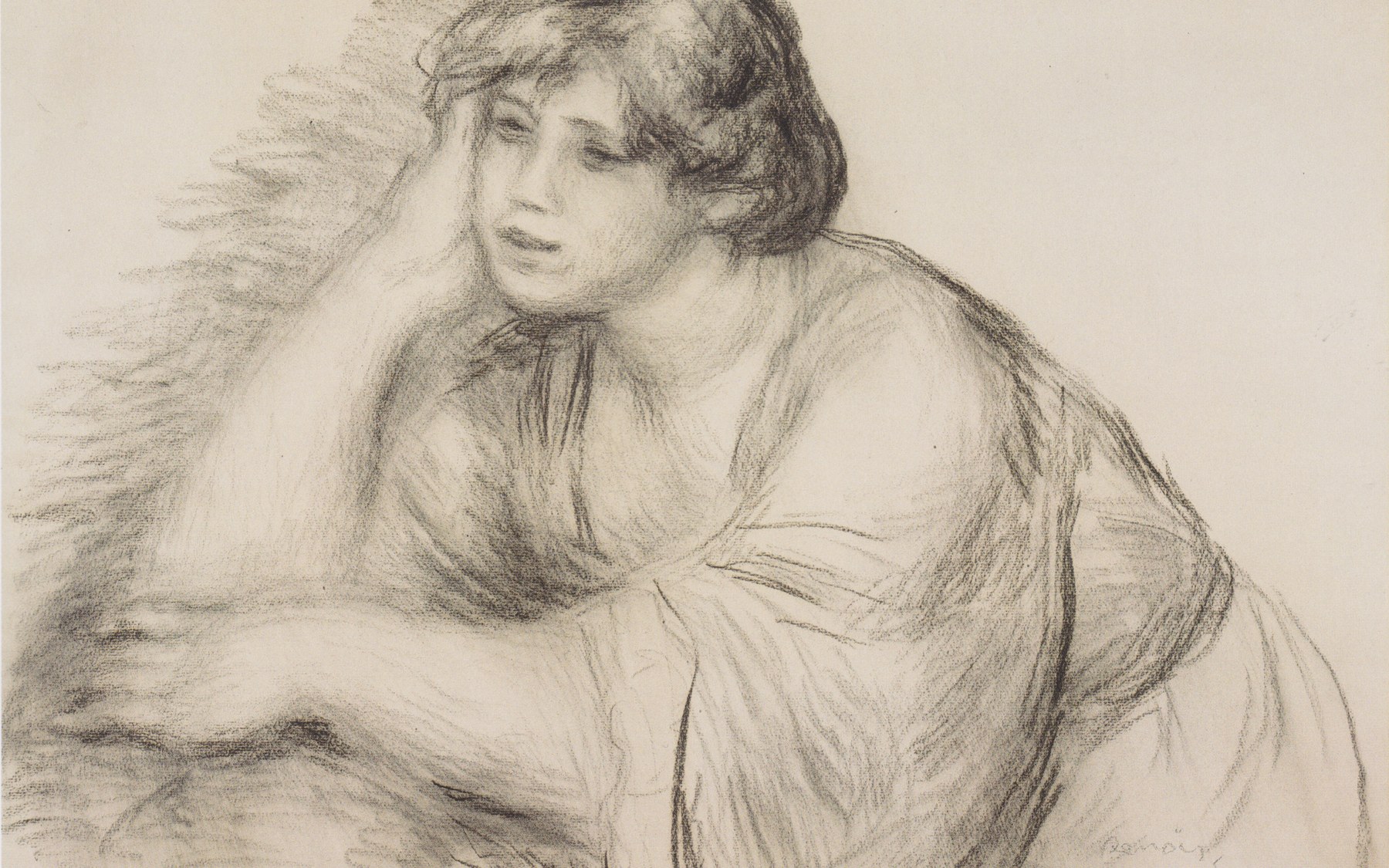
Renoir - Sitzendes Mädchen.jpeg by Pierre-Auguste Renoir; Public domain via Wikimedia Commons. Cropped for TheHistoryOfArt.org. · Image source
What to expect
Renoir Drawings was a Musée d'Orsay exhibition in Paris, shown from 17 March to 5 July 2026. Because it has now closed, this page is an archive record rather than a current visit-planning page. It is still worth a full guide page because the subject corrects a common imbalance in how Pierre-Auguste Renoir is remembered. Renoir is usually introduced as a painter of colour, pleasure, modern life and flesh. Orsay's exhibition asked visitors to take his drawing seriously as a lifelong practice.
The official Orsay page describes the show as the first exhibition dedicated to Renoir's drawings. It was co-organized with The Morgan Library & Museum and brought together some 100 works from around the world, including previously unseen sketches and several paintings. The range matters: graphite, Conté crayon, charcoal, pen and ink, red and white chalk, pastels, watercolors, gouache, etching and lithography all appear in Orsay's account. This was not a small appendix to painting, but a survey of how Renoir used graphic media to think.
The exhibition also made room for Renoir as an illustrator. Orsay's detailed presentation explains that many of his late-1870s drawings were made for books and newspapers, especially La Vie Moderne, the elegant weekly magazine launched by Georges Charpentier. Renoir produced fifteen illustrations for the magazine over seven years, reproduced through a photomechanical process rather than older wood-engraving methods. That gives this page a useful bridge into illustration, print culture and modern publishing.
Why it mattered
The strongest reason to preserve this record is that drawing changes the tempo of Renoir's art. The familiar story of Impressionism often stresses speed, open-air painting, broken colour and the direct capture of light. Orsay's presentation complicates that story. It uses Berthe Morisot's 1886 admiration for Renoir's preparatory studies to challenge the idea that Impressionists worked only with effortless immediacy. Drawing reveals planning, revision, hesitation, experiment and labour.
The exhibition was especially valuable because Renoir himself could be ambivalent about drawing. Orsay notes his long reputation as a poor draftsman and the small, heterogeneous surviving corpus, partly because he probably destroyed many drawings. That makes the remaining sheets unusually revealing. They are not only finished images. They include sketches, studies for painted compositions, tracings, outdoor watercolor notes, portraits in pastel, projects for prints and illustration, and large late drawings around the body.
Renoir's turn around the early 1880s is the key historical hinge. After the success of Le Déjeuner des canotiers, Orsay describes a period of doubt in which Renoir felt he had reached the end of Impressionism and needed a firmer command of form. Raphael and Ingres became points of reference, and the female nude became central to his graphic experiments. The drawings therefore help explain Renoir's move away from pure Impressionist handling toward a more constructed, classical and studio-based art.
What to look for in the archive record
Begin with media. A drawing exhibition is not only a subject exhibition; it is a materials exhibition. Graphite can make a line feel searching or exact. Charcoal can build breadth and softness. Pen and ink can sharpen contour and rhythm. Pastel turns drawing into colour. Watercolor lets Renoir work quickly with transparency and light. Red chalk, or sanguine, mattered especially from the 1880s onward because its warmth, thickness and relation to flesh suited Renoir's interest in the body.
Then look for the relation between drawing and painting. Some sheets prepare compositions, but others stand closer to independent works. The most useful question is not whether a drawing is finished, but what kind of work it performs. Does it solve a pose? Test a group? Translate a painting into another medium? Serve an illustration project? Record an outdoor effect? Or turn the model's body into a problem of line, volume and light?
The illustration strand deserves its own attention. Renoir's drawings for La Vie Moderne place him inside a world of publishers, magazines, photomechanical reproduction and literary modernity. That is a different Renoir from the painter of dance halls and bathers, but not an unrelated one. Modern life was not only painted on canvas. It also circulated through journals, books, prints and images made for reproduction.
Finally, consider the late admiration from younger artists. Orsay notes that artists including Bonnard and Picasso admired Renoir's drawings in the early twentieth century. That afterlife matters because it places Renoir's graphic work inside a modern lineage, not merely behind his better-known paintings. A sheet that once seemed secondary can become a clue to why later artists cared about form, touch and the body.
How it fits Orsay and Paris
This page strengthens the Musée d'Orsay cluster by giving the museum a works-on-paper route beside the Cassatt and Sargent exhibition records. Cassatt brings printmaking and transatlantic independence; Sargent brings portraiture, cosmopolitan Paris and Salon ambition; Renoir brings drawing, illustration and the revision of Impressionist method. Together they make Orsay feel less like a fixed list of famous paintings and more like a place where nineteenth-century media can be re-read.
For Paris planning, the exhibition is now over, so readers should not treat this page as a booking guide. Its practical value is retrospective and comparative. It can help someone understand why a future Renoir, drawing or Impressionist exhibition may be worth seeing, and it can guide looking in Orsay's permanent collection by asking where preparatory thought, line and graphic media sit behind the familiar painted surfaces.
The page also has strong future reader interest. It can later connect to Pierre-Auguste Renoir, Impressionism, drawing materials, pastels, watercolor, illustration, La Vie Moderne, Georges Charpentier, Berthe Morisot, Ingres, Raphael, Bonnard, Picasso and the relationship between painting and print culture. Those links should be added only where the destination gives readers a real continuation path.
Image and rights note
The underlying Renoir works are historic, so public-domain image routes may be possible. The most directly relevant Orsay image, Jeune femme penchée sur un balcon, carries a Fondation Bemberg / Mathieu Lombard credit on the museum page and should not be reused without source review. Morgan Library, Orsay, lender, catalogue and press photographs may each carry separate restrictions. This page remains image-free until a reviewed source and credit route is selected.
How to use this page
Because Renoir Drawings has ended, the page should function as an archive record and a route into related artists, works and venues. The most reliable fixed details are the venue, dates, broad subject, media and official source link. The interpretive notes help place the exhibition in art-historical context: what kind of show it is, why it may matter, and which artists or topics are worth exploring next.
It is marked as a major exhibition in this guide, so it should be useful for readers choosing between several possible museum visits.
Looking notes
For a visitor, the most useful approach is to look for patterns rather than isolated highlights. With Pierre-Auguste Renoir, Berthe Morisot, La Vie Moderne, Georges Charpentier, The Morgan Library & Museum, Bonnard, Picasso, Raphael, Ingres, Bathers, Impressionism, works on paper, ask how the exhibition frames the subject: as biography, period survey, focused theme, collection display or reassessment. With media such as drawing, watercolor, pastel, graphite, charcoal, pen and ink, red chalk, white chalk, etching, lithography, illustration, works on paper, pay attention to changes of scale, surface, lighting, material and display sequence, because those details are often lost in online listings.
The guide avoids over-specific claims where the public source does not yet support them. If a museum has not published a full object list, it is better to stay clear about what is confirmed than to imply certainty.
Who it is best for
Renoir Drawings is most likely to help readers who are already interested in Pierre-Auguste Renoir, Berthe Morisot, La Vie Moderne, Georges Charpentier, The Morgan Library & Museum, Bonnard, Picasso, Raphael, Ingres, Bathers, Impressionism, and works on paper, but it may also be useful for visitors building a wider route around Musée d'Orsay in Paris. If time is limited, use this page to decide whether the subject fills a gap in your knowledge, whether it connects to artists you already follow, and whether the official venue information makes the visit practical.