by Tom Gurney
Tom Gurney BSc (Hons) is an art history expert with over 20 years experience
Published on July 14, 2026 / Updated on July 16, 2026
Email: tomgurney1@gmail.com / Phone: +447429011000
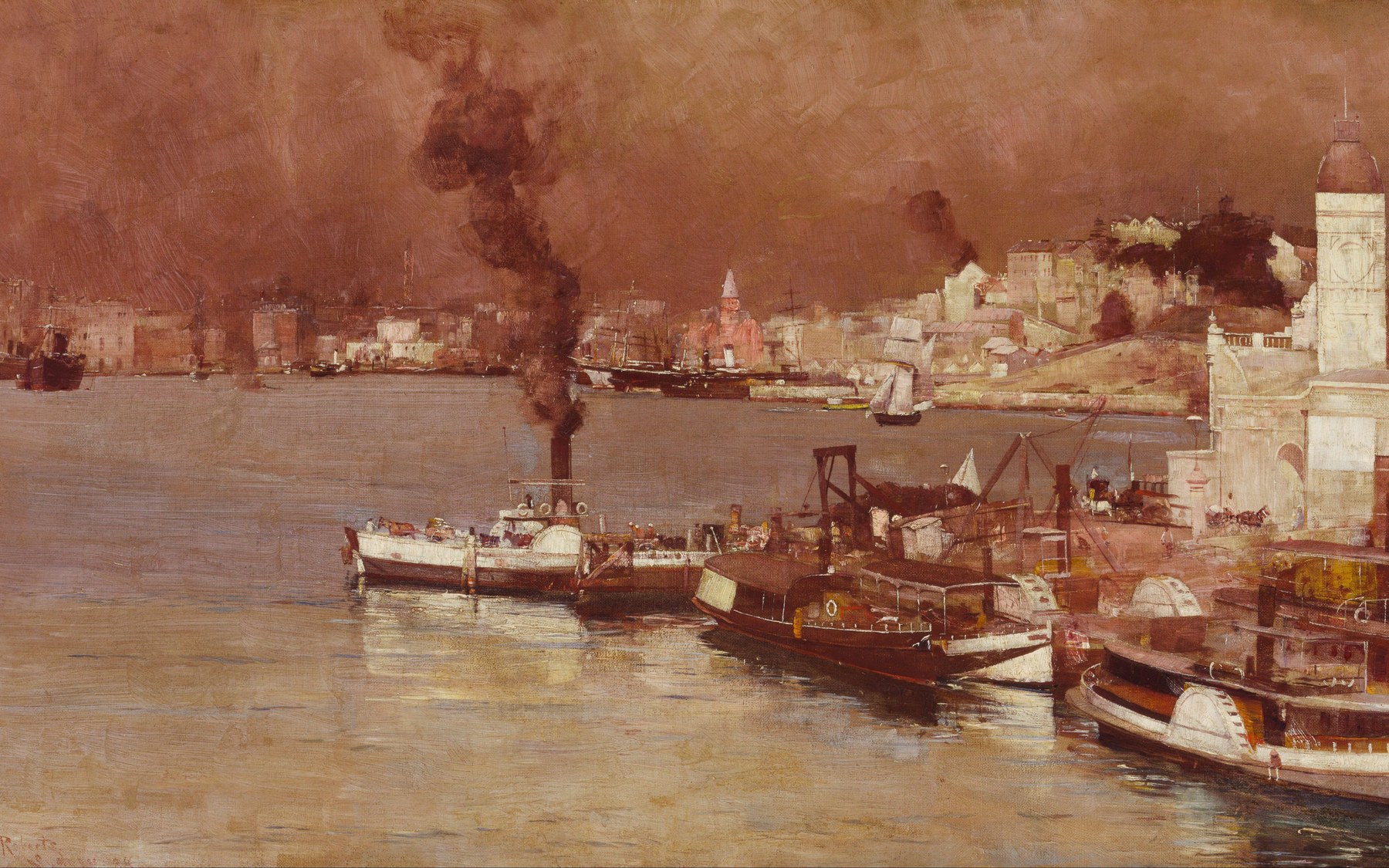
Tom Roberts - An autumn morning, Milson's Point, Sydney - Google Art Project.jpg by Tom Roberts; Public domain via Wikimedia Commons. Cropped for TheHistoryOfArt.org. · Image source
What to expect
She-Oak and Sunlight: Australian Impressionism was an NGV exhibition at The Ian Potter Centre: NGV Australia, shown at Federation Square from 2 April to 22 August 2021. Because it has now closed, this page is an archive record rather than a current visit page. It remains important because NGV presented it as a large-scale reassessment of Australian Impressionism, with more than 250 artworks drawn from major public and private collections around Australia, including the NGV Collection.
The official NGV page makes place central to the exhibition. It explored how artists' responses to different landscapes shaped Australian Impressionism, while also recognising that visions created by recently arrived artists were imposed over the culture, experiences and stories of First Nations peoples whose deep connections to Country were disregarded. That framing is essential. A page about Australian Impressionism should not treat landscape as empty scenery or national myth alone. It has to acknowledge that these painted places were already Country.
The exhibition brought together widely recognised works by Tom Roberts, Frederick McCubbin, Jane Sutherland, Arthur Streeton, Charles Conder, Clara Southern, John Russell and E. Phillips Fox, while also bringing lesser-known paintings by Iso Rae, May Vale, Jane Price and Ina Gregory into view. NGV also compared Australian works with artists including Claude Monet, Alfred Sisley and James Abbott McNeill Whistler. The result was not a simple display of beloved national pictures, but a more complex map of friendship, rivalry, travel, influence, local place and international exchange.
Why it mattered
The strongest reason to preserve this archive page is that the exhibition updated a familiar story. Australian Impressionism is often presented through a tight set of names, camps and icons: Roberts, Streeton, McCubbin, Conder, the Heidelberg School, Box Hill, Eaglemont, Mentone and the 9 by 5 Impression Exhibition. NGV kept those anchors, but widened the frame. The exhibition looked at personal relationships, women artists, international influence, conservation, First Nations Country context and the role of place in shaping the movement.
That widening matters because national art histories can become too tidy. A painting such as Roberts's Shearing the rams may be treated as a national image before it is looked at as a painting. Streeton's The purple noon's transparent might can be reduced to sunlight and patriotic landscape. McCubbin's and Sutherland's paintings can be made to stand for a soft pastoral feeling. NGV's framing encourages a more active form of looking: who painted where, with whom, under what social limits, in relation to which earlier artists, and on whose Country?
The inclusion of women artists is especially important. Jane Sutherland, Clara Southern, Ethel Carrick, Iso Rae, May Vale, Jane Price and Ina Gregory help shift the subject away from a small brotherhood. Some women could visit artists' camps by day but faced social restrictions that shaped how and where they worked. Others built careers through travel, teaching, exhibitions and international networks. Their presence changes the movement's texture.
The conservation angle also gives the exhibition weight. NGV highlighted Arthur Streeton's The purple noon's transparent might after a complex conservation treatment that made its colours newly vivid. That detail matters because museum exhibitions do not only assemble works. They also recondition how works can be seen, remembered and interpreted.
What to look for in the archive record
Begin with the theme of place. NGV's theme list names Eaglemont and surrounds on Wurundjeri Country, artists' camps at Darebin and Gardiner's Creek, Box Hill and Mentone on Wurundjeri and Boon Wurrung Country, and Sydney and Richmond in New South Wales on Gadigal and Dharug Country. Those names should slow the reader down. Australian Impressionist landscapes are not generic bush, sunlight or national atmosphere. They are painted encounters with specific places that have deeper histories than the artists' own arrival.
Then compare the artists' relationships. NGV framed the movement through friends and rivals, not just a style. Roberts, McCubbin, Streeton, Conder, Sutherland and their circles learned from one another, argued, borrowed, competed, travelled and exhibited. The 9 by 5 Impression Exhibition is a key example. Its small panels, tonal groupings and staged display drew on international ideas while creating a distinctly Melbourne event in 1889.
Whistler is another useful route. NGV's materials describe Whistler's influence on display, titles, tonal harmony and the 9 by 5 exhibition. That connection matters because it shows Australian Impressionism looking beyond France. Monet and Sisley help explain light, plein-air painting and Impressionist technique; Whistler helps explain mood, exhibition design, tonal naming and the way modern artists staged their own public image.
Finally, look at scale. More than 250 artworks is a large exhibition for a focused movement. It allowed NGV to set famous icons beside lesser-known works, public collection holdings beside private loans, and local landscapes beside international comparisons. That scale is what made the exhibition more than a nostalgic reprise.
How it fits Melbourne and Australia
This page strengthens the Australia cluster by giving NGV Australia a second archived exhibition after Australian Impressionists in France. Together, the two pages form a strong pair. One follows Australian artists into France; the other examines Australian Impressionism through place, relationships, local camps, international comparisons and the afterlife of national icons.
For current planning, the exhibition has ended and should not be used for tickets or opening hours. Its value is archival and connective. It helps a Melbourne reader understand why The Ian Potter Centre matters for Australian art, and why Australian Impressionism needs to be read through both local Country and international exchange. It also gives future Australia coverage a foundation for collection highlights, artist pages and broader essays on landscape, plein-air painting and national art history.
The page creates internal-link opportunities for Tom Roberts, Arthur Streeton, Frederick McCubbin, Jane Sutherland, Charles Conder, Clara Southern, John Russell, E. Phillips Fox, James Abbott McNeill Whistler, Claude Monet, Alfred Sisley, the 9 by 5 Impression Exhibition, Heidelberg School, conservation, landscape painting and the ethics of place in art history.
Image and rights note
The artists and works are largely historic, so public-domain routes may be possible. However, NGV collection photography, private-collection loans, conservation images, exhibition labels, installation views and press images may carry separate restrictions. This page remains image-free until a reviewed source and credit route is selected.
How to use this page
Because She-Oak and Sunlight: Australian Impressionism has ended, the page should function as an archive record and a route into related artists, works and venues. The most reliable fixed details are the venue, dates, broad subject, media and official source link. The interpretive notes help place the exhibition in art-historical context: what kind of show it is, why it may matter, and which artists or topics are worth exploring next.
It is marked as a major exhibition in this guide, so it should be useful for readers choosing between several possible museum visits.
Looking notes
For a visitor, the most useful approach is to look for patterns rather than isolated highlights. With Tom Roberts, Frederick McCubbin, Jane Sutherland, Arthur Streeton, Charles Conder, Clara Southern, John Russell, E. Phillips Fox, Iso Rae, May Vale, Jane Price, Ina Gregory, Claude Monet, Alfred Sisley, James Abbott McNeill Whistler, Wurundjeri Country, Boon Wurrung Country, 9 by 5 Impression Exhibition, Heidelberg School, ask how the exhibition frames the subject: as biography, period survey, focused theme, collection display or reassessment. With media such as painting, landscape painting, portraiture, oil on wood panel, works on paper, exhibition labels, conservation context, pay attention to changes of scale, surface, lighting, material and display sequence, because those details are often lost in online listings.
The guide avoids over-specific claims where the public source does not yet support them. If a museum has not published a full object list, it is better to stay clear about what is confirmed than to imply certainty.
Who it is best for
She-Oak and Sunlight: Australian Impressionism is most likely to help readers who are already interested in Tom Roberts, Frederick McCubbin, Jane Sutherland, Arthur Streeton, Charles Conder, Clara Southern, John Russell, E. Phillips Fox, Iso Rae, May Vale, Jane Price, Ina Gregory, Claude Monet, Alfred Sisley, James Abbott McNeill Whistler, Wurundjeri Country, Boon Wurrung Country, 9 by 5 Impression Exhibition, and Heidelberg School, but it may also be useful for visitors building a wider route around The Ian Potter Centre: NGV Australia in Melbourne. If time is limited, use this page to decide whether the subject fills a gap in your knowledge, whether it connects to artists you already follow, and whether the official venue information makes the visit practical.