


 by Tom Gurney
Tom Gurney BSc (Hons) is an art history expert with over 20 years experience
Published and updated on September 25, 2026
Email: tomgurney1@gmail.com / Phone: +44 7429 011000
Why Moronobu matters to early ukiyo-e
Hishikawa Moronobu (菱川師宣) worked in seventeenth-century Japan, when pictures of urban pastimes, fashionable clothing, theatre and the pleasure quarters were being made for more than one kind of audience. His home town's memorial museum in Kyonan calls him an originator of ukiyo-e, while the Shimane Art Museum describes how his book illustrations led toward independently appreciated woodblock sheets. Neither description means that he single-handedly invented painting of everyday life, woodblock printing or the pleasure-quarter subject. Earlier painted screens and anonymous prints already existed. Moronobu's importance lies in the way a named artist organised and circulated such imagery through paintings, books and prints, and in the line of artists who continued that work. [1] [2] [3]
Contents
- Why Moronobu matters to early ukiyo-e
- From a textile household to pictures of clothing
- A book was a sequence, not a loose stack of masterpieces
- Single sheets and the views they offered
- Paintings beside the printed sheets
- Looking across subjects without flattening them
- “Founder” as a historical claim
- Books on Japanese Art
Read Hishikawa Moronobu’s biography.
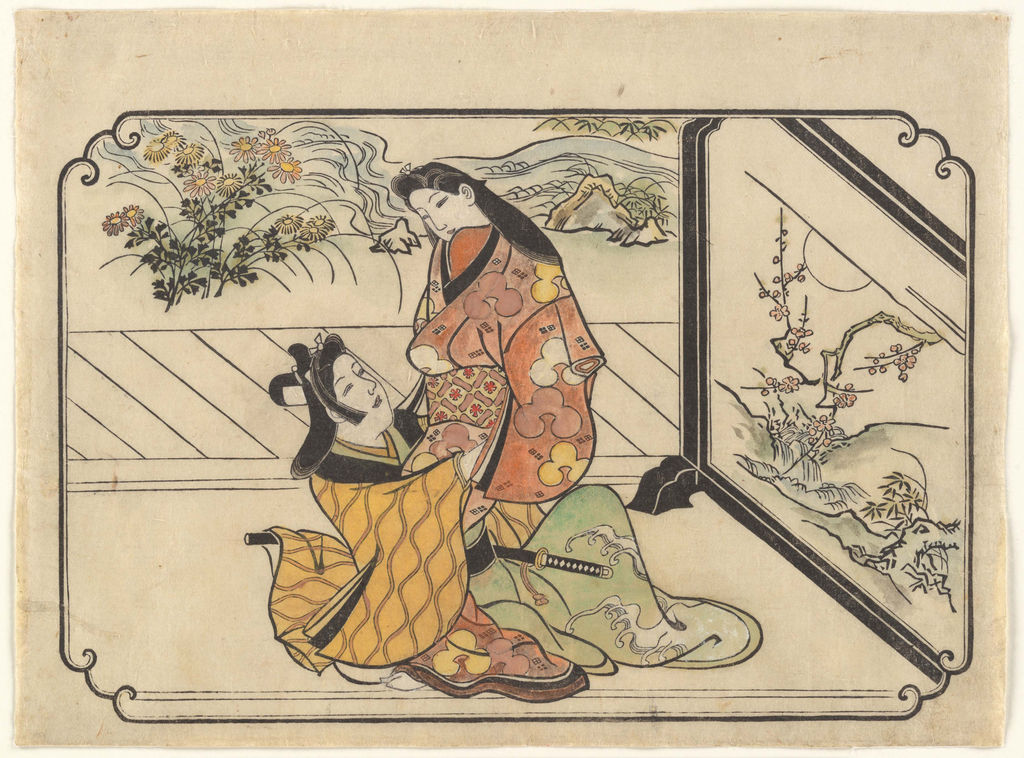
The difference between these objects is visible before one studies a biography. A handscroll is encountered gradually as its length is unrolled. A screen fills a room and allows several figures to be seen together. A book distributes a sequence of pages that can be held, opened and reread. A single woodblock sheet presents one design at once, and a painter may add colour after the black outline has been printed. Calling all of them “prints” conceals how Moronobu's images worked. The Met's Courtesan with a Young Man beside a Screen, dated about 1679–84, offers a vivid opening: it is a woodblock print in ink with hand-applied colour, not a multi-block full-colour print of the later eighteenth century. Its women, young man, fabrics and painted screen establish several of this page's themes in one specific surviving impression. [4]
Moronobu at a glance
- YearsBirth year uncertain–1694
- OriginHota, Awa (now Kyonan, Chiba)
- FormsPaintings, illustrated books and single sheets
- SubjectsDress, people, Yoshiwara, occupations and places
The artist's birth year remains uncertain. The Kyonan museum says it is unknown and estimates around 1630; the Met's object labels use 1618–1694. The death year 1694 is common ground. A home page does not need to conceal this disagreement beneath an apparently exact lifespan. It can tell readers instead where the work is securely dated: a 1677 textile-pattern book, several illustrated books of the 1680s and paintings and printed sheets catalogued with broader ranges. The artist's name on an object, the date of a surviving edition and the date a design was first conceived are not always the same kind of evidence. Those distinctions matter especially for an artist remembered as a beginning. [1] [4] [5]
His place in the story becomes clearer when the viewer begins with objects rather than a heroic “first.” The Met's coloured sheet could be held close enough to notice where the added colour stops against a printed contour. A pattern book presents alternatives across an opening; its forms invite comparison. A painted screen asks the eye to move across a much wider field. All three involve design, yet their making and viewing are different. The artist's achievement is not measured by counting them as interchangeable images. It is seen in how reliably he could set a figure, a garment or an encounter into each format. The surviving examples also put limits on generalisation: the colour of one impression cannot be presumed to match every other impression of the design. [4] [5] [21]
From a textile household to pictures of clothing
Moronobu came from Hota in Awa, now part of Kyonan in Chiba Prefecture. His hometown museum describes a family business in embroidered and decorated textiles, run by his father Hishikawa Kichizaemon. The Met's account of Two Lovers likewise connects his familiarity with cloth to the pictorial force of his designs. The background does not mean every robe in his pictures was copied from one garment in the family workshop. It does explain why clothing could be more than surface ornament to him: patterns indicate fashion, status, motion and the shape of bodies beneath cloth. A sweeping sleeve can lead the eye through a composition even when the figure's face is tiny. [1] [6]
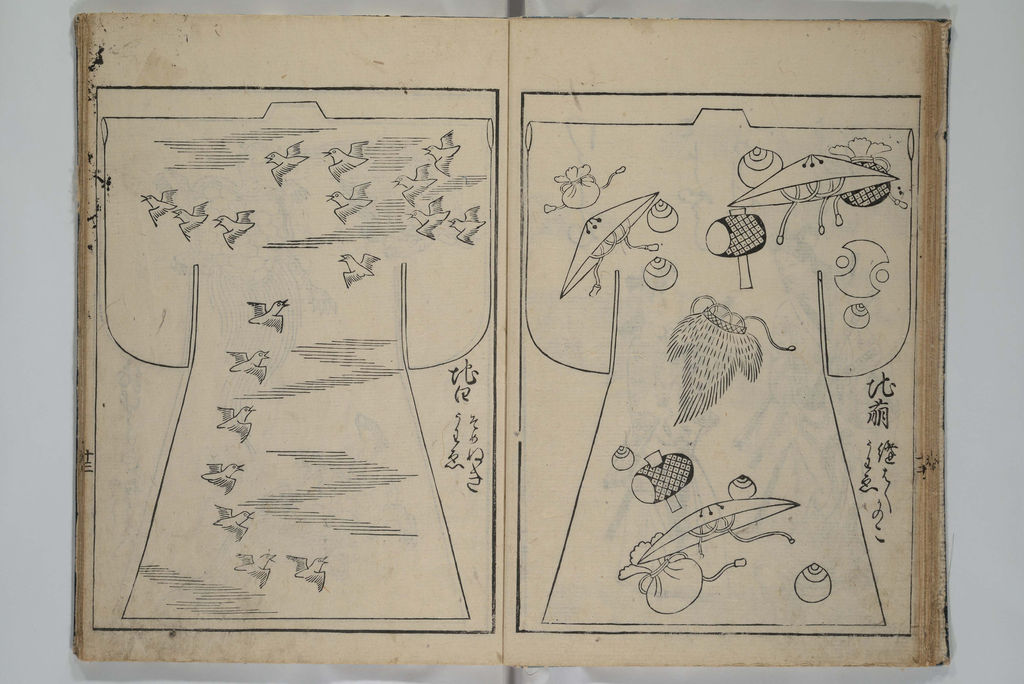
The Met holds the first volume of Contemporary Kimono Patterns / 当世ひいな形, dated 1677, object 2013.887. In its photographed opening, forms are arranged within outlined garment shapes, with birds and accessories spread across the two pages. The book is a printed design resource, not a surviving silk kimono. The British Museum catalogues a related 1677 pattern-book under the title Kosode on hinagata / 小袖御ひなかた and names the publisher Urokogataya Sanzaemon. These institutional records help connect the fabric trade to printing, although the exact relationship between every surviving copy, variant title and edition requires book-level comparison. A page of drawings could guide looking and choosing; it could also advertise what a fashionable textile might become. [5] [7]
Clothing carries narrative in Moronobu's figure pictures too. The hand-applied colour on the opening print draws attention to the courtesan's patterned outer robe and the young man's costume, while the folding screen behind them contains another image within the scene. In the Met's Two Lovers, an album leaf of erotic printmaking, its curators read the abandoned outer robe and the direction of the sleeves as part of the intimacy. One need not repeat the museum's interpretation as a universal code for every robe. It demonstrates how the arrangement of objects can do expressive work even in a black-and-white print. Moronobu's textile knowledge becomes a way of composing relationships, not simply a claim that he painted elegant outfits. [4] [6]
The 1677 pattern-book opening makes that relation unusually visible. Garment outlines create a repeated frame, while the proposed motifs break the sameness of the frame: birds occupy one field, other shapes another. The page lets readers imagine the difference between selecting a pattern and wearing the finished garment. Moronobu's figure pictures reverse that movement. There, the clothed body is already present, and a sleeve or hem tells the viewer about a turn, a step or a pause. Neither book nor figure print proves that a particular textile was manufactured. Read together, however, they show how closely a design for cloth and a design made from the sight of cloth could sit in his work. [5] [4]
A book was a sequence, not a loose stack of masterpieces
The Kyonan museum credits Moronobu with making books in which pictures grew larger and text became relatively smaller. Such books reached readers through writers, publishers, block cutters and printers as well as the artist who designed images. The British Museum's record for Yamato shino ezukushi / 大和侍農絵尽 names Moronobu as designer and Urokogataya Sanzaemon as publisher. Crucially, it calls its particular surviving volume an 1684 edition of a work originally issued in 1680. If one treats an object's date as the instant every figure was first drawn, this distinction disappears. A book page should be read both as a composition and as part of an edition that could have more than one life. [1] [8]
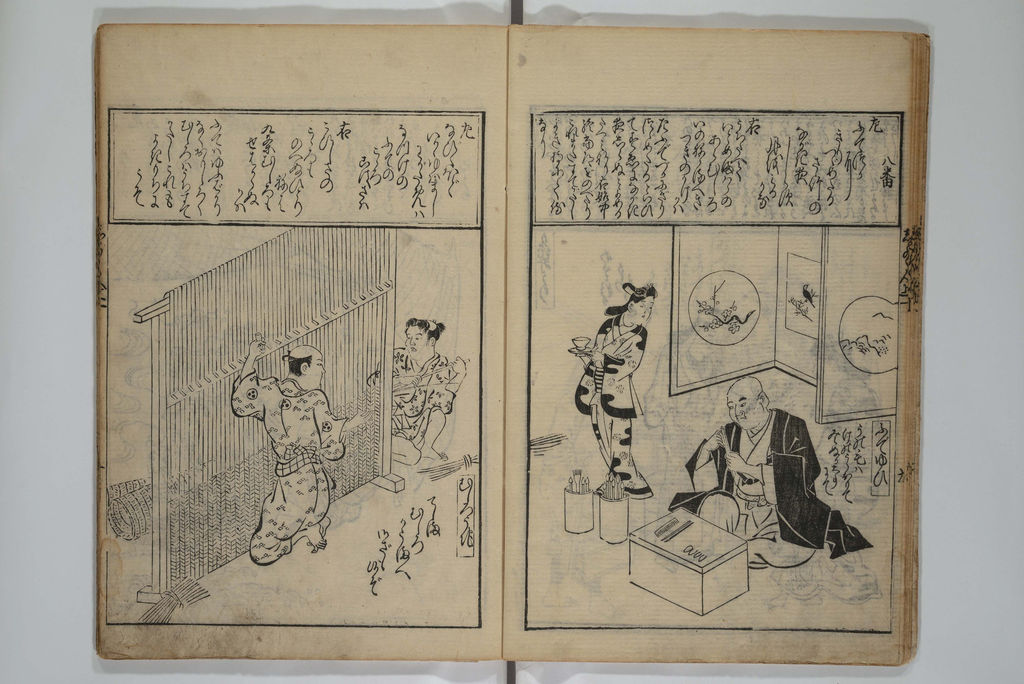
The 1685 A Picture Book Mirror of Various Occupations / 和国諸職絵尽 is a particularly clear example of Moronobu turning work itself into a subject. The Met owns a three-volume set, accession 2013.786a–c. Its selected photograph shows one spread: a person works at a tall frame on one page, while an artisan sits beside tools and a visitor or attendant on the other. The printed words and the set's other leaves must be checked before assigning exact trade names to these two images. Even without that identification, the form matters. Separate activities share a book, so a reader can move from one craft to another and think about how labour is depicted. The page frames, captions and succession of openings are part of the experience. [9]
The two leaves are also useful for looking at Moronobu's economy of description. The tall working frame gives one action a prominent vertical shape. On the facing page, a seated figure, implements and another person form a more compressed encounter. These are observations from a photographed opening, not identifications of the individual crafts. The difference shows what a reader learns by turning a volume: neighbouring images can vary the scale of a body and the amount of room given to tools. The book's title promises a mirror of occupations, but a picture book is still a designed selection. Its images show labour made visible to readers, not a complete census of work in Edo-period Japan. [9]
The subject range of Moronobu's books was wider than famous courtesans. The Met's 1683 Illustrations of Beautiful Women / 美人絵づくし may sound familiar from later ukiyo-e history, but it is one printed set among others. The 1686 Yamato-e zukushi / 大和絵づくし invokes Japanese pictorial themes; the 1691 garden compendium offers images of shaped outdoor space. Their photographed openings are not detachable anonymous “paintings” simply because a modern website displays each as a separate rectangle. Titles, dates and accession numbers allow us to name the actual book; identifying what a particular leaf represents may still require reading the original printed text. The diversity of subjects also prevents a false equation between early ukiyo-e and the pleasure quarter alone. [10] [11] [12]
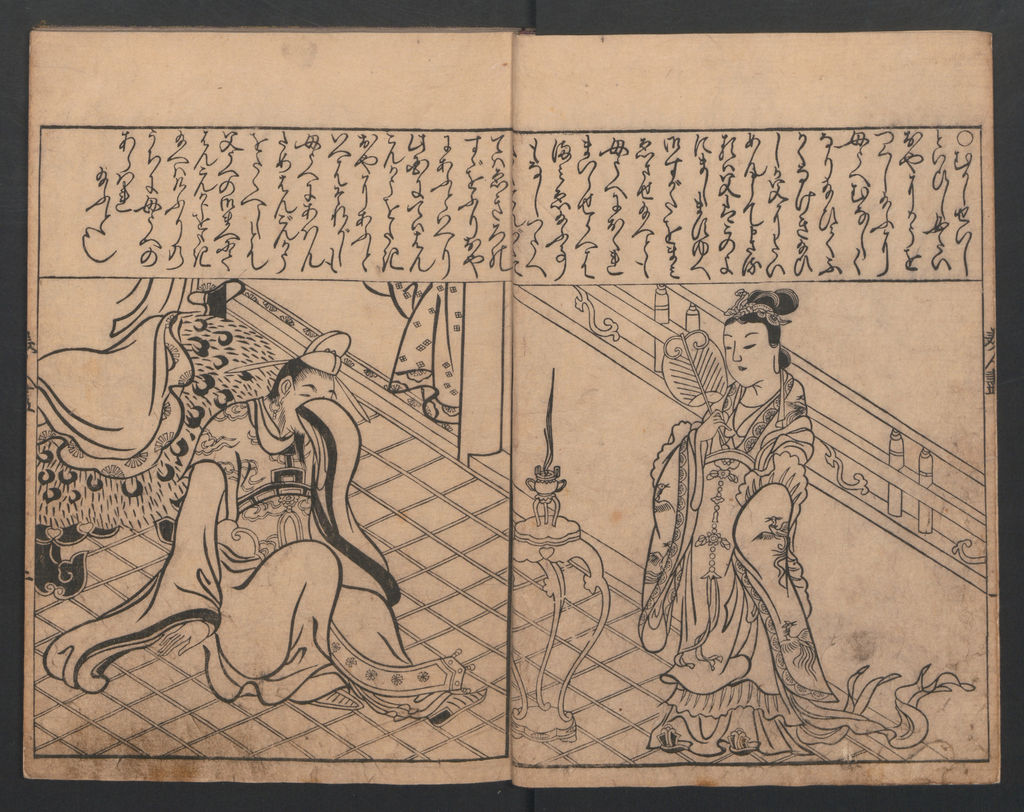
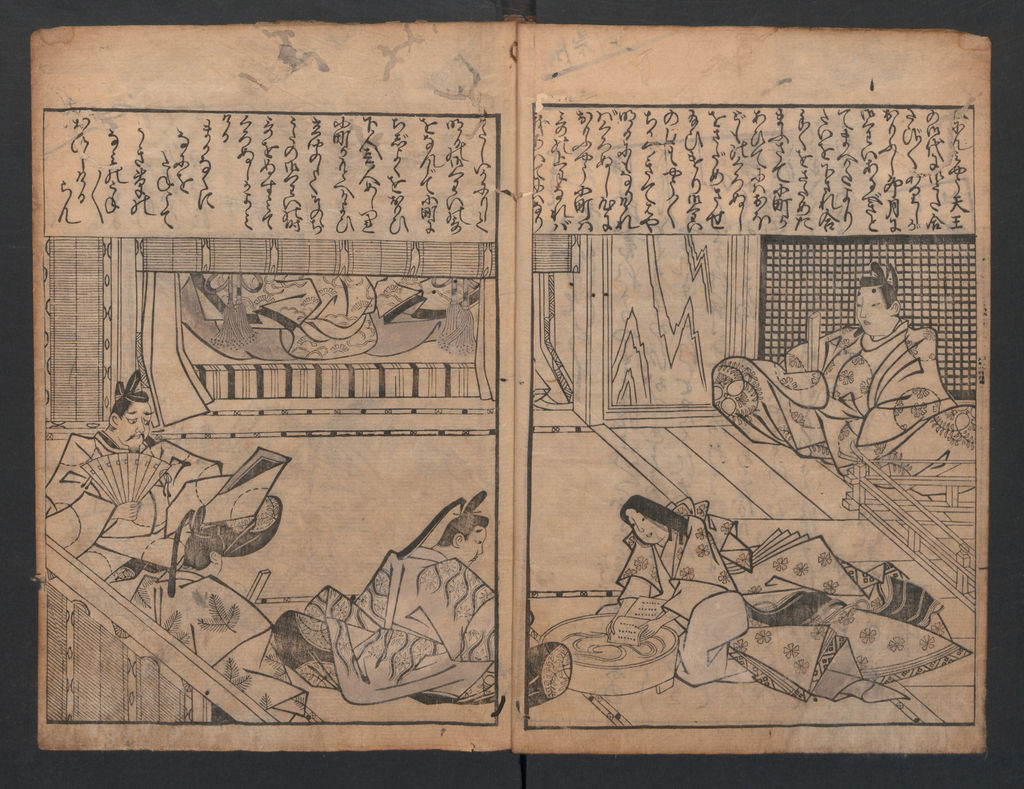
The Illustrations of Beautiful Women opening is more active than its broad title alone suggests. In the photographed spread, two women occupy an interior: one low to the floor, another kneeling with a folding fan. Words run above the figures. Their relation must be read from the printed sequence and text before a particular story is assigned to the scene. Still, the placement matters. The figures are not isolated specimens of beauty against a blank ground; floor lines, the fan and the room make them participants in an encounter. The design crosses the central fold, but the fold also interrupts it. That physical interruption is part of what a bound book asks an illustrator to manage. [10]
In the photographed Yamato-e zukushi opening, the subjects and visual atmosphere shift again. Courtly figures gather within an interior; a hanging blind, fan and the gestures of reading or writing organise the space. A reader can see that the book invokes a different pictorial world without inventing the exact literary episode represented. The printed text across the upper portion is part of the page, rather than a caption that can be cropped away without consequence. Comparing the two openings makes a small but valuable point: a seventeenth-century publisher could ask the same designer to address contemporary figures in one book and an older cultural repertoire in another. “Moronobu's style” therefore has to accommodate more than a single stock pose. [11] [10]
The page-to-page relation also changes what a viewer can infer from a photograph. One photographed opening from Yamato-e zukushi cannot establish the argument of an entire book. Conversely, a bibliographic title without images cannot show how a line bends around a figure or how calligraphy occupies the page. The best account works at both levels. It records the set, edition, maker and surviving copy, then slows down for the visible detail. The British Museum's 1680 original and 1684 surviving edition are a reminder that two apparently identical titles need not designate identical physical books. Comparison of copies can reveal changes in printing, ownership or preservation which a single digital photograph cannot settle. [11] [8]
Single sheets and the views they offered
The rise of individual woodblock sheets changes the tempo of viewing. Instead of turning the pages of a volume, a buyer could place one image before them, pass it on or preserve it in an album. The Met records The Entrance to Ageya-machi, from Scenes in the Yoshiwara / 吉原の躰, about 1681–84, accession JP808. An entrance is not merely background architecture: it establishes a threshold and invites a viewer into the sequence of the quarter's spaces. Another Met sheet, The Kitchen of a Joroya, circa 1680, JP810, shows the practical interior operations behind a place often pictured chiefly through leisure. These are two particular surviving sheets with catalogued titles, not generic illustrations of every Yoshiwara establishment. [13] [14]
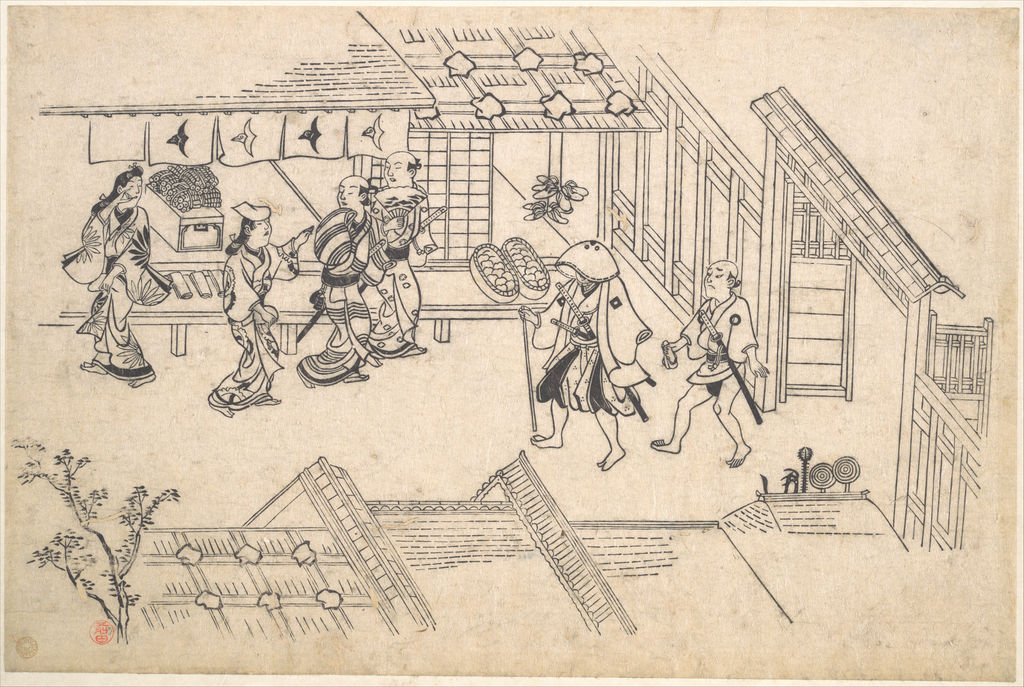
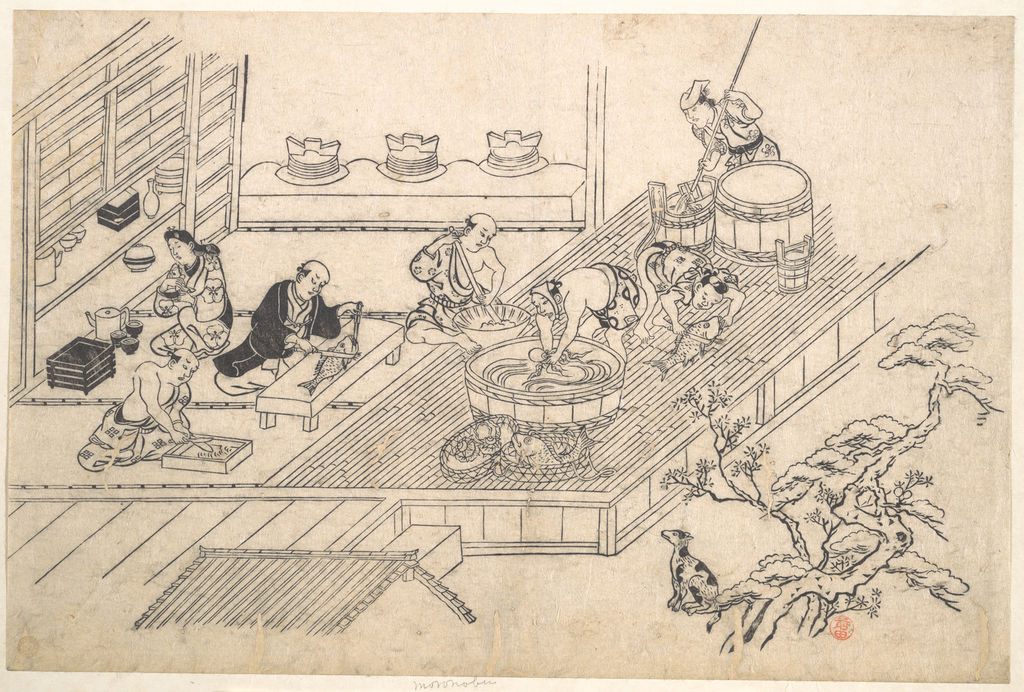
The contrast within this pair is as compelling as their shared subject. Entrance to Ageya-machi looks down onto a street, with figures moving amid rooflines and a shop curtain. Its vantage sets a route through the district in front of the viewer; the title need not be turned into a claim that a particular gate is visible in the sheet. Kitchen of a Joroya moves into a work space. Figures handle fish, vessels and other equipment; the room is busy with preparation. A pleasure quarter is made from work as well as display. The visible tasks do not provide a census of employees, but they bring service and food into a visual history too often reduced to the courtesan's clothing. The shift from street to kitchen is one reason to keep the two exact titles together without pretending they are the same surviving impression. [13] [14]
The Yoshiwara was a regulated pleasure district with workers and businesses, not simply a stage for anonymous fashionable figures. Moronobu's views make its gates, rooms, labour and social encounters visible through a design chosen for circulation. That choice is also selective. A printed kitchen scene cannot tell us every worker's name or how a particular house operated on a given evening. Prints can be evidence for how a space was imagined, offered to buyers and made legible; they need other records before becoming an exhaustive social history. The British Museum's 1681 Ukiyo hyakunin onna e record describes women of different classes with accompanying descriptions, showing that a printed sequence could range beyond a single setting and use text to shape how figures were understood. [15] [13]
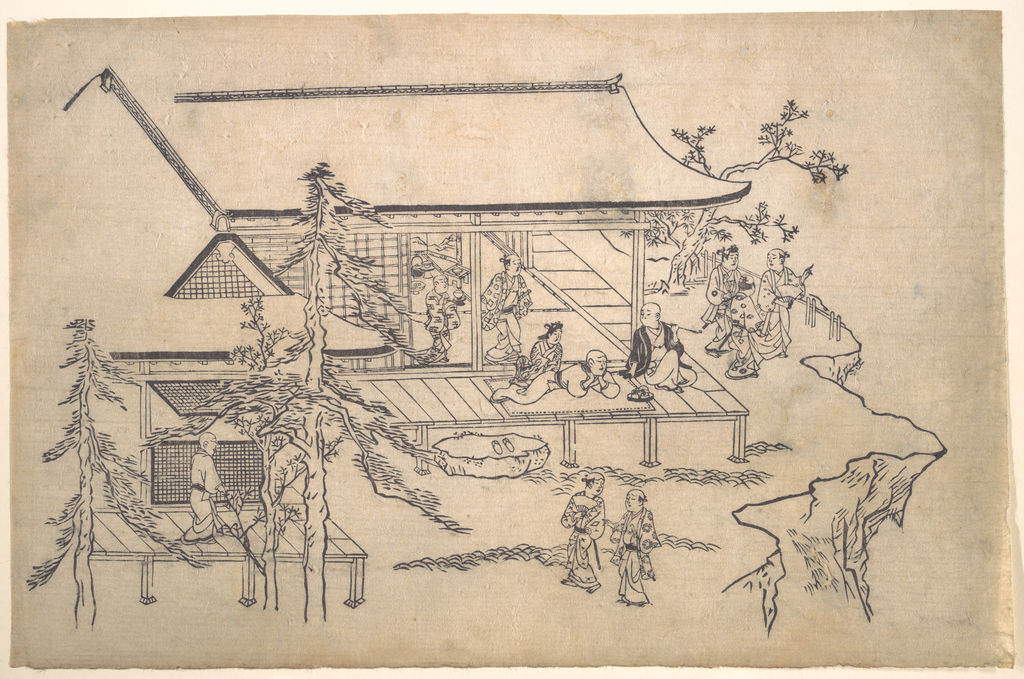
Moronobu also drew places outside the quarter. The Met's Kiyomidzu Temple in Kyoto, JP3066, is a print, while its Flower-Viewing Scene, JP2643, brings people into a landscape of seasonal leisure. The two objects complicate an assumption that early ukiyo-e presented only beauty portraits. Yet their empty or broad dates should not be made more precise by guesswork. The important contrast is pictorial: a famous religious site and a gathering outdoors call for different relationships between architecture, trees, figures and moving viewpoint. The shapes can be compared without insisting that both sheets were made on a single trip or for the same buyer. [16] [17]
Paintings beside the printed sheets
Moronobu also made paintings, and some of the most familiar images are paintings rather than woodblock prints. Tokyo National Museum identifies Beauty Looking Back / 見返り美人図, A-60, as a late painted hanging scroll. Its conservation project describes the figure's red silk robe and the problems of folds and abrasion that come from storing a scroll rolled. The work's much-reproduced image can encourage a false shorthand: the painting is neither an individual woodblock sheet nor the sole source for all later beauty prints. Looking at the original medium clarifies what the painter could do with coloured fabric, the turning body and the surrounding space. The turn of the head creates a small narrative event without the interior setting of the opening print; the scroll's surrounding field gives that event room to register. [18]
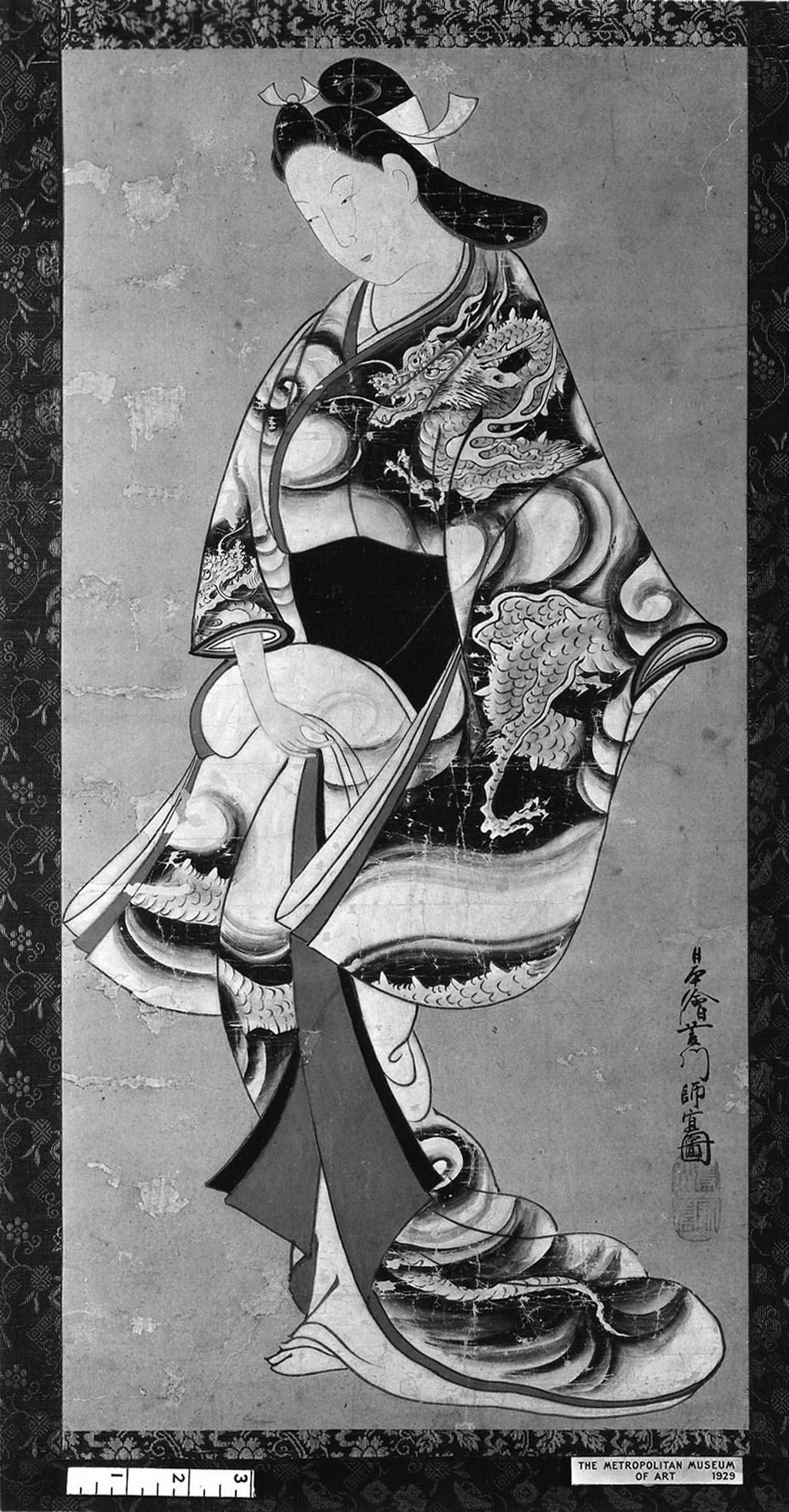
The Met's Standing Beauty, accession 29.100.454, is an undated matted painting in ink and colour on paper. The museum's available photograph is monochrome, so it should not be used to reconstruct the original colour of a robe. Nevertheless the pose, garment pattern and figure-to-ground relation remain legible. It is a different object from the Met's Standing Courtesan, which is on loan from a private collection. Nor is it a version of Tokyo National Museum's Beauty Looking Back. The repeated figure type is exactly why accession, owner, medium and date have to travel with an image. A website showing two solitary women at the same width should not erase those histories. [19] [20]
The size of a screen or scroll can place viewers differently from a page. Chiba City Museum of Art owns Moronobu's Scenes of the Sumida River and Ueno, a six-panel pair assigned to the Enpō period, 1673–81. The museum describes spring and autumn leisure across large surfaces. Seikado Bunko Art Museum's two-scroll Twelve Months of Genre Scenes, dated around 1692–93 on its 2026 exhibition page, offers another extended sequence of seasonal life. These are strong reminders that painting remained part of Moronobu's practice while books and prints multiplied. The subjects unfold over a scale and duration that a single-sheet portrait cannot reproduce. A viewer takes in a screen pair in a room, potentially moving to inspect different passages; a handscroll reveals its months in a controlled succession. The precise movement depends on how each object is displayed and handled, but the difference in format is fundamental. [21] [22]
The Chiba screen pair also gives a check on the easy assumption that every scene of contemporary life belongs to one district. The Sumida River and Ueno are distinct Edo settings, and the museum's spring and autumn description adds seasonal variety. Moronobu is interested in people occupying a place and time, not only in a model figure extracted from context. The Seikado Twelve Months scroll extends that logic over a calendar. Its exhibition information dates the object late in his career and identifies it as a pair of scrolls; it does not license a reconstruction of every scene without examining the scrolls themselves. The comparison is valuable precisely because it keeps the two objects separate: one is a folding-screen pair with named locations, the other a time-based painted sequence. [21] [22]
Looking across subjects without flattening them
At one scale, the page of Contemporary Kimono Patterns is an arrangement of possible designs; at another, a beauty painting turns fabric into an enacted posture. The Occupation book distributes trades across a set, while a Yoshiwara print presents a single entrance. A garden book offers models of shaped space, and a painting can make people move across a whole screen. Such comparisons let us see an artist managing line, sequence and audience rather than using “ukiyo-e” as a catchall for a particular type of woman. They also show why a book's title and a painting's current nickname should not be treated as interchangeable evidence. [5] [9] [13] [21]
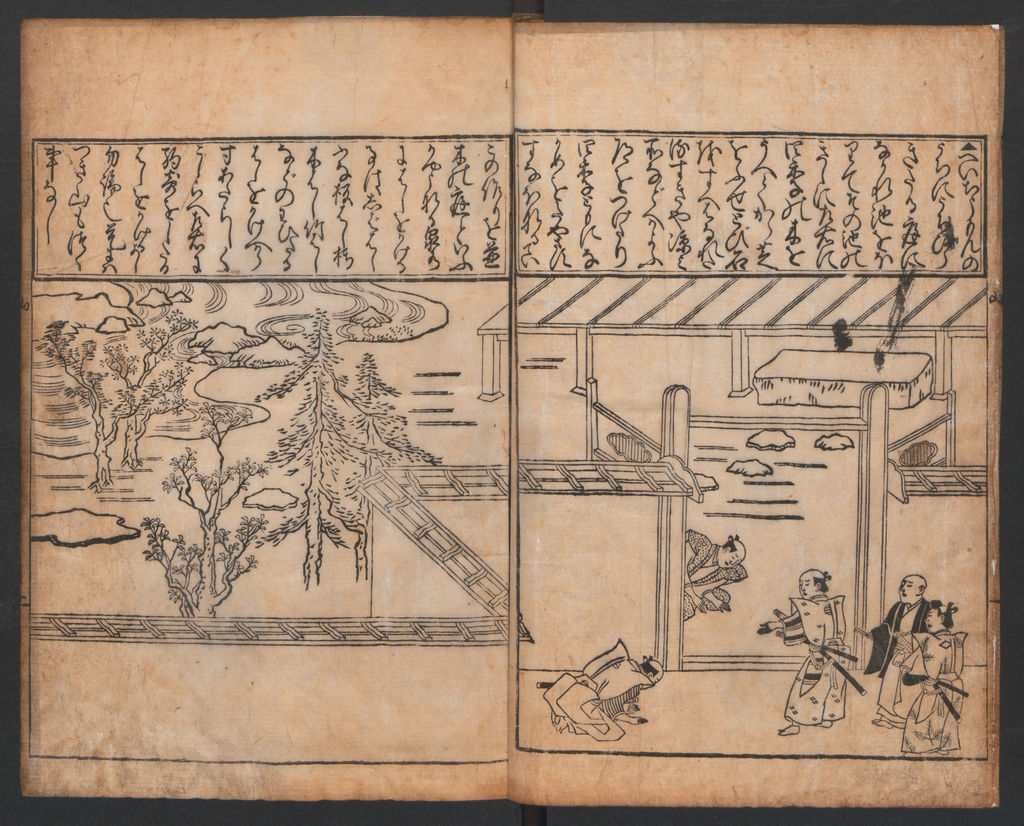
The Met's 1691 A Compendium of Model Gardens, JIB86, is especially useful against a narrow subject definition. The photographed opening shows a printed scheme of built and planted space. It tells us that a book could offer a model to contemplate or adapt; it does not prove that Moronobu built such a garden. Its date, fifth month of 1691, places this subject late in his documented publishing career. The image also prompts a comparison with the flowering branches and people in Flower-Viewing Scene. One is a book of models, the other an image of leisure. Similar trees do not make them the same story, and neither should be claimed as a direct view of the exact garden represented by the other. [12] [17]
The opening itself is densely occupied. Printed words run above a scene of trees, a bridge or crossing, buildings and small figures. Those visible details make the garden a place for movement and viewing, rather than a diagram of planting alone. The lines of built structures and tree branches divide the space into successive sights, recalling the way a reader travels from one spread to another. This does not establish that the represented place existed outside the book. It does show why a garden publication belongs in an account of Moronobu's visual range: he could make an imagined setting legible through the relation of people, plants and architecture. The result is far from the single standing beauty often used to stand for the whole oeuvre. [12]
Across the Met selection, dates range from exact publication months to broad “late seventeenth century” labels and blank date fields. That variation should remain visible. A clear date on a book may belong to a publisher's edition, while an individual sheet could be catalogued decades later from style or series context. The original design, carved block, subsequent impression and modern photograph are separate moments. The British Museum's 1680 original versus 1684 surviving Yamato shino ezukushi edition makes this more than a theoretical warning. The Met also holds books dated 1695, after Moronobu's death. They can show how designs continued to circulate, but cannot be described as new drawings he personally made that year. [8] [23]
“Founder” as a historical claim
Moronobu's status as a founder is useful if it opens inquiry rather than closes it. The British Museum's discussion of earlier small paintings traces the Yoshiwara subject back to painted leisure screens of the seventeenth century's first half. Moronobu did not make those predecessors disappear. He gave contemporary figures and urban places a recognisable visual form in books, sheets and paintings under his own name. Later artists worked in and beyond that inheritance: the Shimane Art Museum names Morofusa, Moroshige and Morohira among the pupils or workshop figures associated with him. Specific works by any of them must still be distinguished from an autographed Moronobu design. [3] [2]
The attribution problem is not abstract. The Met's Dancer, accession 29.100.446, carries School of Moronobu in its open-access record, even though an artist name appears alongside the object. The British Museum records a supposed Moronobu painting, 1913,0501,0.370, as a later forgery copied from a print. Neither should be presented as a confirmed autograph work. Conversely, an institutional attribution to Moronobu is evidence of how the holding museum currently understands an object, not a guarantee that future scholarship cannot revise it. A reader gains more from seeing these levels of confidence than from an enlarged “masterpieces” gallery with its caveats silently removed. [24] [25]
Chiba City Museum of Art's substantial 2001 exhibition catalogue divided Moronobu's work into paintings, prints and books, with separate essays on his career, printed imagery and picture-book problems. Its publicly available contents page identifies the book's 236 pages and 152 plates. Seikado's 2026 exhibition listing points to a catalogue with new conservation findings on the Twelve Months handscroll. Those publications signal the breadth of objects and questions involved in studying him. They also show why a short formula such as “first ukiyo-e artist” cannot settle the history: survival, edition, medium, attribution and the treatment of painted works all remain consequential. [26] [22]
Moronobu died in 1694, yet a book bearing his name might be dated 1695. This is no contradiction if the date is recognised as a publication event and the designs are connected to an earlier practice. Nor should all undated paintings be forced into a final “mature” phase because they look accomplished. A timeline built from surviving objects is uneven: some publications have dates printed in them, some impressions are assigned a range by curators, and some paintings remain undated. Within those limits, the dated run from textile patterns through illustrated occupations, beauties, older narratives and gardens is already a substantial record of invention. It lets us see a working artist in a publishing culture rather than a symbolic founder standing outside one. [5] [9] [12] [23]
The work that followed him need not be understood as simple repetition. The Shimane Art Museum names artists in his circle, while later printed books and individual sheets continued to change in scale, colour and subject. Moronobu's place within that longer history is best represented by a route into objects: compare a dated book with a later edition, a monochrome print with a hand-coloured impression, and a painted figure with a figure printed on paper. Each comparison exposes a different part of the process that later artists inherited and altered. It also makes the historical claim testable. If a museum revises the attribution or dating of one work, the account can be corrected at the level of that object without losing the broader evidence that painting and printmaking developed together in Moronobu's career. [2] [8] [4]
The Moronobu biography follows the uncertain birth year, Hota textile household, move to Edo, dated book production and the end of his life in 1694. Here the invitation is to compare media. Begin with the line and hand-applied colour of the opening sheet; turn to the different sequences of clothing patterns, occupations, beauty subjects and gardens; then return to the room-sized screens and painted scrolls. What matters is the precise object before the viewer and the different kind of looking it asks for. “Founder of ukiyo-e” becomes more illuminating when the printed page, single sheet and painted surface remain distinct. [1] [5] [21]
Frequently Asked Questions
His birth year is not established. The hometown museum in Kyonan estimates around 1630, while the Met's catalogue labels give 1618. Both place his death in 1694. A precise age at a career event would therefore imply more certainty than the sources allow. [1] [4]
Museums often call him an originator because his named paintings, books and individual sheets decisively shaped the developing field. Earlier painted leisure scenes and anonymous prints existed. “Founder” describes his historical importance, not creation from an empty beginning. [1] [3]
No. Tokyo National Museum's A-60 is a painted hanging scroll. Its conservation history and material differ from a printed sheet, even though the image has circulated widely in reproductions. [18]
The date may identify an edition or surviving copy made after his 1694 death. A later book date is not proof that he drew new illustrations after death. Compare publication history and attributed designs before making that claim. [23]
Discussion
Compare a kimono pattern book, a Yoshiwara sheet and a painting. What does each format let Moronobu show?
Reader Insights
Compare the garment outlines in the pattern book with cloth worn by a figure.
How do the two Yoshiwara sheets use space and movement differently?
Which record details distinguish a painting from a hand-coloured print?
Join the Conversation
Share a documented example or a reliable source below, keeping observation separate from inference.
References
- Kyonan Town, Hishikawa Moronobu Memorial Museum, “Who was Moronobu?” / 菱川師宣とは, hometown biography and birth-year uncertainty.
- Shimane Art Museum, Hishikawa Moronobu artist record, book/print development and workshop context.
- British Museum, earlier painted leisure scene and ukiyo-e precursors, object 1914,0512,0.8.
- Metropolitan Museum of Art, Courtesan with a Young Man beside a Screen, c.1679–84, 2020.195.
- Metropolitan Museum of Art, Contemporary Kimono Patterns / 当世ひいな形, 1677, 2013.887.
- Metropolitan Museum of Art, Two Lovers, c.1675–80, JP676.
- British Museum, Kosode on hinagata / 小袖御ひなかた, 1677, 1958,0510,0.1.1.
- British Museum, Yamato shino ezukushi / 大和侍農絵尽, 1684 surviving edition; catalogue notes 1680 original.
- Metropolitan Museum of Art, A Picture Book Mirror of Various Occupations / 和国諸職絵尽, 1685, 2013.786a–c.
- Metropolitan Museum of Art, Illustrations of Beautiful Women / 美人絵づくし, 1683, JIB67a–c.
- Metropolitan Museum of Art, Yamato-e zukushi / 大和絵づくし, 1686, JIB84.
- Metropolitan Museum of Art, A Compendium of Model Gardens / 築山図庭畫, 1691, JIB86.
- Metropolitan Museum of Art, The Entrance to Ageya-machi, c.1681–84, JP808.
- Metropolitan Museum of Art, The Kitchen of a Joroya, c.1680, JP810.
- British Museum, Ukiyo hyakunin onna e / うき世百人女絵, 1681, 1979,0305,0.30.
- Metropolitan Museum of Art, Kiyomidzu Temple in Kyoto, JP3066.
- Metropolitan Museum of Art, Flower-Viewing Scene, JP2643.
- Tokyo National Museum, Beauty Looking Back / 見返り美人図 conservation project, object A-60.
- Metropolitan Museum of Art, Standing Beauty, undated painting, 29.100.454.
- Metropolitan Museum of Art, Standing Courtesan, ca.1690, object on loan L.2019.10.5a–d.
- Chiba City Museum of Art, Scenes of the Sumida River and Ueno / 隅田川・上野風俗図屏風, no. 2961006.
- Seikado Bunko Art Museum, Twelve Months of Genre Scenes / 十二ヶ月風俗図巻, 2026 exhibition and catalogue listing.
- Metropolitan Museum of Art, One Hundred Women of Japan / 和国百女, 1695 edition, JIB65.
- Metropolitan Museum of Art Open Access record, Dancer, 29.100.446, artist prefix “School of.”
- British Museum, later painting claimed to be by Moronobu, 1913,0501,0.370, catalogued as a forgery.
- Chiba City Museum of Art, Hishikawa Moronobu / 菱川師宣展, exhibition catalogue, 2001, 236 pages, public contents list.