


 by Tom Gurney
Tom Gurney BSc (Hons) is an art history expert with over 20 years experience
Published and updated on September 25, 2026
Email: tomgurney1@gmail.com / Phone: +44 7429 011000
A life recorded unevenly
Hishikawa Moronobu (菱川師宣) is a celebrated name in the history of ukiyo-e, yet the basic outline of his own life is less secure than the dates on some of his books. His birthplace can be placed in Hota, in Awa province, and he died in Edo in 1694. The year of his birth is unresolved. The Hishikawa Moronobu Memorial Museum in today's Kyonan estimates around 1630; Metropolitan Museum of Art catalogue labels commonly give 1618. Matsudaira Susumu's 1988 bibliography of Moronobu's picture books explicitly calls its own age figures provisional, reasoning backwards from an assumed age at death in a temple register. A biography should retain this difference between an institutional convention, an argued estimate and a contemporary date printed in a book. [1] [2] [3]
Contents
Explore Moronobu’s works and visual methods.
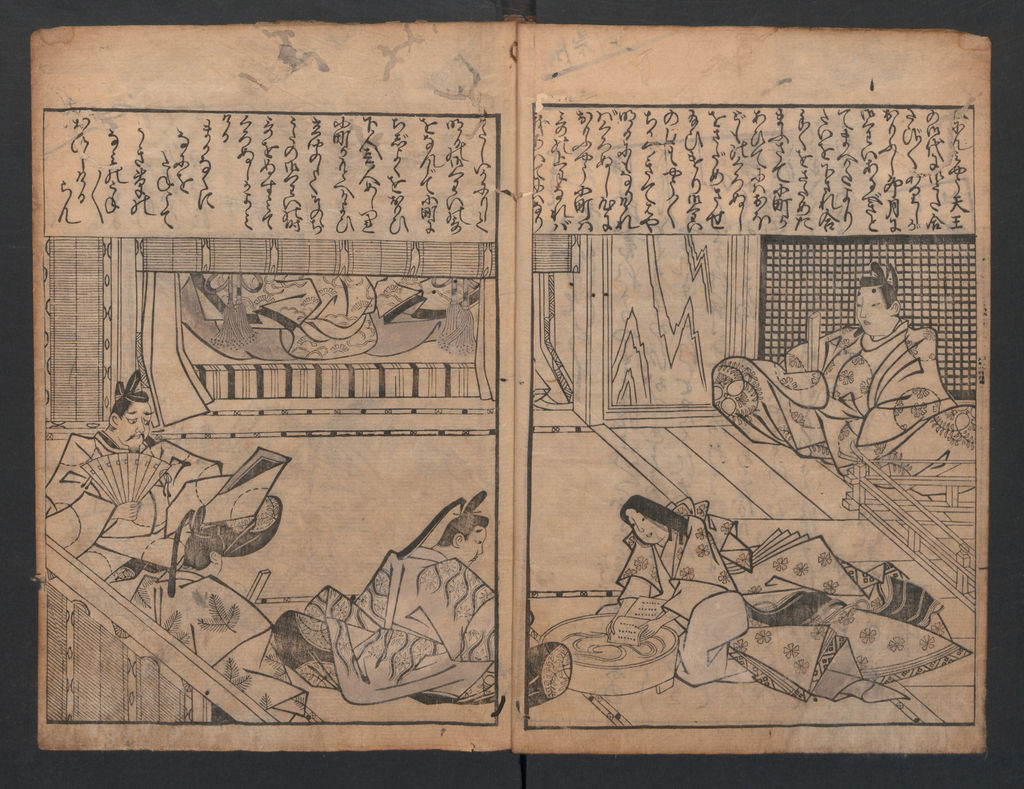
The evidence becomes denser after Moronobu appears by name in the colophon of an illustrated book issued in 1672. Even then, printed books disclose the artist's professional life more readily than his daily routine. A publisher's name tells us who issued a volume. A preface can tell us how the maker wished to be presented to readers. A painted screen reveals a subject and material, but may not give its precise year. Later accounts preserve details about family and training; their wording and date matter. Following Moronobu therefore means moving among different kinds of witness, not filling every gap with a smooth tale of genius progressing inevitably toward “the first ukiyo-e print.” [4] [5] [6]
Moronobu’s life at a glance
- YearsBirth year uncertain–1694
- OriginHota, Awa (now Kyonan, Chiba)
- Early signed bookBuke hyakunin isshu (1672)
- WorkIllustrated books, single sheets and paintings
Hota and a household of textile work
Kyonan's memorial museum places Moronobu in a Hota household engaged in embroidered and decorated textiles. It names his father, Kichizaemon, and mother, Otama; its account calls him the eldest son among seven children and says he helped with pattern drawing. These are useful hometown traditions preserved by the museum, but the page does not provide a dated contract of apprenticeship or a precise birth register. The statement that he saw Chinese, Kanō and Tosa pictures in youth likewise describes artistic exposure rather than a documented period with named teachers. The family trade remains significant without turning conjecture into an eyewitness record: a designer of cloth would have had reason to notice how outlines hold pattern, how a sleeve carries a motif, and how a garment changes when a body moves. [1]
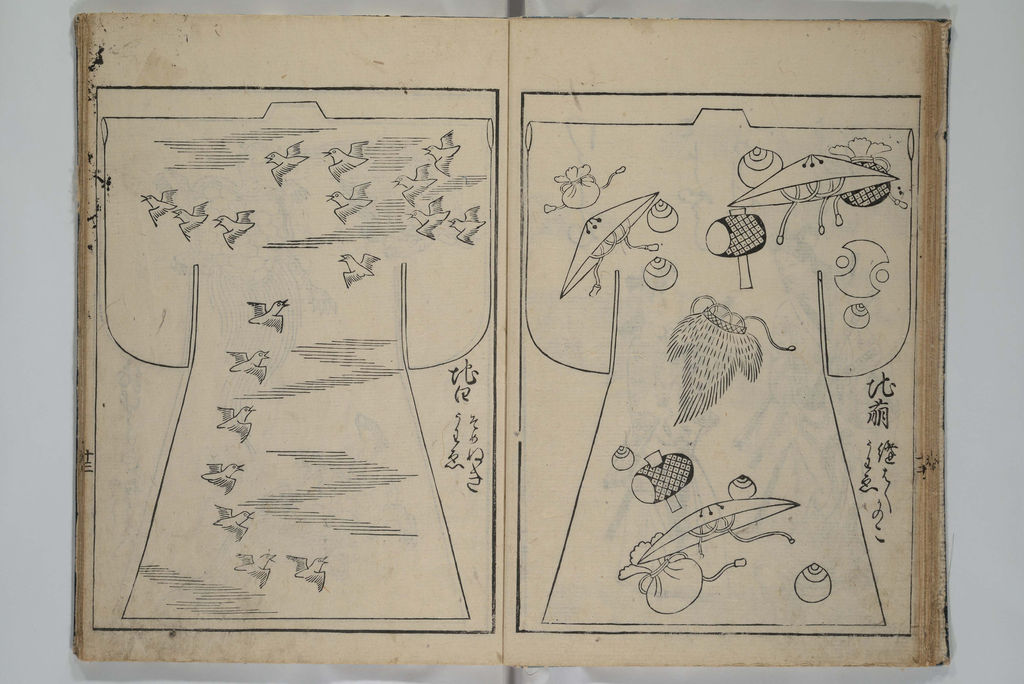
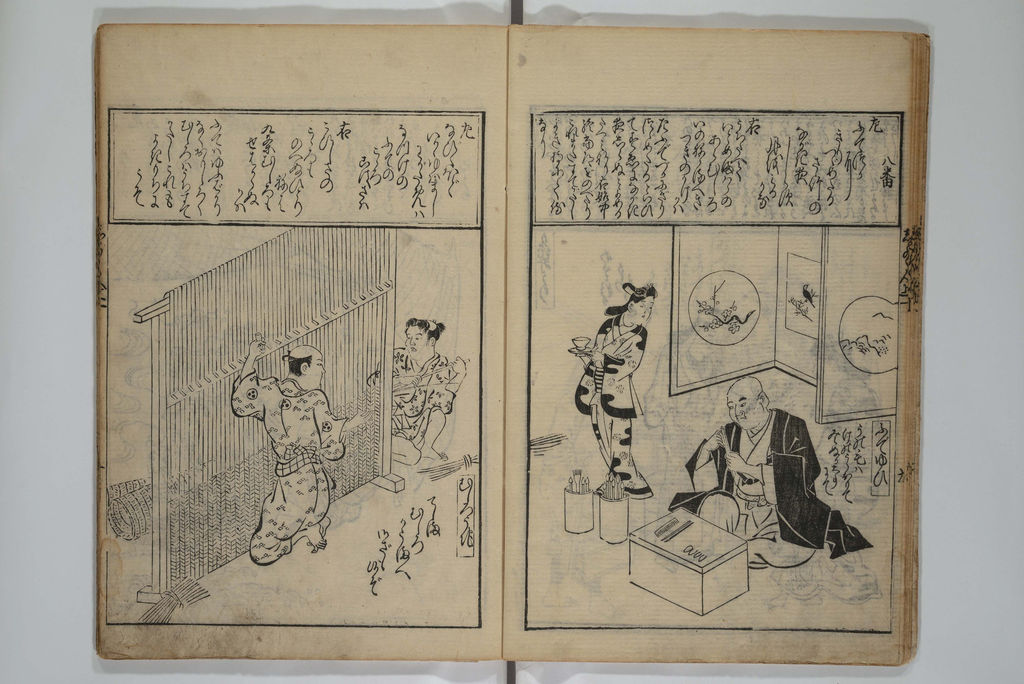
The household connection gains a later, securely dated counterpart in the 1677 pattern book Contemporary Kimono Patterns / 当世ひいな形. The Met holds a first volume, accession 2013.887; the Suntory Museum of Art catalogues a four-volume Shinpan kosode o-hinagata dated the same year. Suntory explains that such books grew from fabric merchants' design samples and order records into woodblock-printed publications which could be enjoyed beyond a tailor's immediate transaction. In its Moronobu set, garments and figures wearing garments share a book. This does not prove that the photographed Met opening records a design once made in Kichizaemon's shop. It does show that the printed phase of the son's career addressed a field close to the family's reported skill. [8] [9]
Suntory's description makes the shift in audience concrete. A merchant's sample can guide an order, but a printed volume can travel beyond the shop, giving its reader examples of shapes, motifs and imagined wearers. The museum notes that pattern-book pages could carry names of designs, colour suggestions and instructions about working the fabric. A reader might inspect an individual page for practical use or enjoy the succession of increasingly inventive garments. The object in the Met is one surviving volume and its photographed opening is one moment in a larger set. Its exact contents should not be substituted for Suntory's four-volume copy. In a biography, these books show a form of expertise Moronobu could bring to the market, while the distinction between copies shows why a career cannot be assembled from image files alone. [8] [9]
Hota also continued to matter as an origin he could name. The Kyonan museum says Moronobu sometimes prefixed signatures with 房陽 or 房國, evoking his home region, and that he donated a bell for relatives at Betsugan'in. These statements give a direction for material research: a signed object and the surviving or documented bell should be located before quoting their inscriptions as independently checked primary evidence. They do, however, resist a biography that erases Hota once the artist reaches Edo. Even if his actual travel date remains unknown, local origin could still be presented in his later professional identity. The memorial museum also calls a burial at Betsugan'in probable; “probable” should remain attached to that report. [1]
Moving to Edo: what the preface can tell us
No checked source here supplies the calendar year Moronobu moved to Edo. His hometown museum describes a preface to Yamato musha-e / 大和武者絵 which says that an artist from the Bōsō coast travelled by boat to the castle town, loved painting from childhood and learned by copying older Japanese styles. The account is valuable as a story placed before readers of a seventeenth-century printed book. It is not a travel diary. The preface's language can promote the artist as someone who joined traditional skill to contemporary invention. It cannot independently name the boat, the departure day or a formal master in a particular painting school. The Metropolitan Museum and MOA Museum of Art also place Tosa and Kanō influences in his artistic formation, but their general accounts do not turn the reported study into a dated apprenticeship. [5] [10]
Moronobu's first documented professional foothold is more precise. The Kyonan museum identifies Buke hyakunin isshu / 武家百人一首, issued in Kanbun 12 (1672), whose colophon names 「絵師 菱川吉兵衛」. The Bibliothèque nationale de France catalogues a copy from Edo, associated with publisher Tsuruya Kiemon, and the National Institute of Japanese Literature's teaching material distinguishes the illustrated 1672 version from an earlier 1666 version of the anthology. The 1672 book had a compiler, a calligrapher, a publisher and an image-maker; these roles matter to the claim that Moronobu's name had entered print. One should not say that every Buke hyakunin isshu was his work or that this was the first book ever illustrated in Edo. It is a specific surviving signed milestone in a larger book culture. [4] [11] [12]
Matsudaira's picture-book chronology begins its dated list with this 1672 title and points to a copy at the Art Institute of Chicago. His preface to the bibliography is as useful as any individual entry: he says his survey cannot claim every first edition and that he selects the earliest accessible copies with comparatively sound book details. A date attached to a surviving copy may tell us when that copy or edition was produced, while the design may have been first issued earlier. The distinction will recur in Moronobu's later career. The 1672 colophon is also a better anchor for the biography than the often-repeated but unsupported formula that he “arrived in Edo in the 1660s.” He was active in its print world by 1672; the beginning of his residence is less certain. [3] [4]
The 1672 book was an illustrated anthology of warrior poets, not a pleasure-quarter scene. Terashima Tsuneyo's National Institute of Japanese Literature seminar places the work within the wider family of “one hundred poets” anthologies and contrasts the earlier edition with the one illustrated by Moronobu. Thus the first securely named point in his publishing record belongs to a subject connected with older literary and warrior culture. Later ukiyo-e histories often begin with courtesans and actors; this book changes the starting view. It also shows why the calligrapher and compiler belong in the story. Poems, handwriting, portraits and the choice of which people to include came together as a book made for readers. Moronobu's contribution has to be located within that collaboration rather than treated as a freestanding series of portraits detached from text. [12] [11]
Working with publishers in the 1670s and 1680s
The 1677 pattern book offers one kind of subject and publisher relationship. A different line of evidence involves Urokogataya Sanzaemon, the Edo publisher named on Yamato shinō ezukushi / 大和侍農絵づくし. The British Museum holds an 1684 edition and explicitly says the first publication was in 1680. The Smithsonian's National Museum of Asian Art records another 1684 copy, identifies Urokogataya and gives its material as a woodblock-printed book on paper. In a paper published by Kokugakuin University, Fujisawa Murasaki notes that Moronobu's signature in the earlier work calls him 「大和絵師菱川吉兵衛尉」. The exact form and date of that signature should be read with the relevant volume before transcribing it as an autograph inscription. At a minimum, these catalogues show the collaboration, the presence of edition history and a deliberate claim to a recognised pictorial tradition. [13] [14] [15]
Calling himself a Yamato-e painter was not a minor flourish. It placed the book designer in conversation with older Japanese pictorial culture when pictures of contemporary people were increasingly marketable. The 2024 Fujisawa paper discusses the Yamato musha-e preface, dated there to 1683, which presents Moronobu as combining older Tosa, Kanō and Hasegawa manners with his own inventions. This is evidence for how Moronobu could be framed in publication. It is weaker evidence for the exact sequence of his personal lessons. The differing forms of Yamato shinō ezukushi, Yamato musha-e and similarly named titles also warn against collapsing separate books into a single dated event. The books ought to be identified by their full title, edition and held copy before claims are combined. [15] [13]
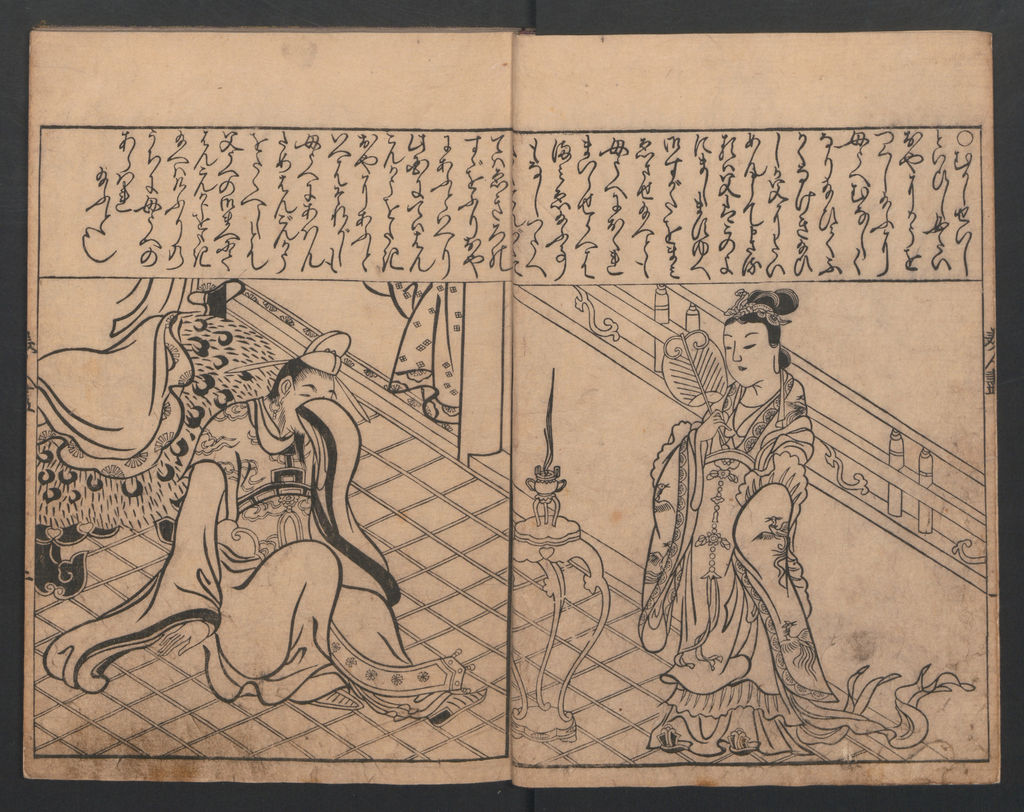
The dated range of books then broadens. The Met catalogues Illustrations of Beautiful Women / 美人絵づくし from the fifth month of 1683, A Picture Book Mirror of Various Occupations / 和国諸職絵尽 from the second month of 1685, and Yamato-e zukushi from the ninth month of 1686. A biography can use these dates to mark continued professional activity, but should not treat titles as evidence that Moronobu wrote every accompanying word. Each set had its own publisher and possibly other writers. The Occupations book made crafts visible in sequence; the Yamato-e volume addressed older subjects; beauty books addressed yet other readers. The variety is relevant to the career, while exact stories on unverified photographed leaves should not be invented for narrative colour. [17] [18] [16]
These dates allow a useful but deliberately uneven timeline. The signed 1672 book is a more secure career milestone than his age at the time. The 1677 pattern book has a precise year but the photographed Met leaf is only part of a set. The 1680 original of Yamato shinō ezukushi and the 1684 surviving editions illustrate how a design and a physical book can have different dates. The 1683, 1685 and 1686 Met sets show repeated commissions or publication opportunities, not necessarily continuous contracts with one publisher. None of this requires a story in which Moronobu abandoned painting when printing accelerated. The dated record is a frame around a practice in more than one medium. [3] [8] [13] [17] [18]
| Year | Object or record | What the date establishes |
|---|---|---|
| 1672 | Buke hyakunin isshu | An illustrated edition naming the artist in its colophon. [4] |
| 1677 | Contemporary Kimono Patterns | A published textile-pattern book attributed to Moronobu. [8] |
| 1680 / 1684 | Yamato shinō ezukushi | First publication and a later surviving edition, respectively. [13] |
| 1683–86 | Beauty, occupation and Yamato-e books | Several separately dated book sets, not one continuous volume. [17] [18] [16] |
| 1691 | A Compendium of Model Gardens | A dated publication late in his recorded career. [30] |
| 1694 | Death reported by the hometown museum | The terminal year; 1695 books are posthumous publications. [1] [31] |
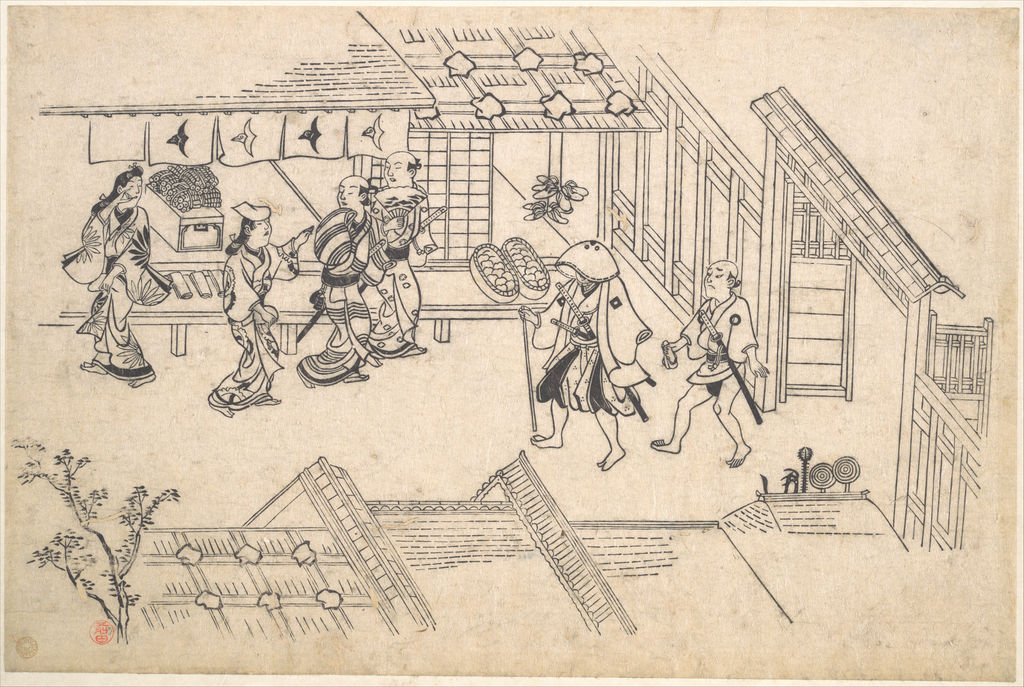
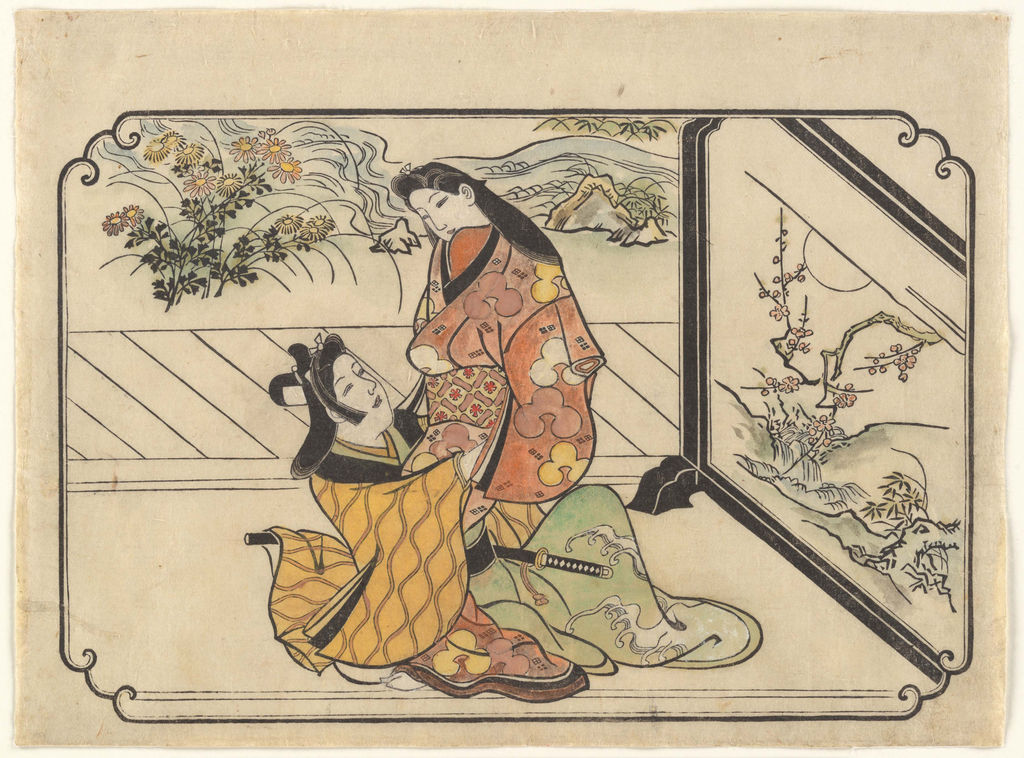
Nor was every printed image bound into a book. The Met's hand-coloured Courtesan with a Young Man beside a Screen, about 1679–84, and Entrance to Ageya-machi, about 1681–84, point toward the circulation of single sheets associated with the Yoshiwara. The hand colour on the former was applied to a black-line print: it belongs to a history before the later multi-block full-colour technique. These images are professional evidence of Moronobu designing for a different scale and purchase than a three-volume book, but the date ranges do not tell us which sheet he drew first. The biography can place them beside the securely dated 1680s publications without pretending that every item fits a year-by-year diary. [19] [7]
The city he inhabited and the city he pictured
Kyonan's museum gives a few Edo addresses associated with Moronobu from period records: Sakai-chō yokochō, Tachibana-chō and Muramatsu-chō 2-chōme. It does not turn them into a complete sequence of moves with dates. They place him around the city's publishing and performance districts rather than in an abstract “floating world.” A printed humorous tale, Shikano Buzaemon kuden banashi, stages a visitor's name being misheard as “ghost” at Moronobu's house; the memorial museum calls one illustration a self-image. As literature, it shows the artist's name could become part of a comic urban scene. The exchange should not be retold as a stenographic account of an evening at his residence. [5]
MOA Museum of Art's painted Edo Genre Handscroll / 江戸風俗図巻 provides a more expansive view of the city Moronobu helped visualise. The museum records one silk scroll 39.1 centimetres high and over nine metres long. Its described route moves from Takanawa Ōkido through Goten-yama cherry viewing, the Nakamura-za theatre in Sakai-chō, the Sumida River and Ryōgoku Bridge, then Nihonzutsumi and the Yoshiwara. The museum dates it to the early Genroku period through its depiction of the theatre. This is a sequence of represented places, not a route proved to have been walked by Moronobu. It demonstrates the interests of an artist making urban life visible to a viewer who unrolls the picture in time. The original work and its institutional record deserve to remain distinct from a printed sheet of one Yoshiwara street. [10]
The route matters to the artist's life because it shows the range of places a painter working in Edo could make meaningful to a city audience. Takanawa gives an entry point, Goten-yama seasonal leisure, Sakai-chō a theatre, Ryōgoku a river crossing and the Yoshiwara a destination. Those meanings are derived from the museum's identification of the scenes, not from a claim that Moronobu observed them on one day. A nine-metre scroll asks the viewer to travel imaginatively as sections emerge. The passage from theatre to river to pleasure district is also a reminder that publishing, performance and urban recreation were connected activities. An address in Sakai-chō gains context beside a painted theatre there, yet the address and the painting remain separate records. [10] [5]
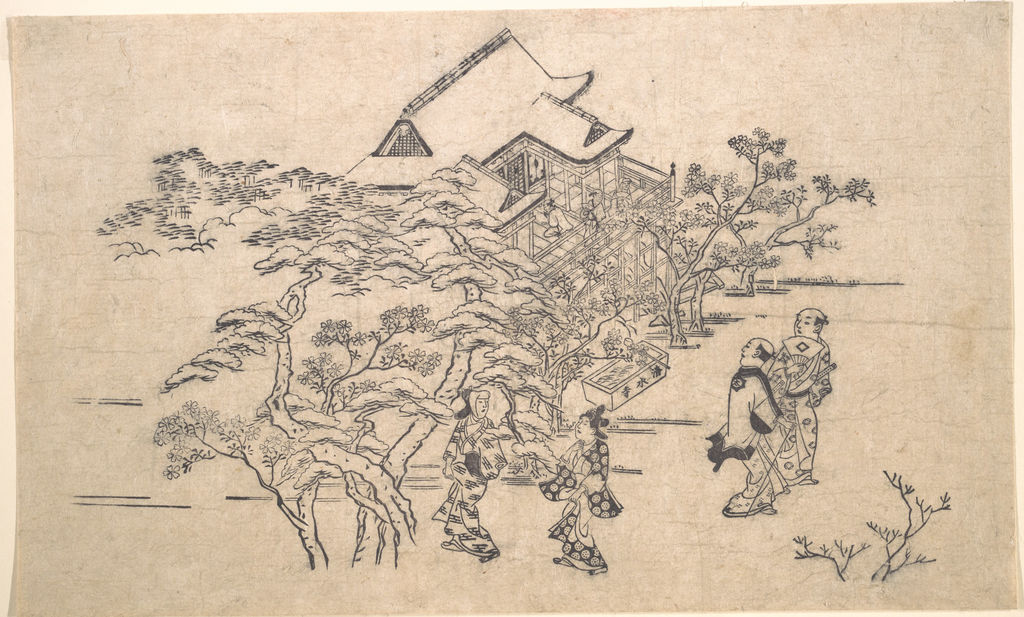
Chiba City Museum of Art's Scenes of the Sumida River and Ueno, an Enpō-period six-panel screen pair, and the National Museum of Asian Art's Autumn at Asakusa; Viewing Cherry Blossoms at Ueno Park likewise indicate that large paintings of urban leisure belonged to his recorded oeuvre. The Smithsonian's object text links the latter to the renewed city after the devastating 1657 fire, and describes crowds in autumn Asakusa and spring Ueno. That curatorial interpretation has value, but the object itself is a particular screen pair, not a panoramic photograph of Edo. The dates and subjects enrich a life in the city; the images would need their own commercial-use clearance before appearing alongside the Met's open-access sheets. [21] [22]
The home page asks what changed when Moronobu used a screen, book or sheet. The biography asks a different question of these places: how could a person who came from a coastal textile household become associated with the routes, theatres, riverfronts and pleasure districts of Edo? Dated publication places him in the city's production networks by 1672. Later addresses connect him to identifiable neighbourhoods. Paintings and prints show what he and his publishers chose to depict. Those kinds of evidence can be put alongside one another, but not merged. A famous bridge in a handscroll is not a deed to a nearby house; a named address does not prove that the artist observed every local scene directly. [4] [5] [10]
Paintings, pupils and names in the final years
Moronobu's late career continued to include painted works. Tokyo National Museum holds the hanging-scroll Beauty Looking Back / 見返り美人図, A-60; its conservation account describes a red silk robe and the folds and abrasion that can affect a rolled painting. Seikado Bunko Art Museum dates the two-scroll Twelve Months of Genre Scenes / 十二ヶ月風俗図巻 to about 1692–93 on its 2026 exhibition page. These works should not be converted into prints because his better-known legacy is connected with woodblocks. The exact painted surfaces, scale, condition and uncertain dating belong to the story of an artist still exploring sequential and single-figure forms near the end of his life. [23] [24]
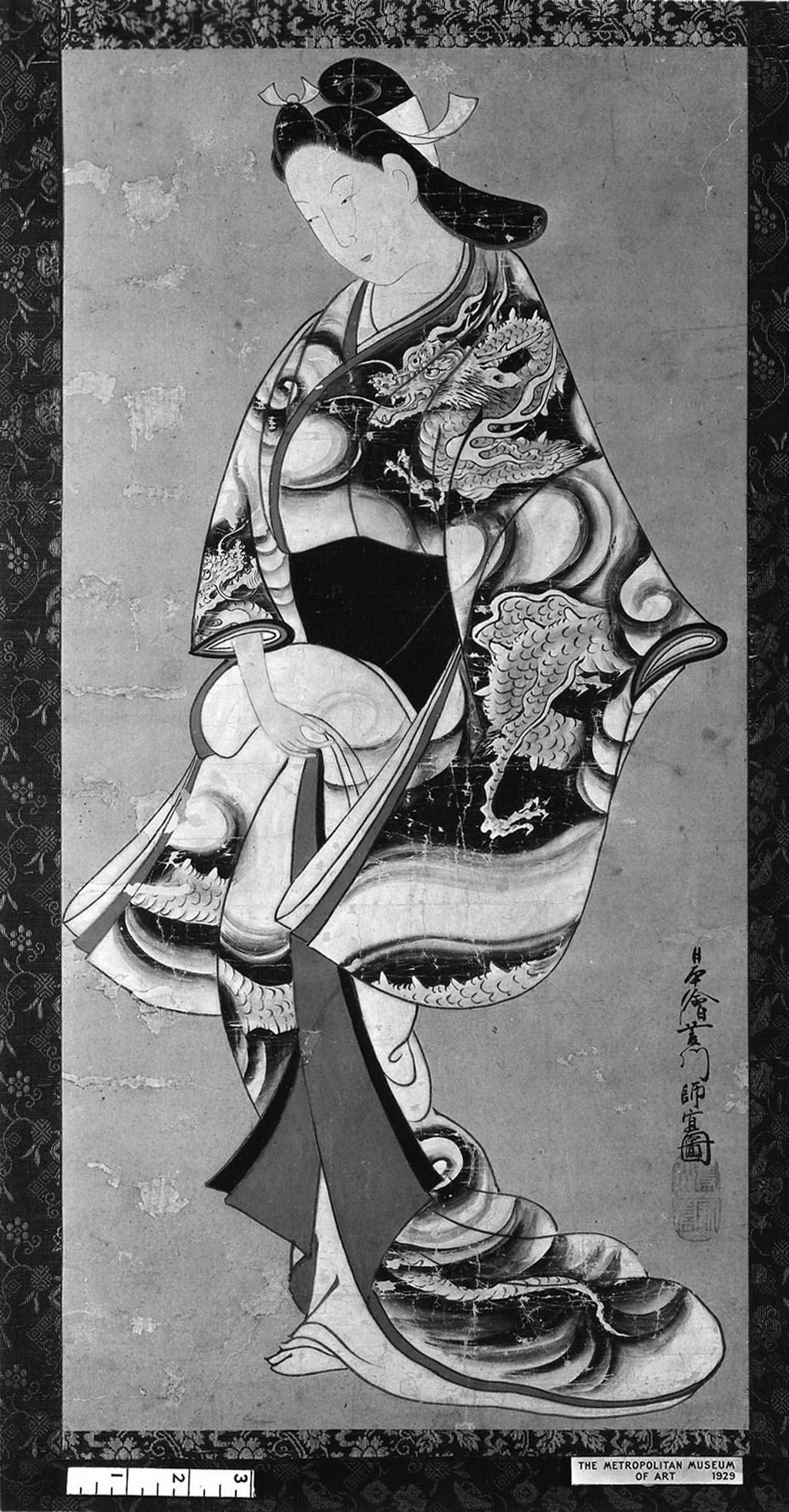
The Met's undated painting Standing Beauty, 29.100.454, offers a publicly reusable object through which to discuss this side of the practice. Its available photograph is monochrome, even though the catalogue's medium says ink and colour on paper. The gap between the object and its photograph is particularly important for a biography that follows a textile designer's son: one cannot use a black-and-white reproduction to say exactly which colours he chose. The clothing, pose and surrounding blank space remain visible. It is a different painting from Tokyo's Beauty Looking Back, and different again from the Met's Standing Courtesan, a private loan rather than a Met-owned open-access object. [25] [26]
Tokyo National Museum's conservation campaign gives a further reason to keep paintings present in the life story. A rolled scroll is not experienced and preserved like a loose printed page. The museum discusses folds, abrasion and the red silk garment of its Beauty Looking Back. Conservation makes an apparently familiar image more particular: a photographer's reproduction may be seen many times, while the underlying painted silk is vulnerable to the manner of its storage and handling. The painting's fame cannot by itself settle the year Moronobu made it, or prove that an undated Met beauty must be earlier or later. Nor does a shared subject imply that one composition was printed from the other. Looking at the material history prevents the biography from turning a surviving object into an undated emblem of an entire career. [23] [25]
A named master also leaves the problem of a school. The Shimane Art Museum names Morofusa, Moroshige and Morohira among painters associated with Moronobu's circle. Such lists help explain why designs similar to his continued to circulate. They are not a reason to assign every related sheet to his own hand. The Met's Dancer, for example, has the qualifying artist prefix “School of” in its open-access record. The British Museum catalogues one later painting once associated with Moronobu as a forgery. Later impressions, workshop output, successors and outright imitations require different descriptions. A biography should describe the productive network without inflating its output into an impossible number of autograph works. [27] [28] [29]
This issue also affects family language. An artist called Morofusa may be listed as a son or pupil in a later authority, but the precise family relationship and each artist's career dates need an identified record before they become a seamless chapter about a hereditary workshop. The useful fact here is that museum catalogues distinguish a circle from the master himself. The line from his designs to later ukiyo-e can be traced through training, influence and imitation, but those are different processes. A print after a design may still matter to his reception; it should be labelled as such. An object described as “School of” should remain qualified even if the photograph looks convincing beside confirmed examples. [27] [28]
The last clearly dated Met book in this selection is A Compendium of Model Gardens / 築山図庭画, fifth month 1691. A garden publication late in the career is another check against a biography limited to courtesans and actors. It offers built and planted space on printed pages, not evidence that Moronobu designed a physical garden. The Seikado Twelve Months scrolls from about 1692–93 suggest that painting and the passing of seasons remained a substantial concern after the 1680s publishing surge. Both dates fall before the 1694 death, but one is a printed publication date and the other an institutional estimate for a painted work. They should not be presented as equally precise calendar points. [30] [24]
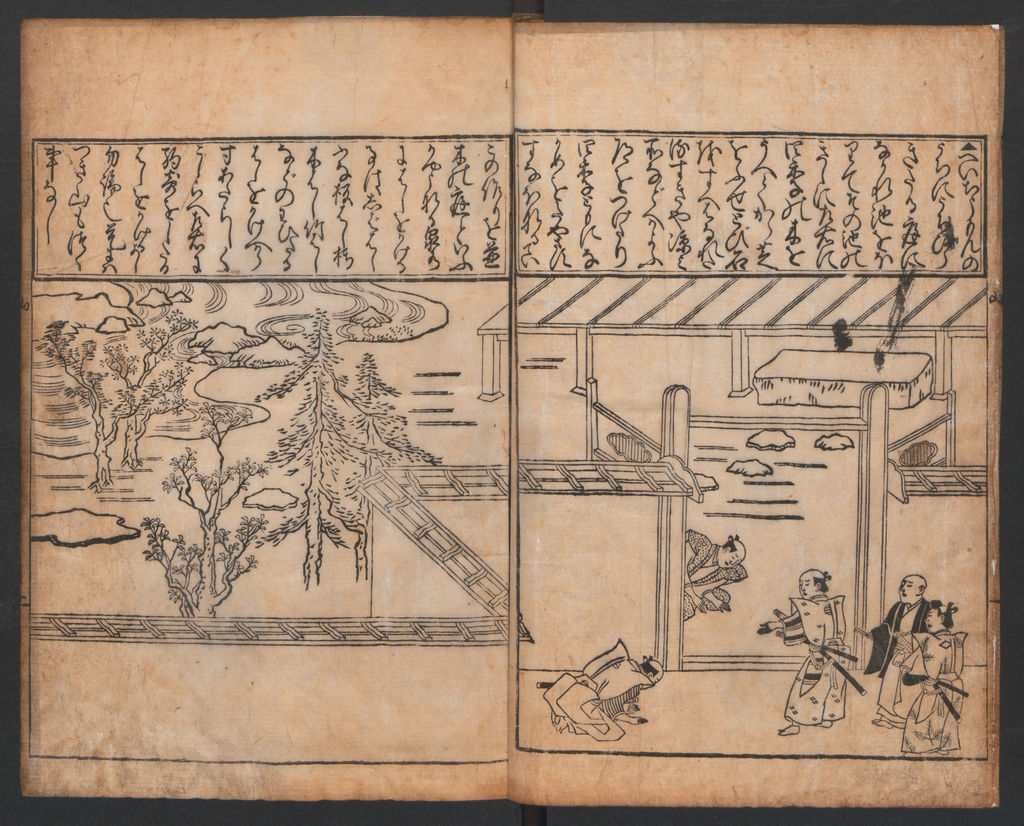
The Kyonan memorial museum reports that Moronobu died in Edo on Genroku 7, sixth month, fourth day. It considers his burial at Betsugan'in in Hota likely. The death year corresponds to 1694, while the day and month are given in the Japanese calendar and should not be silently printed as a Gregorian date without conversion. Some books in museum collections carry a 1695 publication date and Moronobu's name. These are posthumous editions or objects in a continuing publication history, not drawings made by a man who had already died. A career with printed books at its centre is especially likely to have this afterlife in copies, blocks and later impressions. [1] [31]
The 1695 example at the Met, One Hundred Women of Japan, is a useful end point precisely because it is awkward for a simple chronology. A catalogue can truthfully give Moronobu as artist and 1695 as the book's date. A biographer must still ask whether that date belongs to the edition, whether earlier designs were reused, and what evidence identifies the pictured copy. In this case, the safest statement is that his name remained attached to printed material after the reported death. The persistence of books also shaped how later readers encountered him: not only through unique painted screens and scrolls in collections, but through volumes that could be issued, copied, rebound, preserved and separated into illustrated openings. Different survival paths affect which part of a life becomes visible. [31] [3]
What later readers inherited
The phrase “founder of ukiyo-e” arose from the need to place Moronobu in a line of artists, but it can obscure both predecessors and the evidence of his own career. The British Museum records earlier paintings of leisure before his mature period. The Smithsonian describes how his large screens brought different genre-painting manners into a form that later artists could use. The institutions are describing historical importance, not a patent for invention. Moronobu is more interesting when the 1672 name in a colophon, the 1677 pattern book, the 1680s illustrated publications and single sheets, and the late painted scrolls remain a connected but uneven record. [32] [22]
His name subsequently functioned in several ways: an attribution to the individual, a marker for workshop production, and a reference point for artists who did not know him personally. Those uses should not be collapsed. The British Museum's forgery record is an extreme case, while the Met's “School of” label is an ordinary curatorial distinction. Both confirm that reception is part of the biography's ending. A reader asking what Moronobu himself made needs a narrower answer than a reader asking which later pictures show his influence. The museums' object labels provide a practical way to hold those two questions apart. [28] [29]
The books devoted to him continue to ask how these forms relate. Chiba City Museum of Art's 2001 exhibition catalogue covers paintings, prints and books in separate sections. Abiko Rie's 2020 specialist monograph, as described by its publisher, studies Moronobu's relation to older and contemporary themes, his self-description as a Japanese or Yamato-e painter, and the later development of themes he helped establish. These bibliographic records identify serious avenues for further reading; their full arguments are not represented here as if read. The works themselves and the checked museum records already support a biography that has room for uncertainty. His birthplace, family setting, dated emergence as an illustrator, multiple publishing relations and death can be stated; exact birth, arrival, training sequence and the authorship of every related print cannot. [33] [34]
For the viewer, the most direct way into that biography is a comparison of evidence. In 1672 a printed colophon gives a name; in 1677 a pattern book gives a date and a subject tied to the family trade; in the 1680s editions and signatures place the artist among publishers and older painting claims; in the 1690s garden pages and painted seasonal scrolls show work continuing toward the end. A life need not become perfectly documented to be rich. It becomes clearer when a printed signature is treated as a printed signature, a picture of Edo as a picture of Edo, and a later tradition as a later tradition. The artist overview turns back to the works themselves and to the differences between books, sheets and painted surfaces. [4] [8] [13] [24]
Frequently Asked Questions
His birth year is unsettled. The Hota memorial museum estimates around 1630; Met labels frequently use 1618. A 1988 scholarly bibliography openly calls its age calculations provisional. His 1694 death is much better established. [1] [2] [3]
The 1672 illustrated Buke hyakunin isshu names 「絵師 菱川吉兵衛」 in its colophon according to his hometown museum. BnF and a Japanese research institute independently catalogue the 1672 edition and collaborators. Earlier activity is possible, but the dated named book is the stronger anchor. [4] [11] [12]
The museum accounts and printed preface associate his formation with older Tosa and Kanō painting. The sources checked here do not establish a dated apprenticeship to an individual master. [5] [10]
He died in 1694. A 1695 date can identify a later edition, issue or surviving copy involving earlier designs. It cannot mean that he drew new images after death. [31]
Discussion
Compare dated books, later accounts and painting records. What can each establish about Moronobu’s life?
Reader Insights
What evidence and cautions accompany the museum and memorial museum dates?
What does the Buke hyakunin isshu colophon establish, and what does it leave open about his move to Edo?
Can a picture of Kyoto or Edo establish where its artist personally travelled?
Join the Conversation
Share a documented example or a reliable source below, keeping observation separate from inference.
References
- Kyonan Town Hishikawa Moronobu Memorial Museum, 菱川師宣とは, hometown account, family, names, death and qualified burial.
- The Metropolitan Museum of Art, Courtesan with a Young Man beside a Screen, c.1679–84, 2020.195; artist date convention.
- Matsudaira Susumu, 菱川師宣絵本年譜, Kōnan Kokubun 35 (1988), pp.89–95, especially its provisional-age note on p.89.
- Kyonan Town memorial museum, 菱川家に幽霊がやって来た, 1672 colophon, preface and Edo-address discussion.
- Kyonan Town memorial museum, printed biography in 大和武者絵 and 鹿野武左衛門口伝ばなし, read as seventeenth-century representations rather than direct diary evidence.
- Chiba City Museum of Art, 隅田川・上野風俗図屏風, museum object record for a period-dated screen pair.
- The Metropolitan Museum of Art, Entrance to Ageya-machi, c.1681–84, JP808.
- The Metropolitan Museum of Art, Contemporary Kimono Patterns / 当世ひいな形, 1677, 2013.887.
- Suntory Museum of Art, 新板小袖御ひいなかた, four-volume 1677 set and curatorial explanation of pattern books.
- MOA Museum of Art, 江戸風俗図巻, silk handscroll, 39.1 × 903.7 cm, early Genroku period.
- Bibliothèque nationale de France, Buke hyakunin isshu catalogue, Edo, Kanbun 12 (1672), Tsuruya Kiemon.
- National Institute of Japanese Literature, Terashima Tsuneyo, 百人一首の諸相及び歌仙絵, 2017 seminar, slide 5 on 1666 and illustrated 1672 versions.
- British Museum, Yamato shinō ezukushi / 大和侍農絵づくし, 1684 copy of 1680 original, Urokogataya publisher.
- Smithsonian National Museum of Asian Art, Yamato jinō ezukushi, FSC-GR-780.88, 1684 copy.
- Fujisawa Murasaki, “Kōrin's Images in Katsushika Hokusai's Thirty-six Views of Mt. Fuji”, Kokugakuin Japan Studies 5 (2024), pp.29–31 on Moronobu's books and self-description.
- The Metropolitan Museum of Art, Yamato-e zukushi / 大和絵づくし, 1686, JIB84.
- The Metropolitan Museum of Art, Illustrations of Beautiful Women / 美人絵づくし, 1683, JIB67a–c.
- The Metropolitan Museum of Art, A Picture Book Mirror of Various Occupations / 和国諸職絵尽, 1685, 2013.786a–c.
- The Metropolitan Museum of Art, Courtesan with a Young Man beside a Screen, c.1679–84, 2020.195.
- The Metropolitan Museum of Art, Kiyomidzu Temple in Kyoto, JP3066.
- Chiba City Museum of Art, 隅田川・上野風俗図屏風, 2961006.
- Smithsonian National Museum of Asian Art, Autumn at Asakusa; Viewing Cherry Blossoms at Ueno Park, F1906.266–267.
- Tokyo National Museum, 見返り美人図 conservation project, A-60.
- Seikado Bunko Art Museum, 十二ヶ月風俗図巻, 2026 exhibition record and catalogue listing.
- The Metropolitan Museum of Art, Standing Beauty, 29.100.454.
- The Metropolitan Museum of Art, Standing Courtesan, L.2019.10.5a–d, private loan.
- Shimane Art Museum, Hishikawa Moronobu artist record, circle and successors.
- The Met Open Access API, Dancer, 29.100.446, artist prefix “School of.”
- British Museum, supposed Moronobu painting, 1913,0501,0.370, catalogued as a later forgery.
- The Metropolitan Museum of Art, A Compendium of Model Gardens / 築山図庭画, 1691, JIB86.
- The Metropolitan Museum of Art, One Hundred Women of Japan / 和国百女, 1695 edition, JIB65.
- British Museum, earlier painted leisure scene, object 1914,0512,0.8, precursor context.
- Chiba City Museum of Art, Hishikawa Moronobu exhibition catalogue, 2001, 236 pp, 152 plates; publicly available table of contents.
- Geika Shoin, Abiko Rie, Hishikawa Moronobu: Kofū to tōfū o egaku eshi, 2020, 248 pp, ISBN 978-4-904706-08-4; publisher description.