


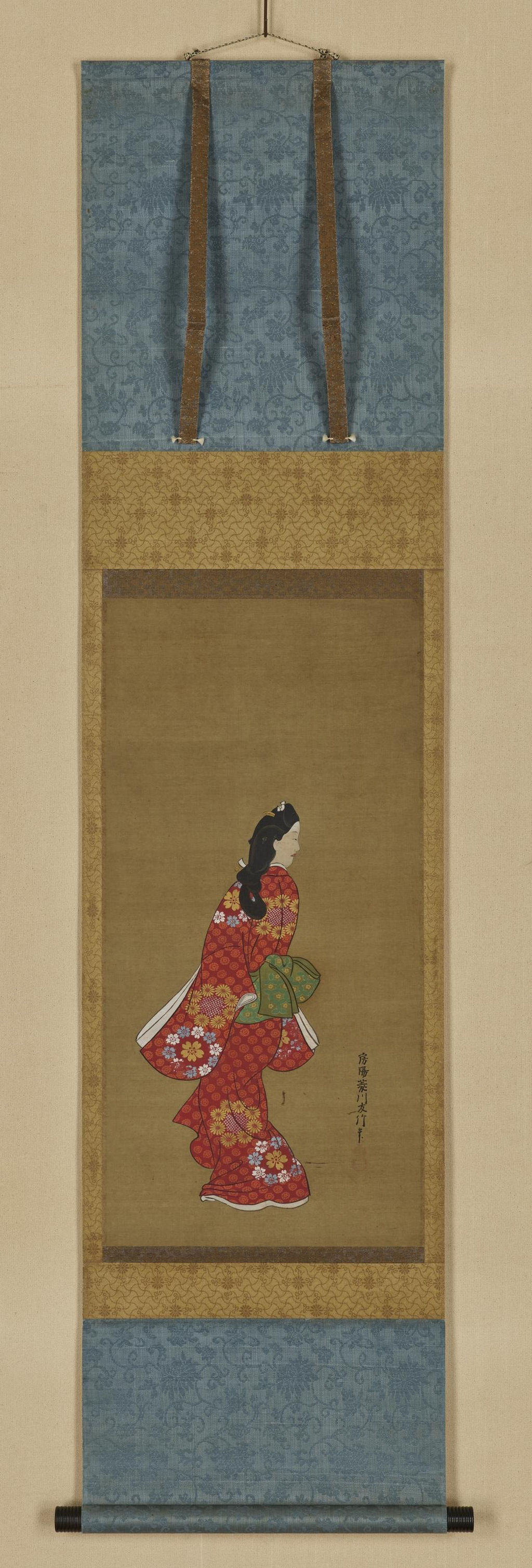
Hishikawa Moronobu, Beauty Looking Back, complete hanging scroll. Image: Tokyo National Museum A-60, ColBase; resized for this article.
 by Tom Gurney
Tom Gurney BSc (Hons) is an art history expert with over 20 years experience
Published and updated on September 25, 2026
Email: tomgurney1@gmail.com / Phone: +44 7429 011000
A glance that made a painting famous
A woman in a patterned crimson robe moves across a bare field of warm silk. Her body faces one way, but her head turns back. Hishikawa Moronobu gives us no second figure, doorway or street to explain her attention. The turn is enough to make a quiet painting feel like a moment in progress. Its familiar English title, Beauty Looking Back, translates 《見返り美人図》, but the person in the picture has not been securely named. The title describes what she does, not whom she sees or why she pauses. Tokyo National Museum holds the work as A-60 and attributes it to Moronobu, a painter and designer active in the emergence of ukiyo-e during the seventeenth century. [1] [2]
Explore Moronobu’s works · Read Moronobu’s biography
Contents
The celebrated image is a painting on silk, not a woodblock print. That distinction is easy to lose because Moronobu's name is so closely associated with illustrated books and printed pictures, and because reproductions of this figure appear in so many formats. A stamp, museum poster or web image can also detach the woman from the hanging scroll that carries her. To see the work clearly, it helps to start with the scroll, move in to the painted field, and then return to the actual size and history of the object. A printing block did not make the coloured robe or the turning face in Tokyo's A-60. The museum describes the work as 絹本着色, colour on silk, mounted as one hanging scroll. [1] [3]
Beauty Looking Back at a glance
- ArtistHishikawa Moronobu
- DateEdo period, 17th century
- MediumColour on silk, hanging scroll
- CollectionTokyo National Museum A-60
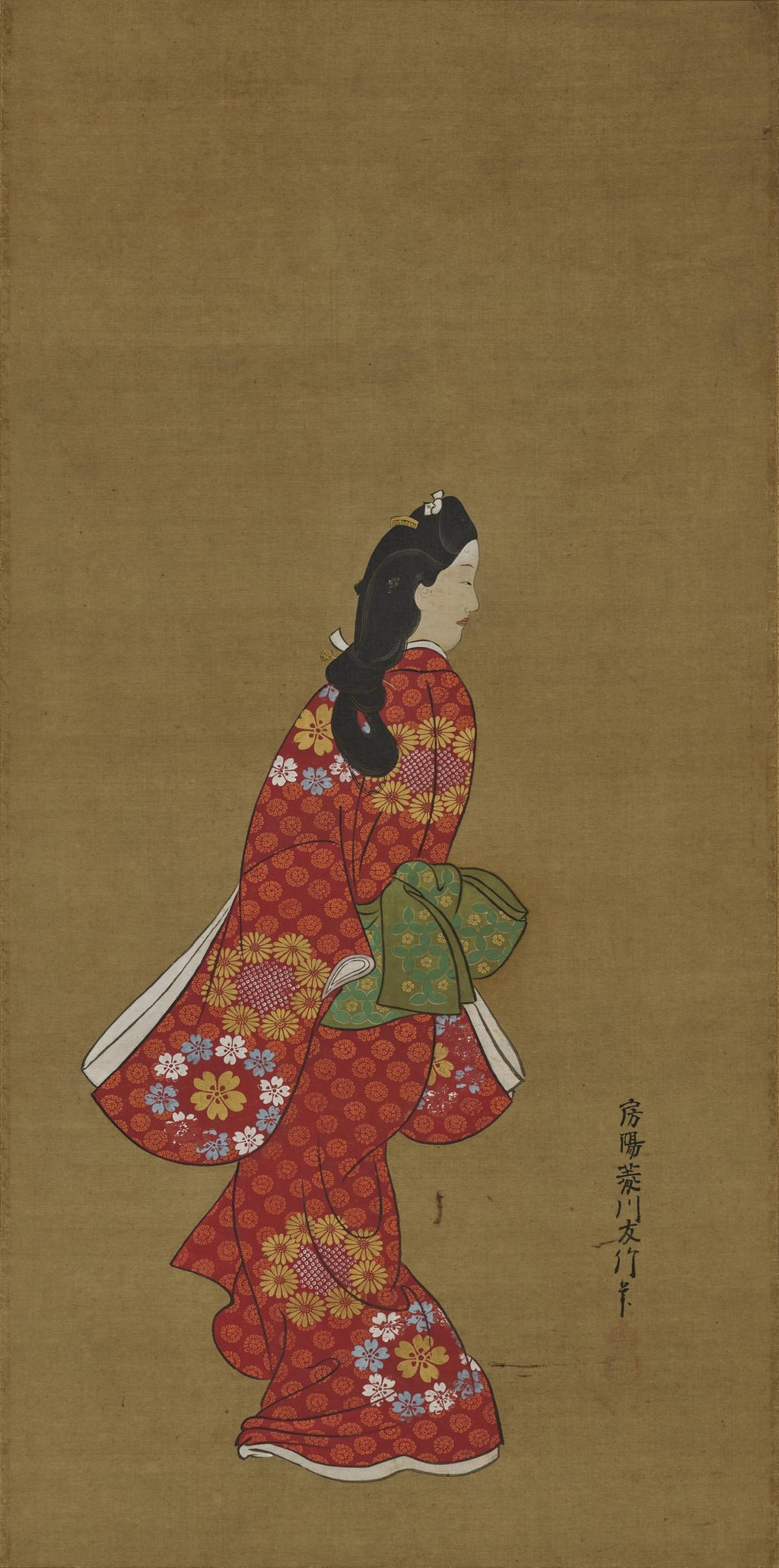
The two ColBase views tell different truths. In the complete scroll photograph, the painted field occupies only a part of a tall assembly of fabric, paper, hanging cords and roller. The woman feels almost small within that structure. The closer museum file isolates the image so that flowers, the green obi and the writing beside her can be read. Neither view should be mistaken for the way every historical viewer encountered the work. Mountings can change in a scroll's life, and a photograph fixes one arrangement and one illumination. ColBase identifies the painting field as 63.0 by 31.2 centimetres. That is a relatively intimate surface: the figure's fame in enlarged reproductions should not persuade us that the original painted woman towered over a room. [1] [3]
What the turn makes us see
The figure's body and face resist a single direction. Her robe carries a long, forward-moving shape while her face turns sideways. The movement is slight, yet the contrast makes the otherwise empty space active. We can follow the falling hem and the broad sleeve, then move back up to the hair and profile. The painter's choice of a plain ground denies us an obvious story setting. There is no painted companion whose response would close the episode. This is an observation of the image, not evidence that Moronobu intended a particular meeting, farewell or flirtation. The unknown sitter remains unknown. [1] [4]
She is often reproduced cropped closely around the figure. The full painting field makes the blank space easier to notice: it separates her from any setting and allows the turn to be read as a complete event. What first appears to be a simple portrait type becomes a composition about pause and direction. The surrounding field does not have to stand for an actual road. It gives the profile and richly worked clothing room to register. Look, too, at how much information is concentrated in the dress compared with the ground. The patterned robe has colour, circles, flowers and layered edges; the background has neither architecture nor landscape. The picture's subject is therefore as much a way of looking at fashionable dress as a conjectural person or anecdote. [1] [5]
This use of a single fashionable woman belongs to a larger history. Kyoto National Museum explains that independent beauty paintings developed from earlier genre scenes with groups of people, while their images could still carry cultural and literary associations. That institutional account does not establish a direct source for A-60. It gives a useful boundary: Moronobu's woman is neither a timeless abstract icon nor merely a cut-out from a scene we can reconstruct. Her clothing belongs to a particular urban world, while her isolation is an artistic decision. The artist worked across painted and printed formats, so the existence of a painted hanging scroll should not surprise anyone who knows his books; it should encourage us to ask what each format allowed him to do. [6] [7]
Four details in the original image
Look closely at Beauty Looking Back
Open each numbered crop from the retained high-resolution ColBase file. The same explanations appear below.
Annotated image details
Turn of the head and hair arrangement
Looped hair and turning profile. The fashion does not date the painting to a single year.
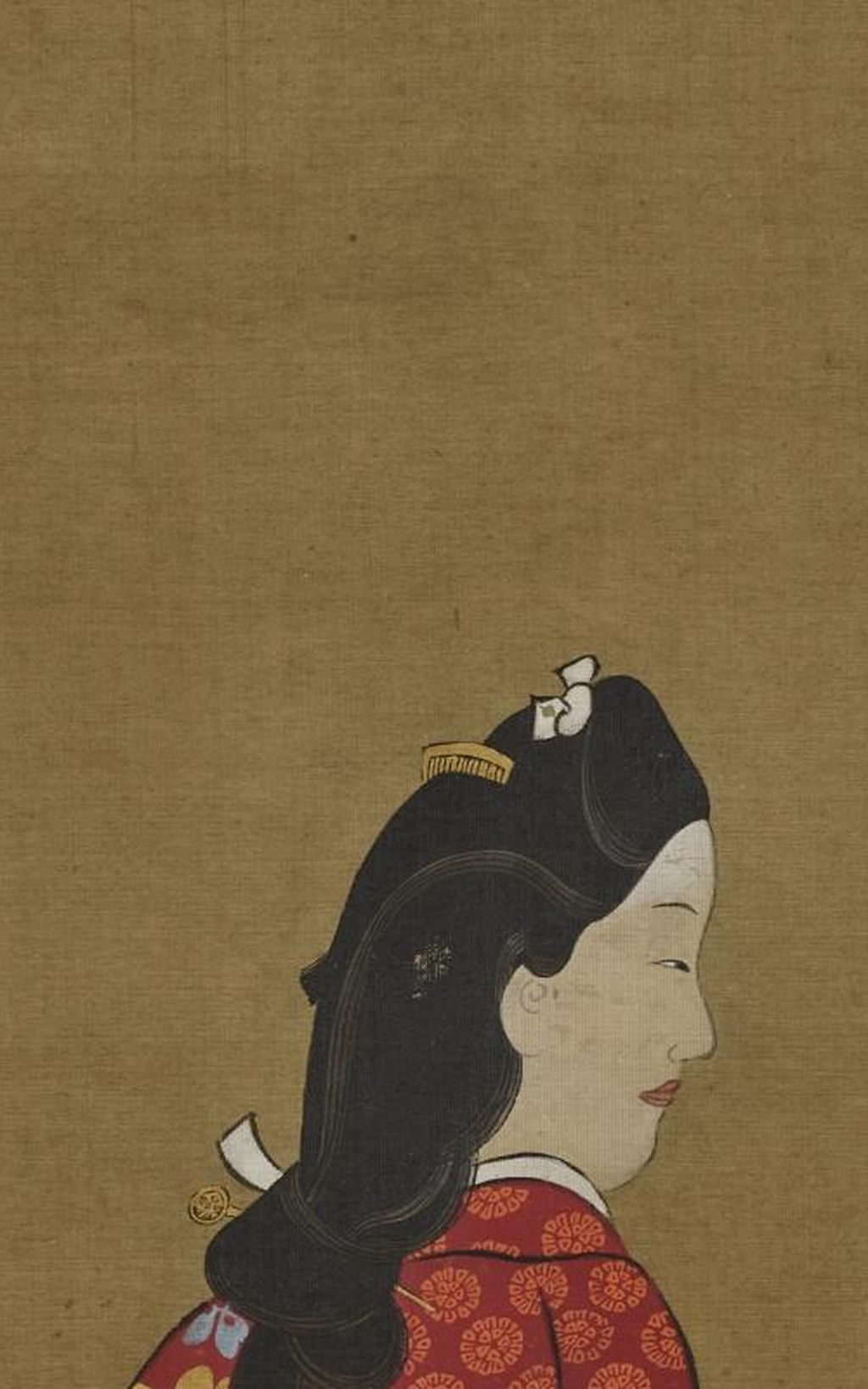
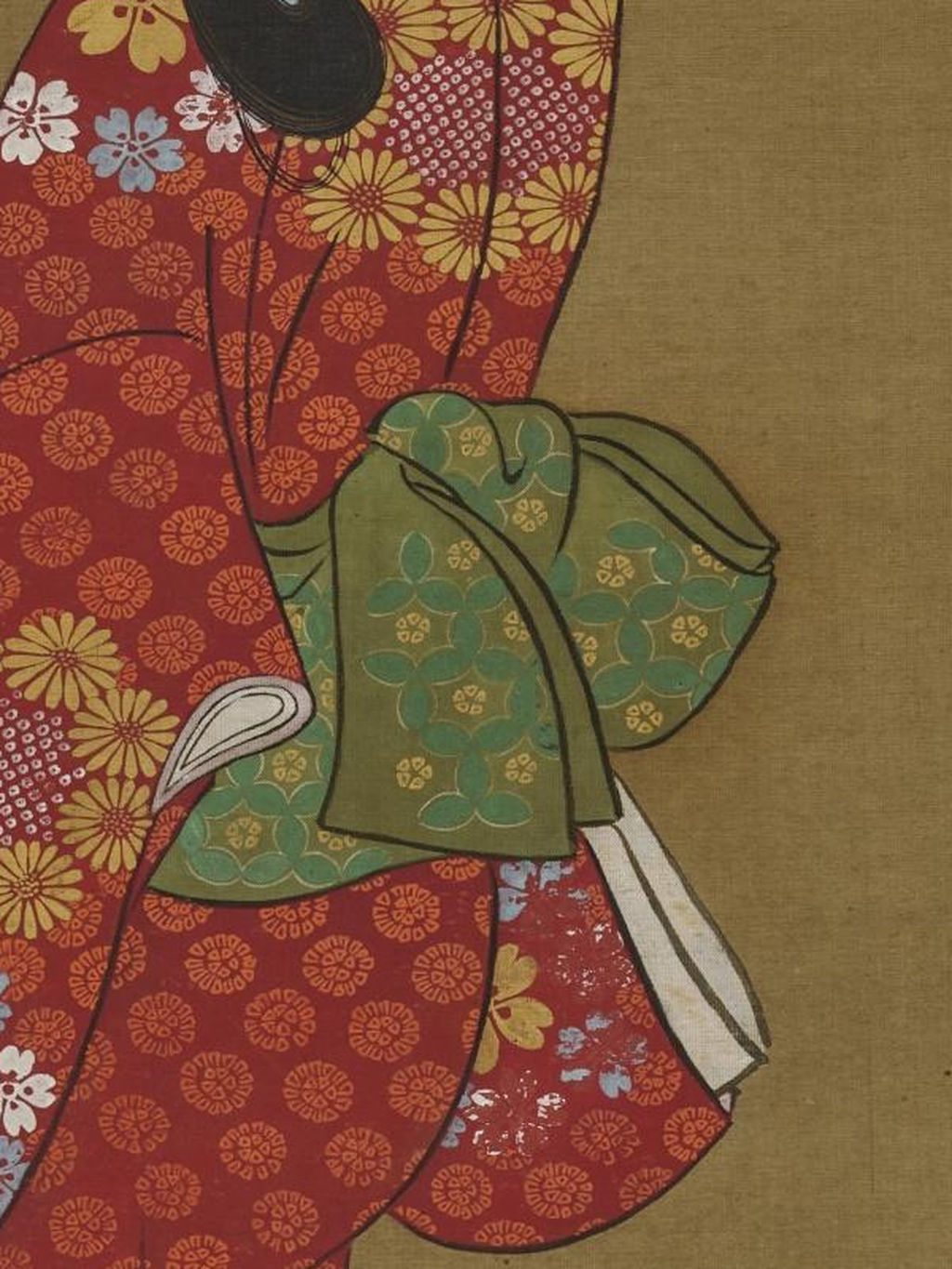
Floral patterns of the crimson sleeve
Chrysanthemum and cherry roundels on the crimson sleeve. The painted silk has a documented conservation history.
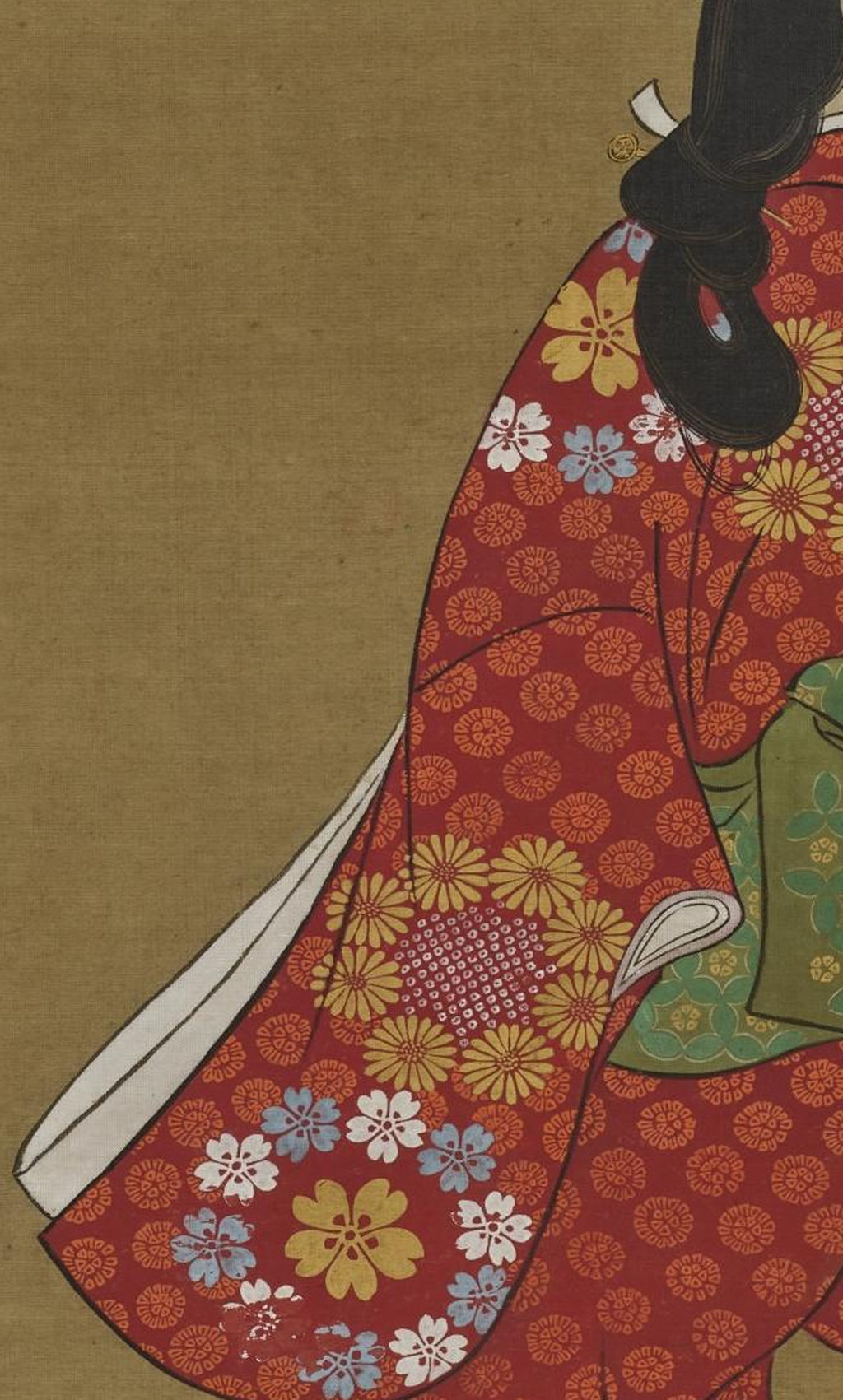
Green obi and long hanging ends
The green Kichiya-style obi interrupts the crimson robe; a fashion reference does not establish the sitter’s occupation.
Signature beside the figure
The painted inscription “Bōyō Hishikawa Yūchiku hitsu”; distinguish it from later box and catalogue records.
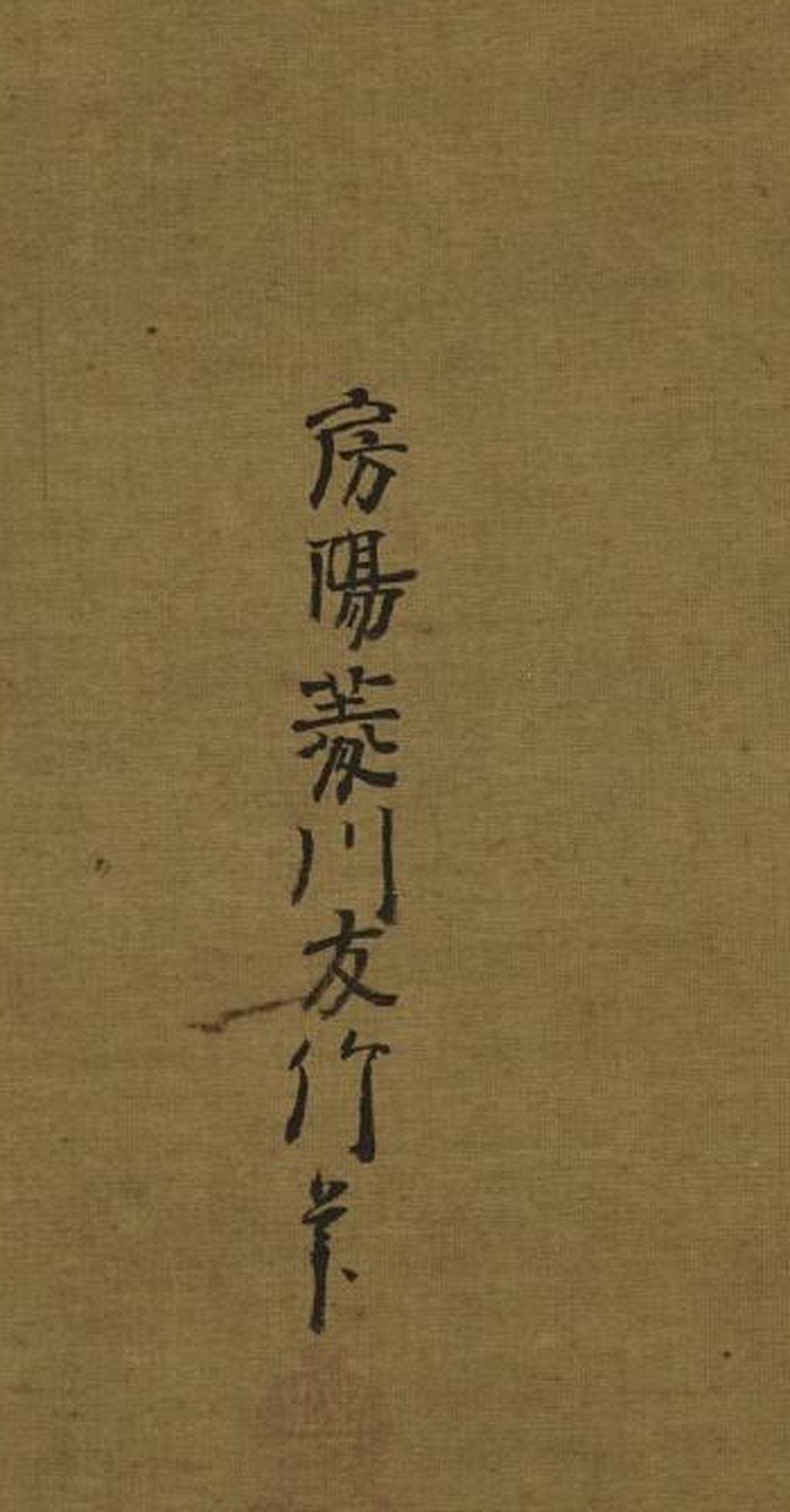
Image: Tokyo National Museum A-60, ColBase; editorial crop and resize.
The first detail is the turned head. Tokyo National Museum identifies the hair arrangement as tama musubi, a loop formed from the long hair, and describes its popularity around the Jōkyō years, 1684–88. The comb looks precious; the museum compares it with tortoiseshell. The turn of the face is what makes the image memorable, but the way the hair is dressed is a stronger clue to the fashionable world the artist chose to show. A fashion date is not a date painted on the silk. The museum gives the object a broad seventeenth-century label, and the popularity of a style cannot prove the exact year of execution. [5] [8]
Next come the robe and sleeve. The crimson ground has small repeated circular motifs and larger scattered blossoms. The museum names chrysanthemums and cherry blossoms in the hana no maru, or roundel-flower, design. Seen close, the flowers are not one flat block of colour. Light blues, whites and warm yellows interrupt the red, while the garment's overlapping edges create several rhythms of line. TNM connects this attention to textiles with Moronobu's background in a family of cloth decoration; its repair account describes the robe as a dark crimson figured silk. We can see the painted pattern and its contrasts in the ColBase file. We cannot, simply from a digital photograph, identify every original pigment or reconstruct the feel of the real cloth represented. The photograph records a painting of a garment, not a swatch of that garment. [8] [9]
The green obi stands out against the robe. Its long hanging ends change the silhouette as decisively as the sleeve does. Tokyo National Museum calls this a Kichiya musubi, linked to the dress of a popular male kabuki performer of female roles, Kamimura Kichiya. The association makes sense of the obi as an up-to-date fashion choice rather than an arbitrary decorative knot. It does not prove that the painted woman herself was a performer, or that she lived at a specific theatre. The viewer can appreciate the green's visual work without converting a fashion reference into a biography. Notice how the obi interrupts the red field just where the sleeve and body overlap; it helps us find the body's turn even before we follow the face. [5] [8]
These clothing details also reveal how different kinds of evidence meet in one picture. The museum can identify a named hair arrangement and a historically fashionable knot; the image itself shows their shapes and colours; Moronobu's family background helps explain why a painter might attend so closely to fabric. None of those steps proves the model's social identity. The composition invites a viewer to recognise a fashionable type, while withholding the biographical particulars that a portrait label would normally supply. Reading the red, green and pale hair ornaments in this order keeps both sides in view: the pleasures of the painted surface and the limits of what it documents. The latter matter because the work is often reproduced without accession, medium or explanatory caption, making fashion appear to be a self-explanatory costume drama. [5] [2]
The fourth detail is the writing to the right of the figure. ColBase transcribes the ink inscription as 房陽菱川友竹筆 and records a white-on-gourd-shaped 菱河 seal. Its commentary relates Bōyō to the artist's Bōshū origins and Yūchiku to a later art name. A close detail is useful because the words are not a printed caption placed beneath a reproduction; they are visible on this painted object. At the same time, a signature should be discussed as part of the museum's object evidence, not treated as a shortcut that settles every broader attribution question about Moronobu and his workshop. Other institutional records contain paintings marked “claimed to be by” or “school of” the artist. A-60's precise museum attribution must not be transferred to those other works because their figures look related. [1] [10]
Dating a fashion without dating the brush
The museum identifies the painting broadly as seventeenth century and describes it as a work of Moronobu's later years. A reader may see a narrower estimate elsewhere, because hairstyle and dress help place an image within changing fashion. The looped hair was popular in the Jōkyō years, and the wide obi belongs to a world alert to theatrical styles. Yet a painting need not have been made at the first appearance of a fashion, and a painter could depict a look after its peak. The museum's object record does not give a dated commission, diary entry or inscribed year on the painted field. A historically informed estimate should therefore remain an estimate. The inscription's use of Yūchiku as a late name is another piece of context, not a calendar date on its own. [1] [5]
This matters when comparing A-60 with Moronobu's books. A surviving volume may carry a publication year, while a painted scroll lacks one. The Met's Contemporary Kimono Patterns and other volumes show the artist's sustained attention to dress in a reproducible medium, but a book's printed date cannot simply be assigned to the silk painting because a motif appears in both. Even an exact match of hairstyle would have to be considered alongside edition, copying and the difference between a designer's repertoire and a particular execution. A-60 is better described by the museum's broad date and its visible fashion than by an unsupported single year. [7] [1]
The wider late-career setting is also visible through other separate museum objects. Seikado dates its long Twelve Months of Genre Scenes to about 1692–93, close to the end of Moronobu's life in 1694. That is Seikado's estimate for its own two-scroll handscroll, not an automatic date for A-60. Its many figures and seasonal episodes make a useful counterpoint to the Tokyo woman's concentration of action in a single body. Moronobu could work with a long sequence and an isolated figure without those works having to be plotted as steps in one simple progression from crowded to spare. The two museums' dates and formats should remain attached to their own holdings. [12] [1]
Silk, mounting and care
A scroll is made to be hung and rolled. Both actions shape what can survive. The complete ColBase view shows the woman within a larger mounted object; the painting-field view lets us inspect the coloured figure. The museum's recorded 63.0 by 31.2 centimetres refer to the painted part, and the catalogue calls it one hanging scroll. A reader should not substitute the height of an image file in pixels for the scroll's dimensions, or take a modern presentation photograph as proof that the present mounting has remained fixed since Moronobu's day. The separate ColBase files are different views of one object, A-60. [1] [3]
Tokyo National Museum and the National Center for the Promotion of Cultural Properties documented damage that can accompany a rolled hanging scroll. Their account describes creases and abrasion, along with lifting or losses of paint in areas including the flowers. They planned consolidation of fragile paint, local reinforcement from the reverse with narrow strips of Japanese paper, infilling of missing material, cleaning and new backing where necessary. These are descriptions of a conservator's treatment programme for this particular work, not a licence to assert that every pale mark in a web image is a loss or that an editor can identify a repair under normal screen light. The small painting carries physical history that a widely circulated image easily conceals. [9]
The chronology of that project matters. An older appeal explains what needed to be done in the future tense. A subsequent Tokyo National Museum notice reports that the treatment was completed, and that the painting would be kept under stable temperature and humidity for observation before display. Seikado Bunko Art Museum then listed A-60 in a 2026 exhibition and gave its display dates as 27 June to 12 July. Those dates are now past. They do not imply that the scroll is on permanent view at Tokyo National Museum. Nor do the timestamps on ColBase's photographs by themselves establish whether either file shows a surface before or after all treatment. The responsible description is narrower: the museum documented the condition, completed the project and later lent the work for a dated display. [11] [12]
The care story changes how one looks at the costume. The flower colours are central to the work's appeal, yet some areas of coloured paint have required stabilisation. The robe's patterned surface, which reproductions turn into an instantly recognisable design, is also a vulnerable layer on silk. The material painting and the iconic image are related but not interchangeable. This is why an annotation should enlarge real details of the documented ColBase file and name the object; it should not take a cleaned modern merchandise picture as if it were direct evidence about an original seventeenth-century brushstroke. [9] [1]
There is another time layer in the written record. ColBase lists several inscriptions associated with the object and its documentation, including the artist inscription on the picture and wording that names a half-face beauty. The list also includes later museum and connoisseur marks. These entries are not all a single sentence written by Moronobu on the silk. The repair project's note about Santō Kyōden's box inscription is likewise evidence attached to the scroll's later custody, not a seventeenth-century label for its sitter. A careful page can show how the object accumulated names and records without asking a modern title to carry more historical certainty than it has. [1] [9]
The familiar English title is useful because it directs attention to the decisive turn, but titles can make a composition feel more fully explained than it is. Beauty Looking Back tells us what a viewer sees; it does not identify the place, the person behind her or the social rank of the woman. The more formal Japanese catalogue name, 見返り美人図, functions similarly. The recorded phrase 半面美人図 points to the half-visible face, another way later viewers described the striking pose. Neither expression turns the work into a portrait with a recoverable name. This distinction is particularly important in English, where the word “beauty” can sound like a character or nickname. Here it identifies a pictorial type and a celebrated object. [1] [4]
Moronobu's other women are other objects
It is tempting to speak of every solitary woman by Moronobu as another version of Beauty Looking Back. The records resist that flattening. The Metropolitan Museum of Art's Standing Beauty, 29.100.454, is a separate painting on paper. The Met's accessible photograph is monochrome even though its catalogue identifies ink and colour as the medium. Its dress, posture and use of surrounding empty space can be compared with A-60, but its photograph cannot tell us the exact colours of its painted robe. The two works do not become the same object because an article displays them side by side. Keep title, accession, material and source attached to each image. [13] [1]
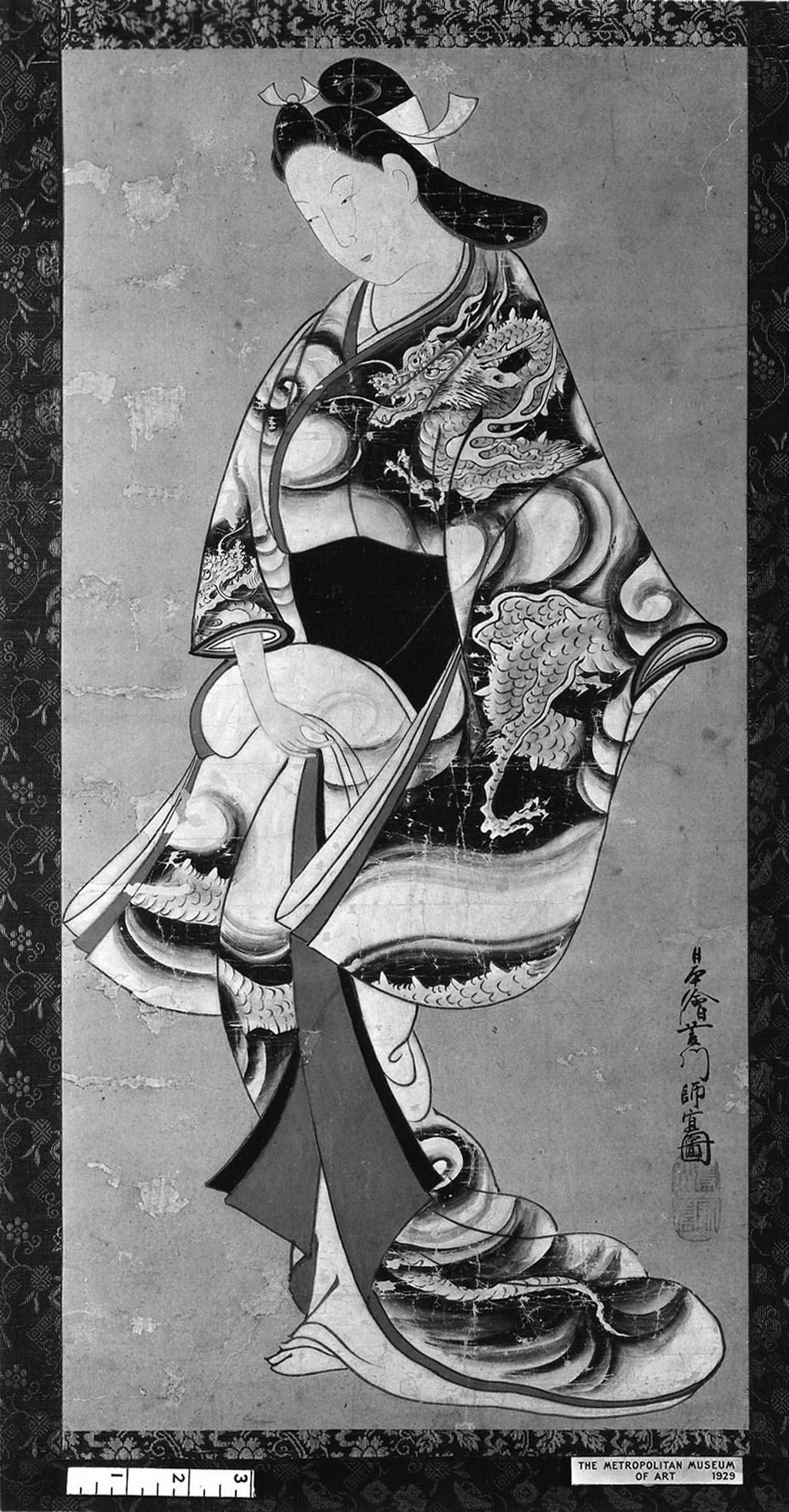
The Met also catalogues Standing Courtesan, a silk hanging scroll lent by a private collection. Its account connects Moronobu's fashion interests to the world of the Yoshiwara, but the object is marked as a loan, and its museum page says the image cannot be downloaded. The record is useful research text, not a default image source for this page. More importantly, the existence of a courtesan in one painting is not proof that A-60's unnamed woman had the same occupation. British Museum records likewise show the need for attribution discipline: one scroll is only claimed to be by Moronobu, while a different handscroll is catalogued as painted by him. These are separate objects with separate reasons for each label. [14] [10] [15]
The British Museum's more qualified record is valuable because it explains why its label is qualified. Its curator compares the walking woman's proportions, fashion and crudely executed signature with other examples and rejects a straightforward attribution to Moronobu's hand. That does not cast a new doubt over Tokyo's A-60 by association. It shows how specialists evaluate a painting rather than accepting a familiar pose or written name in isolation. An artwork page on A-60 can use this comparison to teach a general habit: first establish which object an image depicts, then read the holding institution's attribution and supporting description. The contrast is particularly sharp when websites circulate unlabeled copies of solitary women. [10] [1]
The wider career also helps explain why this painting should have its own page. Moronobu worked in books, prints and paintings, not one medium. The Met's Contemporary Kimono Patterns is a volume of woodblock-printed designs, a different way of attending to textile fashion. Its Kitchen of a Joroya is a crowded woodblock scene of daily work, where food preparation and architectural space do much of the storytelling. A-60 removes that crowded setting. By making one woman, one turn and one elaborate costume bear the picture, the painter uses a format that a book opening or busy print would not produce in quite the same way. This is an interpretive comparison across identified objects, not a claim that any particular book sheet was a preparatory design for the Tokyo scroll. [7] [16] [1]
How the image travelled
The work's fame has more than one period. The TNM repair project notes that the Edo writer Santō Kyōden wrote on its storage box, pointing to an earlier history of recognition. That fact should not be inflated into a claim that we know how often the painting was displayed, who first owned it or how many seventeenth-century people saw it. A hanging scroll can have a life of owners, storage and occasional presentation that is much less visible than the circulation of printed sheets. The object's inscriptions and later box documentation are evidence worth keeping distinct from the familiar, simplified image on today's products. [9] [1]
A clear modern turn came in 1948. Tokyo National Museum identifies a Stamp Collecting Week issue based on Beauty Looking Back as a major source of its national familiarity. Japan Post's own history confirms that the 1948 issue attracted attention and that the programme began the previous year. A later Japan Post archive gives the original issue date as 29 November 1948. A printed stamp is a reproduction and graphic adaptation of the painting, not the painted silk itself. Its small scale and distribution changed how the woman was seen: many more people could possess an image of her than could visit the scroll. That is a reason to discuss the stamp in the work's reception, while keeping it out of the painting's seventeenth-century origin story. [5] [17] [18]
The stamp also reverses the normal relationship between the object and its copy. For many viewers, the little printed rectangle came first; the silk scroll became the “original” of an already familiar silhouette. Japan Post reused the painting in later issues, including designs referenced in its 2001 archive. That history explains why a visit to the museum can be surprising: a person may expect a print because a stamp was the first version encountered, or expect a large poster-sized work because reproductions have enlarged the figure. The object label, whole-scroll image and 63.0 × 31.2 cm painting field correct those expectations without diminishing the stamp's cultural importance. Reproduction is part of the work's modern story, and close attention to the silk is how the reproduction is put back in context. [18] [1]
Seikado's 2026 exhibition put the Tokyo scroll alongside a broader group of Moronobu and related early Edo painting. The museum states the A-60 display was limited to 27 June–12 July, while its own Twelve Months of Genre Scenes handscroll anchors a different, long-format side of the artist's late career. This is evidence of how the original continues to be interpreted as an object, not just a free-floating symbol. The exhibition catalogue is a verified 120-page book with 27 works and a conservation-related essay on Seikado's handscroll. Its unpublished-to-us text cannot be made to say anything more specific about A-60 without reading it. The museum's public page, however, is enough to date the loan and to remind readers that temporary display windows are part of preserving fragile works. [12]
How to look again
Begin with the complete hanging scroll to register how much the mounting frames the image. Move closer to the separate painting-field photograph and follow the direction of the robe, head and gaze. Look at the hair and the asymmetrical obi as signs of fashion, while leaving the woman's name and destination open. Then inspect the flowers and signature as actual parts of the A-60 photograph, aware that the original silk and colour have a conservation history. Finally, compare an identified other Moronobu object only after reading its own medium, attribution and holding institution. Each step brings the familiar stamp silhouette back to a particular painted scroll. [1] [9]
The painting can reward both a quick first look and sustained attention. The first impression is a turn. A second look reveals that the turn is constructed with fabric, hair, empty ground and a body moving on without a drawn setting. The museum's records then add scale, signature, material and a more recent story of care. Those layers deepen the image without supplying an invented identity for the sitter. Moronobu's woman still looks back, but the fullest question for a reader may be what we overlook when we see only a famous reproduction. [1] [5]
Frequently Asked Questions
No. Tokyo National Museum A-60 is a painting in colour on silk, mounted as a hanging scroll. Moronobu also worked on prints and books, and the painting was later reproduced as a postage stamp. Those are separate media and objects. [1] [17]
The sitter has not been securely identified. The museum discusses her fashion, not a documented name or biography. Her dress and hairstyle do not establish that she was a courtesan or actor. [1] [5]
Tokyo National Museum gives a broad seventeenth-century date and describes it as a work of his later years. Certain fashions were popular in the 1680s, but that observation does not yield an exact day or year for this painting. [1] [5]
ColBase records the painted field as 63.0 by 31.2 centimetres. The full hanging scroll includes a larger mounting; the two ColBase images show these different views of the same A-60 object. [1]
Discussion
Compare the full scroll with its painted field and share what the clothing and empty space make you notice.
Reader Insights
Which lines or colours make the gesture feel immediate?
What is lost when you see only a crop of the painting?
Which of the hair, sleeve or obi catches your eye first?
Join the Conversation
Share a documented example or a reliable source below, keeping observation separate from inference.
References
- ColBase, Tokyo National Museum, *Beauty Looking Back* / 見返り美人図, A-60; object record, two individual image files, dimensions, inscriptions and attribution.
- Kyonan Town Hishikawa Moronobu Memorial Museum, artist account; local institutional context and uncertain birth year.
- Tokyo National Museum, *Beauty Looking Back* collection record, A-60.
- Cultural Heritage Online, 見返り美人図, exact A-60 metadata.
- Tokyo National Museum, 2022 “Future National Treasures” exhibition interpretation, A-60 and 1948 stamp.
- Kyoto National Museum, やまとなでしこ―江戸時代のアイドルたち―; historical context for independent beauty paintings.
- The Metropolitan Museum of Art, *Contemporary Kimono Patterns*, object 78777, woodblock-printed book.
- Tokyo National Museum, *Beauty Looking Back* fashion study, 2012.
- Tokyo National Museum and National Center for the Promotion of Cultural Properties, A-60 conservation project; condition, treatment plan, historical box inscription.
- British Museum, hanging scroll 1946,0209,0.33, catalogued as claimed to be by Moronobu; attribution comparison.
- Tokyo National Museum, *Beauty Looking Back* repair-completion notice.
- Seikado Bunko Art Museum, 2026 *Genroku! Moronobu Theatre* exhibition and catalogue listing; A-60 display window and catalogue scope.
- The Metropolitan Museum of Art, *Standing Beauty*, 29.100.454; separate painting and monochrome image.
- The Metropolitan Museum of Art, *Standing Courtesan*, L.2019.10.5a–d; private loan and restricted image.
- British Museum, painted handscroll 1913,0501,0.371; a separate Moronobu attribution.
- The Metropolitan Museum of Art, *The Kitchen of a Joroya*, JP810, woodblock print.
- Japan Post, Stamp Times, Stamp Collecting Week history; 1948 *Beauty Looking Back* issue.
- Japan Post, 2001 international stamp-exhibition issue archive; lists 29 November 1948 original issue date.