


 by Tom Gurney
Tom Gurney BSc (Hons) is an art history expert with over 20 years experience
Published on June 19, 2020 / Updated on November 6, 2026
Email: tomgurney1@gmail.com / Phone: +44 7429 011000
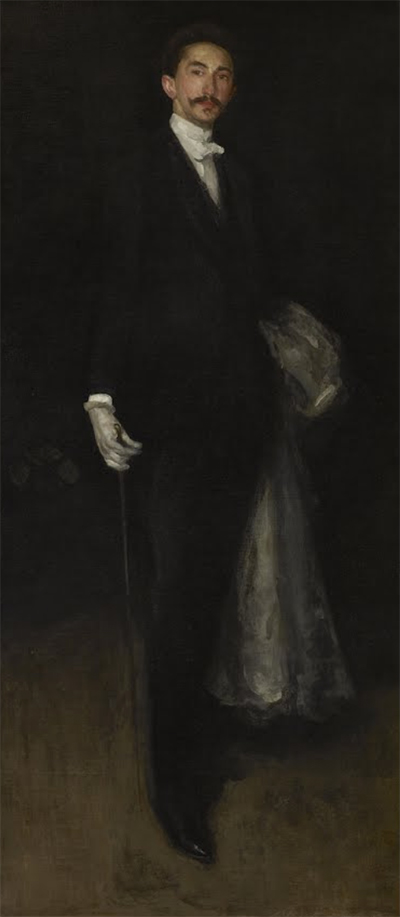
James McNeill Whistler's Arrangement in Black and Gold: Comte Robert de Montesquiou-Fezensac is a portrait of almost unnerving economy. A tall man in evening dress emerges from darkness, his pale face, shirt, glove and pointed shoe supplying a few controlled flashes. He holds a walking stick in one hand and carries a grey fur-lined cloak over the other arm. There is no furnished room, narrative incident or display of professional attributes. Yet the painting is not empty. Small changes of black against black establish the figure; a brown-gold floor gives him ground; the gilded frame completes an object whose colour relationships extend beyond the painted canvas. The Frick Collection, which owns the work as accession 1914.1.131, dates it to 1891–92 and currently displays it in the first-floor Oval Room.[1][4]
The apparent simplicity was hard won. Montesquiou later remembered more than one hundred sittings, while Whistler's letters record interrupted work in London, a renewed campaign in Paris, substitute models, scraping, pumice-stoning, washing and plans for a final coating. Technical examination finds a fine-weave canvas and predominantly thin paint, not a century of accumulated layers. Whistler repeatedly reduced the surface before rebuilding it. This is therefore a crucial test of the myth that a freely handled portrait must have been painted quickly: here extended labour was used to make effort disappear.[4][5][9]
At a Glance
- CatalogueYMSM 398 / Frick 1914.1.131
- Date1891–92
- SitterRobert de Montesquiou-Fezensac (1855–1921)
- MediumOil on fine-weave canvas
- Dimensions208.6 × 91.8 cm
- Framed dimensions234.3 × 117.5 × 5.4 cm
- SignatureButterfly; no inscription recorded
- FrameF. H. Grau, London, 1892
- CollectionThe Frick Collection, Henry Clay Frick Bequest
- DisplayOn view in the Oval Room on 26 August 2026; verify current status
Contents
- The object at a glance
- Black is structure, not absence
- Where the gold resides
- A turn held in suspension
- Glove, cane and cloak
- Robert de Montesquiou beyond the label `dandy`
- Friendship before commission
- Advice from the Comtesse Greffulhe
- Two portraits, not one changing title
- The London campaign of 1891
The object at a glance
The painting is oil on canvas and measures 208.6 by 91.8 centimetres, or 82 1/8 by 36 1/8 inches. It bears Whistler's butterfly signature; the catalogue records no inscription. Its unusually narrow proportions matter because the design depends upon a long vertical body, a near-vertical cane and a tall fall of fur rather than upon a broad interior. The current credit line is Henry Clay Frick Bequest. On the dated check for this article, the Frick records the portrait as on view in First Floor, Room 15, the Oval Room; that location is a mutable museum fact and should be checked again before planning a visit.[1][4][14]
The accepted identity is YMSM 398, not the separate Impressions de gris perle: Comte Robert de Montesquiou-Fezensac, YMSM 397. Whistler began two portraits of the same man in 1891: one in black evening dress with fur over the arm, and another in a large grey cloak with its collar raised. The Frick canvas is the black portrait. The grey-cloak project was not simply an early title for the finished painting, even though traces and recollections around the two works have sometimes encouraged confusion. Keeping the catalogue numbers apart is essential to reconstructing what Whistler and Montesquiou actually attempted.[4][7]
Black is structure, not absence
At first glance, the black suit seems to dissolve into the background. A longer look reveals that Whistler has separated adjacent darks by temperature, value and handling. The shoulder line, lapels and trouser edges appear and recede instead of being bounded evenly. The head is carried by a small wedge of white shirt; the shirt in turn is contained by the coat. This intermittent visibility makes the viewer assemble the body rather than receive a uniformly described outline. The Frick's commentary rightly treats the challenge as one of seeing subtle distinctions between the paint of the figure and that of the surrounding field.[1]
The background should not be imagined as a void into which a cut-out figure has been inserted. Its uneven darkness participates in the sitter's visibility. Around the head it helps warm flesh and dark hair register; around the torso it allows the suit to hover close to disappearance; near the floor it shifts towards brown and gold. The portrait's drama therefore lies less in sharp contrast than in thresholds. Whistler preserves enough difference to establish a person while withholding the fuller illumination expected in a conventional society portrait.[1][2]
Where the gold resides
The lower part of the canvas is a dark gold-brown floor, the most continuous warm field in the painting. It supports the pointed shoe and prevents the figure from floating entirely free of place. That floor is one plausible reason for the second colour in the title. It is not the only one. The 2009 Frick interpretation notes that the gold may also refer to the gilded frame, which was associated with the canvas early in its making. The painting and frame can thus be read as a coordinated black-and-gold object rather than as an image later placed in neutral furniture.[1][12]
This double possibility suits Whistler's musical naming practice. Arrangement directs attention to relations among tones, shapes and intervals, but it does not cancel the sitter. Black is distributed through costume and setting; gold is distributed through floor and frame; grey and white act as smaller counterweights. The title neither inventories every visible colour nor turns the man into an abstraction. It asks the viewer to attend to how a recognisable individual has been organised within a deliberately restricted scheme.[4][12]
A turn held in suspension
Montesquiou stands with his body elongated and his face turned towards the viewer. The Frick describes the moustached head as slightly cocked, a small displacement that prevents the pose from becoming rigidly frontal. His body seems to continue along one course while the head has just responded to something beyond the frame. That impression of interrupted movement is an effect of design, not evidence of a particular anecdote. There is no documented doorway, caller or destination to supply a literal story.[1][2]
The pointed shoe advances near the lower centre and carries a tiny pale indication of reflected light. The other leg is harder to retrieve from the dark suit. Technical evidence shows that Whistler altered this lower structure: the sitter's right leg was originally farther left, and the foot lower and farther left. The final placement draws the projecting shoe closer to the vertical cane and stabilises the narrow design. These are specific changes, not proof that every part of the composition was continually reinvented.[5]
Glove, cane and cloak
The white or smoke-grey glove on Montesquiou's right hand is one of the canvas's sharpest accents. That hand, appearing on the viewer's left, closes around a slim walking stick that descends almost vertically. The stick does more than identify fashionable equipment. Its line echoes the upright figure and supplies a taut counterweight to the softer, wider fall of the cloak. An 1894 commentator likened its provocative placement to a court sword, but this was an interpretation of the sitter's cultivated bearing, not a claim that the object actually was a weapon.[7]
The chinchilla-lined cloak over the sitter's left arm belonged to his cousin and muse, Elisabeth, Comtesse Greffulhe. Its grey mass is tonally distinct from the evening coat and introduces the painting's largest soft passage. The garment's ownership matters: it was lent for the sittings, so it should not be casually described as Whistler's studio prop or as Montesquiou's documented possession. A later recollection says its weight tired the sitter while he posed, adding a bodily cost to an accessory that appears effortlessly suspended in the finished image.[3][7]
Robert de Montesquiou beyond the label `dandy`
Marie Joseph Robert Anatole de Montesquiou-Fezensac was born in Paris in 1855 and died in 1921. He was a Symbolist poet and writer, a collector and a conspicuous participant in the social, artistic and intellectual worlds of fin-de-siècle Paris. His home and collection included East Asian art, while his public manner combined aristocratic lineage, literary ambition and deliberate self-fashioning. Calling him only a dandy captures an element of performance but strips away his activity as author, collector, patron and intermediary.[3][8]
Montesquiou is also frequently introduced as a model for Baron de Charlus in Marcel Proust's In Search of Lost Time. The connection is useful as an afterlife of his persona, provided it is kept proportionate. He was one of the sources from whom Proust developed Charlus, not a one-to-one original, and the novel was not the reason the portrait was commissioned. Whistler's canvas belongs to the earlier relationship between a living sitter and painter; Proust's character belongs to a later act of literary transformation.[1][3][8]
Montesquiou's sexuality forms part of his biography, but it is not something that can be diagnosed from a tilted head, glove, cloak or slender silhouette. Such readings too easily convert period stereotypes into visual evidence. The painting instead documents a negotiated public image: aristocratic, intellectual, fashionable and deliberately unlike the bluntly declarative attributes of many official male portraits. It is most productive to ask how that image was made, not to claim that pose discloses a private essence.[7][8]
Friendship before commission
The Frick dates Whistler and Montesquiou's acquaintance to 1885. Montesquiou admired the artist and helped connect him with influential French circles. Their relationship combined friendship, mutual theatricality and patronage. Whistler valued a champion able to speak for him in Paris, while Montesquiou saw in Whistler a painter capable of turning social presence into a lasting aesthetic object. The later rupture over the portrait's sale makes sense only if this prior investment is recognised; it was more personal than a dealer's routine transfer of a commissioned canvas.[3][8]
The sitter's long February 1891 commissioning letter performed that relationship rather than stating a simple order. Montesquiou imagined the projected portrait as evidence of the glory he intended to leave behind and playfully joined the future masterpiece to its canvas and frame. The elaborate prose can sound comic in summary, but its ambition was serious. He wanted representation by a painter whose own public identity matched the scale of his self-conception. Whistler accepted a commission already charged with expectations about posterity.[4]
Advice from the Comtesse Greffulhe
On 16 March 1891, Elisabeth Greffulhe wrote to Whistler about choosing the pose. She urged him not to be seduced too quickly by fashionable elegance and asked for an expression suited to a many-sided person. She favoured the sitter's profile and associated it with concentrated thought. Her intervention shows that the portrait's design was discussed within Montesquiou's circle before it settled into its present form; the sitter did not simply arrive, stand wherever instructed and leave the entire conception to the painter.[4]
The finished canvas does not mechanically execute Greffulhe's proposal. Whistler gives substantial importance to the profile, but the head also turns outward and meets the viewer more directly than a strict side view would. The result holds competing wishes together: the body's long, remote elegance and the face's alert contact. Greffulhe's letter is therefore evidence of collaborative pressure around the portrait, not a blueprint from which every final detail can be derived.[4][7]
Two portraits, not one changing title
By July 1891, Montesquiou was describing two canvases: the black evening-dress portrait and a second image in a large grey cloak. The latter is YMSM 397. It appears not to have been pursued to the same conclusion, although the catalogue discusses the possibility that traces near the foot of the Frick canvas might relate to a cloak design. Possibility should not be upgraded into certainty that one entire painting lies beneath the other. The secure point is that contemporary evidence names two projects and distinguishes their costumes.[4]
This distinction also clarifies the fur in YMSM 398. The Frick portrait is not the `grey portrait` simply because a grey cloak hangs over one arm. Its governing costume is black evening dress, and the fur acts as an accessory within that design. Confusing the works would distort the sequence, collapse an abandoned alternative into the finished object and make the documentary record seem more contradictory than it is.[4][7]
The London campaign of 1891
Work began in Whistler's London studio during the spring of 1891. The picture was nicknamed the `Black Lord`, an apt working description for its union of costume, tone and rank. Sittings were vulnerable to illness and society: influenza interrupted them in May, and both painter and sitter guarded the project from premature exposure. Montesquiou asked in June that their plans for the canvases remain private, treating secrecy as part of the prestige surrounding their collaboration.[4]
The portrait still demanded concentrated work in the autumn. More sittings were arranged in October; Montesquiou was posing in London in November; and Whistler told Stéphane Mallarmé that he was working on it every day until darkness. A report of 27 November said it was unfinished. In December Whistler showed the canvas to Claude Monet, yet he refused to accept Montesquiou's payment before he considered the portrait complete. These facts replace any neat story of a brilliant springtime performance with a prolonged and uncertain campaign.[4]
Refusing payment did not mean that money was irrelevant, nor does it supply a recoverable final price. It indicates that Whistler connected payment with his own judgement of completion. The surviving documents offer rhetoric, negotiation and later resentment, but they do not justify turning every monetary remark into a settled single-canvas transaction. The more secure history is that the artist retained control while the sitter repeatedly returned.[4][6]
Paris and the borrowed studio
In January 1892, work shifted to Paris. Montesquiou arranged access to a studio at 22 rue Monsieur-le-Prince associated with Antonio de la Gandara and Joseph-Félix Bouchor. The arrangement was not frictionless. The regular occupant's movements, social engagements and the need for privacy disrupted Whistler's hope for a continuous run of work. In a letter of 24 January he described one useful session on the head, an unsuccessful attempt at the hand and his frustration at having to pack the large black canvas away again.[4][9]
Whistler nevertheless believed a few uninterrupted days might carry the picture through. That prediction should be read as hope, not as a record of what finally happened. It came after months of London sittings and before further revisions. The letter is especially valuable because it sets apparent spontaneity inside a sequence of preparation, interruption and renewed effort. Even when the artist imagined a rapid conclusion, he was trying to conclude a work already burdened by an extended history.[9]
Other bodies inside the sitting process
On 30 January, Antonio de la Gandara arrived in evening clothes and stood in before Montesquiou appeared. Whistler used him to work on the background and the general tone of the figure; the Count then took his place and the session continued. Logan Pearsall Smith also recalled standing in while wearing Montesquiou's coat. These substitutions were practical ways of preserving pose, costume and tonal relationships when the principal sitter was unavailable or delayed.[4][10]
Neither substitute becomes the subject of the portrait. Their participation instead shows that `from life` can describe a composite studio procedure. Montesquiou's face, bearing and final identity remained indispensable, but another man could support work on the costume or surrounding field. The documents make the portrait less mysterious without making it mechanical: Whistler alternated between the named sitter, stand-ins, memory, surface preparation and his own changing judgement of the canvas.[4][10]
More than one hundred sittings
Montesquiou later said that he had posed more than one hundred times. At another point, Whistler joked that even sixty sessions were insufficient. The exact count is not a surviving day-by-day register, so it should be presented as the sitter's retrospective testimony rather than as an audited total. Even with that caution, the evidence is emphatic. This was no brief encounter disguised as finish; repeated posing became part of the work's contemporary identity.[4][12]
The number has often been paired with Whistler's final injunction that the exhausted sitter look at him a moment longer and would then look forever. The story captures the portrait's wager on duration: temporary bodily endurance traded for a durable public presence. It also risks romanticising the imbalance between artist and model. Montesquiou's fatigue, the heavy borrowed fur and the social negotiation around his time remind us that the finished ease depended on somebody repeatedly holding a demanding pose.[2][12]
Why the surface remains thin
Technical study describes a fine-weave canvas with predominantly thin paint. Despite the many sittings, there are few signs of major compositional change. Whistler rubbed the surface down between sessions, reducing material before adding more. Thicker passages survive around the shoulders, in the white shirt front and in selected modelling and colour accents on the face. The painting's material hierarchy therefore matches its visual hierarchy: broad dark fields are lean, while small points needed for recognition receive greater emphasis.[5]
This process explains how long labour and fresh handling can coexist. Duration need not produce a thick geological stack if the painter repeatedly removes, abrades or levels what has been done. Whistler's method was subtractive as well as additive. The final canvas retains evidence of decision without displaying every rejected state. Thinness here is not the absence of work; it is one result of working, judging and reducing over time.[5][11]
Scraping before the `final coating`
Whistler's 24 January letter supplies unusually direct evidence. He said that he had prepared the canvas through scraping, pumice-stoning and washing before attempting a final coating. The phrase does not mean that the entire painting was repainted in one miraculous pass. It describes an intended concluding phase made possible by earlier preparation. He delayed beginning that phase because interruption might prevent the relationships of background and figure from being carried together.[5][9]
Montesquiou's recollections complement this account. He remembered frenetic early action, with Whistler springing back from the canvas, but also the painter holding a touch in the air before placing it precisely. Those images are not mutually exclusive. One concerns bursts of physical energy; the other, suspended judgement. Together they resist the simple choice between reckless improvisation and slow academic modelling. Whistler could move rapidly, hesitate, erase and return within the same extended practice.[5]
The alterations that remain visible
The clearest recorded compositional alterations affect the sitter's right leg and foot. The leg originally lay farther to the left, and the foot was lower and farther left. Their final positions tighten the lower design, but the evidence does not support a claim that the whole portrait underwent drastic transformation. The head, glove, cloak and torso may have been repeatedly refined while retaining their principal arrangement.[5]
This limited pentimento is worth separating from the many sittings. A sitting could be spent adjusting tone, reducing paint or renewing a small passage rather than moving a limb. The number of sessions measures repeated access to the sitter, not the amount of visible redesign. The discrepancy between enormous effort and few major changes is precisely what makes the painting instructive: Whistler invested time in calibration and surface unity rather than in multiplying conspicuous revisions.[5][9]
A frame made as part of the work
The flat frame is recorded as a Whistler design and carries the signature `F H Grau - London` with the date 1892. YMSM identifies the maker as Frederick Henry Grau. Its moulding is about fourteen centimetres wide, and the framed object measures 92 1/4 by 46 1/4 by 2 1/8 inches. The date links the frame to the painting's active period rather than to a much later museum reframing.[5]
The frame sharpens the title's logic. Its gold surrounds a canvas whose internal gold is deliberately subdued, allowing the warm border and dark centre to operate together. This does not prove that every word in the title names a single physical component, but it confirms that the boundary was designed rather than incidental. To reproduce only the canvas is to reproduce the painted image; to understand the original arrangement requires attention to the frame as well.[5][12]
The 1894 Paris debut
The portrait was delivered to Montesquiou in 1894 and exhibited that year at the Société Nationale des Beaux-Arts on the Champ de Mars. It appeared as catalogue number 1186 under a French black-and-gold title. The two-year interval between the accepted 1891–92 painting date and public display should not automatically be treated as two more years of painting. The documented chronology supports a completed or substantially completed work in 1892, followed by delivery and exhibition in 1894.[3][6]
The debut placed the canvas where Whistler's French position and Montesquiou's social identity could reinforce one another. Viewers encountered a well-known Parisian figure pictured by an expatriate artist who had long sought recognition in France. The portrait's restricted means did not make it marginal. It offered critics a concentrated case in which contemporary dress, aristocratic performance, old-master memory and Symbolist atmosphere could be debated together.[6][8]
Praise, mystery and the `passer-by`
Reception was substantially enthusiastic, not a repetition of the hostility often attached to Whistler's earlier controversies. The Magazine of Art called it a remarkable recent achievement. Gustave Geffroy praised the conjunction of painter and model and described the image through paired qualities: boldness and finesse, irony and melancholy. Such pairings recognised that the surface could be loose without being careless and that the sitter could appear socially assured without becoming psychologically transparent.[6]
Geffroy imagined the figure as an enigmatic passer-by: someone whose destination and thoughts remain unknown. That reading makes good visual sense because the pose seems momentary while the setting withholds narrative clues. Yet the review remains a historical interpretation, not a decoded story. Its importance lies in showing what a sympathetic 1894 viewer found new—a portrait capable of asserting presence and preserving mystery at once.[6]
Whistler tries to reproduce his own portrait
The painting soon generated works on paper. David Croal Thomson asked Whistler for a lithographic version for The Art Journal. Whistler sent a drawing to the printer Thomas Way in July 1894 but disliked the outcome, arguing that copying the existing painting lacked the stimulus of working from nature. The episode exposes a limit within his own aesthetic: a successful arrangement could not simply be translated line for line and expected to retain the original's force.[6]
The lithograph was eventually passed for reproduction without enthusiasm. Beatrix Whistler also made two lithographic interpretations, and later cataloguing corrected older attributions that had assigned them to her husband. The Frick's current object record links related works, including reproductive studies and a Whistler lithograph of the sitter. These sheets should be treated as an afterlife around the painting, not as interchangeable substitutes for its scale, dark tonal field or gold frame.[1][6][7]
Sale, offence and competing dates
Montesquiou eventually sold the portrait through the Paris dealer Arnold Seligmann to the American collector R. A. Canfield. The current Frick record dates the sale to 1902, and the YMSM narrative uses correspondence from that year, even though its compressed provenance list begins the transfer at 1901. The present article follows the current holder's 1902 date while acknowledging why older summaries differ. This is more responsible than silently combining the two into an invented exact day.[1][6]
Whistler felt personally betrayed. He had understood Montesquiou's ownership through the language of friendship, artistic destiny and possible public bequest; the resale for a much larger sum made that language appear hollow. His response included an antisemitic insult directed through the stereotype of the Paris art trade. The slur should neither be repeated for colour nor concealed when analysing the letter's prejudice. It reveals how injured vanity, money and bigotry entered his attack; it does not provide a trustworthy moral account of Montesquiou's decision.[6]
Montesquiou replied that he had been unable to reach Whistler and believed the sale could secure a fitting future for the work. The disagreement cannot be resolved simply by choosing the artist or sitter as reliable narrator. Each framed the transfer to defend his conduct. What can be established is that a portrait conceived as a collaboration and token of affinity became a high-value commodity, and that the change exposed different ideas about what ownership permitted.[6][8]
Canfield, Knoedler and Henry Clay Frick
After Canfield acquired the painting, it returned for a time to Whistler's studio, perhaps for cleaning or further attention. Following the artist's death in 1903, Rosalind Birnie Philip arranged for it to pass through the London dealer W. Marchant for delivery to Canfield. The sequence warns against assuming that sale, physical delivery and final possession occurred in one simple step.[6]
Knoedler acquired the portrait on 12 March 1914 and sold it to Henry Clay Frick. Frick's ownership made it part of an unusually strong group of Whistler works, and his 1919 bequest transferred it to the institution that bears his name. The current museum history compresses the chain to Montesquiou, Canfield, Knoedler and Frick; the catalogue adds the intermediate documentation needed to understand why the canvas crossed the Atlantic and how it entered a permanent public collection.[1][6][13]
What can and cannot be said about conservation
The catalogue's technical section gives valuable evidence about support, paint thickness, rubbing and compositional change, but it does not provide a detailed conservation history for this object. That silence matters. It would be wrong to borrow lining, cleaning or varnish treatments from other Whistler portraits merely because they share a collection or period. The present appearance necessarily includes age and stewardship, but no specific undocumented campaign should be asserted.[5]
The strongest material account remains centred on making: fine weave, predominantly thin paint, rubbed-down intervals, selected fuller accents and limited leg-and-foot changes. Those findings already overturn the most tempting misconception. A surface can look direct because revisions were absorbed, abraded or coordinated, not because no revisions occurred. Where treatment evidence is absent, interpretive discipline is more informative than a generic conservation narrative.[5][11]
Seeing the painting now
The Frick currently places the portrait in its first-floor Oval Room, where it can be considered alongside other full-length Whistler portraits in the collection. That installation revives a long institutional association between Whistler's figures and the room, but it should not be mistaken for the painting's original studio setting. The museum location is a present display decision and may change; the black-and-gold pictorial space remains deliberately nonspecific.[1][13]
The museum's online record supplies a 500 by 1,163 pixel preview that matches the complete composition. The inherited site image is also an exact match, though smaller at 400 by 917 pixels. Identity does not settle permission. The Frick's current policy limits website contents to personal, educational and non-commercial use and requires an application to reproduce collection images. Any later publication should therefore use a separately documented, rights-cleared file rather than treating the visible preview as open access.[1][3]
Why this portrait deserves its own article
This painting cannot be adequately explained as another example of Whistler's black portraits. Its distinct history joins an unusually self-conscious sitter, advice from Greffulhe, two competing portrait projects, London and Paris work, substitute models, more than one hundred remembered sittings, a thin rubbed-down surface, a signed 1892 frame, a major 1894 reception and a sale that damaged a friendship. Each element changes the meaning of the finished restraint.[4][5][6][7]
Most of all, Arrangement in Black and Gold makes duration visible by hiding it. The viewer sees a man who appears to have turned for an instant, yet that instant was constructed across months of work and repeated bodily effort. Black clothes and background nearly meet; small whites and greys prevent disappearance; gold binds floor and frame. Whistler's achievement was not to remove the sitter in favour of formal harmony, but to make formal harmony the means by which this particular sitter continues to appear.[1][5][12]
Discussion
How does Whistler turn almost-black evening dress into a portrait of unmistakable presence?
Follow the shifts of black, the white shirt and glove, the grey cloak, cane, floor and frame while keeping the painting's prolonged making distinct from its apparently effortless surface.
Reader Insights
Which small tonal differences make the figure emerge?
How do pose, dress and accessories construct public identity?
Why can a thin surface still embody more than one hundred remembered sittings?
Join the Conversation
Share a close observation.
References
- [The Frick Collection, Arrangement in Black and Gold: Comte Robert de Montesquiou-Fezensac, accession 1914.1.131](https://collections.frick.org/objects/285/arrangement-in-black-and-gold-comte-robert-de-montesquiouf) (accessed 26 August 2026).
- [The Frick Collection Custom Prints, Arrangement in Black and Gold: Comte Robert de Montesquiou-Fezensac](https://customprints.frick.org/detail/511021/whistler-arrangement-in-black-and-gold-comte-robert-de-montesquiou-fezensac-1891%E2%80%9392) (accessed 26 August 2026).
- [The Frick Collection, Copyright and Image Permissions](https://www.frick.org/about/copyright) (accessed 26 August 2026).
- [University of Glasgow, The Paintings of James McNeill Whistler, YMSM 398: date and making history](https://www.whistlerpaintings.gla.ac.uk/catalogue/display/?mid=y398) (accessed 26 August 2026).
- [University of Glasgow, YMSM 398: technique, support and frame](https://www.whistlerpaintings.gla.ac.uk/catalogue/display/?mid=y398&xml=tec) (accessed 26 August 2026).
- [University of Glasgow, YMSM 398: provenance, exhibitions, reception and reproductions](https://www.whistlerpaintings.gla.ac.uk/catalogue/display/?mid=y398&xml=his) (accessed 26 August 2026).
- [University of Glasgow, YMSM 398: sitter and related works](https://www.whistlerpaintings.gla.ac.uk/catalogue/names/display/?mid=y398&nid=&xml=sub) (accessed 26 August 2026).
- [University of Glasgow, Robert de Montesquiou-Fezensac biographical record](https://www.whistlerpaintings.gla.ac.uk/catalogue/biog/?mid=y398&nid=MontRde&xml=his) (accessed 26 August 2026).
- [University of Glasgow, The Correspondence of James McNeill Whistler, GUW 06606, Whistler to Beatrix Whistler, 24 January 1892](https://www.whistler.arts.gla.ac.uk/correspondence/recno/display/?cid=06606) (accessed 26 August 2026).
- [University of Glasgow, The Correspondence of James McNeill Whistler, GUW 06608, Whistler to Beatrix Whistler, 30 January 1892](https://www.whistler.arts.gla.ac.uk/correspondence/recno/display/?cid=06608) (accessed 26 August 2026).
- [The Frick Collection, Whistler's Working Method](https://www.frick.org/sites/default/files/archivedsite/exhibitions/whistler/working.htm) (accessed 26 August 2026).
- [The Frick Collection, Portraits, Pastels, Prints: Montesquiou](https://www.frick.org/sites/default/files/archivedsite/exhibitions/whistler/montesquiou.htm) (accessed 26 August 2026).
- [The Frick Collection, James McNeill Whistler](https://www.frick.org/artists/james-mcneill-whistler) (accessed 26 August 2026).
- [The Frick Collection, Cocktails with a Curator: Whistler's Comte Robert de Montesquiou-Fezensac](https://www.frick.org/interact/miniseries/cocktails_curator/whistler_comte_robert_de_montesquiou-fezensac) (accessed 26 August 2026).


