


 by Tom Gurney
Tom Gurney BSc (Hons) is an art history expert with over 20 years experience
Published on June 19, 2020 / Updated on November 6, 2026
Email: tomgurney1@gmail.com / Phone: +44 7429 011000
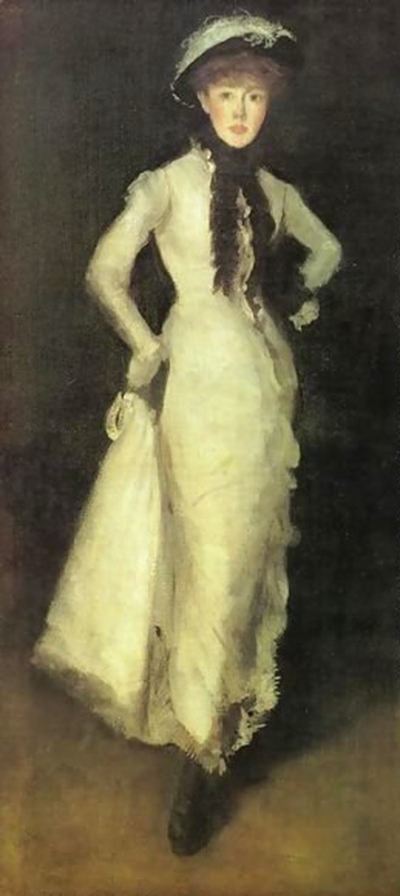
James McNeill Whistler's Arrangement in White and Black presents Maud Franklin stepping out of darkness in a fitted pale dress, black scarf and feathered bonnet. She is almost life-size, her hands set at her hips and one foot advanced as if the prolonged work of posing has been compressed into a moment of forward movement. Painted between 1876 and 1878 and first exhibited at the Grosvenor Gallery in 1878, the portrait is now in the Freer Gallery of Art Collection at the Smithsonian's National Museum of Asian Art, accession F1904.78a-b.[1][2]
The musical title asks viewers to attend to the relation of light dress and dark field, but it never succeeds in turning Maud into colour alone. Her gaze, fashionable silhouette, balancing arms and apparent stride are too assertive. That tension was visible from the first exhibition. Critics complained that Whistler converted young women into “arrangements”, yet others recognised that the contemporary body and dress distinguished his portrait from the literary and classical figures around it. The painting's importance lies in this unresolved double identity: it is an arrangement of tones and a portrait of a working model whose class, sexuality and labour shaped what viewers thought they saw.[3][5][11]
At a Glance
- CatalogueYMSM 185 / Smithsonian F1904.78a-b
- Date1876–78; Smithsonian uses circa 1876
- SitterMaud Franklin (born Mary Franklin)
- MediumOil on coarse-weave canvas
- Painting dimensions191.4 × 90.9 cm
- Framed dimensions219.1 × 117.5 × 5.1 cm
- SignatureNearly invisible butterfly left of the figure; no inscription
- Current frameAmerican Portrait Whistler type, circa 1910; original unknown
- CollectionNational Museum of Asian Art, Freer Collection
- DisplayNot on view on 26 August 2026; verify current status
Contents
- Identity, date and present condition
- Maud Franklin, the sitter
- Reading the full-length figure
- Posing as movement and work
- Fashion, restriction and display
- A late White Girl—and a different painting
- Thin paint, rubbing and soft boundaries
- Rapid execution, but not no revision
- Conservation and the later frame
- The Grosvenor Gallery in 1878
Identity, date and present condition
The painting is YMSM 185 in the catalogue raisonné and F1904.78a-b at the Smithsonian. The current museum record calls it an oil on canvas made about 1876; costume evidence and the first exhibition support the broader 1876–78 range used by the catalogue raisonné. The canvas measures 191.4 centimetres high by 90.9 centimetres wide. In its present frame the object measures 219.1 by 117.5 by 5.1 centimetres. Those two sets of dimensions distinguish the painted support from a later surround.[1][2][6]
YMSM identifies a coarse-weave canvas. A butterfly device lies to the left of Maud, but it has become nearly invisible; there is no written inscription. The current frame, made in America around 1910, belongs to a type catalogued as `Portrait Whistler`. Its broad incised basket-weave panel sits between narrow bands marked with irregular dashes. The rounded and incised reeds differ from securely documented Whistler frames. The original frame is unknown, so the present one should be described as Whistler-like rather than as a surviving design by the artist.[4][6]
On the dated check of 26 August 2026, the Smithsonian record states that the painting is not on view. That status can change. The Freer Gallery remains its current collection, and Charles Lang Freer's gift supplies the credit line. The museum's broad `Geography: United States` metadata reflects its American-art classification or collection system, not evidence that this London-career portrait was made in the United States.[1]
Maud Franklin, the sitter
Maud Franklin was born Mary Franklin in Bicester in 1857. She began modelling for Whistler as a teenager and became his principal model and partner during the 1870s and 1880s. Her work appears across paintings, drawings, watercolours, etchings and lithographs. She also identified herself as an artist, exhibited under the name Clifton Lin and is documented printing Whistler's etchings in 1886. The older label “mistress” names a non-marital sexual relationship but is radically incomplete as a description of modelling, artistic work, partnership and family.[8][9]
That larger biography should not be read directly from this one pose. An outward gaze does not prove permanent self-confidence, and a fashionably fitted dress does not record ordinary daily clothing. Whistler selected costume, stance, background and scale for pictorial effect. Maud supplied the bodily work of holding and repeating the pose, but he controlled the image that was signed and exhibited. Portrait and person touch without becoming interchangeable.[8][9]
The distinction matters because the painting has often been used as a shorthand for Maud's youth and beauty. The Smithsonian label speaks of her vibrancy and nonchalance, persuasive descriptions of the visual effect. Yet such terms belong first to the constructed figure. They cannot substitute for the documentary person who modelled through long sessions, lived with Whistler under unequal legal conditions, became a mother and made art of her own.[1][9]
Nor was Maud American. Later German and French titles called the figure Amerikanerin or L'Américaine. Théodore Duret explained that the national label arose from a misunderstanding: Whistler was American, while the sitter was English. Repeating the market title as identity would let an error erase the named woman in front of us.[3][12]
Reading the full-length figure
The canvas is unusually tall and narrow. Maud occupies most of its height, with limited space above the feathered bonnet and a shallow brown-grey ground beneath her feet. The dark background offers no furniture, landscape or domestic clue. It makes the body the only large structure and turns every bend of arm or fall of fabric into part of the composition.[1][3]
Her face is the warmest concentrated area. Rosy cheeks and red lips emerge from the black surrounding the bonnet and scarf. The eyes face outward rather than dropping modestly towards a book, flower or lap. Although the features are softly resolved, their placement arrests the upward movement of the white dress. A pale plume curves above, almost dissolving where it enters the dark field.[3][6]
The black scarf falls from head and neck across the upper body. Its diagonal interrupts the pale torso and binds bonnet to background. Dark accents at the waist and arms sharpen the figure's structure, while the face remains framed rather than isolated. White and black do not divide the canvas into simple halves. Each colour penetrates the other: shadow enters the dress, the bonnet carries both tones, and the scarf makes a dark current across the light form.[3]
Maud's hands sit at or close to her hips, pushing the elbows outward. On the viewer's left, her right hand also gathers the train into a broad hanging mass. The opposing arm bends against the darker side of the body. These angled limbs widen the middle of the composition even as the dress pulls the waist inward. The resulting silhouette is poised but not static.[1][3]
One leg advances while the other recedes. A dark shoe emerges below the frayed or softly broken hem. The train lags to one side, increasing the sensation that Maud has just stepped forward rather than settled into a ceremonial standing pose. No detailed floor secures her. The thin lower ground and merging edges make the figure seem to arrive out of the dark rather than occupy a fully described room.[3][6]
The empty field is actively shaped by the pose. Dark wedges press between the waist and elbows, narrowing the torso while making the bent arms legible. Above, a wider interval surrounds the bonnet and plume; below, darkness lengthens beside the skirt until the body appears suspended within the vertical. These spaces are not a setting emptied of detail after the fact. They are compositional forms calibrated against the figure's changing width.[3]
The gathered train serves as a counterweight. Its broad pale descent on the viewer's left answers the more compact dark arm on the right and prevents the advanced leg from pulling the whole design off balance. Because the train is lifted, its hem does not simply repeat the skirt's lower edge. It introduces a second falling curve, making fabric seem momentarily displaced by movement.[3][8]
Scale changes the encounter. Maud's painted height approaches that of an adult viewer, but the narrow canvas keeps her close rather than monumental in the manner of an official state portrait. The face occupies a small fraction of the surface, while dress, scarf and surrounding black dominate. Whistler could therefore insist that colour was structural without making likeness irrelevant: the concentrated face draws attention precisely because so much of the canvas withholds detail.[1][6]
The official full-object image also reveals how strongly the later gold frame participates in this effect. Its bright, patterned width establishes a luminous boundary before the eye enters the nearly black field. A crop that removes the frame makes the painting appear more abruptly dark and enlarges Maud relative to the object. Neither view is useless, but only the full object shows the historical presentation now encountered at the Freer.[4][6]
Posing as movement and work
The impression of walking is a pictorial paradox. A model had to remain sufficiently still for Whistler to observe balance, contour and tonal relation, yet the result suggests an instant of motion. The advanced foot, lifted train and angled elbows create that effect. Maud's labour lies precisely in making a held configuration look spontaneous.[8][9]
Full-length modelling demanded control. Weight had to be distributed across legs without losing the intended line; hands and elbows had to return to the same position; a fitted bodice and long skirt constrained breathing and movement; and the train had to retain a usable fall. Many sittings could be condensed into a figure that seems to pass the viewer in one stride. The final ease conceals duration rather than proving that no work occurred.[8]
Whistler's title intensifies that concealment. To call the portrait an arrangement shifts attention from an individual session to a finished relation among masses. That shift was deliberate, but it does not abolish the sitter's contribution. Without Maud's capacity to sustain and repeat the pose, there would be no particular arms, waist, foot or gathered train through which white and black could be arranged.
The pose also belongs to a wider sequence. Whistler returned to women standing with hands at their hips in later portraits. Repetition indicates that the stance solved a pictorial problem he valued: it opens the elbows, narrows the waist and generates movement without narrative action. In YMSM 185, however, the solution is inseparable from Maud's fashionable costume and the moment in which critics judged her directness.[3][8]
Fashion, restriction and display
The close-fitting dress helps date the canvas. Scholarship on Whistler and fashion places its silhouette between 1876 and 1878. Bodice and skirt follow the torso and legs before the fabric loosens around the lower body. The white bonnet, dark trim and plume also correspond to fashionable commentary in 1878. Period writing recommended white sateen and elaborate bonnet feathers while treating black and white as suitable combinations.[2][3][8]
Fashionable tightness was itself a subject of jokes. Cartoons imagined women unable to sit or climb stairs because a dressmaker had fitted them so closely. Such humour registered a real contradiction: the costume displayed disciplined modern elegance while limiting ordinary movement. Whistler exploited that contradiction. Maud appears to stride confidently in clothing that contemporary satire described as restrictive.[3][8]
The dress made the body unusually legible. It marked waist, hip and leg beneath a pale surface, while the lifted train gave the hand a practical-looking task. To some Victorian viewers, this clarity could become sexual display. The figure did not offer the distancing protections of mythological identity or aristocratic title. A known model in current fashion met the viewer directly.[3][8]
Class shaped the response. The same hands-on-hips stance could be praised as command in a celebrated society sitter or condemned as insolence when attached to a working model. The Magazine of Art judged the action “vulgar”. That word does not reveal Maud's character. It shows how critics used bodily gesture to police distinctions among refinement, labour, sexuality and social rank.[3][11]
Whistler neither wholly defeated nor simply reproduced those conventions. His scale and controlled tonal field grant Maud the visual prominence of an important portrait. At the same time, the title withholds her name and offers the body as colour. The painting can dignify the model's presence while converting her work into the artist's arrangement. Both effects remain active.
A late White Girl—and a different painting
Art historians have sometimes treated Arrangement in White and Black as the last of Whistler's “White Girls”. The comparison is useful. Like the three White Symphonies, it asks pale costume to carry fine differences of light, shade and texture rather than function as a single blank white. It also tests whether a woman's identity can coexist with a musical title that foregrounds formal relation.[3]
The differences are stronger than the nickname suggests. Symphony in White, No. 1 presents Joanna Hiffernan with a white dress against a white curtain and bears a long history involving innocence, sexuality and rejection at the Royal Academy. The second and third symphonies construct other relations among multiple figures, flowers, fans, mantel or sofa. YMSM 185 places a single fashionably dressed Maud against near-blackness and makes apparent locomotion its central event.[3]
Calling all four paintings White Girls risks making different sitters interchangeable. Joanna Hiffernan, Maud Franklin and the other models or named figures had distinct relationships to Whistler and to the social meanings of dress. It also blunts the chromatic premise of this canvas. Black is not an incidental foil; it occupies most of the surface and gives the white figure its unstable emergence.
The preferred title therefore deserves to stand without a narrative subtitle. It was used when the painting first appeared in 1878. Later forms—Damenbildniss, Amerikanerin, Jeune femme dite L'Américaine and Arrangement in Black and White, No. 1—record changes in market, language and classification. They do not improve the original identity.[3][5][12]
Thin paint, rubbing and soft boundaries
YMSM describes oil paint applied thinly with soft brushstrokes on coarse canvas. Layers were extensively rubbed down, merging and blurring parts of the contour. The result is not pale or insubstantial. Dark colour remains rich, and the canvas weave gives quiet texture to passages that photographs can flatten.[4]
Thin handling serves the figure's movement. A hard continuous outline would lock Maud against the background. Instead, shoulders, skirt and train become more or less distinct as tonal contrast changes. The waist and scarf can read sharply while an arm or hem passes into shadow. The body seems to gather itself from the field and return to it.[3][4]
The white dress is built from grey, cream, greenish and shadowed notes rather than opaque white fill. Face and lips carry warmer accents. Black also varies: scarf, bonnet, background and shoes are not a single undifferentiated pigment effect. A brightened reproduction can destroy those differences by lifting every pale passage and flattening the surrounding dark. The official Smithsonian image is consequently a more reliable guide than the high-contrast local crop.[1][6]
The coarse weave and rubbing complicate any claim that finish depends on minute detail. Cloth texture remains visible through thin layers, while lost or softened edges allow the viewer to complete the figure. Whistler's economy is selective. The eye receives enough information to recognise fashion and stance without the exhaustive description expected in many contemporary society portraits.[4][8]
Rapid execution, but not no revision
The Smithsonian label characterises Whistler as working quickly, thinly and with little or no alteration. That summary captures the painting's economy, but YMSM records a small number of specific changes: the body was reduced to the left of the bust and waist, and the right shoulder was lowered. These are limited rather than wholesale revisions, yet each affects the silhouette that gives the portrait its force.[1][4]
The sources are best reconciled rather than ranked as mutually exclusive. Whistler did not repeatedly rebuild the entire composition under thick paint. He established the figure with relatively direct, thin handling and then adjusted key contours. Speed can include correction. Economy is not the same as a single untouched pass.[4]
Those changes also undermine the idea that Maud's apparent stride was simply captured. The reduced bust and waist sharpened the pale vertical; the lowered shoulder changed the relation of arm, neck and scarf. The finished body is both observed and edited. Naturalism here is an effect produced through selection.
No locked technical source supplies an object-specific pigment analysis. It would therefore be wrong to name a special black, identify the white chemically or import a paint recipe from another Whistler canvas. The secure evidence is sufficient: coarse weave, thin application, soft brushwork, rubbing, a few contour revisions and rich dark tone.[4]
Conservation and the later frame
The canvas's history has affected what is visible. Freer conservation files record that by 1921 the support was rotten and the painted surface uneven. It was relined that year but not fully restored. Cleaning followed in 1922, with further treatments in 1935 and 1951. The older files say the painting was “surfaced” in the latter two campaigns, a term that should be reported without pretending it specifies every material and procedure.[4]
In 1965 the conservator Ben Johnson noted disturbing retouches and dirty, discoloured varnish. The work was cleaned and the varnish partially removed. These interventions warn against treating current darkness, colour balance or the near-invisibility of the butterfly as an unchanged record of 1878. They do not license a speculative reconstruction of exactly how bright every passage once appeared.[4]
Relining stabilised a failing canvas but changed the physical relationship between original fabric and support. Cleaning and partial varnish removal altered the way light reaches the paint. Retouch can help losses cohere while also obscuring the distinction between original and later work. The portrait's material history is therefore part of its appearance, not a separate footnote.
The circa-1910 frame adds another historical layer. Its broad gold basket-weave field makes the black canvas seem deeper and the pale figure more concentrated. Because the original surround is lost, modern viewers cannot assume Whistler intended this exact proportion or incised pattern. The frame is significant evidence of later presentation even though it is not original design.[4][6]
The Grosvenor Gallery in 1878
The painting first appeared as number 55 in the Grosvenor Gallery's second summer exhibition in 1878. The title Arrangement in White and Black was already in place. The gallery had opened the previous year as an alternative to the Royal Academy and offered Whistler a setting in which musical titles, reduced description and contemporary figures could be seen beside works by Burne-Jones and other prominent artists.[2][5][10]
One report claimed that Whistler asked a studio visitor whether he should submit the picture and received encouragement. Whether or not the anecdote captures the entire decision, it shows the portrait understood as a risky public statement rather than a routine commission. Its sitter was not protected by a prestigious name in the catalogue. Viewers encountered the arrangement first and had to decide what kind of portrait it was.[5][11]
Henry Blackburn included a small pen drawing made by Whistler in his Grosvenor Notes. Catalogued M.0691, the drawing is known through its 87-by-37-millimetre reproduction; the original's location and size are unknown. Reduced to line, the advanced leg, narrow waist, bent elbows and gathered dress remain recognisable. The exercise demonstrates that pose, not colour alone, carried the identity of the work.[7][10]
The 1878 setting sharpened the contrast with Burne-Jones. His literary and classical scenes came with stories, named subjects and an imagined past. Whistler's tall woman wore current fashion and stood in an undefined dark space. One critic complained that such figures looked lost in London fog. The fog metaphor was dismissive, but it also recognised a new kind of urban, atmospheric portrait.[5][11]
Critics confront an “arrangement”
The Times objected that Whistler's two full-length portraits of Maud made dress colour seem more important than face and converted young women into arrangements. The criticism goes to the centre of the picture. A musical title can resist anecdotal biography, yet a sitter is not inert material. The review asked, however sarcastically, whether the woman had a claim against formal abstraction.[5][11]
The Evening Mail said Whistler's arrangements puzzled uninitiated viewers. The Sheffield Daily Telegraph opposed his fog-like figures to Burne-Jones's elaborate subjects. The Magazine of Art found Maud's action vulgar. These reactions were not identical. Some rejected the title, some the abbreviated handling, some the modernity of the subject and some the model's bodily confidence.[3][5][11]
To call the reception hostile without analysing its terms would miss the social evidence. Critics were acutely attentive to dress, class and gender. They could read a hand at the hip as a breach of decorum and a softened edge as inadequate finish. The portrait made those conventions visible by refusing to soften Maud's stance into conventional female reserve.
Whistler's formal vocabulary did not prevent such readings. In fact, the absence of a biographical title may have intensified them. With no named lady, profession or narrative to guide judgement, viewers interpreted the body through fashion and social type. The arrangement title displaced one story and opened space for others.[3][8]
Titles, exhibitions and European circulation
The painting's later titles trace its movement. In Colnaghi's records and at the Berlin Secession in 1900 it became Damenbildniss, a generic portrait of a lady. By 1903 it was Amerikanerin in Max Linde's collection. Duret's 1904 French title called it a young woman known as the American. Each form made the image legible to a new market while reducing the specificity of Maud Franklin.[3][5][12]
The secure exhibition sequence extends from London in 1878 to Berlin in 1900, New York in 1904 and the Sixth International Art Exhibition in Venice in 1905. In New York the title was inverted to Arrangement in Black and White No. 1. Such inversion may look trivial, but Whistler's preferred ordering began with the light dress and then named the dark field. Restoring Arrangement in White and Black preserves the title under which the work entered public history.[5]
The painting cannot travel today under the terms of Freer's bequest. This restriction limits temporary loans but has helped keep the collection together in Washington. Modern exhibition histories recorded in the Smithsonian manifest show long periods of display at the Freer, including its opening installation from 1923 and later Whistler-focused presentations. On the current check, however, it is off view.[1][6]
Miethke, Linde, Duret and Freer
The earliest ownership history remains incomplete. By December 1896 the Viennese dealer Hugo Othmar Miethke, of Miethke & Wawra, sold the painting to Colnaghi in London. Colnaghi transferred it to the ophthalmologist Max Linde of Lübeck on 22 March 1897 for £900. It remained visible in Linde's collection in 1903, where German publication reproduced it in his dining room.[5][13]
Paris dealers became involved in 1904. On 9 April, Théodore Duret told Charles Lang Freer that he could obtain the portrait from people in Paris. Duret temporarily hung it in his rue Vignon apartment and served as the immediate intermediary. Freer bought it in June for 62,500 francs.[5][12][13]
The current Smithsonian record compresses this chain by listing Duret to 1904 and Freer from June. That summary identifies the immediate source from whom Freer acquired the work, but it should not erase the Miethke, Colnaghi and Linde evidence preserved in stock books and catalogue research. Duret's role was crucial without necessarily making him the continuous owner before 1904.[1][5]
Freer held the painting until his death in 1919. His original gift deed was signed in 1906, and the Smithsonian received the collection in 1920 when the Freer Gallery was completed. The portrait thus moved from Whistler's London exhibition through Austrian, British, German and French market settings into an American museum whose collection policy prevents its lending.[1][5]
Why Arrangement in White and Black matters
The painting distils several of Whistler's strongest ideas into one narrow canvas. Tonal relation replaces elaborate setting; thin paint and softened boundaries make finish depend on selection; a musical title resists literary storytelling; and a later gold frame intensifies the relation between pale figure and darkness. Yet none of those formal choices removes the sitter.[1][3][4]
Maud Franklin's body is the structure through which the arrangement works. Her model's labour sustains the advanced foot, angled arms and gathered train. Her fashionable dress supplies white variation and a silhouette legible to class-conscious viewers. Her social position helps explain why confidence could be called vulgar. The portrait's modernity comes from the contact between aesthetic abstraction and embodied social evidence.[8][9][11]
The material history adds another layer. Specific contour changes qualify the myth of untouched speed. Relining, cleaning, retouch and varnish removal qualify the idea of an unchanged surface. The circa-1910 frame qualifies the apparent completeness of the present object. In each case, closer evidence replaces a simple legend with a more interesting process.[4][6]
What finally emerges from the dark is neither an anonymous colour note nor a transparent biography. It is a deliberately fashioned portrait of Maud Franklin, made through the unequal but productive work of artist and model, received through Victorian judgements about women and class, and carried through changing names and owners into the Freer. The painting matters because its white and black never settle into pure form: they continue to organise how a real woman's presence is revealed and withheld.
Discussion
What remains of Maud Franklin when Whistler asks us to see an arrangement of white and black?
Trace the advanced foot, gathered train, angled elbows, scarf and gaze, then ask how model labour, fashionable restriction and the musical title shape one another.
Reader Insights
Which held features create the impression that Maud is stepping forward?
How did class and gender affect whether the pose appeared commanding or vulgar?
What changes when the later frame, conservation and cropped reproduction are kept visible?
Join the Conversation
Share a close observation or an object-history question.
References
- National Museum of Asian Art, Smithsonian Institution, “Arrangement in White and Black”, F1904.78a-b, object record, accessed 26 August 2026, https://asia-archive.si.edu/object/F1904.78a-b/.
- Margaret F. MacDonald and Grischka Petri, “Arrangement in White and Black”, YMSM 185, date and main record, The Paintings of James McNeill Whistler: A Catalogue Raisonné, University of Glasgow, https://www.whistlerpaintings.gla.ac.uk/catalogue/display/?mid=y185.
- MacDonald and Petri, YMSM 185, title, subject and sitter record, University of Glasgow, https://www.whistlerpaintings.gla.ac.uk/catalogue/display/?mid=y185&xml=sub.
- MacDonald and Petri, YMSM 185, technical, conservation and frame record, University of Glasgow, https://www.whistlerpaintings.gla.ac.uk/catalogue/display/?mid=y185&xml=tec.
- MacDonald and Petri, YMSM 185, provenance, exhibition and reception record, University of Glasgow, https://www.whistlerpaintings.gla.ac.uk/catalogue/display/?mid=y185&xml=his.
- Smithsonian Institution, IIIF manifest `FS-6817_02`, https://ids.si.edu/ids/manifest/FS-6817_02.
- Margaret F. MacDonald, “Arrangement in White and Black”, M.0691, James McNeill Whistler: Drawings, Pastels and Watercolours—A Catalogue Raisonné, University of Glasgow, https://whistlerpaintings.gla.ac.uk/catalogue/display/?mid=m0691.
- Margaret F. MacDonald, Susan Galassi, Aileen Ribeiro and Patricia de Montfort, Whistler, Women and Fashion (New Haven and London: Yale University Press, 2003), pp. 135, 137, 146, 220.
- Margaret F. MacDonald, “Maud Franklin”, in Ruth E. Fine, ed., James McNeill Whistler: A Reexamination, Studies in the History of Art 19 (Washington, DC: National Gallery of Art, 1987), pp. 13–26.
- Grosvenor Gallery, Second Summer Exhibition (London, 1878), cat. 55; Henry Blackburn, Grosvenor Notes (London, 1878), p. 20.
- Reviews of the Grosvenor Gallery in The Times, 2 May 1878; Evening Mail, 3 May 1878; Sheffield Independent, 4 May 1878; Magazine of Art; and Sheffield Daily Telegraph, 28 May 1878, collated in YMSM 185.
- Théodore Duret, Histoire de J. McN. Whistler et de son oeuvre (Paris: H. Floury, 1904), pp. 34, 36–37, 114.
- Colnaghi stock books, Freer Gallery Archives and Charles Lang Freer to Rosalind Birnie Philip, 26 June 1904, GUL Whistler BP III 4/49, collated in YMSM 185.


