


 by Tom Gurney
Tom Gurney BSc (Hons) is an art history expert with over 20 years experience
Published on June 19, 2020 / Updated on November 6, 2026
Email: tomgurney1@gmail.com / Phone: +44 7429 011000
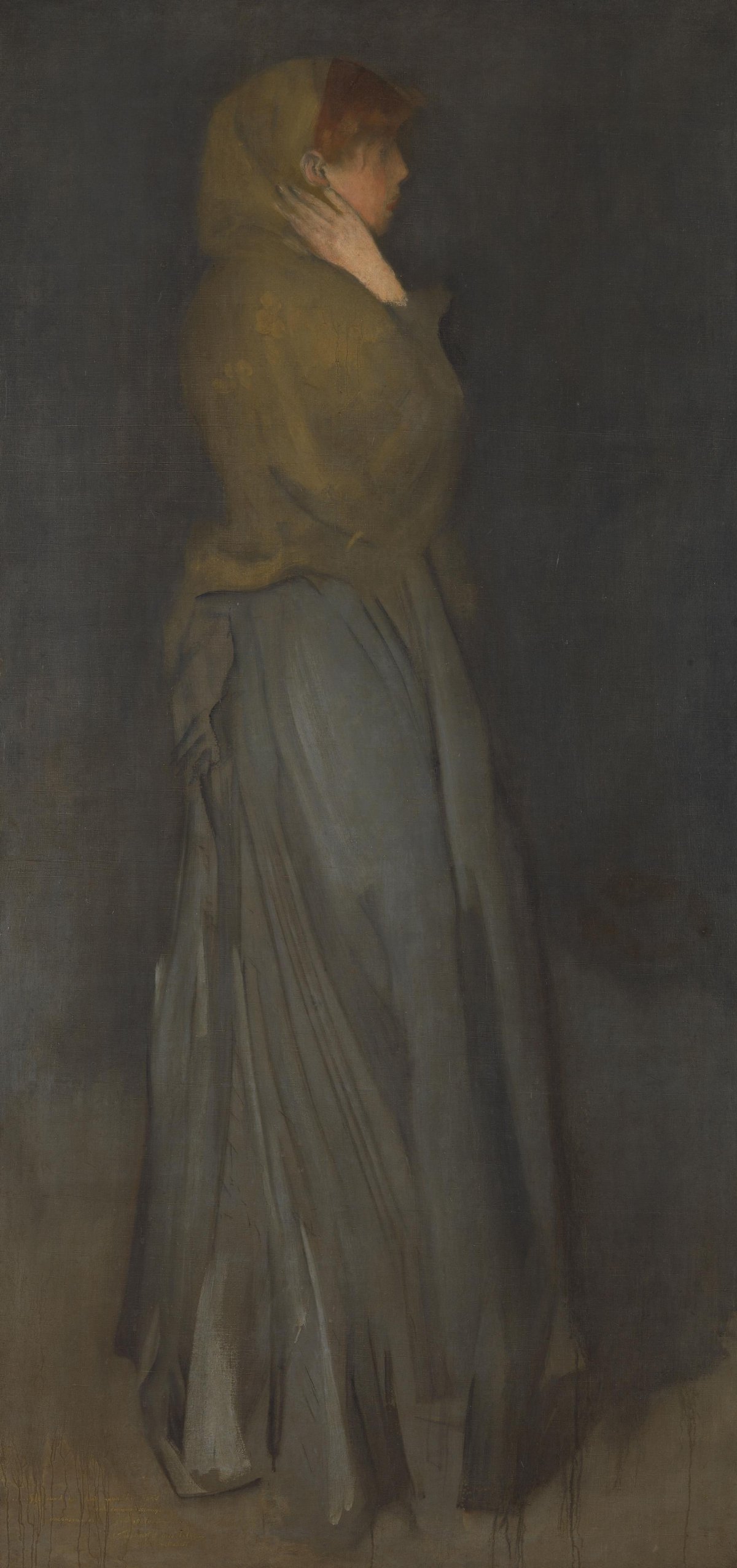
James McNeill Whistler's Arrangement in Yellow and Grey: Effie Deans is a full-length portrait whose apparent stillness conceals an unusually long and experimental history. Maud Franklin, Whistler's model and partner, stands in right-facing profile with one hand raised to her neck. A yellow-brown cloak encloses her head and shoulders, a grey-blue dress falls through the lower two-thirds of the narrow canvas, and successive black washes create a field that seems to absorb the figure at its edges. The Rijksmuseum identifies the painting as SK-A-1902, an oil on canvas measuring 194 by 93 centimetres.[1]
The familiar title contains two different ways of approaching the picture. `Arrangement in Yellow and Grey` asks the viewer to attend to relationships of colour and shape. `Effie Deans`, first used when the painting was exhibited in 1886, invokes a character in Walter Scott's The Heart of Mid-Lothian. Neither phrase simply names the woman before us. Maud Franklin is the sitter, not Scott's fictional Effie, and the literary subtitle arrived after the painting had already undergone years of change.[1][2]
The work was begun in or about 1876, but it cannot be assigned an uncomplicated moment of completion. Historical photographs show Whistler altering the background, cloak and dress over time. The current butterfly signature and literary inscription are absent from the earliest known state and were probably added in connection with the painting's sale in 1889. Technical examination has, in turn, revealed repeated fluid layers, a small amount of beeswax and an unusual mineral white containing celestine. The visible drips are not careless residue around a conventionally finished portrait; they belong to the painting's structure and to Whistler's late-1870s experiments with transparency.[2][3][4]
At a Glance
- CatalogueYMSM 183 / Rijksmuseum SK-A-1902
- Preferred titleArrangement in Yellow and Grey: Effie Deans
- SitterMaud Franklin, not Scott's fictional Effie Deans
- DateBegun circa 1876; worked through 1879 and altered before 1889 signature
- MediumOil paint on canvas
- Canvas dimensions194 × 93 × 9 cm
- Framed dimensions224.5 × 124 cm
- Signature and inscriptionLater than earliest photograph; probably 1889; inscription hand disputed
- CollectionRijksmuseum; gift of M.C. Baroness van Lynden-van Pallandt, 1900-04
- DisplayGallery 1.18 on 26 August 2026; verify current status
Contents
- Object record at a glance
- A figure held inside colour
- Arrangement before anecdote
- Maud Franklin is the sitter
- Effie Deans in Walter Scott's novel
- Begun in 1876, not finished in a moment
- The Glasgow and Lucas photographs
- Paint that runs and remains
- What the cross-sections reveal
- Drips are not a synonym for unfinished
Object record at a glance
The Rijksmuseum's present title is ‘Arrangement in Yellow and Gray’: Effie Deans, using American spelling for `Gray`. The Waterhouse+ title follows the British `Grey` used by the University of Glasgow catalogue raisonné. Both identify the same painting, YMSM 183 and Rijksmuseum SK-A-1902. The museum dates it circa 1876 to circa 1878, while the catalogue gives 1876/1879 and allows for subsequent work. The difference reflects the picture's extended making history rather than a dispute over its identity.[1][2]
The canvas measures 194 centimetres high by 93 centimetres wide; the museum also records a depth of 9 centimetres. With its current frame it measures 224.5 by 124 centimetres. Those framed dimensions describe the present museum object, not the painted field. A butterfly appears at lower right and a Walter Scott inscription at lower left. The frame is catalogued as a `Portrait Whistler` type with a broad 1876/1879 date, but the available record does not establish that Whistler personally designed or painted the surviving surround.[1][3]
The work entered the Rijksmuseum as a gift from Maria Catharina, Baroness van Lynden-van Pallandt, in April 1900. Its persistent museum identifier is `https://id.rijksmuseum.nl/200108886`, and the museum classes both object and reproduction as public domain. On 26 August 2026 the collection record stated that the picture was on view in gallery 1.18. That location is useful for visitors but remains a dated status rather than a permanent feature of the object.[1]
A figure held inside colour
The painting's extreme verticality is the first fact of its composition. It is more than twice as high as it is wide, yet the figure does not stretch theatrically from edge to edge. Dark space remains above her hood and on either side of her body. Whistler makes Maud's upright form the central measure of the canvas while allowing the surrounding field to feel materially active rather than empty.[1][11]
Maud faces right in almost strict profile. Her brow, nose, lips and chin form a small warm silhouette against black-grey paint. Reddish hair or the reddish lining of her head covering crosses the brow. The cloak closes around the head in a broad yellow-olive mass, then drops across the shoulders and upper body. Muted flower-like forms interrupt it without becoming descriptive embroidery. Colour establishes the garment more decisively than seam, weight or textile sheen.[1][11]
Her raised hand is the brightest concentrated passage. The fingers spread along the side and back of her neck, making a pale fan between face and cloak. That gesture has encouraged emotional readings, especially once the Scott title is known. Yet the hand does not prove despair, guilt, pregnancy or any other private state. It is first a compositional hinge: it joins the small profile to the broad cloak and prevents the dark sleeve from swallowing the upper body.[1][3]
Below the waist, a cool grey-blue dress opens into long folds. Some descend almost without interruption; others bend and darken as they approach the lower edge. Behind the body at left is a second hanging form, perhaps gathered fabric, whose darker contour briefly separates from the skirt. The right-hand boundary is less secure. Black wash overlaps the silhouette and falls past it in narrow streams.[3][11]
There is no legible room, furniture or horizon. Even the floor is withheld. The lowest zone changes in tone, but drips and rubbed passages prevent it from becoming stable ground. Maud is therefore neither walking through a setting nor acting inside a scene. The body supplies the only sustained vertical, while colour fields, blurred edges and gravity organise everything around it.
Arrangement before anecdote
Whistler's use of `arrangement` was not an attempt to pretend that the sitter did not exist. It changed the order in which a viewer was asked to look. A conventional portrait title might have begun with Maud's name and social identity. The colour title instead makes yellow and grey the organising terms, encouraging comparison between the warm enclosure of the cloak and the cool descent of the dress.[1][2]
Black is equally important even though it is absent from the title. It gives the profile its warm edge, enters the folds and provides the fluid runs at the bottom. The black field is not a uniform coating. Some passages are softly grey, others almost opaque, and some reveal vertical application. Whistler used dark paint to suppress setting while keeping the woman's outline selectively permeable.[3][4]
The result is not pure abstraction. The colour relation works because it is borne by a posed body: a hand interrupts the transition between head and cloak; the waist alters the movement from warm upper mass to cool lower mass; the right-facing profile gives the whole arrangement direction. Form and sitter cannot be separated without impoverishing both.
The later literary subtitle complicates this first mode of looking. Once `Effie Deans` is attached, the raised hand can appear to enact a passage from Scott and the still profile can seem absorbed in a fictional crisis. But the picture was not conceived as a straightforward book illustration. Its literary identity emerged during a changing title history and was physically reinforced by an inscription added after the earliest recorded state.[1][2]
Maud Franklin is the sitter
Maud Franklin was born Mary Franklin in 1857. She became Whistler's principal model and partner during the later 1870s and remained part of his household and working life for more than fifteen years. She also made art and assisted with print production. Those roles matter because `model` can otherwise sound like passive availability rather than skilled, repeated labour.[1][2]
In this painting Maud sustained a full-length profile in which the head, raised arm and long fall of dress had to remain relationally coherent across sessions. The surface subsequently changed, but the head and hand appear to have survived one later campaign without evident revision. Her bodily work therefore persists through a picture that Whistler repeatedly reconfigured.[3]
The relationship between sitter and artist was intimate, unequal and productive. Whistler controlled title, selection, exhibition and sale; Maud supplied a recognisable body and helped sustain the conditions under which it could be painted. A responsible account should neither reduce her to `the mistress` nor convert the portrait into a complete biography. Her separate Waterhouse+ article treats her daughters, Venice work, exhibitions and later life. Here the essential fact is narrower: the woman painted is Maud Franklin.[1][2]
Calling her Effie Deans would repeat the title's fiction as identity. Scott's character is not a disguised biographical name for Maud. The Rijksmuseum correctly identifies Franklin as the model while explaining that the subtitle refers to literature. That separation makes it possible to ask what the title did without pretending it documents the sitter's character.[1]
Effie Deans in Walter Scott's novel
The Heart of Mid-Lothian appeared in 1818 as the second series of Tales of My Landlord. Its central journey belongs to Jeanie Deans, who travels from Scotland to London to seek a pardon for her sister. Effie is nevertheless a crucial character. She has concealed a pregnancy, cannot produce the infant and faces a Scottish law that allows concealment to support a presumption of child murder.[7][8]
Scott's plot does not ultimately prove that Effie killed her child. The baby was taken while she was ill. Jeanie refuses to save her sister by giving false testimony, Effie is condemned, and the later appeal secures mercy. This distinction matters because abbreviated accounts can turn legal presumption into established murder and then make Whistler's quiet profile carry a crime that Scott's narrative does not assign to Effie.[7][8]
The phrase now written on the canvas begins, `She sunk her head upon her hand`, and describes a statue-like stillness.[1] It offers an apparent match for Maud's raised arm. Yet the gesture in the picture is not an exact illustration of a head resting in a palm: the hand reaches behind the neck while the profile remains upright. Word and image touch without becoming equivalent.
The subtitle was first used in 1886, years after the reported beginning of the portrait. Scholars have proposed that the unmarried-mother theme resonated with Maud Franklin's pregnancies and her children with Whistler.[2] That reading is historically plausible, but it is not a surviving declaration of Whistler's intention. It should remain an attributed interpretation rather than a diagnosis of the sitter's body or an assertion that artist and model deliberately staged Maud as Scott's character.
The title nevertheless changed the social pressure around the image. `Arrangement` makes the body a vehicle of tonal relation; `Effie Deans` restores gendered biography in fictional form. The two halves do not cancel one another. Their tension is the point: a real working model is simultaneously present, formalised and overlaid by a famous story about secrecy, judgement and public shame.
Begun in 1876, not finished in a moment
The Pennells reported that Whistler began the portrait from Maud in 1876.[2][10] The Rijksmuseum's circa 1876–78 range reflects that origin, while the Glasgow catalogue's 1876/1879 date accommodates a longer process. Maud gave birth to daughters in this period, and scholars have considered 1876, 1877 and 1879 as possible phases. The precise relation between any pregnancy and any sitting remains uncertain.[2]
Whistler's financial collapse provides another chronological marker. He petitioned for bankruptcy in January 1879 and was declared insolvent on 6 May. What happened to this canvas during the proceedings is not securely documented. YMSM judges that it was probably deposited with the London print dealers H. Graves & Co., but the cautious adverb is essential. A likely custody route is not a proven transfer.[2]
The painting first entered secure public exhibition history at the International Exhibition in Edinburgh in 1886. It was catalogue number 1412 and used the title Effie Deans. That appearance establishes the literary name before the present signature and inscription were probably added. It also shows Whistler treating the canvas as exhibit-worthy despite the drips that modern viewers may mistake for evidence of abandonment.[2]
Three types of evidence must therefore be kept apart. The reported beginning belongs to 1876. The first secure exhibition belongs to 1886. The present signed and inscribed state probably belongs to 1889. Between those points historical photographs record material change, but they do not date every individual layer. `Painted 1876` is too narrow, while `finished 1889` is too final for a surface whose campaigns cannot all be assigned exact years.
The Glasgow and Lucas photographs
An albumen photograph in Glasgow University Library, Whistler PH4/18, records an early state. The cloak was then considerably darker and glossier, more like satin, and the sitter's back stood against a lighter area. Most importantly, the photograph predates the current butterfly and Scott inscription.[2][3]
A later photograph in the G.A. Lucas Collection in Baltimore shows a different stage. It bears a butterfly that can be dated to about 1881 and records the wording `Arrangement in Grey & Yellow`. By then Whistler had added a dark wash down the right side. The liquid paint crossed the hem and ran towards the bottom of the canvas.[2][3]
The present work is later still. Comparison indicates that Whistler darkened selected folds in the dress and deepened the shadowy field on the right with very wet paint. He lightened the cloak and added its flower pattern. The head, hand and skirt do not appear to have been changed in that particular campaign. Revision was thus selective: one area could remain stable while adjacent colour and silhouette were rebuilt.[3]
These photographs dismantle two familiar myths at once. The portrait was not completed through one brilliant uncorrected performance, and its current darkness is not simply the unchanged atmosphere of the first sittings. Whistler revised through washing, overlaying and adjusting contrast. The long runs are records of those decisions.
Photography also changes how `finish` should be understood. A polished academic portrait normally hides its stages inside a unified surface. Here earlier states remain visible through documents and, materially, through thin layers. The work's coherence does not depend on erasing its process. Whistler's choices accumulate into a final public object that still admits how fluidly it was made.
Paint that runs and remains
The paint is exceptionally thin. Long broad applications extend through the background and dress, while black liquid descends in narrow channels. Some runs gather at the lower edge; others cut into or pass across earlier material. Their direction records gravity and suggests that at least part of the work stood upright while these applications settled.[3][4]
Hermens and Wallert made Effie Deans the principal case study in their examination of Whistler's late-1870s full-length portraits. Microscopy and chemical analysis showed that the surface is not one diluted veil. It contains repeated, partly overlapping applications with different fluorescence. Black paint mixtures in the drips contain carbon, and some liquid runs appear to have furrowed the paint beneath them.[3][4]
Linseed oil was confirmed as the binding medium, with a small amount of beeswax. The researchers reasoned that such extreme fluidity required substantial volatile solvent, probably turpentine or spike oil. Once the solvent evaporated, beeswax and the particulate paints would help maintain a matt, velvety appearance rather than leaving a slick film.[4]
This object-specific finding is more reliable than a universal recipe for Whistler's famous `sauce`. Studio recollections name mixtures of oil, resin and solvent, but they vary and often derive from other works. Effie Deans supplies its own material evidence. It confirms deliberate control of very fluid oil paint without proving that every nocturne and portrait was made from an identical formula.[4][6]
Ultraviolet examination adds a conservation warning. Thin applications fluoresce with unexpected variety, and some are barely visible in ordinary light. Removing a varnish from such a surface could also remove or disturb paint that is difficult to distinguish from the coating above it. The lack of a published conservation chronology does not mean the canvas is materially simple; it means treatment claims must stop where evidence stops.[3][6]
What the cross-sections reveal
A sampled cross-section begins with a greyish ground containing strontium, barium, zinc, lead, small quantities of iron oxide and ivory black. Above it are three principal dark applications: a grey-black layer, a thin blackish layer associated with dripping, and a still thinner black wash responsible for further runs, especially at the right. A highly fluorescent transparent layer sits above these campaigns and was interpreted as probable oiling-out before the signature was applied in 1889.[3][4]
In many passages the full stratigraphy comprises only two or three thin paint layers. The palette is correspondingly restrained: whites, yellow ochres, red and brown earth colours and black. Material economy does not mean visual poverty. Small changes in particle size, opacity and dilution allow the cloak, dress and field to separate even where hue differences are slight.[4]
Barite, a natural form of barium sulphate, occurs in the pale paint with conventional lead white. Its relatively large particles helped a heavily thinned mixture retain an open, matt texture. A smooth transparent glaze might have collapsed into gloss; the particulate white allowed Whistler to create a veil that stayed physically present.
The more unexpected finding was strontium sulphate in the form of celestine. This is a mineral white, not the dangerous radioactive strontium sometimes evoked by the modern name. Its large crystals could support an open paint film and a cool cast in the silvery greys. The scientific result is the identification of celestine; explaining exactly how it entered Whistler's materials requires a further historical argument.[4][5]
Hermens and Wallert considered two possibilities. Whistler may have combined artists' tube colours such as lead white, blanc fixe and zinc white with mineral strontium sulphate. Alternatively, he may have adapted an oil-based house paint associated with John Bryson Orr, adding conventional lead white. Orr patented a celestine-bearing Duresco product in 1884, although related production began during the late 1870s.[3][4]
The later Kress review uses this investigation to demonstrate technical art history as an interdisciplinary method. Gas chromatography–mass spectrometry, electron microscopy with elemental analysis, X-ray fluorescence, polarised-light microscopy and X-ray diffraction were combined with correspondence, historical paint literature and testimony about Whistler's practice.[5] No instrument by itself could identify an artistic intention. The interpretation emerged by joining physical composition to the dates and context of experimental commercial paints.
That method supports a strong conclusion and a cautious one. Whistler intentionally explored unusually transparent, highly diluted paint containing celestine. It is less certain that a specific branded Duresco product was the sole source. The article can therefore explain the house-paint hypothesis without turning it into a label on an unrecorded tube.
Drips are not a synonym for unfinished
The visible runs have often tempted viewers to call paintings of this kind unfinished. That judgement assumes finish requires hidden brushwork, opaque coverage and a clean lower edge. Whistler's own exhibition and sale history offers a different test. He allowed Effie Deans into public view in 1886, continued to adjust it, signed it for an owner and saw it again without disowning its fluid surface.[2][3][6]
The drips also perform visual work. At right, black wash strengthens contrast while preserving a soft boundary around the grey dress. At the bottom, descending lines lengthen the narrow format and prevent the skirt from ending as a solid block. On the cloak and bodice, thinner overlays allow earlier tone to breathe through. Accident and decision cannot be separated neatly: gravity produced the exact course of each run, but Whistler chose the dilution, application and whether to leave the result.[3][4]
Historical photographs show that he could alter these effects. He rubbed, overlaid and darkened selected areas, yet allowed other runs to remain. If every drip were merely unwanted failure, the sustained sequence of revision offered ample opportunity to remove or cover them. Their survival in a signed and sold object makes deliberate retention the better explanation.
`Experimental` is therefore more useful than `unfinished`. It describes a painter testing how little material could establish a figure, how open mineral whites behaved when heavily diluted and how fluid black could both veil and articulate. The term also acknowledges risk. A transparent passage cannot always be corrected without changing everything beneath it.
Signature, inscription and disputed handwriting
The current butterfly at lower right is not present in the early Glasgow photograph. The Lucas photograph appears to show an earlier butterfly, dateable to about 1881, yet the physical evidence and later ownership story associate the present signature campaign with 1889. An oiling-out layer immediately beneath the signature supports its position late in the stratigraphy.[2][3][4]
The inscription is more contested. Walter Sickert told the Pennells that it had been added by somebody other than Whistler, and Elizabeth Robins Pennell was not convinced that the handwriting was his. The Pennells also observed that Whistler did not object to it when he saw the picture in 1902.[3][10] These statements do not identify the writer. They establish uncertainty alongside lifetime acceptance.
The Rijksmuseum transcribes the present words with the Scott attribution followed by The heart of Mid Lothian. YMSM arranges the title and author differently.[1][2] Such variation may arise from line breaks and catalogue normalisation, but it is safer to follow the current holder when describing the physical inscription.
The title and inscription should not be treated as simultaneous evidence. `Effie Deans` was used at Edinburgh in 1886; the present writing was probably added in 1889. A viewer could therefore encounter the literary identity before the canvas carried the quotation. The inscription consolidated an existing title rather than necessarily inventing it.
From Edinburgh to Amsterdam
After Edinburgh, the next decisive public event was the third exhibition of the Nederlandsche Etsclub in Amsterdam in 1889. Reinhard Boelens, Baron van Lynden, bought the painting in connection with that exhibition. According to the Pennells, Whistler signed it at the new owner's request during his Dutch visit, and the inscription was probably added at about the same time.[2][10]
This history helps explain why a painting begun in the 1870s bears material associated with 1889. Sale did not merely transfer a static object. It prompted an act of authentication and perhaps literary reinforcement. Whistler's return to the canvas made its ownership history part of its physical structure.
Baron van Lynden and his wife, Maria Catharina, Baroness van Pallandt, assembled paintings for their Hague residence. Recent Rijksmuseum research deliberately calls the holdings the Van Lynden–Van Pallandt Collection. Contemporary legal incapacity prevented married women from appearing fully in Dutch archival records, so older accounts attributed collecting decisions almost entirely to the baron. Naming the couple together corrects that documentary imbalance without pretending every individual purchase can be divided precisely between them.[9]
Their Hague rooms favoured modern French and international painting with loose or sketch-like handling. The couple visited Paris and dealt through businesses including Goupil, later Boussod, Valadon & Cie, and Van Wisselingh. Whistler's experimental portrait belonged within a collection interested in modern surfaces rather than only highly finished academic description.[9]
When the baron died in 1896, the Hague collection was intended for the Rijksmuseum, subject to family rights. In 1900 the baroness chose to donate it during her lifetime. The museum records Effie Deans as her gift in April of that year.[1][9] The distinction matters: the painting did not simply arrive as an anonymous part of her husband's estate. Her decision converted a future bequest into a present public collection.
The larger gift helped bring modern international art into the Rijksmuseum alongside works by Monet, Courbet, Corot, Delacroix and Daubigny. Shifting national preferences and limited space meant that the collection was not always kept together or consistently displayed. Its importance is now clearer: a late-nineteenth-century Dutch collecting partnership placed Whistler's radical surface inside the national museum decades before modernism became an easy institutional category.[9]
Looking at the painting in the Rijksmuseum
The current museum object holds several dates at once. The figure remembers sittings begun around 1876. Black washes and cloak revisions record later campaigns. The title was public by 1886. Signature and inscription probably belong to 1889. The 1900 acquisition then fixed the work within a Dutch public collection. No single date printed beneath the frame can communicate all of that history.[1][2][3]
High-resolution viewing reveals effects that a small reproduction suppresses. The dark field is not featureless, the hand is not smoothly modelled, and the skirt is crossed by strokes of different density. At the bottom, the paint behaves less like a finished architectural boundary than a record of liquid descending and drying. The Rijksmuseum's public-domain image makes those details available beyond gallery 1.18, while the physical work retains scale, surface and framing that a screen cannot reproduce.[1][11]
Viewers should resist using the inscription as an instruction to discover one emotion. Maud's profile, hand and still posture may correspond with the Scott phrase, but the portrait remains materially prior to that text. Looking first at the hand's brightness, the cloak's changed colour, the dress's long cool folds and the black wash's direction allows the later literary layer to enrich rather than dictate interpretation.
The current frame should likewise be treated as part of the museum object without overclaiming. Its `Portrait Whistler` classification situates it within a presentation tradition, but the locked evidence does not prove that every surviving component carries Whistler's personal design. Canvas, frame, title, inscription and collection history each have related but distinct chronologies.[1][3]
Why Effie Deans matters
This painting makes Whistler's idea of arrangement inseparable from material experiment. Yellow and grey are not simply selected hues; they are built through particulate whites, earth colours, black wash, solvent, wax and repeated thin layers. The dark field is not neutral support. It was changed over years until it could hold Maud's form without turning into a described room.[3][4][5]
It also exposes the limits of formal naming. The title begins by abstracting a woman into colour relations, then restores a female story through Scott. Neither act gives Maud her own name. Recovering her as sitter does not solve that tension, but it prevents the fictional subtitle from replacing the labouring person who made the pose possible.
The photographic record gives the canvas unusual authority as evidence of process. We can see a darker cloak, a lighter zone behind the back, an intermediate black wash and the later flower pattern. Scientific cross-sections then carry that sequence beneath the visible surface. Art history, conservation science and archival photography converge without pretending to date every stroke.[2][3][4]
Finally, the painting asks viewers to reconsider finish. Whistler left gravity visible, yet he did not abandon the object. He exhibited it, revised it, signed it and allowed it to pass into a major collection. What looks accidental is held inside years of decision. Arrangement in Yellow and Grey: Effie Deans matters because its still figure and running paint remain in productive contradiction: Maud appears almost statue-like while the surface records movement that never entirely stops.
Discussion
How does the painting change when its still profile is read beside its running paint?
Begin with Maud Franklin's raised hand, cloak and dress, then follow the photographic states, black washes and later Scott inscription without allowing the fictional title to replace the sitter.
Reader Insights
What does the title add—and conceal—once Maud Franklin is named?
Which visible effects become clearer when the historic photographic states are compared?
Why can intentional retained drips be evidence of experiment rather than abandonment?
Join the Conversation
Share a close observation or an object-history question.
References
- Rijksmuseum, ‘Arrangement in Yellow and Gray’: Effie Deans, SK-A-1902, current object record, accessed 26 August 2026, https://www.rijksmuseum.nl/en/collection/object/Arrangement-in-Yellow-and-Gray-Effie-Deans--895b07048d5aa8628495e274abf24f74.
- Margaret F. MacDonald and Grischka Petri, Arrangement in Yellow and Grey: Effie Deans, YMSM 183, date, title, exhibition and provenance record, The Paintings of James McNeill Whistler: A Catalogue Raisonné, University of Glasgow, https://www.whistlerpaintings.gla.ac.uk/catalogue/exhibitions/display/?eid=Amsterdam_1889a&mid=y183.
- MacDonald and Petri, YMSM 183, composition, technique, conservation and frame record, University of Glasgow, https://www.whistlerpaintings.gla.ac.uk/catalogue/exhibitions/display/?mid=y183&xml=tec.
- Erma Hermens and Arie Wallert, “James McNeill Whistler: Fluidity, Finish and Experiment”, in Marika Spring et al., eds., Studying Old Master Paintings: Technology and Practice (London: Archetype Publications, 2011), pp. 229–36, https://www.researchgate.net/publication/273138732_James_McNeill_Whistler_fluidity_finish_and_experiment_Erma_Hermens_and_Arie_Wallert.
- Erma Hermens, Technical Art History: An Interdisciplinary Journey into the Making of Art (Samuel H. Kress Foundation, 2024), pp. 57–60, https://www.kressfoundation.org/getattachment/c85b7694-94dc-4c03-b23b-9e9f39720bc6/Hermens,-Technical-Art-History_2024.pdf?lang=en-US.
- Erma Hermens, Margaret MacDonald, Gail McConnell, David Blatchford, Devi Ormond and Arie Wallert, “James McNeill Whistler: Fluidity, Finish and Accident”, in Studying Old Master Paintings—Technology and Practice: Book of Abstracts (National Gallery, London, 2009), p. 69, https://www.nationalgallery.org.uk/media/15375/conference_abstracts_studying-old-master-paintings.pdf.
- Edinburgh University Library, Walter Scott Digital Archive, “The Heart of Midlothian”, publication history and synopsis, https://www.walterscott.lib.ed.ac.uk/works/novels/midlothian.html.
- Walter Scott, The Heart of Mid-Lothian (1818), digital text, Project Gutenberg, https://www.gutenberg.org/files/6944/6944-h/6944-h.htm.
- Jenny Reynaerts, “A Curious Case of Neglect: The Collection of Paintings from Baron Van Lynden and Baroness Van Pallandt”, The Rijksmuseum Bulletin 71, no. 4 (2023), pp. 308–33, https://doi.org/10.52476/trb.18495.
- Elizabeth Robins Pennell and Joseph Pennell, The Life of James McNeill Whistler, vol. 2 (London: William Heinemann, 1908; revised 1911), especially pp. 276–77, Smithsonian Libraries digital edition, https://library.si.edu/digital-library/book/lifejamesmcneil2penna.
- Rijksmuseum, Micrio IIIF image `pqdys`, public-domain digital asset, https://iiif.micr.io/pqdys/full/1200,/0/default.jpg.


