


 by Tom Gurney
Tom Gurney BSc (Hons) is an art history expert with over 20 years experience
Published on June 19, 2020 / Updated on November 6, 2026
Email: tomgurney1@gmail.com / Phone: +44 7429 011000
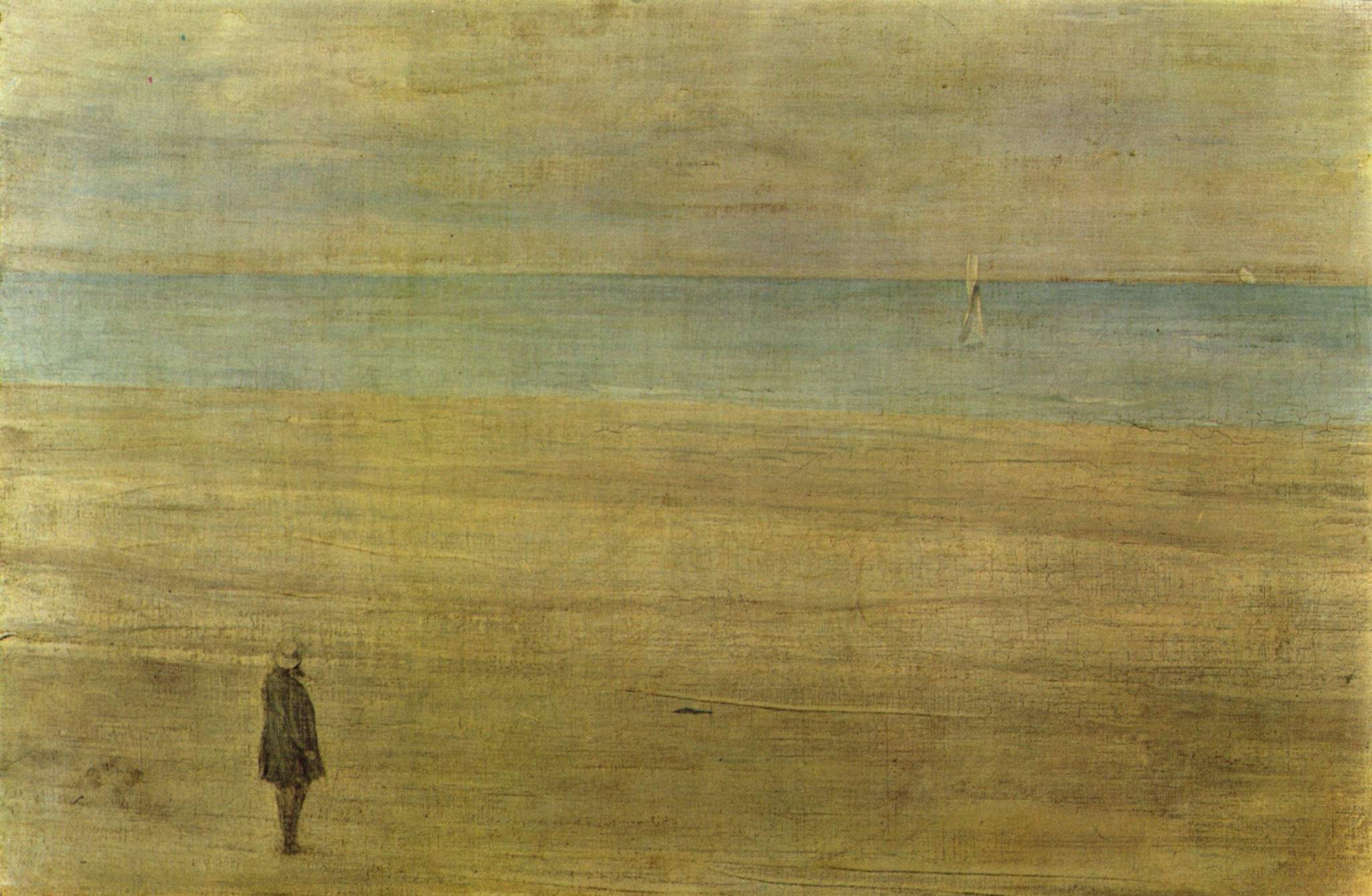
James McNeill Whistler painted Harmony in Blue and Silver: Trouville on the Normandy coast in the autumn of 1865. The University of Glasgow catalogue identifies the canvas as YMSM 064. It belongs to the Isabella Stewart Gardner Museum in Boston, where its object number is P1e6.[1][4]
The painting is a horizontal arrangement of beach, water and sky. A small man stands at the lower left, while two boats interrupt the distant sea. The man is not an anonymous holidaymaker: Whistler identified him as the French painter Gustave Courbet, with whom he worked at Trouville that season.[1][5][12]
The familiar title was fixed much later than the image. In 1892 Whistler used several descriptive names before writing Harmony in Blue and Silver, Trouville on his receipt to Isabella Stewart Gardner. That chronology matters. The canvas began as an encounter between painters, weather and coast; its musical title later taught viewers to attend closely to colour and relation.[1][3][15]
At a Glance
- CatalogueYMSM 064
- DateAutumn 1865
- SiteTrouville, Normandy
- FigureGustave Courbet
- MediumOil on fine-weave canvas
- Gardner dimensions51 × 76.7 cm
- YMSM dimensions49.5 × 75.5 cm
- CollectionIsabella Stewart Gardner Museum, P1e6
- FrameFlat Whistler frame; probably c.1878
- DisplayYellow Room
Contents
- The painting at a glance
- Which Trouville painting is this?
- Why the title is retrospective
- What “harmony” asks viewers to notice
- Gustave Courbet is the figure
- Which way is Courbet looking?
- Sand, sea and sky as horizontal bands
- How the painting creates depth
- Pale colour is not empty colour
- Long strokes and thin veils
The painting at a glance
Gardner describes an oil painting measuring 51 × 76.7 centimetres. YMSM gives the slightly smaller dimensions 49.5 × 75.5 centimetres. Rather than disguising the difference, it is best to attribute the two records. Both identify the same fine-weave canvas, YMSM 064 and P1e6.[1][2][4]
Light brown sand fills more than half the image. Pale water runs across it, edged by small breaking waves. The sky is only a little lighter than the sea and carries wispy blue-grey clouds. A narrow distant landform, a white mast-like accent and two remote sailing boats make the emptiness articulate rather than blank.[1][4]
Courbet's dark coat and trousers create the strongest vertical mass near the lower-left corner. His pale hat, shoulder-length dark hair and beard sharpen the silhouette. He is large enough to identify yet small enough for the coastal expanse to remain the main visual event.[1][4][5]
Which Trouville painting is this?
Whistler produced a group of seascapes at Trouville. Their related dates, palettes and titles make confusion easy. Harmony in Blue and Silver: Trouville is YMSM 064 on canvas in Boston. It is not YMSM 066 Blue and Silver: Trouville, a larger work on millboard at the Freer Gallery of Art.[1][7]
It is also distinct from YMSM 065 Sea and Rain, YMSM 067 Crepuscule in Opal: Trouville, YMSM 069 Green and Grey. Channel and YMSM 070, now called Trouville (Grey and Green, the Silver Sea). Each has its own support, details, ownership and exhibition history.[1][7]
Comparison across the group remains valuable. Repeated high horizons, thin paint and restrained coastal colour show Whistler testing related problems. Catalogue control prevents those similarities from becoming a licence to transfer a pigment analysis, signature, treatment or provenance from one picture to another.[1][7][8]
Why the title is retrospective
No secure 1865 label establishes the complete modern title. During negotiations in June 1892, both the Cavafy family and Whistler called the work Sea and Sand. Whistler also listed it as Courbet—on sea shore and referred in French to the Trouville marine with Courbet on the beach.[1][3][14]
On his November 1892 receipt for Gardner, Whistler used Harmony in Blue and Silver, Trouville. The catalogue raisonné later adjusted the punctuation to conform with his other titles. The Copley Society showed it in Boston in 1898 as Courbet on the Beach.[1][15][16]
Gardner's published commentary dates Courbet—on sea shore to 1866, while YMSM's documentary title sequence first secures that wording in 1892. The prudent account exposes the difference rather than choosing a false certainty. What can be said securely is that the colour title is documented from the painting's 1892 sale history, not from the moment Whistler laid out the beach in 1865.[1][5]
What “harmony” asks viewers to notice
The word “harmony” moves attention from a named episode towards relationships among tones. Blue and silver do not label two flat swatches. They describe a narrow range in which sand, water, air, cloud, coat and sail become distinct through small adjustments.[1][5]
That musical language does not erase Courbet. The figure remains historically specific, and the place remains Trouville. Instead, title and image place different kinds of reading side by side: one can recognise a painter on a Normandy beach while also following intervals of pale colour across the surface.[5][6]
This balance protects the picture from two reductions. It is more than an anecdotal portrait of one famous artist by another, but it is also more than a proto-abstract pattern detached from people and geography. Whistler's later title changes the emphasis without abolishing the represented world.[1][5]
Gustave Courbet is the figure
Courbet stands at the lower left in an overcoat and pale hat. Whistler listed the work under Courbet's name in 1892 and, in 1895, called it his only painting of the French artist. Those statements make the identification much stronger than resemblance alone.[1]
Courbet was forty-six in 1865, an internationally controversial advocate of Realism. Whistler had known and admired his work since his student years in Paris. At Trouville the older painter referred to the younger man as his pupil, language that Whistler would later resist.[11][12]
The figure's small scale is not evidence that Whistler wished to belittle Courbet. Size answers the design: the body supplies a dark still accent against long pale bands. Rivalry and changing allegiance belong to the documented relationship, but the silhouette does not transparently record either man's private thoughts.[1][5]
Which way is Courbet looking?
The placement of Courbet's head is deliberately hard to resolve. If his beard appears in profile, he looks diagonally towards the right. If the hat sets the main direction, he may face almost straight away from the viewer and out to sea.[2][5]
Each reading changes the space. A rightward gaze follows the beach laterally and stresses the canvas as a broad field. An outward gaze carries attention from foreground sand towards the middle-distance boat and the farther horizon. Whistler lets both routes remain available.[5]
Ambiguity therefore belongs to construction before it becomes psychology. The viewer cannot quite settle the angle of a few dark and pale marks. There is no need to convert that uncertainty into Courbet's arrogance, humility, loneliness or contemplation.[2][5]
Sand, sea and sky as horizontal bands
Three broad zones organise the composition. Sand rises through the foreground, a narrower sea crosses the middle and sky completes the upper field. Their boundaries are sufficiently clear to establish order but sufficiently soft to suggest atmosphere.[2][4][5]
Calling them stripes is useful shorthand, not a complete inventory. Waves curl at the shoreline. Clouds move within the sky. A thin stretch of land modifies the horizon, and boats interrupt the water. The bands contain incident without surrendering their overall calm.[4][6]
The high horizon gives sand unusual prominence. Instead of opening a conventional prospect through a large sky, Whistler makes the empty beach a principal colour area. Courbet's body activates its scale: the expanse feels broad because a recognisable human measure stands within it.[2][5]
How the painting creates depth
The image can appear almost flat because its main strokes run horizontally and its tones lie close together. Yet it also constructs considerable distance. Courbet occupies the front left, one boat sits farther away and another approaches the far horizon.[2][5]
The shore narrows as it recedes, while water overlaps sand in small pale waves. Cloud, sea and distant land differ by slight degrees rather than strong outlines. Space emerges from placement and tonal interval instead of theatrical perspective.[4][5]
This double condition is central to the work. The canvas declares its painted surface through long bands, but the same bands become an extensive coast. Neither reading defeats the other. Whistler makes flatness and recession mutually dependent.[2][5]
Pale colour is not empty colour
Blue and silver describe a restrained system, not a colourless scene. Pale lavender moves through water and air. Blue-grey clouds sit against a related sky, while warmer sand and Courbet's dark clothes keep the cool field from becoming uniform.[1][5]
Small contrasts carry unusual weight. The hat separates from hair; a white vertical meets the sea; boat shapes punctuate the horizon. Because Whistler avoids a crowded range of saturated hues, each change in temperature or value becomes easier to see.[4][5]
The picture's calm depends on calibration. A more forceful dark outline around every element would break the continuity of atmosphere. A completely even wash would lose coast and distance. Whistler holds the scene between those extremes.[2][5]
Long strokes and thin veils
Technical description identifies a fine canvas crossed by long brushstrokes parallel to the frame. Whistler carried these marks across large areas towards a high horizon. Direction of touch reinforces the coastal structure.[2]
The paint is comparatively thin. Gardner scholarship describes veils of colour rather than the dense material surface often associated with Courbet. That distinction must remain page-specific: it applies to YMSM 064 and should not become a claim that Whistler always used dilute paint.[2][5]
Nor should a poetic term such as “veil” imply effortlessness. Thin paint exposes every decision about ground, overlap and continuity. Whistler later warned his restorer that the lightly impasted picture required exceptional tenderness. Material economy made the surface vulnerable as well as refined.[2][14]
Courbet was added after the coast
The figure did not arise simultaneously with the principal beach and sky. Examination shows that Whistler added Courbet after the background had dried. The painter first established the large coastal field, then placed the dark body upon it.[2]
Courbet's feet also changed. They originally stood farther to the left. Moving them adjusted the relation between figure, corner and open sand without requiring Whistler to rebuild the entire background.[2]
These findings complicate the appearance of immediate observation. Whistler may have worked quickly across the main field, but he still revised the human accent after drying. Spare design is the result of sequence and correction, not proof that every element arrived in a single untouched session.[2][14]
The comparison with Courbet at Palavas
Whistler's composition is frequently related to Courbet's The Seaside at Palavas of 1854. Courbet's earlier picture places an isolated man at the shore confronting a wide marine horizon. The shared arrangement makes comparison more than a vague association.[2][5][13]
Differences are equally instructive. Courbet's picture has stronger diagonal energy, richer colour and more substantial paint. Whistler expands quieter horizontal bands and reduces the figure to a small tonal interruption. His beach does not reproduce Courbet's surface.[2][5]
The relation can therefore be understood as an answer rather than a tracing. Whistler borrows an available problem—a solitary painter before the sea—and reorganises it through scale, palette and brush direction. Tribute and competitive independence can coexist without pretending that one motive is provable from every stroke.[5][13]
Courbet as teacher and colleague
The two painters worked side by side at Trouville in autumn 1865. Courbet told his father that Whistler was his pupil. The description fitted Courbet's expansive public personality, but it also registers a real asymmetry: he was older, already famous and a major model for younger artists.[1][12]
Their practices were not identical. Courbet's 1865 Fishing Boat, painted during the same September-to-November stay, makes a rigged working vessel the material centre of a denser composition. Whistler's picture distributes attention across lightly painted sand, air and distance.[12]
Courbet later remembered their cold sea bathing, meals and painting of space towards the horizon. Written twelve years afterwards, the letter is affectionate evidence of shared experience rather than a minute-by-minute diary. It supports companionship without settling artistic dependence.[10]
Whistler's later rejection of Realism
In 1867 Whistler wrote a remarkable letter to Henri Fantin-Latour about Courbet. He insisted that Courbet's work retained important qualities, yet attacked the appeal that Realism's call to nature had once held for his own vanity as a painter.[11]
That statement is not a simple confession followed by a clean break. Whistler denied a direct pictorial influence while naming his early interiors, Thames subjects and seascapes as products of the education he now regretted. The intensity of the denial shows how urgently he was redefining himself.[11]
YMSM 064 makes that history visible. It portrays Courbet and recalls his seashore design, but its thin, pale, lateral structure pursues another language. The canvas is valuable precisely because affiliation and separation remain entangled.[2][5][11]
Trouville after the holiday season
Whistler was still at Trouville on 20 October 1865. He told Lucas Ionides that the season had ended and almost everyone had left. Instead of regretting the empty resort, he judged the effects of sea and sky finer in the less gentle weather.[7][9]
The letter places the pictures outside the brightest phase of fashionable summer tourism. The broad vacant beach is consistent with an autumn coast, although it should not be treated as a meteorological chart for one named day.[7][9]
Whistler said he remained to finish two or three sea pieces and hoped they would rank with his best work of the kind. More Trouville canvases are now identified, so his phrase described active tasks rather than a complete future catalogue.[7][9]
The wider Trouville campaign
The surviving group tests how a limited coastal vocabulary could change with weather, support, figure and horizon. Some views contain boats or working craft; some emphasise rain or twilight; some reduce the shore almost to atmosphere.[1][7]
The Gardner canvas is unusual because a named artistic colleague occupies it. The figure provides scale, biography and a direct link to Courbet's marine painting. Yet the surrounding expanse is not merely a backdrop for his portrait.[1][5]
Looking across the series can illuminate Whistler's movement towards the later nocturnes, but chronology must remain exact. These are daylight or transitional 1865 coast studies. They are not Thames night scenes, and their technical evidence cannot be pooled indiscriminately.[7][8]
Joanna Hiffernan and the limits of the scene
Joanna Hiffernan was part of Whistler's life and the wider Trouville encounter with Courbet. Modern Courbet scholarship notes her presence in the circle. She is not, however, the person represented in YMSM 064.[12][17]
Later accounts of Courbet, Hiffernan and Whistler can encourage a private triangle to overtake the beach. The canvas supplies no such narrative. Its single visible body is Courbet's, and its documented revisions concern his placement rather than an absent second sitter.[1][2]
Keeping that boundary does not erase Hiffernan. It prevents her biography from being used as atmosphere whenever two male painters meet. Her own modelling and collaborative histories belong on pages where the evidence directly supports them.[12][17]
Whistler's gift to George Cavafy
During the 1870s Whistler gave the painting to the London collector George John Cavafy. Cavafy already owned other works by him. The transfer was a genuine gift, although Whistler later used his continuing care for the picture to question the owner's entitlement.[3][14]
Around 1878 the canvas came back to Whistler in poor condition. He complained that dirt or discoloured surface layers had obscured its light and purity. He cleaned and restored the work, then arranged a frame.[2][14]
When Cavafy's son would not pay the frame maker, Whistler demanded the picture back, arguing that the family had enjoyed his gift long enough. The demand reveals his proprietary attachment, but it did not by itself reverse ownership. The Cavafys retained the work into 1892.[3][14]
Cleaning and framing around 1878
Whistler presented his intervention as a recovery of the original fairness. Modern readers should distinguish artist-directed cleaning from fresh making. Removing accumulated material can change a thin surface even when the artist approves the result.[2][14]
The surviving flat Whistler frame bears a Foord & Dickinson label. A bill found among bankruptcy papers describes a wainscot reeded frame of matching size, green-gold gilding, a painted panel and plate glass. It probably concerns YMSM 064, but the link is not absolute.[2][4]
The present border may therefore descend from the 1878 campaign, with later alteration to its painted surface. The form and location of any separate 1865 frame remain unknown. “Whistler frame” should not be expanded into “original 1865 frame” without that missing evidence.[2]
Glass, dirt and a vulnerable surface
The frame bill includes plate glass, and Whistler later discussed whether the picture should travel glazed. Glass belonged to protection and presentation; it was not a layer on the painted canvas.[2][14]
The distinction matters because several operations cluster in the record. Cleaning removed unwanted surface material, varnishing added a transparent coating, framing organised the boundary and glazing shielded the face. Treating them as one act would obscure different agents and risks.[2][14]
Whistler's anxiety was proportionate to the technique. Broad, thin passages could lose delicate relations through abrasion or harsh solvent action. His close supervision shows that apparent simplicity did not make the work materially expendable.[2]
The four-picture sale in 1892
After George Cavafy's death, his son John offered four Whistler paintings. The group contained YMSM 064, The Last of Old Westminster, Battersea Reach and Variations in Flesh Colour and Green: The Balcony.[3][14]
John Cavafy was prepared to accept £600 cash for the group. John Chandler Bancroft made an offer, but Cavafy completed a better transaction before that sale closed. The New York dealer Edward Guthrie Kennedy bought all four for £650.[3][14]
These are package amounts. They must not be assigned wholly to Harmony in Blue and Silver. Whistler simultaneously helped the transaction and attacked Cavafy's haste and greed, believing the works could fetch much more. His outrage was interested market speech, not a neutral valuation.[3][14]
How the canvas returned to Whistler
Kennedy agreed to return Sea and Sand to Whistler. The arrangement emerged from their broader dealings, including Whistler's encouragement of the four-picture purchase. By mid-1892 the canvas was once again under the artist's control.[3][14]
Whistler first tried to place it through Durand-Ruel in Paris for 600 guineas. When that did not succeed, he considered selling it to Kennedy and apologised for offering it elsewhere first. The sequence shows attachment mixed with active commerce.[3]
Recovery did not restore the 1865 situation. The work now carried the history of Cavafy ownership, Whistler's earlier cleaning and its probably 1878 frame. Its return opened another treatment and presentation campaign.[2][3]
Stephen Richards's 1892 treatment
Whistler directed the restorer Stephen Richards to clean the four recovered pictures, remove varnish and varnish them again. He called Richards the only person fit to touch his work and insisted on care and speed.[2][14]
He remembered the seascape as painted largely in one go and therefore not heavily impasted. That recollection agrees with the visible economy, but it should not erase the documented late addition and movement of Courbet's feet.[2]
The surface seen today has passed through at least two artist-directed campaigns, around 1878 and in 1892. It is neither an untouched deposit from one autumn session nor merely a later restorer's construction. Its history combines original thin handling, revision, cleaning and revarnishing.[2][14]
Isabella Stewart Gardner's purchase
Isabella Stewart Gardner acquired the picture directly from Whistler in Paris for 600 guineas. Receipt and correspondence place the completed transaction in November and December 1892.[3][4][15]
A later account says Gardner loved the picture in Whistler's studio, tired of his delay and arrived with a companion prepared to carry it away. Whistler supposedly protested that the canvas was unfinished because it lacked his signature. Gardner invited him to add it before collecting payment.[3][5]
The episode suits both personalities, but it survives as a transmitted version with differing details about Gardner's companion. It should be told as an acquisition story, not exact stenography. Documentary evidence more securely establishes price, timing, receipt and the late butterfly.[2][3][15]
The butterfly was added late
Gardner records Whistler's butterfly at the lower left. YMSM says he added it in 1892 and that cleaning has partly reduced it. The signature therefore belongs to the sale campaign, twenty-seven years after the beach was painted.[2][4]
Late signing does not make the canvas unfinished until 1892 in every other respect. Whistler's complaint to Gardner may have given him one final act of authorship, but the main image had long been given away, cleaned and framed.[2][3]
The butterfly's chronology is a useful warning. A signature can certify and re-present an older work without dating its principal execution. Here it records Whistler's renewed possession and sale as much as the autumn at Trouville.[2][15]
Was it exhibited in 1883?
YMSM lists only one secure public exhibition: the Copley Society's Boston loan exhibition of 1898, where the painting appeared as Courbet on the Beach, catalogue 90.[3][16]
An 1883 Paris exhibition included a Harmonie en bleu et argent. Earlier writers proposed YMSM 064, but the contemporary description dwells on blue sea, reflected cloud colour and gentle effect without mentioning the conspicuous dark figure.[3][16]
That omission makes Sea and Rain or YMSM 066 more plausible. Absolute proof may remain unavailable, yet evidence grading favours rejection of the 1883 claim for this object. Similar Whistler titles cannot substitute for descriptive fit.[1][3]
The painting in Gardner's Yellow Room
Gardner bequeathed the picture to the museum collection in 1924. The museum's current record places P1e6 on view in the Yellow Room. That status was explicitly exposed during the 25 August 2026 check.[3][4]
There it appears with Whistler's later Nocturne, Blue and Silver: Battersea Reach. The room guide connects their musical titles with a space associated with music. Gardner's installation invites visitors to compare blue tonal structures across coast and river.[6]
This is a meaningful afterlife, not the painting's original environment. Courbet did not stand on the beach as part of a Boston music-room ensemble. Whistler's retrospective title made the pairing possible; Gardner's arrangement turned that possibility into a collection experience.[6]
The redirected route and missing image
The existing web address is not currently served as a standalone public article. It redirects to the general paintings hub, is omitted from the sitemap and has no inherited body. Its retained local document contains title and canonical scaffolding only.[18]
The page also points to a Whistler reproduction whose local file does not resolve. A filename is not an asset. Restoration will require a separate image-rights and quality decision rather than reuse of a missing file.[18]
Those are later implementation matters. The present work establishes a documented account without altering redirects, HTML, images or navigation. Route restoration should happen only after the production and publication-review gates authorise it.[18]
Why the painting matters
YMSM 064 catches Whistler at a productive threshold. He works beside Courbet and portrays him, yet reduces the beach to long pale intervals unlike Courbet's more material marine painting. Influence becomes a problem to transform rather than a debt either to confess or deny.[2][5][11]
The canvas also makes economy complex. Sand, sea and sky look simple, but their thin layers create both surface order and deep recession. Courbet was added later and moved. Two cleanings, a probable 1878 frame and a late signature further complicate any myth of one effortless session.[2][14]
Finally, its ownership changes how it is seen. A disputed gift became part of a four-picture trade, returned to Whistler, then entered Gardner's collection at a price equal to his failed Paris asking price. In the Yellow Room, a painter on an autumn beach now participates in Gardner's conversation between colour and music.[3][6][15]
Frequently Asked Questions
The complete colour title is securely documented on Whistler's November 1892 receipt to Isabella Stewart Gardner. Other 1892 names included Sea and Sand and Courbet—on sea shore. Gardner commentary gives an earlier 1866 date for the Courbet wording, but YMSM does not document it that early.[1][5][15]
Discussion
How does Whistler make a nearly banded surface remain a particular coast?
Follow the sand, water and sky from edge to edge, then locate the figure, boats, distant land and small vertical accents that turn tonal divisions into depth.
Reader Insights
Where do the horizontal zones flatten the image, and where do they still imply recession?
How does Courbet's small dark silhouette change the scale and tempo of the shore?
Which thin strokes and muted transitions distinguish Whistler's handling from Courbet's?
Join the Conversation
Share a close observation or an object-history question.
References
- Margaret F. MacDonald and Grischka Petri, “Harmony in Blue and Silver: Trouville,” YMSM 064, The Paintings of James McNeill Whistler: A Catalogue Raisonné, University of Glasgow, 2021. https://www.whistlerpaintings.gla.ac.uk/catalogue/display/?mid=y064&xml=sub
- Margaret F. MacDonald and Grischka Petri, “Harmony in Blue and Silver: Trouville: Technical Description,” YMSM 064, University of Glasgow, 2021. https://www.whistlerpaintings.gla.ac.uk/catalogue/display/?mid=y064&xml=tec
- Margaret F. MacDonald and Grischka Petri, “Harmony in Blue and Silver: Trouville: History,” YMSM 064, University of Glasgow, 2021. https://www.whistlerpaintings.gla.ac.uk/catalogue/display/?mid=y064&xml=his
- Isabella Stewart Gardner Museum, “Harmony in Blue and Silver: Trouville,” P1e6. https://www.gardnermuseum.org/experience/collection/10899
- Aileen Tsui, “Harmony in Blue and Silver: Trouville,” in Alan Chong et al., eds., Eye of the Beholder: Masterpieces from the Isabella Stewart Gardner Museum, Boston, 2003, pp. 198–99.
- Isabella Stewart Gardner Museum, “Yellow Room: North and East Walls,” collection guide. https://www.gardnermuseum.org/sites/default/files/uploads/files/Yellow%20Room%20Guide.pdf
- Stephanie L. Strother, “Trouville (Grey and Green, the Silver Sea), 1865,” in Whistler Paintings and Drawings at the Art Institute of Chicago, Art Institute of Chicago, 2020. https://publications.artic.edu/whistlerart/reader/paintingsanddrawings/section/77
- Kimberley Muir, “Ground and Atmosphere: Observations on Whistler's Painting Supports,” in Whistler Paintings and Drawings at the Art Institute of Chicago, 2020. https://publications.artic.edu/whistlerart/reader/paintingsanddrawings/section/24
- James McNeill Whistler to Lucas Ionides, 20 October 1865, GUW 11310, The Correspondence of James McNeill Whistler, University of Glasgow.
- Gustave Courbet to James McNeill Whistler, 14 February 1877, GUW 00695, The Correspondence of James McNeill Whistler, University of Glasgow.
- James McNeill Whistler to Henri Fantin-Latour, June/July 1867, GUW 08045, The Correspondence of James McNeill Whistler, University of Glasgow. https://www.whistler.arts.gla.ac.uk/correspondence/freetext/display/?cid=8045
- Metropolitan Museum of Art, “Gustave Courbet: The Fishing Boat,” 1865, object 99.11.3; Gustave Courbet retrospective research, 2008. https://www.metmuseum.org/art/collection/search/436012
- Musée Fabre, Montpellier, Gustave Courbet, The Seaside at Palavas, 1854, collection and gallery records.
- Whistler, George and John Cavafy, Edward Guthrie Kennedy, John Chandler Bancroft and Stephen Richards correspondence, 1878–92, GUW 00549, 00562, 00565, 00783–84, 09680, 09685 and related records, University of Glasgow.
- Whistler and Isabella Stewart Gardner records, November–December 1892, including the artist's receipt and GUW 01642/01645, Isabella Stewart Gardner Museum and University of Glasgow.
- Copley Society, Loan Exhibition of Pictures by Modern Painters, Boston, 1898, cat. 90; 1883 Paris exhibition description discussed in YMSM 064.
- Patricia de Montfort and Clare A. P. Willsdon, Whistler and Nature, London, 2018, pp. 58–59.
- James McNeill Whistler Waterhouse+ route, redirect, sitemap, local-image, inherited-prose and protected-live inventories, frozen 25 August 2026.


