


 by Tom Gurney
Tom Gurney BSc (Hons) is an art history expert with over 20 years experience
Published on November 6, 2026 / Updated on November 6, 2026
Email: tomgurney1@gmail.com / Phone: +44 7429 011000
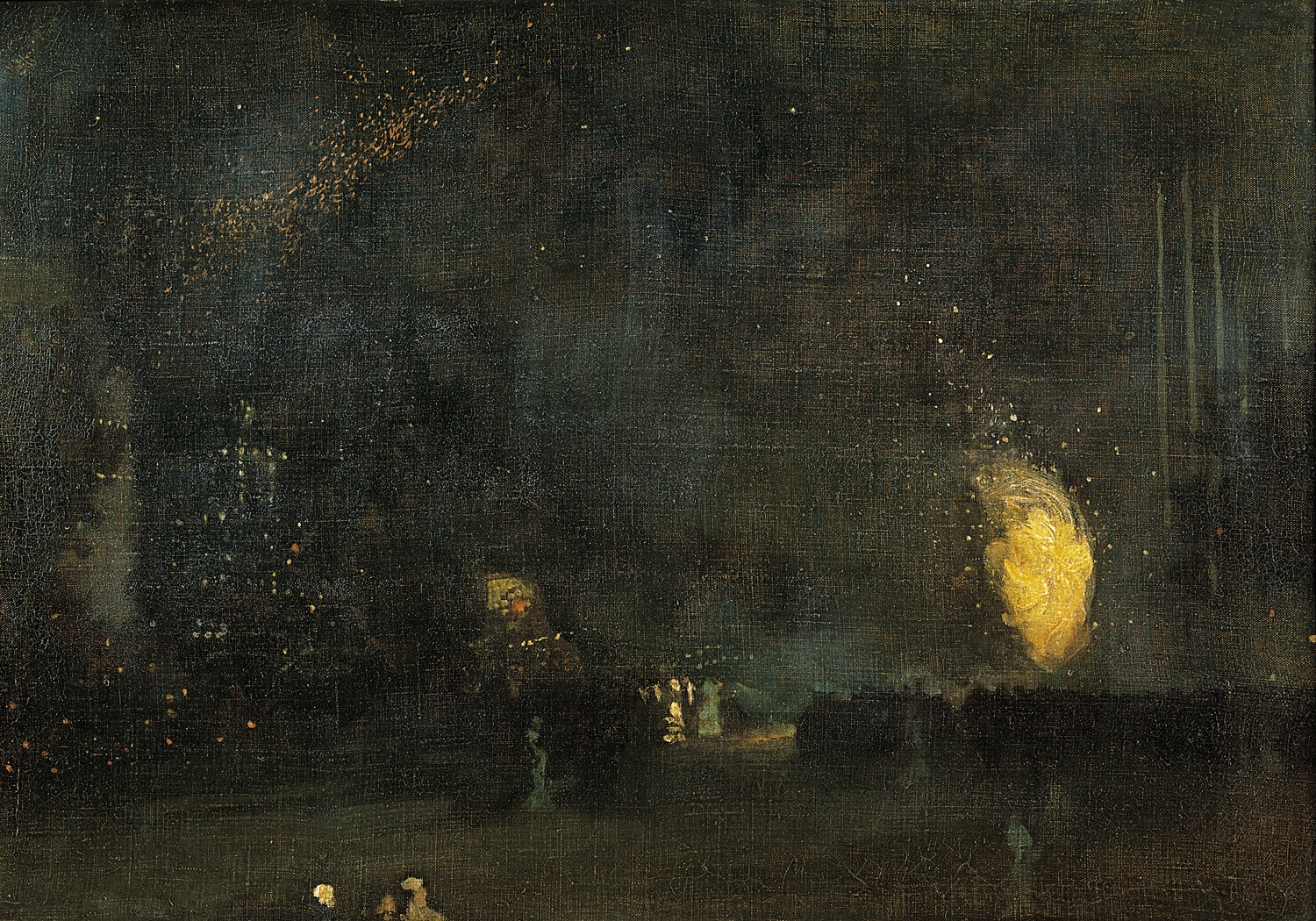
James McNeill Whistler's Nocturne: Black and Gold—The Fire Wheel fixes a rapidly turning firework inside one of the darkest surviving pictures of Victorian entertainment. A broken disc of white, yellow and orange burns at the right. Sparks travel outwards and downwards, a reddish burst hangs higher at the left, and minute spectators gather along the lower edge. The crowd sees a performance; the viewer sees the painted traces by which motion, glare and smoke survive after the explosion has ended.[1][4]
The painting is YMSM 169 and Tate N03419. It is oil paint on canvas, unsigned and uninscribed, and the catalogue raisonné dates it 1875–77. Tate currently uses the single year 1875 and measures the support at 54.3 by 76.2 centimetres. With its later frame, the object measures 84 by 106.8 by 11.9 centimetres.[1][3]
When checked on 26 August 2026, The Fire Wheel was displayed at Tate Britain in the exhibition James McNeill Whistler. The London presentation was scheduled to close on 27 September 2026 before later legs in Amsterdam and Washington. Exhibition locations and future loans can change; N03419 is the stable identifier to consult before visiting.[1][2]
At a Glance
- CatalogueYMSM 169
- Date1875–77
- SupportOil paint on fine, unprimed canvas
- Dimensions54.3 × 76.2 cm; framed 84 × 106.8 × 11.9 cm
- SignatureUnsigned and uninscribed
- SubjectCatherine-wheel fireworks at Cremorne Gardens
- Preferred titleNocturne: Black and Gold—The Fire Wheel
- FrameFrederick Henry Grau frame, 1892; Tate modification, 1919
- CollectionTate, N03419
- DisplayTate Britain exhibition on 26 August 2026; verify current status
Contents
- Which Whistler firework painting is this?
- A title assembled over time
- Why the date is 1875–77
- First encounter with the dark canvas
- The rotating Catherine wheel
- A performance of more than sight
- Cremorne as an entertainment machine
- Black and gold are relationships, not a recipe
- Carefully painted sparks
- What X-rays reveal—and cannot reveal
Which Whistler firework painting is this?
The large circular set-piece is the decisive clue. This is the horizontal canvas Whistler called the one with the great Catherine wheel in an 1882 letter. In the same request he separately named an upright picture with a falling rocket. Those descriptions establish that The Fire Wheel and Nocturne in Black and Gold: The Falling Rocket are two objects, not alternative names for one painting.[4][6][9]
Their later fame has repeatedly collapsed that boundary. The Detroit painting, YMSM 170, supplied John Ruskin's notorious criticism and Whistler's courtroom evidence about work completed over two days. Tate's N03419 did not. The distinction matters because an error at the title level migrates into accounts of price, labour, exhibition and technique.[6][16]
Nor is this another view across the Thames. Nocturne: Blue and Silver—Cremorne Lights reduces the resort to distant lamps beyond water, while Cremorne Gardens, No. 2 spreads figures across a broad piazza. Here the spectator stands inside the pleasure ground, facing a pyrotechnic apparatus that fills the right half of the composition.[3][4]
A title assembled over time
Whistler did not begin with one fixed museum title. In 1882 he used a descriptive phrase, the long picture with the great Catherine wheel. The Grosvenor Gallery showed it in 1883 as Nocturne in Black and Gold—The Great Fire Wheel. Brussels listed it in 1888 in French as No. 2 and a remembrance of Cremorne. Other exhibitions translated, shortened or reordered the words.[4][6][17]
By the late 1880s Whistler commonly called it The Firewheel or Nocturne in Black & Gold—The Fire-wheel. The Goupil exhibition of 1892 separated the musical colour structure from the identifying subtitle. French catalogues used roue de feu; Stockholm later used the more general Fyrverkeri, or fireworks.[4][6]
The preferred form preserves both halves of that history. `Nocturne: Black and Gold` names an arrangement of darkness and illumination, while `The Fire Wheel` identifies the particular event. Modern punctuation varies between a hyphen and a longer dash, but YMSM 169 and Tate N03419 remain the controlling identities.[1][4]
Why the date is 1875–77
Whistler wrote to Frances Leyland in late summer 1875 that another pair of nocturnes hung on his walls and might win even her approval. In September, Anna Matilda Whistler told relatives that her son's moonlight pictures included a recently completed view of Cremorne Gardens. These are valuable contemporary signs of a concentrated campaign around night subjects.[3][8]
Neither letter describes a wheel, fountain, dimensions or orientation. The unnamed Cremorne canvas could have been another of several related paintings. Assigning either sentence directly to N03419 would give attractive precision without documentary support.[3][8]
The evidence therefore supports a range. The work belongs to the middle-1870s Cremorne group, and the operating gardens closed in 1877. YMSM's 1875–77 date states what can be defended; Tate's 1875 label gives a narrower public convention. The records are compatible so long as the single year is not treated as a documented day or session.[1][3][15]
First encounter with the dark canvas
The picture does not surrender all of its forms at once. At first the Catherine wheel seems to float in a brown-black field. Its bright centre sits to the right of the vertical midpoint, and incomplete curves sweep around it. Small strokes peel from the circumference as if centrifugal force had flung them into the garden.[1][4]
The left is quieter but not empty. A dim fountain is plotted with pale dots. Higher up, an orange-red cluster and a thin rising passage suggest another rocket or firework at a different stage. Dark foliage occupies much of the upper zone, while a tall structure or garden building emerges near the display.[4][5]
Along the bottom, blue-white and warm-coloured marks accumulate into heads, shoulders and dresses. Some figures form a compact audience beneath the wheel; others stand further left. Their backs and profiles direct attention into the scene. They are not staffage added to prove scale after the fact: the direction of their looking helps turn a circular pigment pattern into a public spectacle.[4][14]
The rotating Catherine wheel
A Catherine wheel is fixed to an upright support and spins as angled jets expel burning material. Unlike a rocket, it does not describe one trajectory across the sky. Its body remains anchored while luminous force repeats around a centre. Whistler's broken rings convey that paradox of stability and speed.[4][14]
The wheel is not drawn as a mechanically complete circle. Short bars, hooks and deposits imply successive positions. Gaps prevent the luminous mass from becoming a solid sun. Because the dark ground shows between strokes, the eye supplies rotation across intervals where no paint records flame.[5][12]
The most intense lights are not uniform. Pure pale accents coexist with yellow glaze, orange and red. Some marks radiate; others fall away as spent particles. This differentiation resists the idea that Whistler merely sprinkled decoration on a dark surface. The wheel has centre, direction, scatter and depth even though its structure remains radically abbreviated.[5][12][13]
A performance of more than sight
Victorian fireworks arrived with reports, hisses, spinning noise, sulphurous smoke and a crowd's collective response. Painting cannot reproduce those sounds or smells. It can, however, arrange visual triggers that prompt remembered sensations: figures lean towards the action, sparks seem to travel, and the central darkness reads as smoke partly because light disappears inside it.[14]
Kate Flint argues that nineteenth-century firework spectators brought extensive cultural knowledge to such images. Public displays appeared in pleasure gardens, celebrations, illustrated papers, fiction and technical accounts. Viewers knew that a still fleck stood for something bright, moving and short-lived. Their experience completed what a fixed surface could not enact.[14]
Flint's principal painting is The Falling Rocket, so her trial and exhibition analysis cannot be moved to N03419. Her wider account remains useful here: spectacle is neither pure optical abstraction nor a subject exhausted by naming the device. It joins material technology to individual memory and mass spectatorship.[14][16]
Cremorne as an entertainment machine
Cremorne Gardens occupied a Thames-side site in Chelsea within walking and river reach of Whistler's home. Its landscaped walks and lawns were combined with refreshment rooms, dancing platforms, music, theatrical entertainments, balloon ascents and pyrotechnic displays. Nature and commerce were designed to operate together after dark.[15]
Fireworks were not incidental points in a quiet garden. They were advertised, prepared and released at a particular time, gathering visitors into shared orientation. The crowd in The Fire Wheel faces a temporary event built by workers using combustible materials and a fixed launching structure. The nocturne transforms that infrastructure without erasing it.[14][15]
The resort attracted different audiences at different hours. River access widened its metropolitan reach, while late-night drinking and sexual commerce contributed to a contested reputation. Local complaints about noise, disorder and rowdiness became part of a sustained campaign before the gardens shut in 1877.[1][15]
Tate's older gallery label says Whistler's nocturnes convey Thames tranquillity far removed from the busy waterfront. That contrast catches one effect of tonal reduction, but it is incomplete for this picture. A spinning wheel, smoke and gathered spectators make tranquillity unstable. The painting quietens a noisy event; it does not prove that the event itself was quiet.[1][14]
Black and gold are relationships, not a recipe
The title directs attention to the distribution of values. `Black` is not one flat pigment filling every interval. Olive, brown, deep blue and grey passages build a darkness whose temperature changes around the fountain, crowd and trees. `Gold` gathers several warm materials into the perceptual category of fire.[5][13]
Whistler's musical terminology allows subject and colour to coexist. The wheel remains recognisable, yet it does not dominate through drawn contour alone. Its brightness depends on how rarely pale paint is used elsewhere. A small mark can carry disproportionate force because the surrounding field withholds light.[4][12]
This economy also regulates narrative. The picture tells us that people watched a display but does not identify a named evening, operator or visitor. Black and gold organise what remains visible; they do not encode a secret allegory. The nocturne's restraint should not be answered by invented symbolism.[3][4]
Carefully painted sparks
An older technical account said the cascades were deliberately dripped onto the surface. Close study corrects that summary. Most dots were placed neatly and individually with a brush. Marc Simpson observes that their position establishes the direction and focus of each burst, making scatter recede or project rather than forming an accidental spray.[5][12]
The correction changes how speed is understood. Whistler may have used fluid paint and rapid gestures, but the visible event is structured through numerous decisions. One fleck begins a curve, another thickens the wheel, and a third detaches into darkness. The appearance of spontaneity was made through controlled placement.[5][12]
That evidence also blocks a popular myth. The painter did not need to imitate an explosion by throwing paint. Material procedure and represented action are different things. A brush can register energy precisely because it interrupts the surface at selected points.[5][13]
What X-rays reveal—and cannot reveal
X-radiography found no earlier composition beneath the nocturne and no sign that Whistler reused a previously painted canvas. Raking light likewise disclosed no large change of arrangement. The essential wheel, audience and enclosure were not laid over a recognisable abandoned subject.[5][13]
The X-ray nevertheless indicates more rockets and sparks than a viewer can now distinguish. Their disappearance has no single proved cause. Whistler might have suppressed some marks; past varnish removal may have disturbed extremely thin paint; or layers of altered resin may now swamp them optically.[5][13]
That uncertainty is productive only if it remains explicit. Imaging proves the presence of information that present viewing cannot recover, but it does not identify the responsible treatment or reconstruct exact colours. Technical evidence sets a boundary around speculation rather than granting a perfect view of the first state.[5][13]
A fine canvas rubbed almost bare
Microscopic examination shows a very fine weave whose thread tops are exposed across much of the picture. Whistler rubbed the support down to an exceptional degree. The abrasion was part of making the surface, not simply later damage, although it increased the object's vulnerability to subsequent treatment.[5][13]
The canvas appears not to have received a commercial priming. It was probably sized, after which Whistler applied a warm dark-grey imprimatura. Analysis identifies lead white, bone black and cadmium yellow in that layer.[5][13]
This foundation enabled light touches to emerge without thick modelling. It also established a long-term optical problem. As upper paint becomes more transparent with age, the darker preparation exerts greater influence. A passage once distinct can sink towards the ground even when no pigment has physically fallen away.[5][13]
Pigments inside the night
The apparently restricted surface contains a broad palette. Examination has found vermilion, red ochre, natural ultramarine, cobalt or cerulean blue, raw umber and ivory black. Blue glazes and dull olive-green runs remain visible under magnification even where their original representational role is difficult to determine.[5][13]
The fire wheel includes pure white that can now be mistaken for yellow ochre. Intense chrome-yellow glaze, probable chrome orange and an organic red built the heated colour. Elsewhere Whistler also used vermilion, chrome yellow, chrome orange and Prussian blue.[5][13]
Some fireworks that currently appear red were orange when applied. The organic red is the identified component most susceptible to fading from light. The resulting change is not merely a general yellow cast: relations among red, orange, white and the dark field have shifted selectively.[5][13]
Townsend characterises this palette as less tightly controlled than those of some other nocturnes and cautions that not every colour may have been recognised. That conclusion is more revealing than a neat `sauce` recipe. It shows a painter adapting materials to a difficult artificial-light subject while leaving a surface too thin for easy later intervention.[5][13]
The 1893 watercolour as evidence
On 20 April 1893 Whistler made a small watercolour after the oil. The Hunterian work, M.1359 or GLAHA 46175, measures only 9.5 by 15.5 centimetres. An inscription on the reverse identifies it as copied from the original Fire Wheel.[11]
The copy renders forms now difficult to retrieve in N03419, particularly the fountain and pyrotechnic activity. A photograph made for the 1892 Goupil album supports the comparison. Together they show that the oil once separated lights and dark structures more strongly than it does today.[5][11]
Neither record is a colour-calibration chart. Watercolour changes medium, scale and handling, while the monochrome photograph translates hue into tone. Their value lies in convergence: two near-contemporary records made before later lining and varnish changes preserve more legible organisation.[5][11]
An uncertain treatment in 1892
Preparing for his Goupil exhibition, Whistler wrote to the restorer Stephen Richards about a large Cremorne nocturne. He had wanted it cleaned, stripped of varnish and returned unvarnished so that he could work on the surface. On first inspection he doubted that Richards had done anything.[5][10]
The letter is unusually revealing about authorship after first completion. Whistler treated varnish removal as a possible prelude to more painting years after the 1870s. Yet the document does not establish whether Richards removed a coating, cleaned the surface only or left it untouched.[5][10]
The possibility of renewed work should therefore not become a claim that N03419 was substantially repainted in 1892. X-ray and raking-light examination reveal no recognisable compositional revision. Documentary intention and physical proof must remain separate.[5][10][13]
Cloudy varnish after America
The painting crossed the Atlantic twice during Edgar G. Kennedy's unsuccessful effort to sell it in America. By its return in 1896, Whistler described the varnish as chilled, sunken and patchy, with parts of the background difficult to see. `Chilled` meant cloudy rather than automatically amber with age.[5][10][13]
Whistler washed surface dirt from the coating and asked Richards to rub it gently with chamois before applying a thin layer of his best varnish. A later letter reports that the old, perished coating was removed under the artist's supervision and a new one added.[5][10]
Whistler celebrated the recovered brilliance and enamel-like surface. His response documents the finish he valued, but it is not a modern conservation report. He was promoting a favourite picture, reassuring its new owner and narrating a successful sale. The physical record confirms intervention while requiring more caution about perfect recovery.[5][10][13]
Lining, browning and yellow resin
Further treatment probably occurred at Maison Chapuis in Paris in 1900. At some later point before Tate's 1959 work, the canvas was trimmed, attached to a new support with glue paste and fitted to another stretcher. A surviving Parisian trade label records the structural intervention.[5][10][13]
The lining compound travelled through the heavily rubbed weave into the paint structure. Heat used during the procedure has caused the oil medium to become browner. In 1959 Tate removed surface dirt from an existing natural-resin varnish and applied another coating of mastic.[5][13]
Regular exposure has severely yellowed both resin layers, and fine haze cracks now cross them. The current darkness therefore has several interacting sources: original dark preparation, increasingly transparent upper paint, absorbed lining adhesive, heat-browned medium, possible fading and altered varnish.[5][13]
No treatment has been undertaken since 1959. Removing yellow resin would not reverse the dark underlayer or browned paint medium, and Whistler's extensive rubbing makes it difficult to separate coating from fragile paint. Conservation restraint acknowledges how easily an attempt to reveal more could remove what remains.[5][13]
The 1892 Grau frame
The frame known from the 1883 Grosvenor exhibition has not been identified. The present surround was made in 1892 by Frederick Henry Grau as Whistler prepared the Goupil display. It is pine covered with oil-gilded gold leaf.[4][5]
Whistler instructed that his pictures should arrive properly framed and glazed. The luminous perimeter was therefore part of the work's later presentation under his direction, although it cannot be projected backwards to its first public showing.[4][10]
After Tate acquired the painting in 1919, the frame was altered into a removable glazing door. Thumbscrews bearing N03419 allowed the glass and picture to come away while the frame stayed on the wall. Regilding and later surface deterioration add an institutional history to an artist-selected structure.[1][5]
The two nocturnes held by Graves
In September 1878 two Cremorne nocturnes and other works were deposited with Henry Graves & Co. as security for a loan of £85. Account and correspondence evidence identify the pair as The Fire Wheel and The Falling Rocket. They remained distinct assets even while shorthand references made their later histories difficult to separate.[6][9]
A Graves letter in 1881 unexpectedly mentions getting back three nocturnes. No surviving explanation reconciles that number with the two usually named. The anomaly should be preserved rather than solved by attaching an unidentified picture.[6][9]
In 1882 Whistler asked to borrow the upright falling rocket and the long Catherine wheel for a studio display. Graves agreed to release works under conditions tied to debt and possible sale. In April 1883 Whistler paid £50 towards recovering the pair, leaving £35 and £9 18s 4d interest outstanding.[6][9]
The arrangement explains both mobility and confusion. A painting could appear publicly while still securing a private loan. Exhibition was also a sales opportunity that might release Whistler from the balance.[6][9]
From £400 to 1,500 guineas
In 1889 Whistler proposed that Graves sell the Fire Wheel for £400, deduct ten per cent commission and clear the remaining debt. Interest was still listed at the end of 1890, although the account was probably settled soon afterwards. Goupil handled both firework pictures by 1891 and explored a £300 sale that Whistler resisted.[6][9]
His ambitions rose rapidly. He suggested 800 guineas for Bertha Palmer, then told the dealer Max Williams in 1892 that he required 1,500 guineas. The escalation was part confidence, part scarcity and part performance: Whistler presented a once-ridiculed nocturne as an appreciating asset.[6][16]
Williams did not secure the sale. Kennedy later carried the picture to America, also without finding a buyer. Alexander Reid was prepared to offer only about half a requested 1,000 guineas. The famous asking prices document strategy, not completed transactions.[6]
Arthur Haythorne Studd ultimately bought the returned and treated picture in 1896 for 1,000 guineas. The coincidence of restored visibility and sale allowed Whistler to narrate an immediate market triumph, though the previous failures show how long the price had been tested.[5][6][10]
Did this painting provoke Ruskin?
No. While negotiating with Max Williams, Whistler claimed that The Fire Wheel was among the works that especially angered John Ruskin and led to the libel trial. YMSM correctly calls the claim untrue. Ruskin's attack concerned The Falling Rocket, the Detroit canvas.[6][16]
The misstatement was commercially useful. It transferred the notoriety of the trial to a closely related work Whistler wanted to sell for a spectacular sum. Because both pictures represented Cremorne fireworks and had been held together by Graves, the substitution could sound plausible.[6][9][16]
The same boundary governs the famous labour exchange. Whistler testified that the relevant nocturne could be executed across two days and that the price represented knowledge accumulated over a lifetime. That testimony must not be quoted as the making time for Tate N03419.[14][16]
A current Tate Shop description nevertheless says The Fire Wheel was painted in two days. The retail statement conflicts with the trial record and object-specific catalogue. It is a useful example of how an anecdote can cross from one image to another even within material attached to the holding institution.[16][18]
First exhibition at the Grosvenor Gallery
No exhibition has been located before 1883, when the Grosvenor Gallery showed the canvas under its Great Fire Wheel title. Reviewers did not agree about what they saw. One comparison likened it to a Crystal Palace firework on the point of extinction in blackness; another dismissed it as outright nonsense.[6][17]
Such responses register more than conservative incomprehension. The painting asked viewers to identify a spectacular subject while offering unusually little continuous description. Its present darkening was less advanced, but critics already encountered abbreviated lights and an expansive night field.[5][6]
The Pall Mall Gazette responded with facetious caution, conscious of Whistler's combative relationship with criticism. Public persona had become part of viewing. A writer could not discuss the dark canvas without anticipating the artist's reply.[6][17]
Brussels, Paris and divided recognition
An Edinburgh `Nocturne` in 1886 and a Paris picture in 1887 may have been either of the Graves firework canvases. Their identities remain uncertain. Brussels in 1888 is secure enough because the catalogue title, Whistler's hanging sketch and associated correspondence converge on The Fire Wheel as the No. 2 Cremorne souvenir.[6][17]
Munich valued the picture at £500 later in 1888. It travelled to Wunderlich's New York exhibition in 1889 but remained unsold at 350 guineas. In Paris in 1890, a jury reportedly rejected Whistler's anonymously submitted `studio sketches`, then reversed itself when his name became known. Because the episode survives through reports, it should remain attributed rather than narrated as a documented ballot.[6][17]
Gustave Geffroy offered a more attentive response. He described luminous rain, a greenish ground and light entering a night that nevertheless retained its authority. His language acknowledges representation and tonal structure together: sparks clarify the field but do not convert it into daylight.[6][17]
The Goupil photograph and failed typography
The Goupil Gallery displayed The Fire Wheel in London in 1892, and the picture was sent urgently to Paris when Alfred Chapman refused to lend Chelsea Snow. Whistler considered both firework nocturnes proof that his apparently summary works were complete.[6][17]
A Paris firm doubted that The Fire Wheel would yield anything in typographic reproduction. That judgement makes sense: coarse translation could merge tiny sparks into noise or close the dark intervals entirely. Yet Goupil produced a successful photograph for its London album.[5][6]
The difference exposes a continuing problem. Reproduction is not neutral transmission. Contrast, scale and process decide whether the fountain appears, whether the audience separates from the ground and whether scattered marks remain spatially ordered. The 1892 photograph now serves conservation history because it preserved those relations before later structural treatment.[5]
Stockholm and the adapting eye
The painting was almost certainly shown in Stockholm in 1897 as Fyrverkeri. One observer wrote that the scene first seemed impenetrably dark but disclosed a deep blue sky, a city and many moving spectators after the eye adjusted. Other responses called the colour bizarre or admitted attraction without comprehension.[6][17]
These accounts should not be averaged into a verdict. They record different durations of looking and different expectations of finish. The favourable description is especially relevant today because altered resin and paint make adaptation still more necessary than it was in 1897.[5][6]
Later memorial displays in Boston in 1904 and Paris in 1905 consolidated the canvas within Whistler's career. Photographs of the Boston installation also preserve the Grau frame as an exhibition object, not merely a protective edge.[5][6][7]
Arthur Studd's bequest and Tate's stewardship
Studd kept the painting after buying it in 1896 and accepted Whistler's direct involvement in its care. A later story claimed that Charles Lang Freer offered an immense sum for three Studd paintings, but its retrospective source requires caution. What is certain is that Studd did not sell N03419.[6]
His 1919 bequest placed it in the National Gallery. The canvas transferred to Tate in 1949, where the accession number and altered frame record its institutional life. Tate treated it in 1959 but has since judged further intervention too hazardous and too limited in likely benefit.[1][5][13]
That restraint complicates the desire to see an `original` Whistler. The current object contains his rubbed support and carefully placed colour, but also his own supervised varnishing, later Parisian lining, Tate coating and decades of light exposure. Its history is inseparable from its material appearance.[5][10][13]
The painting at Tate today
Tate's live record supplies the current support and frame measurements, the Studd credit and the mutable display location. Its February 2010 label remains accessible but should not be mistaken for a newly researched conservation account. The catalogue raisonné and Townsend examination provide the more precise date and technical history.[1][3][5]
Tate's public API exposes a 1,536 by 1,073-pixel master image and marks its internal status as cleared. That field verifies the file used for visual research; it does not, by itself, state a public commercial licence. Anyone preparing a publication should consult Tate's current image terms rather than infer permission from metadata.[1]
At the dated 2026 check, the painting's presence in the Whistler exhibition made direct comparison with other nocturnes possible. Later tour schedules may move the object abroad. Visitors should search accession N03419 shortly before travel.[1][2]
Why The Fire Wheel matters
This painting converts a popular technological entertainment into an argument about duration. The Catherine wheel spins, its sparks expire and the crowd's encounter passes. Whistler builds those events from fixed marks whose intervals prompt the eye to supply rotation. The nocturne is representational because its abstraction is exact enough to produce a particular machine in action.[4][12][14]
Its condition adds another timescale. Colours have faded selectively, paint has grown transparent, lining has browned the medium and resin has yellowed. The 1892 photograph and 1893 watercolour show a more legible arrangement, yet the present canvas cannot be returned to that state without unacceptable uncertainty and risk.[5][11][13]
Its documentary history exposes a parallel instability. Whistler changed titles, borrowed the picture from a creditor, raised its price, attached another canvas's scandal to it and supervised its surface. Later writers transferred the two-day anecdote back again. Close identification is therefore not clerical work around the painting; it is the means by which its visual, material and commercial histories remain intelligible.[6][9][16]
Frequently Asked Questions
Several causes overlap: Whistler's dark imprimatura, increasing transparency of thin upper paint, absorbed lining adhesive, heat-browned medium, possible fading and two yellowed natural-resin varnishes. Removing varnish would not reverse all of those changes and could endanger the abraded paint.[5][13]
Do not assume so from the API. Tate marks the master image `CLEARED`, but that operational field is not a public commercial licence. Check Tate's current terms or obtain the necessary permission for the intended use.[1]
Discussion
How does Whistler make a rotating firework emerge from darkness without turning it into a diagram?
Follow the wheel's broken rings, deliberately placed sparks, dim fountain and spectators, then compare those visible accents with the rubbed canvas, dark imprimatura, increasing transparency and yellowed varnishes.
Reader Insights
How do gaps between bright strokes make the fixed wheel appear to rotate?
How do the small spectators turn paint marks into a timed public event?
Which parts of the darkness belong to Whistler's design, and which may reflect later material change?
Join the Conversation
Share a close observation or an object-history question.
References
- Tate, “Nocturne: Black and Gold—The Fire Wheel,” N03419, live object page and public API page 46206, accessed 26 August 2026, https://www.tate.org.uk/art/artworks/whistler-nocturne-black-and-gold-the-fire-wheel-n03419 and https://www.tate.org.uk/api/v2/pages/46206/.
- Tate, “James McNeill Whistler,” exhibition and touring metadata, accessed 26 August 2026, https://www.tate.org.uk/whats-on/tate-britain/james-mcneill-whistler.
- Margaret F. MacDonald and Grischka Petri, “Nocturne: Black and Gold—The Fire Wheel (YMSM 169): Date,” James McNeill Whistler: The Paintings, a Catalogue Raisonné, University of Glasgow, updated 20 May 2021, https://www.whistlerpaintings.gla.ac.uk/catalogue/display/?mid=y169.
- MacDonald and Petri, “Nocturne: Black and Gold—The Fire Wheel (YMSM 169): Subject and Titles,” University of Glasgow, updated 20 May 2021, https://www.whistlerpaintings.gla.ac.uk/catalogue/display/?mid=y169&xml=sub.
- MacDonald and Petri, “Nocturne: Black and Gold—The Fire Wheel (YMSM 169): Technical Description,” University of Glasgow, updated 20 May 2021, https://www.whistlerpaintings.gla.ac.uk/catalogue/display/?mid=y169&xml=tec.
- MacDonald and Petri, “Nocturne: Black and Gold—The Fire Wheel (YMSM 169): History,” University of Glasgow, updated 20 May 2021, https://www.whistlerpaintings.gla.ac.uk/catalogue/display/?mid=y169&xml=his.
- MacDonald and Petri, “Nocturne: Black and Gold—The Fire Wheel (YMSM 169): Bibliography,” University of Glasgow, updated 20 May 2021, https://www.whistlerpaintings.gla.ac.uk/catalogue/display/?mid=y169&xml=bib.
- James McNeill Whistler to Frances Leyland, 20 August/4 September 1875, GUW 08052; Anna Matilda Whistler to James H. and Harriet Gamble, 9–20 September 1875, GUW 06555, The Correspondence of James McNeill Whistler, University of Glasgow, https://www.whistler.arts.gla.ac.uk/correspondence/recno/display/?cid=08052 and https://www.whistler.arts.gla.ac.uk/correspondence/recno/display/?cid=06555.
- Whistler–Graves correspondence and accounts, including Whistler to Algernon Graves, 1882 and 2 March 1889, GUW 10774 and 10775, and Graves account, 26 December 1888, GUW 01827, University of Glasgow, https://www.whistler.arts.gla.ac.uk/correspondence/recno/display/?cid=10774, https://www.whistler.arts.gla.ac.uk/correspondence/recno/display/?cid=10775 and https://www.whistler.arts.gla.ac.uk/correspondence/recno/display/?cid=01827.
- Whistler treatment correspondence with Stephen Richards, Arthur Studd and Edgar G. Kennedy, 1892–1900, GUW 08114, 03153, 10722, 03155, 09745 and 05613, University of Glasgow, beginning https://www.whistler.arts.gla.ac.uk/correspondence/recno/display/?cid=08114.
- Margaret F. MacDonald, “Copy of ‘Nocturne: Black and Gold—The Fire Wheel’ (M.1359),” James McNeill Whistler: Drawings, Pastels and Watercolours, a Catalogue Raisonné, The Hunterian GLAHA 46175, https://www.whistlerpaintings.gla.ac.uk/catalogue/display/?mid=m1359.
- Marc Simpson, “Whistler, Modernism, and the Creative Afflatus,” in Like Breath on Glass: Whistler, Inness, and the Art of Painting Softly (Williamstown, Massachusetts: Sterling and Francine Clark Art Institute, 2008), 24–51, especially 37 and 47–48.
- Joyce H. Townsend, technical examination report on Tate N03419, September 2017, Whistler Paintings Project files, substantial extracts and summary published in reference 5.
- Kate Flint, “Fireworks,” 19: Interdisciplinary Studies in the Long Nineteenth Century 25 (2017), https://doi.org/10.16995/ntn.797.
- Royal Borough of Kensington and Chelsea, Chelsea Creek historical assessment, and London Museum, “The Waterside Entrance to Cremorne Gardens” and “What Were London's Pleasure Gardens?”, accessed 26 August 2026, https://www.rbkc.gov.uk/sites/default/files/media/documents/LR41%20HTVIA%20Lo%20Res.pdf, https://www.londonmuseum.org.uk/collections/v/object-99256/the-waterside-entrance-to-cremorne-gardens/ and https://www.londonmuseum.org.uk/collections/london-stories/what-were-londons-pleasure-gardens/.
- James McNeill Whistler to Max Williams, July 1892, GUW 08162; Linda Merrill, A Pot of Paint: Aesthetics on Trial in Whistler v. Ruskin (Washington, DC: Smithsonian Institution Press, 1992), especially the trial transcript, https://www.whistler.arts.gla.ac.uk/correspondence/recno/display/?cid=08162.
- Grosvenor Gallery (1883), Les XX (1888), Wunderlich (1889) and Goupil (1892) catalogues and contemporary criticism, transcribed and documented in references 6 and 7.
- Tate Shop, “James McNeill Whistler: Nocturne: Black and Gold—The Fire Wheel,” current retail description, accessed 26 August 2026, https://shop.tate.org.uk/james-mcneill-whistler-nocturne-black-and-gold---the-fire-wheel/whiwhi2606.html.


