


 by Tom Gurney
Tom Gurney BSc (Hons) is an art history expert with over 20 years experience
Published on June 19, 2020 / Updated on November 6, 2026
Email: tomgurney1@gmail.com / Phone: +44 7429 011000
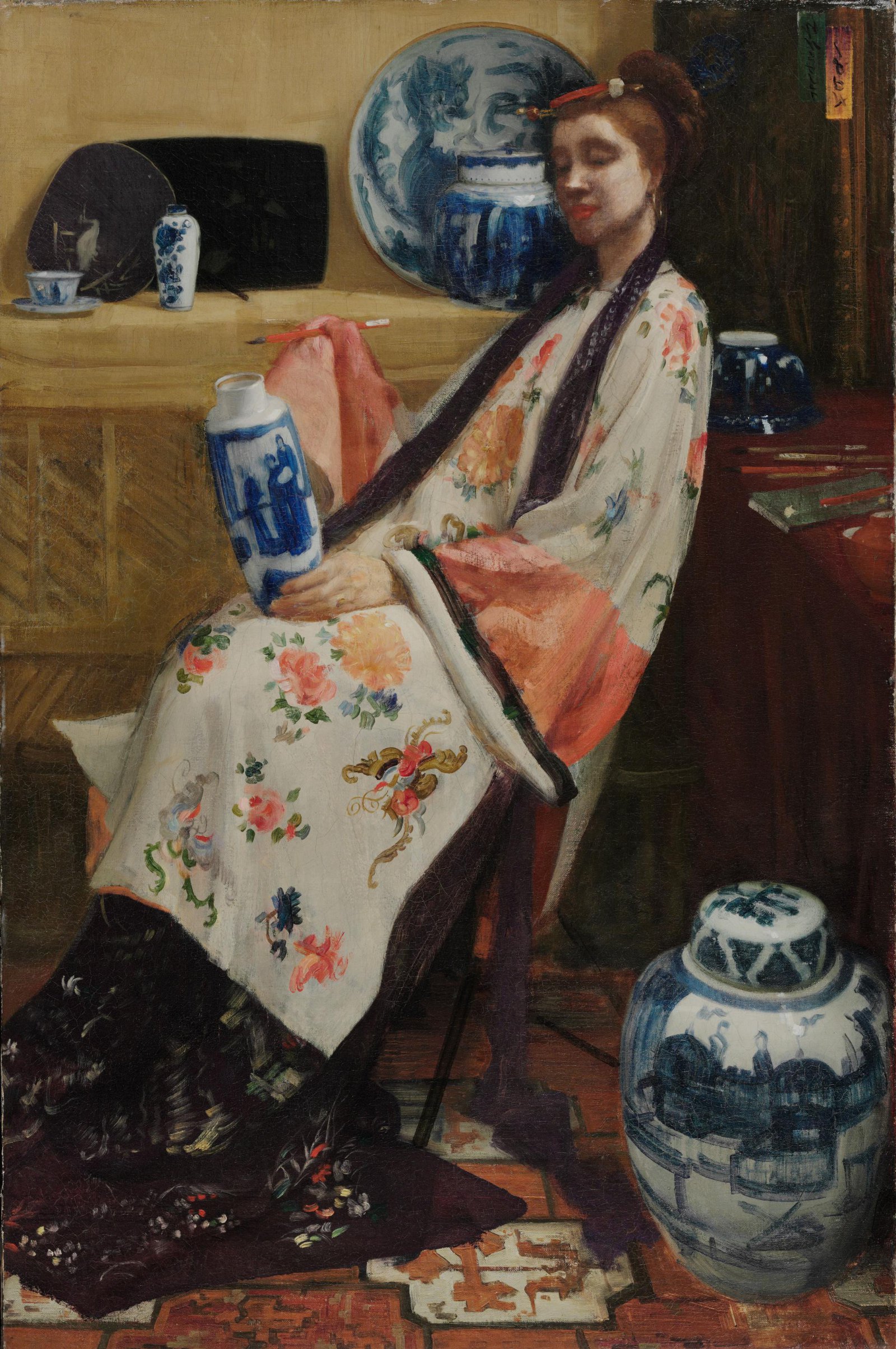
James McNeill Whistler's Purple and Rose: The Lange Leizen of the Six Marks is an oil painting on canvas, perhaps begun late in 1863 and signed and dated 1864. It is YMSM 047 and belongs to the Philadelphia Museum of Art's John G. Johnson Collection, catalogue number 1112 and web object 101800. Joanna Hiffernan sits in a richly coloured robe, painting a tall porcelain jar balanced on her lap. Around her, Whistler arranged ceramics, textiles, a fan, lacquer and furniture from several cultural traditions into an exacting London studio picture.[1][2][5][6]
Its unusual title is a key rather than a riddle. Lange lijzen is Dutch collecting vocabulary for the elongated women represented on Chinese blue-and-white porcelain—“long ladies” or “long Elizas.” The “six marks” refer to a six-character imperial reign inscription of the kind painted beneath porcelain. Whistler moved those characters onto six roundels in his specially designed frame, making the picture's boundary part of its subject.[3][5][14][15]
The woman in front of that frame was not Chinese or Japanese. Hiffernan was Irish-born and Whistler's partner, principal model and studio collaborator. Whistler described the represented character as a Chinese porcelain merchant painting a pot; his mother called the fair-haired model a Japanese study. Their incompatible labels reveal the scene's hybrid European fantasy. Modern viewers can name the historical staging without mistaking it for Hiffernan's identity or documentary East Asian life.[1][8][9][10][11]
At a Glance
- IdentityPurple and Rose: The Lange Leizen of the Six Marks
- CatalogueYMSM 047
- DateMay have begun in 1863; signed 1864
- SitterJoanna Hiffernan
- MediumOil on canvas
- Dimensions93.3 × 61.3 cm
- SignatureWhistler 1864, upper right
- CollectionJohn G. Johnson Collection, Cat. 1112
- Museum recordPhiladelphia Museum of Art object 101800
- Image usePMA educational-use image
Contents
- The painting at a glance
- What does Lange Leizen mean?
- What are the six marks?
- Joanna Hiffernan as model and collaborator
- A staged porcelain painter
- Inside Whistler's drawing room and studio
- Whistler as a collector
- Chinese, Japanese, South Asian and European elements
- The robes and their painted motifs
- Purple, rose and the colour structure
The painting at a glance
The canvas measures 93.3 × 61.3 centimetres, approximately 36 × 24 1/8 inches. It is vertical but not life-size. Hiffernan is seated facing left, absorbed in applying decoration to a tall vase on her lap. Shelves, a chair or sofa, rugs, fabric, small vessels and a second large jar build a dense interior around her. The upper-right “Whistler 1864” signature sits within a rectangular painted cartouche.[1][2][3][6]
The Royal Academy first exhibited the work in 1864 as Die Lange Lizen—of the Six Marks, catalogue 593. The preferred modern title reverses the hierarchy: Purple and Rose states the chromatic arrangement first, while the porcelain-derived phrase follows as a subtitle. That order encourages two kinds of attention. The viewer decodes the figure and objects, then notices how their local colours are joined into a purple-and-rose structure.[1][2][4][13]
This is not La Princesse du pays de la porcelaine, YMSM 050, a different Whistler painting now associated with the Peacock Room. The two works share a 1860s engagement with Asian art and female costume, but have separate sitters, designs, ownership histories and museum identities. The dedicated discussion here concerns YMSM 047 alone.[1][18]
What does Lange Leizen mean?
“Lange Leizen” is one spelling in a family of Dutch terms that includes lange lijzen. Museums translate it as “long ladies” or “long Elizas.” European dealers and collectors used it for a category of Chinese porcelain decorated with slender women in long robes. The words did not originate as the personal name of one Chinese woman, and they do not title Hiffernan herself.[5][14]
Comparable Kangxi-period dishes and bowls in the Rijksmuseum show women in fenced gardens or interiors, sometimes with flowers, boys, fans or low tables. The figures are painted in underglaze cobalt blue and organised around the vessel's curved surface. A six-character Kangxi mark may appear beneath the object inside a double circle. Such comparisons clarify Whistler's title without proving that any one surviving Rijksmuseum piece was in his collection.[14]
The vocabulary also exposes the routes by which Chinese art reached Whistler. A Dutch trade term travelled with Chinese export porcelain into British collecting and then into the title of a painting by an American in London. This chain did not preserve Chinese categories intact. It produced new commercial names, spellings and associations. The title is therefore a small history of cross-cultural circulation as well as a descriptive label.[5][14]
What are the six marks?
The “six marks” are six written characters, not six fingerprints, brush dabs or signatures of individual potters. On Kangxi porcelain they can state that an object was made during the reign of the Kangxi emperor of the Great Qing dynasty. Reign marks link a vessel to an imperial era, although later objects can also use earlier marks; the presence of a mark is not by itself a complete authentication.[3][14]
Whistler's frame carries one character in each of six incised roundels. Four roundels sit at the corners and two at the vertical midpoints. Glasgow records the translated sequence as Great, Qing, Kang on the right and Xi, year, made on the left, yielding a Kangxi reign statement when read in the intended order. By relocating the inscription from a vessel's concealed base to a conspicuous gilt border, Whistler turns connoisseurial knowledge into ornament.[3][15]
The move is clever but not archaeologically neutral. A Chinese reign mark normally belongs to the ceramic object and participates in its production history. On Whistler's frame the same characters advertise the theme of blue-and-white collecting. They make the entire canvas resemble a prized object offered for inspection. The painted jar, the title and the physical frame become three connected sites where porcelain is invoked.[3][5][15]
Joanna Hiffernan as model and collaborator
Joanna Hiffernan was born in Limerick in 1839 and moved to London with her Irish Catholic family. She met Whistler around 1860 and became his leading model during the early 1860s. Their partnership extended beyond posing. Later documents made her his attorney and sole heir, while exhibition scholarship records her help with studio and financial affairs.[8][9]
In this painting, her labour is doubled. Hiffernan worked as a model in Whistler's studio while representing a woman at work on a ceramic surface. The depicted brush in her hand echoes the painter's own activity without making the two roles identical. Whistler authored the canvas, but her held pose, costume and concentrated handling of the jar were necessary to its construction.[2][8][10]
Anna Whistler's letter makes the sitting unusually tangible. She wrote that the fair model had been posing for about a fortnight and described her as intent on painting a jar. The account comes from a family member proud of her son's picture, so it is not detached observation. Even so, it preserves otherwise lost information about duration, room, objects and repeated revision.[1][10]
A staged porcelain painter
Whistler told Fantin-Latour that the picture represented a porcelain merchant—a Chinese woman painting a pot. Anna instead called the model a Japanese study. The visual setting mixes Chinese porcelain and chair forms with a Japanese fan and cup, embroidered robes, a South Asian rug and European studio furniture. No one cultural label adequately describes the assembled room.[1][2][10][11]
Glasgow's catalogue emphasises that the pose and composition remain conventional European genre painting. Hiffernan sits on a chair rather than adopting a pose derived from Japanese prints. Space is built through overlap, furniture and carefully separated objects. Whistler's novelty lies in the subject inventory, colour and picture-frame integration more than in a wholesale adoption of East Asian pictorial organisation.[3][7]
The merchant role gives the display a loose narrative. Porcelain pieces and a fan appear arranged as if customers might inspect them. Hiffernan decorates another vessel, suggesting production or finishing within an imagined shop. Yet the known objects came from Whistler's domestic collection, and the room was his working and living space. The “shop” is a fiction constructed from a collector's possessions.[10][11]
Inside Whistler's drawing room and studio
Anna Whistler described a room that was more than half studio, even though her son dignified it as their drawing room. It held an easel, a fire and her own regular place for correspondence. Artists visited, handled Chinese and Japanese objects, examined their painted subjects and looked through a Japanese book. Collecting was social activity rather than silent storage.[1][10]
Her inventory maps directly onto the picture. A shelf or sofa was covered in buff Chinese matting, with several pieces of china and a fan arranged like goods for sale. A crimson-covered table held a scarlet cup she identified as Japanese. A large jar stood on the floor, which was covered by a Scinde or Sindh rug of a kind Whistler owned in several examples.[10]
The letter even notices the shadow cast by the fan handle. That small observation corresponds with Anna's explanation of Whistler's slow method: he wanted every element distinctly separated. The painting's abundance therefore should not be confused with casual clutter. Light, shadow, edge and colour distinguish objects while still binding them into a compact pattern.[3][10]
Whistler as a collector
By 1863 Whistler was searching shops and markets in Amsterdam, Rotterdam and Paris as well as London for Asian ceramics, prints, textiles and lacquer. His taste developed within a competitive circle that included Dante Gabriel Rossetti and other artists. International trade, the 1862 London exhibition and dealer networks had made such objects more available, although reliable cultural information did not travel evenly with them.[3][7][8]
The painting documents this collecting without becoming a catalogue. Whistler selected and rearranged things for pictorial reasons. A circular fan interrupts straight furniture edges; porcelain blue answers darker fabric; red and scarlet objects punctuate buff matting. The represented shop lets the collector display abundance, but composition decides what can be seen and how strongly each item registers.[2][3][10]
Claims about the exact size or cost of Whistler's early collection vary in later literature and should not be treated as settled merely because they sound precise. What the February 1864 letters securely establish is ownership of multiple porcelain pieces and other Asian objects, their use in his rooms and their importance to his artist friends. The picture offers visual confirmation at the level of selected types, not a full inventory.[1][10][11]
Chinese, Japanese, South Asian and European elements
The blue-and-white ceramics and the “long ladies” title are Chinese. Glasgow also identifies the chair, robe symbolism and some textiles as Chinese-associated. The circular fan, lacquer tray and scarlet cup were described as Japanese. The floor covering came from Sindh or was known in Britain as a Scinde rug. Hiffernan and the room belonged to Whistler's London life.[2][3][10][14]
Keeping those origins separate corrects the broad Victorian word “Oriental,” which often bundled much of Asia into one decorative category. It does not follow that every object can now be attributed to a precise maker, dynasty or place. The evidence supports different levels of certainty: a category of porcelain, period descriptions of objects and a documented European studio arrangement.[2][7][10]
The scene's hybrid character is not an accidental flaw that can be solved by choosing “Chinese” instead of “Japanese.” Whistler and Anna used both words because their collecting knowledge and the staged costume picture crossed categories. A modern account should expose that process. Hiffernan is not evidence of Chinese daily life; she performs inside a European construction made from globally circulating things.[8][9][10][11]
The robes and their painted motifs
The outer robe is cream silk embroidered with colourful butterflies, bright leaves, peonies, chrysanthemums and buds. Beneath it, a black garment bears finer sprays of flowers among narrow leaves. The motifs belonged to textile traditions that Whistler admired, but their painted function also matters: small light forms break up dark areas while broad rose bands turn sleeve and body into a chromatic mass.[3][7]
The outer garment later appears in Caprice in Purple and Gold: The Golden Screen. Reuse shows that Whistler's costume pictures drew on a finite studio wardrobe. It does not mean the two scenes show the same moment, role or room. In the later panel Hiffernan sits on the floor studying prints; here she sits on furniture and works on porcelain. Each arrangement reorganises the same textile around a different action.[3][7]
Nor is costume a transparent record of how a garment would have been worn in China or Japan. Whistler layered pieces to intensify colour and pattern. Hiffernan's body supplies the structure across which cream, black, rose and white fold. Fashion scholarship helps identify motifs and handling, but the outfit remains a studio assemblage designed for the canvas.[7][8]
Purple, rose and the colour structure
Deep purple in the robe, rose across the sleeve, magenta and orange accents, blue-and-white vessels, black underlayers and buff matting create a saturated but controlled range. William Michael Rossetti thought the painting among the most delightful colour displays at the 1864 Academy. His praise responds to abundance organised without one shrill or isolated note.[3][7][13]
The colour title became standard later, but the arrangement is already central in Whistler's February 1864 letter. He told Fantin-Latour that the canvas was full of superb porcelain from his collection and was good in arrangement and colour. This is self-assessment sent to an artist friend, not independent proof. It nevertheless shows that formal organisation was part of his stated purpose before exhibition criticism.[1][11]
Purple and rose do not cover everything. They describe a governing relation capable of absorbing smaller contrasts. Blue pottery cools the lower and side zones; red objects flare against buff; black sharpens the robe's interior. The viewer can recognise merchandise, flowers and fabric while also experiencing a field held together by repeated hue, edge and weight.[2][3][7]
How Whistler painted the fabrics
The rose sleeve band was laid with broad brushes. Short strokes were scumbled across the canvas grain, allowing a broken texture to suggest fabric catching light. Longer strokes follow folds and changes in direction. Narrow round bristles and fine pointed sable brushes define individual leaves and buds. Technique changes with scale and material instead of following one signature mark.[3][7]
Paint can be thick and vigorous even where the final effect looks polished. This canvas belongs to a phase before Whistler's later reliance on extremely thin mixtures in many nocturnes. A generic account of translucent veils would be wrong here. Rich local colour and substantial handling help the textiles and ceramics maintain their distinct presences.[3][7]
At the same time, “high finish” does not mean photographic description. Embroidery is selected and abbreviated, and colour relations sometimes matter more than exact contour. The work is highly finished relative to much of Whistler's production because separate objects, figure and setting are sustained across a complex scene. Brush variety remains visible within that finish.[3]
Scraping, repainting and slow decisions
Whistler admitted that the picture was difficult and that he scraped a great deal. He told Fantin that on some days he thought he had learned something, only to become discouraged again. The statement counters a legend of effortless decorative taste. Arrangement emerged through doubt, removal and renewal.[3][11]
Anna described the same process in domestic language. Her son was not rapid because his conceptions were exacting; he took elements out and put them over until satisfied. Because her letter was written while the work was nearing completion, it carries more weight for process than a late anecdote. Both sources independently place revision at the heart of the painting.[1][3][10]
No preparatory study is known. A small pencil sketch survives, but Whistler made it around 1887, roughly twenty-three years later, on a list connected with a proposed retrospective. It is a memory aid showing a woman seated left with a tall vase, not an initial design. Treating it as preparatory would reverse the chronology.[3][17]
The original frame as part of the work
Whistler's 1864 frame has a flat Oriental Cassetta profile. A raised outer edge bears an applied cross-hatch pattern associated with lacquer-box decoration. A step leads to a wide frieze cut with whorls and six roundels, followed by an incised astragal at the sight edge. The design turns a gilded border into an extension of depicted ceramics and textiles.[3][15]
Frame historian Sarah Parkerson Day and the Glasgow catalogue place it among Whistler's rare earliest original designs. Joseph Green, a frame maker favoured by Rossetti and Pre-Raphaelite artists, may have constructed it. Whistler designed the scheme, but Glasgow explicitly rejects the idea that he personally carved the ornament. Design authorship and workshop fabrication need to remain separate.[3][15]
The frame is believed to have stayed with the canvas from 1864 and apparently escaped the broad reframing campaign surrounding Whistler's 1892 Goupil retrospective. That continuity is unusually important. The six characters make full sense only when seen around this porcelain subject, and the bands mediate between the painting's dense interior and the physical wall.[3][15][16]
Royal Academy reception in 1864
The Royal Academy displayed The Lange Leizen as catalogue 593 in the same exhibition as Wapping. Reviewers regularly discussed them together. William Michael Rossetti regarded both as among the most satisfying works on view and singled out the porcelain picture's colour. Other writers admired direct brushwork and technical command while finding the figure or particular objects negligent.[4][13]
The Times described unquestionable power accompanied by defiant eccentricity, then complained of slovenly execution and faulty perspective in the large blue-and-white jar. Such terms reveal expectations as much as defects. A critic could accept the colourist and resist the ways Whistler subordinated conventional finish or spatial consistency to the total arrangement.[4][13]
Comic commentary played on the difficult foreign title, joked that the model was a German woman with Chinese sympathies and turned her seated pose into a threatened gymnastic feat. The satire is useful evidence that the cultural vocabulary seemed obscure and the pose unconventional to some viewers. It is not a reliable description of Hiffernan or an objective analysis of balance.[13]
Mixed reception is therefore more informative than a verdict of success or scandal. Praise and mockery identified the same pressure points: colour, hybrid subject, pose, execution and cultural legibility. The work could look finished and careless, technically powerful and spatially strange, depending on what a critic demanded from Royal Academy painting.[4][13]
Exhibitions after the Royal Academy
Ernest Gambart exhibited the painting in London in 1866. By 1887 it belonged to Newcastle collector James Leathart and appeared in the Royal Mining Engineering and Industrial Exhibition there. Whistler's later pencil memory sketch was made during an attempt to identify owners for a Society of British Artists retrospective, a project abandoned after his resignation.[4][17]
The decisive later display was Nocturnes, Marines & Chevalet Pieces at the Goupil Gallery in 1892. Catalogue number 5 appeared as The Lange Leizen—of the Six Marks. Purple and Rose. The retrospective placed an early, densely furnished work beside Whistler's later tonal paintings and helped establish the colour-title order now preferred.[2][4][16]
The work continued to circulate after it moved to Philadelphia, including the Metropolitan Museum of Art's 1910 Whistler exhibition and the Art Institute of Chicago's 1934 Century of Progress display. Those later loans expanded its American reception, while Johnson's municipal bequest secured its long-term public status.[4][6]
The cleaning dispute of 1892
Before Goupil's exhibition, Whistler told Leathart's household that seeing the picture properly cleaned and varnished under his supervision was a priority. He cast the intervention as preservation and care. The painting was treated, but Leathart refused the bill, arguing that he had lent the work as a favour and had not commissioned washing or cleaning.[3][16]
Boussod, Valadon replied that Leathart's telegram appeared to consent to treatment and that the work improved in condition and appearance. This did not resolve the disagreement. It reveals a three-way problem of authority: the artist claimed continuing aesthetic concern, the owner controlled expenditure, and the exhibition organiser arranged work that benefited its show.[3][16]
Whistler later remembered the picture as arriving filthy through Leathart's neglect and resented the collector's profit. His quoted recollection also changed the price he said Leathart had paid. The Pennells went in the opposite direction in 1921, calling the canvas a wreck whose surface had been scrubbed away. Glasgow rejects that literal account as exaggerated.[3][16]
The safest conclusion is neither that the surface remained untouched nor that restoration destroyed it. Cleaning and varnishing occurred under Whistler's supervision in 1892, payment was disputed, and later witnesses amplified the episode for reputational reasons. Present appearance has a treatment history, but the surviving painting still supports close technical analysis.[3][16]
From Gambart to Leathart
The earliest ownership is uncertain. Dante Gabriel Rossetti wrote in December 1863 that Gambart had bought an unfinished “Chinese” picture, which may be this work. George du Maurier heard that Gambart had bought Whistler's nearly completed Chinese woman for £100, while Anna mentioned 100 guineas without the separately priced frame. These reports do not constitute one settled receipt.[1][10][12]
The painting passed to James Leathart during the 1860s, perhaps from Whistler or through Gambart. Whistler later claimed that Leathart had paid him only £80 or £60. His changing numbers appeared in a resentful 1894 letter written after Leathart refused the cleaning charge and sold at a profit. Earlier and later figures should therefore remain attributed, not averaged into false precision.[4][12][16]
Leathart was a major Newcastle collector who owned Whistler as well as Pre-Raphaelite and other modern British works. His loan to the local 1887 exhibition and response to Goupil show that ownership carried both civic display and financial negotiation. The artist could seek access to “his” picture, but the collector could resist expenses attached to that access.[4][16][17]
John G. Johnson and Philadelphia
Leathart sold The Lange Leizen through Goupil to John Graver Johnson in 1893. Johnson was a prominent Philadelphia lawyer and collector whose holdings ranged widely across European art. The purchase moved a London Japoniste studio picture into an American collection only a year after Whistler used it to narrate his own development at Goupil.[4][6][16]
Johnson bequeathed his collection to the City of Philadelphia in 1917. The painting has been exhibited at the Philadelphia Museum of Art since 1963 and remains part of the John G. Johnson Collection. The museum's current web record explains the “long ladies” title and links the accessories to Whistler's own holdings.[5][6]
The official object page checked on 25 August 2026 does not publish a current gallery number or explicit on-view status. Older photographs or visitor reports may place it in a room at a particular date, but such information is not stable enough to present as current. Visitors whose trip depends on seeing the canvas should consult the museum directly.[5]
How to look at the painting
Begin with the action rather than the inventory. Hiffernan's head, hands and the jar form a compact working triangle. Her brush joins the actual painted surface to the imagined decoration of porcelain. The image contains one maker representing another, with the sitter's labour positioned between Whistler's canvas and a ceramic tradition invoked through title and frame.[2][8][10]
Then separate the objects by colour and origin. Blue-and-white ceramics, buff matting, rose sleeve, dark under-robe, crimson table and scarlet cup do not merge into generic luxury. They maintain distinct edges and textures. The fan-handle shadow noticed by Anna is a useful test: even a minor thing earns spatial clarity within the crowded design.[3][7][10]
Finally, follow the six roundels around the frame. They transform what would normally be hidden under a porcelain base into a public sequence. The eye returns from gilded characters to the jar on Hiffernan's lap and to the title. Painting, frame and name form a circuit, making connoisseurship itself visible.[3][14][15]
Why The Lange Leizen matters
The painting captures Whistler at a point when Asian objects were changing his subject matter faster than they changed every part of his composition. The pose and spatial construction remain European, while porcelain, costume, colour and frame introduce new problems. This unevenness makes the work historically precise: cultural influence appears as selection and experiment, not instant conversion.[3][7]
It also offers unusually rich evidence of making. Whistler's frustrated scraping, Anna's observation of repeated revision, brush analysis and the absence of a preparatory study all point to decisions made directly on the canvas. The polished density seen at the Academy was the result of hesitation as well as confidence.[1][3][10][11]
Most importantly, the title can now be read without turning Hiffernan into its porcelain stereotype. “Long ladies” belongs to a Dutch name for Chinese ceramic decoration; Joanna Hiffernan was an Irish woman whose posing and collaboration helped Whistler stage a painter at work. Keeping those identities apart makes the picture more, not less, complex.[5][8][9][14]
Frequently Asked Questions
The sitter is Irish-born Joanna Hiffernan, who shared Whistler's life and worked as his leading model and studio collaborator. Whistler represented her as a Chinese porcelain merchant or painter, while Anna Whistler called the sitting a Japanese study. Those are staged Victorian labels, not Hiffernan's nationality.[1][8][9][10][11]
Discussion
Does the painting present a portrait, a performance of collecting or a picture about skilled making?
Follow how Hiffernan's concentrated action joins porcelain, robes, furniture, fan, frame and Western brushwork without turning the studio into documentary China or Japan.
Reader Insights
How do the Dutch porcelain term and six frame characters redirect your attention?
What changes when Hiffernan is seen painting the jar rather than merely posing?
How does Whistler's original frame continue the painting's patterns and inscriptions?
Join the Conversation
Share a close observation or an object-history question.
References
- Margaret F. MacDonald and Grischka Petri, “Purple and Rose: The Lange Leizen of the Six Marks,” YMSM 047, The Paintings of James McNeill Whistler: A Catalogue Raisonné, University of Glasgow, 2021. https://www.whistlerpaintings.gla.ac.uk/catalogue/display/?mid=y047
- Margaret F. MacDonald and Grischka Petri, “Purple and Rose: The Lange Leizen of the Six Marks: Subject,” YMSM 047, University of Glasgow, 2021. https://www.whistlerpaintings.gla.ac.uk/catalogue/display/?mid=y047&xml=sub
- Margaret F. MacDonald and Grischka Petri, “Purple and Rose: The Lange Leizen of the Six Marks: Technical Description,” YMSM 047, University of Glasgow, 2021. https://www.whistlerpaintings.gla.ac.uk/catalogue/display/?mid=y047&xml=tec
- Margaret F. MacDonald and Grischka Petri, “Purple and Rose: The Lange Leizen of the Six Marks: History,” YMSM 047, University of Glasgow, 2021. https://www.whistlerpaintings.gla.ac.uk/catalogue/display/?mid=y047&xml=his
- Philadelphia Museum of Art, “Purple and Rose: The Lange Leizen of the Six Marks,” object 101800, Cat. 1112. https://www.philamuseum.org/objects/101800
- Royal Academy of Arts, “Whistler's Woman in White: Joanna Hiffernan—List of Objects Proposed for Protection,” 2022. https://royal-academy-production-asset.s3.amazonaws.com/uploads/e0cafa7d-2ce0-4503-9c6f-58ecafa0b2e7/20%2012%2021%20Whistlers%20Woman%20in%20White%20Joanna%20Hiffernan%20-%20IFS%20report.pdf
- Margaret F. MacDonald, Patricia de Montfort, Aileen Ribeiro and others, Whistler, Women and Fashion, Yale University Press, 2003, pp. 58–61.
- Margaret F. MacDonald, ed., The Woman in White: Joanna Hiffernan and James McNeill Whistler, National Gallery of Art and Yale University Press, 2020. https://www.nga.gov/research/publications/woman-white
- National Gallery of Art, “First Exhibition to Explore the Collaborative Partnership of James McNeill Whistler and Joanna Hiffernan,” 25 March 2022, updated 18 August 2022. https://www.nga.gov/press/first-exhibition-explore-collaborative-partnership-james-mcneill-whistler-and-joanna-hiffernan
- Anna Matilda Whistler to Julia H. Gamble, 10–11 February 1864, GUW 06522. https://www.whistler.arts.gla.ac.uk/correspondence/
- James McNeill Whistler to Henri Fantin-Latour, 3 February 1864, GUW 08036. https://www.whistler.arts.gla.ac.uk/correspondence/
- Dante Gabriel Rossetti to James Leathart, 9 December 1863, GUW 12441; George du Maurier's February 1864 report; Gambart and Leathart records.
- Royal Academy of Arts, The Exhibition of the Royal Academy, the Ninety-Sixth, London, 1864, cat. 593; Times, William Michael Rossetti, Francis Turner Palgrave and comic reviews, 1864.
- Rijksmuseum, Kangxi-period blue-and-white “lange lijzen” porcelain, including AK-RBK-16289 and AK-NM-6851-A. https://www.rijksmuseum.nl/en/collection/object/Bowl-with-figures-in-an-interior-and-trees-near-rocks--3f352fcfc4e67a07d48e069b2d880a88
- University of Glasgow, “The 1864 Whistler,” Picture Frames; Sarah Parkerson Day frame research. https://www.whistlerpaintings.gla.ac.uk/catalogue/essaydisplay/?eid=frames
- James McNeill Whistler, James Leathart and Boussod, Valadon & Co. correspondence concerning cleaning, payment and sale, 1892–94, GUW 10061, 02503, 13296, 02502 and 09715.
- James McNeill Whistler, “Sketch of Purple and Rose: The Lange Leizen of the Six Marks,” M.1105, ca. February 1887, GUW 08188. https://www.whistlerpaintings.gla.ac.uk/catalogue/display/?mid=m1105
- James McNeill Whistler Waterhouse+ route, redirect, local-image, inherited-prose and protected-live inventories, frozen 25 August 2026.


