


 by Tom Gurney
Tom Gurney BSc (Hons) is an art history expert with over 20 years experience
Published on November 6, 2026 / Updated on November 6, 2026
Email: tomgurney1@gmail.com / Phone: +44 7429 011000
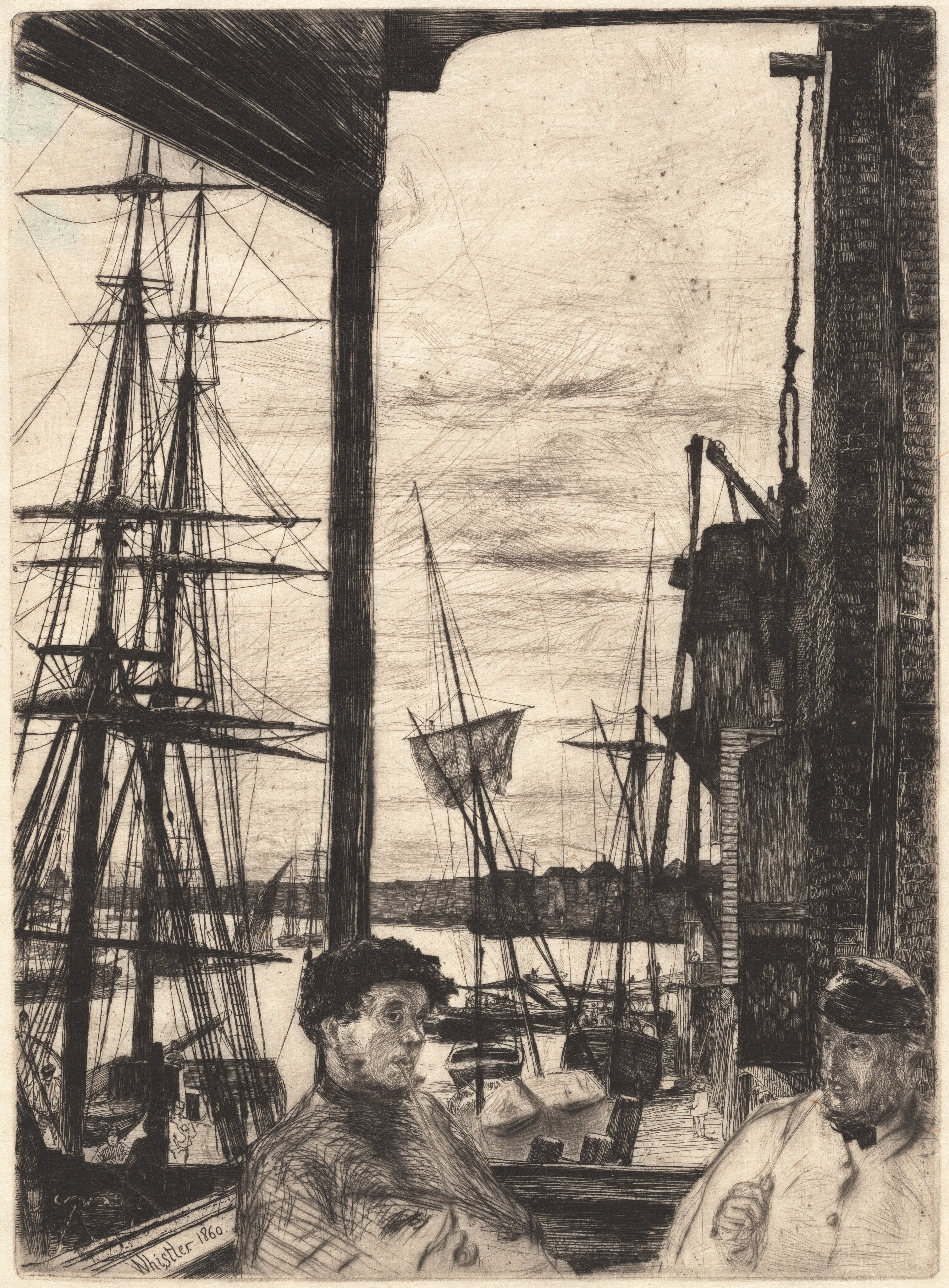
James McNeill Whistler's Rotherhithe begins with two men who seem close enough to share the viewer's balcony. One folds his arms around a long clay pipe; the other holds a second pipe against a pale shirt. Behind them, the Thames opens through a thicket of masts, rigging, hulls, warehouses and cranes. A heavy post interrupts the view, a dark overhead structure lowers across the upper left, and brickwork presses down the right edge. The river is presented through a working threshold rather than as an unobstructed prospect.[1][6]
Whistler signed and dated the copper `1860`. The current University of Glasgow catalogue records six states before cancellation and 118 known impressions. Ellis & Green published the sixth state in the Thames Set in 1871, but under the title Wapping. That change of name is not a minor cataloguing nuisance: the foreground was on the south bank around Rotherhithe, while the view crosses towards Wapping on the north. Plate, title, site, state and printed sheet each answer a different question.[5][6][7][10]
At a Glance
- Plate cataloguesGlasgow 70 / K.66 / M.66 / T.41 / W.60
- Date1860
- MediumEtching and drypoint on copper
- Plate size278 × 203 mm
- Featured impressionNGA 1943.3.8442 / K0660316, state 6/6
- Ink and paperBlack ink on ivory Asian laid paper
- Sheet size34.61 × 24.77 cm (NGA)
- States and impressionsSix states before cancellation; 118 known impressions
- PublicationThames Set as Wapping, Ellis & Green, 1871
- DisplayNGA: not on view on 26 August 2026; verify current status
Contents
- Plate identity
- Why the title is Rotherhithe
- The Angel, Cherry Gardens and Bermondsey
- Not the painting Wapping
- Not The Little Rotherhithe
- The featured National Gallery impression
- An exact open image
- Two men at the threshold
- A pause without a story
- A portrait-format river view
Plate identity
The Whistler Etchings Project assigns the work record 70. It is K.66 in Edward Kennedy's catalogue, with the further concordances M.66, T.41 and W.60. Glasgow gives a general plate size of 278 by 203 millimetres. The medium combines etching, which establishes most of the architecture, ships and figures, with drypoint additions whose burr and delicacy change as the copper is worked and printed.[5][7][9]
An etched inscription at lower left reads `Whistler. 1860.` The lettering runs along the sloping lower edge beside the nearest ship and is part of the matrix, not a later signature written on paper. The featured National Gallery of Art sheet has no separate paper signature by Whistler. This distinction matters because inscriptions scratched into copper repeat with the design, whereas writing on a particular impression belongs only to that sheet.[1][11]
Why the title is Rotherhithe
The Royal Academy exhibited the print as Rotherhithe in 1862, and Whistler again used that name for his 1874 Pall Mall exhibition. Ellis & Green called it Wapping in their 1871 portfolio, and Whistler used the same word in an 1887 letter. Other historical catalogues alternate between the names or combine them. The instability records a viewpoint straddling two banks rather than two different etchings.[6][10]
Whistler drew from a riverside balcony on the south side of the Thames. The close architectural frame and seated men belong to that bank; the warehouses across the water belong to Wapping. The specialist catalogue therefore prefers Rotherhithe, giving priority to the place occupied by the foreground. A title that instead privileged the distant shore would remain historically intelligible, but it would organise the same evidence differently.[6]
The Angel, Cherry Gardens and Bermondsey
Joseph and Elizabeth Pennell and Howard Mansfield associated the viewpoint with the Angel at Cherry Gardens. The building stands in Bermondsey, adjacent to Rotherhithe, so even the preferred title should not be turned into an artificially exact parish coordinate. What is secure is the south-bank balcony, the northward view and the long-lived identification of the riverside inn as Whistler's vantage point.[6]
St Paul's dome appears beyond a bend of the Thames, giving the fine distant lines a metropolitan anchor. Present-day photographs from the Angel are dominated by Tower Bridge, which opened decades after the copper was made. The bridge is useful for recognising how the view has changed, but it cannot be read backwards into the etched skyline or used to locate a structure that did not yet exist in 1860.[6]
Not the painting Wapping
Whistler's oil painting Wapping is closely related in viewpoint and subject, but it is a separate object with a separate chronology. The painting includes Joanna Hiffernan, Matthew White Ridley and a sailor connected with the Greaves boatyard. None of those names identifies either of the two men in the etching. Visual resemblance of setting does not override the catalogue's explicit statement that the etched sitters remain unknown.[6]
An 1861 letter to Henri Fantin-Latour describes the difficulty of painting a river scene as real boats continually changed position. It is valuable adjacent evidence for Whistler's sustained looking from this locality and for the challenge of moving traffic. It is not a diary entry documenting the making of the 1860 copper. The two media can be related without making one medium's evidence serve as the other's direct technical record.[6]
Not The Little Rotherhithe
The similar title The Little Rotherhithe belongs to K.73, a different plate dated 1861. Its smaller river subject, catalogue number, state history and impressions must remain separate from K.66. Adding `large` to the present title may help in an archival note, but it is not necessary when the preferred catalogue name and number are supplied accurately.[5][6]
This distinction also shows why title matching alone is unsafe. A river district could generate several views, and nineteenth-century exhibition labels could change. Secure identity comes from the particular composition, measurements, inscriptions, catalogue concordance and surviving copper. Here those controls converge on the tall plate with two smokers at the bottom and a ship-filled opening above them.[5][7][8]
The featured National Gallery impression
The featured sheet is National Gallery of Art 1943.3.8442, catalogued by Glasgow as K0660316. It is an ordinary sixth-state impression, not a cancellation pull. The current NGA record describes etching and drypoint on Asian laid paper, with a plate mark of 27.62 by 20.16 centimetres and a sheet measuring 34.61 by 24.77 centimetres. Its credit line is the Rosenwald Collection.[1][11]
Lessing Julius Rosenwald owned the sheet before giving it to the National Gallery in 1943. The museum currently lists it as not on view, a mutable fact checked on 26 August 2026. Glasgow records additional accession number B-10504 and several dealer stock numbers. Those marks document this impression's commercial passage; they do not belong to every pull from K.66.[1][11]
An exact open image
The NGA download for 1943.3.8442 is an exact 3,019-by-4,096-pixel JPEG showing the full sheet. The museum labels the media free and in the public domain. Its Open Access policy releases eligible images under CC0 for commercial and non-commercial reuse without prior permission, while encouraging a courtesy credit to the National Gallery of Art, Washington.[1][2][4]
That image is the preferred illustration because it joins a clearly identified state with a rights-resolved, high-resolution file. NGA's CC0 status applies to its download, not automatically to photographs embedded in the Glasgow catalogue, which retain separate terms. The full-sheet view also preserves margins and paper tone that a tight crop would suppress.[2][4][14]
Two men at the threshold
The lower foreground is dominated by two half-length figures. The man on the left has curly uncovered hair in the exact NGA image, a lined face turned towards the viewer and arms crossed firmly over his torso. A clay pipe projects from his mouth. The right-hand man wears a soft cap, lowers his gaze and cups the bowl or stem of another pipe against his lighter clothing.[2][6]
The specialist description suggests that the men look like sailors or boatmen, but it does not identify them. Their clothing, pipes and setting support an occupational inference without supplying names, employer, rank or individual history. Facial expression is equally limited evidence. Words such as wary, tired or defiant might sound vivid, yet each would convert an observed pose into an undocumented mental state.[6]
A pause without a story
Long pipes and folded arms make the encounter feel paused. Nothing in the plate, however, establishes whether the men have stopped work, are waiting for a tide, are customers at the inn or occupy some other relationship to the balcony. The image records a social presence with unusual directness while withholding the anecdote that many genre scenes would use to explain it.[2][6]
That withholding is one source of the work's force. The men do not demonstrate a trade for the spectator; neither points towards the shipping or turns away to resume a task. Instead they share the narrow foreground with us. The river behind them remains economically active, but the closest human evidence refuses to become a diagram of industry or a moral illustration of labour.[2][6]
A portrait-format river view
The etched field is substantially taller than it is wide. That portrait orientation is unexpected for a broad river prospect and changes how the Thames can be seen. Rather than spreading horizontally, shipping rises in layers. Masts travel up the sheet; rigging crosses the sky; the central post occupies almost the full height; the right-hand warehouse becomes a vertical wall.[1][5]
The two figures occupy the lower register as a paired human base. Above them, the image opens into water and sky but never escapes the balcony's structure. Whistler therefore makes the portrait format perform two jobs at once: it brings bodies close, and it stacks a commercial landscape behind them. The result is neither simply double portrait nor simply topographical view.[2][6]
The great central post
A dark timber rises near the left third of the plate. It divides the rigged vessel on the far left from the broad central opening and partly conceals whatever lies beyond. The post is not an accidental obstruction to be mentally removed. Its breadth, hatching and long uninterrupted descent make it one of the composition's strongest forms.[2]
The post turns looking into an act of assembly. A viewer must join the left ship, middle-distance boats, far warehouses and pale sky across a deliberate interruption. This experience echoes the working balcony itself, where beams and supports would govern what could be seen. The riverscape is thus conditioned by built space rather than offered as a neutral panorama.[2][6]
Roof, wall and hanging chain
At upper left, a heavily hatched roof or overhead platform descends towards the post. Its diagonal underside compresses the ship's rigging and makes the bright paper of the sky appear more exposed. At right, dense brick hatching and projecting timbers narrow the opposite side. A long chain or hoisting element hangs down beside this wall.[2][6]
These dark zones operate like shutters around a luminous centre, but they also belong to the practical architecture of the wharf-side building. Formal analysis need not strip them of use, and occupational description need not ignore their tonal role. Whistler builds the scene from structures that both support work and regulate the picture's light.[2]
The ship on the left
Two tall masts and a dense web of rigging fill the left opening. Because the balcony stands above the water, the vessel's deck is seen from a raised angle. Vertical spars, nearly horizontal yards and diagonal ropes overlap the central post and the darker roof. The ship appears through fragments rather than as a complete profile.[2][6]
That incompleteness is visually productive. The vessel extends beyond the frame and behind architecture, conveying a scale greater than the visible hull. Fine rigging can almost dissolve into sky while heavier mast lines retain physical weight. Whistler differentiates these elements through density and pressure rather than through colour, making one printed ink carry multiple distances.[2][9]
Boats between the sitters
A smaller beached or grounded vessel sits between the men's heads. Its mast leans left, while the hull and partly furled sail occupy the strip immediately beyond the railing. Other craft cluster around it, some reduced to a few dark contours and narrow masts. Their overlaps create a transitional zone between human foreground and far shore.[2][6]
The central boat became especially important in the state sequence. A worked proof uses wash to test an area that remained lightly defined on the copper. Whistler then translated parts of that solution into drypoint for state three. The boat is therefore both a represented object and a record of decision-making across proof, plate and later impression.[7][9]
Warehouses and St Paul's
Across the Thames, low warehouses form a broken horizontal band. Masts interrupt their roofline, and St Paul's rises as a small dome in the distance. The cathedral is easy to miss at reproduction scale, which is precisely why it works as a locating detail rather than a monumental centre. It draws the metropolitan horizon into a scene dominated by maritime infrastructure.[2][6]
The far bank is rendered with fewer emphatic darks than the balcony. Lines accumulate, but they do not rival the sitters' faces or the left ship's rigging. This calibrated restraint creates distance without abandoning specificity. The viewer can recognise docks, roofs and the dome while still experiencing them as atmosphere seen across moving water.[2][9]
Paper as light and air
Much of the upper centre remains pale. Fine scratched lines drift across the Asian laid support, while scattered pitting and foul biting disturb any impression of untouched blankness. Paper supplies sky, river light and the interval around rigging. Ink does not fill a pre-existing scene; it selects and weights relations across the sheet.[2][9][11]
This makes the physical support interpretively active. The featured sheet is ivory rather than bright white, and the specialist record notes pale tone on the figures' torsos. What appears as atmosphere therefore depends on paper colour, ink, wiping and age as well as on the copper's lines. A digital image can reveal these relations, but its screen brightness is not a neutral measure of the original sheet.[1][2][11]
Etching and drypoint
Etching establishes the principal design by allowing acid to bite drawn lines into the copper. Drypoint works directly with a needle, raising a burr that can hold soft, rich ink but wears during printing. In Rotherhithe, the methods cooperate: etched architecture and rigging provide a durable framework, while drypoint repeatedly strengthens hands, clothing, boats, horizon and sky.[7][9]
The distinction should not become a simple opposition between hard etching and soft drypoint. Line character varies with depth, crossing, ink and pressure, and the plate developed pitting and foul biting. Some atmospheric marks may be faint drypoint; others arise from etched texture or accidental acid action. The catalogue's state descriptions are more secure than an attempt to diagnose every line from a web reproduction.[7][9]
State one: complete but open
Glasgow calls state one compositionally complete, meaning that the basic subject and structure are already present. Yet the central boat's hull is not fully drawn, and the right man's coat and hand remain lightly indicated. The plate signature and date are established at lower left. Completion here does not mean that Whistler had finished revising local passages.[7]
An exceptionally fine early proof on Japanese paper combines strong burr on figures and post with very delicate lines between the masts. That contrast shows why state number alone cannot describe appearance. A first-state pull can differ from another first-state pull according to burr condition, ink, support and wiping, even before any new marks are added to the matrix.[9]
State two: pitting in the sky
By state two, many dots appear in the upper-right sky, probably associated with corrosion, pitting or foul biting. The strength of drypoint in that area varies among sheets. These changes complicate the idea that a later state simply contains more intentional information. The copper's material behaviour becomes visible alongside Whistler's deliberate additions.[7][9]
Foul biting results when acid reaches areas that were not meant to be bitten. A printer may reduce or accentuate its appearance through wiping, but cannot treat it as if it had never altered the plate. In this work the irregular marks help give the broad sky a granular life, although their aesthetic effect should not erase their technical origin.[7][9]
State three: the tested solution
State three adds drypoint shading to the deck, bow and bowsprit of the vessel between the men, and to the inside of a nearby rowboat. The men's hands and coats receive renewed definition. Further drypoint crosses the left man's pipe, travels along the horizon and gathers behind the ships' rigging.[7]
NGA 1987.41.67 provides an exact state-three comparison. It is printed on wove paper and trimmed to the plate mark, which measures 27.6 by 20.1 centimetres. John Nichols and Dorothy Coogan Estabrook gave it to the Gallery in 1987. The current museum page marks its image public domain and lists the sheet as not on view.[3]
Comparing states three and six
In the state-three NGA image, the overall architecture and figures are already stable. The comparison with 1943.3.8442 instead directs attention to accumulations: stronger crossings on clothing, developed boat shading and the varying presence of sky texture. One should not expect the subject to transform as though six states were six separate compositions.[2][3][7]
The two files also differ as sheets. The state-three impression is trimmed to the plate mark and printed on wove paper; the sixth-state feature retains margins and uses Asian laid paper. A visible difference can therefore arise from matrix revision, paper, inking, wiping, trimming, photographic conditions or later history. Reliable comparison asks which of those levels can actually support a claim.[1][3][11]
States four, five and six
State four introduces strong diagonal lines across the left man's chest and short strokes in the area between the sitters. State five adds fine cross-shading to the bow of the central vessel. State six further augments the shading across the left man's chest and pipe. These are focused revisions to weight and texture, not changes of place or identity.[7]
Ellis & Green published the Thames Set in state six. The featured NGA sheet belongs to that normal condition. Glasgow notes that drypoint varies with burr and inking, and it allows the possibility of reinforcement when Frederick Keppel's firm printed the plate later. `State six` consequently names a matrix stage, not one uniform visual result across every surviving sheet.[7][9]
Published papers and watermarks
Recorded impressions use black ink and warmer blacks that can look brown on particular supports. Early pulls appear on off-white wove, cream laid, Japanese and other papers. One lightweight Asian sheet may have served as proofing stock. Heavy wove paper of the kind sometimes used to support thinner Asian sheets also appears in the corpus.[9]
Many impressions issued with the Thames Set are on laid paper bearing De Erven de Blauw or beehive watermarks; a Strasbourg Lily also occurs. Those patterns are tendencies, not a rule that defines authenticity. The featured NGA impression is Asian laid with no recorded watermark. Its material identity must remain its own rather than being normalised to the most frequent edition stock.[1][9][11]
Ordinary sixth state versus cancellation
The specialist catalogue lists cancellation separately after the six normal states. The cancelled copper bears four ruled strokes arranged as a large diamond touching the edges, a dotted rough circle and eight smaller crosses. Those marks were intended to prevent the retired plate from producing an uncancelled commercial image.[7][8]
Metropolitan Museum of Art 17.3.51 is explicitly a pull from that cancelled plate. It is black ink on thick ivory laid paper, with a 27.5-by-19.8-centimetre plate mark and a 37.3-by-26.7-centimetre sheet. It is a valuable document of the matrix's afterlife, but it cannot represent what viewers saw in the Royal Academy, the Paris Salon or the published Thames Set.[12]
The surviving copper
The physical plate survives at the National Museum of Asian Art as Freer Gallery F1896.10. Glasgow records no maker's stamp and notes that its size differs from Whistler's other coppers. The current holder measures it at 27.8 by 20.2 centimetres. Freer bought it from Frederick Keppel & Co. in 1896; his deed of gift was signed in 1906, and the Gallery received the copper in 1920.[8][13]
The CC0 photograph shows the matrix laterally reversed against the print and makes every cancellation stroke legible across its warm copper surface. It provides evidence unavailable from even the clearest impression: the direction of marks, the damage imposed at retirement, and the fact that one worked object generated many non-identical sheets. A plate made to describe river commerce became itself a transported, marketed and institutional object.[8][13]
Exhibition before publication
The Royal Academy displayed an impression in 1862. F. G. Stephens praised Whistler's feeling for substance and tone and compared the solid rigging to Rembrandt. The same year brought a Société Nationale des Beaux-Arts showing in Paris. In 1863, a richly printed Japanese-paper impression appeared at the Salon and was acquired by George Aloysius Lucas.[10]
Whistler also sent a fine proof for James Anderson Rose's 1863 exhibition at Willis's Rooms. These events establish visibility well before Ellis & Green assembled the Thames Set. `Published in 1871` therefore describes the formal portfolio issue, not the first moment the image existed, circulated, attracted criticism or entered a collection.[10]
The Thames Set review
When the set appeared in 1871, Stephens reviewed this plate under the title Wapping. He emphasised bright midday heat, cranes, ropes, the ship and the two men smoking without conversation. His account is valuable evidence of an early viewer attending to the same tension between intense river detail and suspended foreground action.[10]
The review is not a neutral caption. Its weather, social description and ranking of the plate belong to a critic's rhetoric. Modern interpretation can use that response without treating every phrase as measurable fact. The most stable claims still come from the plate, impression records and documented site; reception shows how those materials were framed at a particular historical moment.[6][10]
A long collecting history
The British Museum bought an impression in July 1872. Rose's examples circulated through an 1874 travelling exhibition and an 1876 sale. Samuel Putnam Avery lent a touched proof and a finished state in New York. Later sheets appeared at Glasgow International Exhibitions, the World's Columbian Exposition, dealer displays and memorial exhibitions after Whistler's death.[10]
Prices varied by date, state, paper, attribution and market. Some early proofs were described as rare; published sets also moved through auction. Whistler sometimes bought back impressions and resold them, while dealers such as Keppel and Wunderlich promoted later pulls. The record resists a single story of steady appreciation: access, terminology and connoisseurial priorities changed across owners and venues.[10]
Looking at an impression, not an abstract design
The featured sheet carries pale tone across the figures, fresh foul biting or etched texture in the sky, and dealer numbers in its margin. Its Asian laid paper, untrimmed edges and Rosenwald provenance make it a particular object. Another state-six sheet can share every intentional line yet differ in colour, tone, watermark, trimming and marks.[1][11]
This is why reproduction should be identified at accession level whenever possible. `Rotherhithe, 1860` names the design and its date; `NGA 1943.3.8442, state vi/vi` identifies the material witness being shown. Supplying both levels lets readers move between composition and object without pretending that one digital file is the entire edition.[1][5][11]
What Rotherhithe makes visible
The plate's achievement lies partly in refusing to choose between proximity and extent. The men are encountered at arm's length, while the river stretches towards warehouses and St Paul's. Posts, roof, wall and chain make that distance difficult to see all at once. The viewer experiences metropolitan scale through the constraints of one working balcony.[2][6]
Its material history deepens that idea. Drypoint wears, acid leaves unwanted marks, papers alter tone, printers preserve or diminish burr, owners trim or annotate sheets, and a publisher changes the name. Rotherhithe is not a fixed window onto 1860. It is a copper, a sequence of revisions and a dispersed population of impressions through which one location has remained available to close looking.[5][7][9][10]
A method for close viewing
Begin with the two faces and follow the pipes towards the surrounding hatch. Then move upward along the central post, across the ship's yards and into the faint lines of sky. Returning down the right edge reveals how chain, brick and timber compress the open water. This route keeps figure, architecture and shipping in relation; none needs to be treated as a detachable illustration of `character`, `industry` or `atmosphere`.[2][6]
Next compare the full-sheet feature with the trimmed state-three impression. Margins change the apparent scale, and different supports change the warmth of the unprinted areas. Only after noting those sheet-level effects should the viewer seek the drypoint added to coat, hand, boat and horizon. Such sequencing prevents digital contrast or cropping from being mistaken for a new state and makes the catalogue's distinctions visible rather than merely technical.[1][3][7][11]
Discussion
How does Whistler make a vast commercial river appear through the constricted frame of one balcony?
Move from the two unidentified smokers through the post, railing, chain and rigging towards Wapping and St Paul's, while keeping the ordinary sixth-state sheet distinct from the cancelled plate.
Reader Insights
How do the two men block and invite the view?
Which lines carry the eye from balcony to river?
What belongs to copper revision, printing or paper?
Join the Conversation
Share a close observation.
References
- National Gallery of Art. “Rotherhithe.” Accession 1943.3.8442. https://www.nga.gov/artworks/10939-rotherhithe
- National Gallery of Art. Exact open-access image for Rotherhithe, 1943.3.8442. https://api.nga.gov/iiif/645f5f8f-edaa-4a5f-9375-ddfb9eeda0d2/full/full/0/default.jpg
- National Gallery of Art. “Rotherhithe.” Accession 1987.41.67, state iii/vi. https://www.nga.gov/artworks/70119-rotherhithe
- National Gallery of Art. “Terms and Notices: Open Access Policy.” https://www.nga.gov/terms-and-notices
- University of Glasgow. Whistler Etchings Project. “Rotherhithe” K.66, record 70. https://www.etchings.arts.gla.ac.uk/catalogue/plate/display/index.php?catno=K066
- University of Glasgow. Whistler Etchings Project. “Rotherhithe: Subject, Title, Sitters and Site.” https://www.etchings.arts.gla.ac.uk/catalogue/plate/display/index.php?catno=K066&xml=sub
- University of Glasgow. Whistler Etchings Project. “Rotherhithe: States.” https://www.etchings.arts.gla.ac.uk/catalogue/plate/display/index.php?catno=K066&xml=sta
- University of Glasgow. Whistler Etchings Project. “Rotherhithe: Plate.” https://www.etchings.arts.gla.ac.uk/catalogue/plate/display/index.php?catno=K066&xml=pla
- University of Glasgow. Whistler Etchings Project. “Rotherhithe: Technique and Printing.” https://www.etchings.arts.gla.ac.uk/catalogue/plate/display/index.php?catno=K066&xml=pri
- University of Glasgow. Whistler Etchings Project. “Rotherhithe: Publication, Exhibitions, Sales and Collectors.” https://www.etchings.arts.gla.ac.uk/catalogue/plate/display/index.php?catno=K066&xml=mar
- University of Glasgow. Whistler Etchings Project. “Impression K0660316.” https://www.etchings.arts.gla.ac.uk/catalogue/etchings/etching/?filename=K0660316
- Metropolitan Museum of Art. “Rotherhithe (Wapping).” Accession 17.3.51, cancelled-plate impression. https://www.metmuseum.org/art/collection/search/372521
- National Museum of Asian Art. “Etching plate: Rotherhithe.” Accession F1896.10. https://asia.si.edu/explore-art-culture/collections/search/edanmdm:fsg_F1896.10/
- University of Glasgow. Whistler Etchings Project. “Copyright.” https://www.etchings.arts.gla.ac.uk/copyright/


