


 by Tom Gurney
Tom Gurney BSc (Hons) is an art history expert with over 20 years experience
Published on November 6, 2026 / Updated on November 6, 2026
Email: tomgurney1@gmail.com / Phone: +44 7429 011000
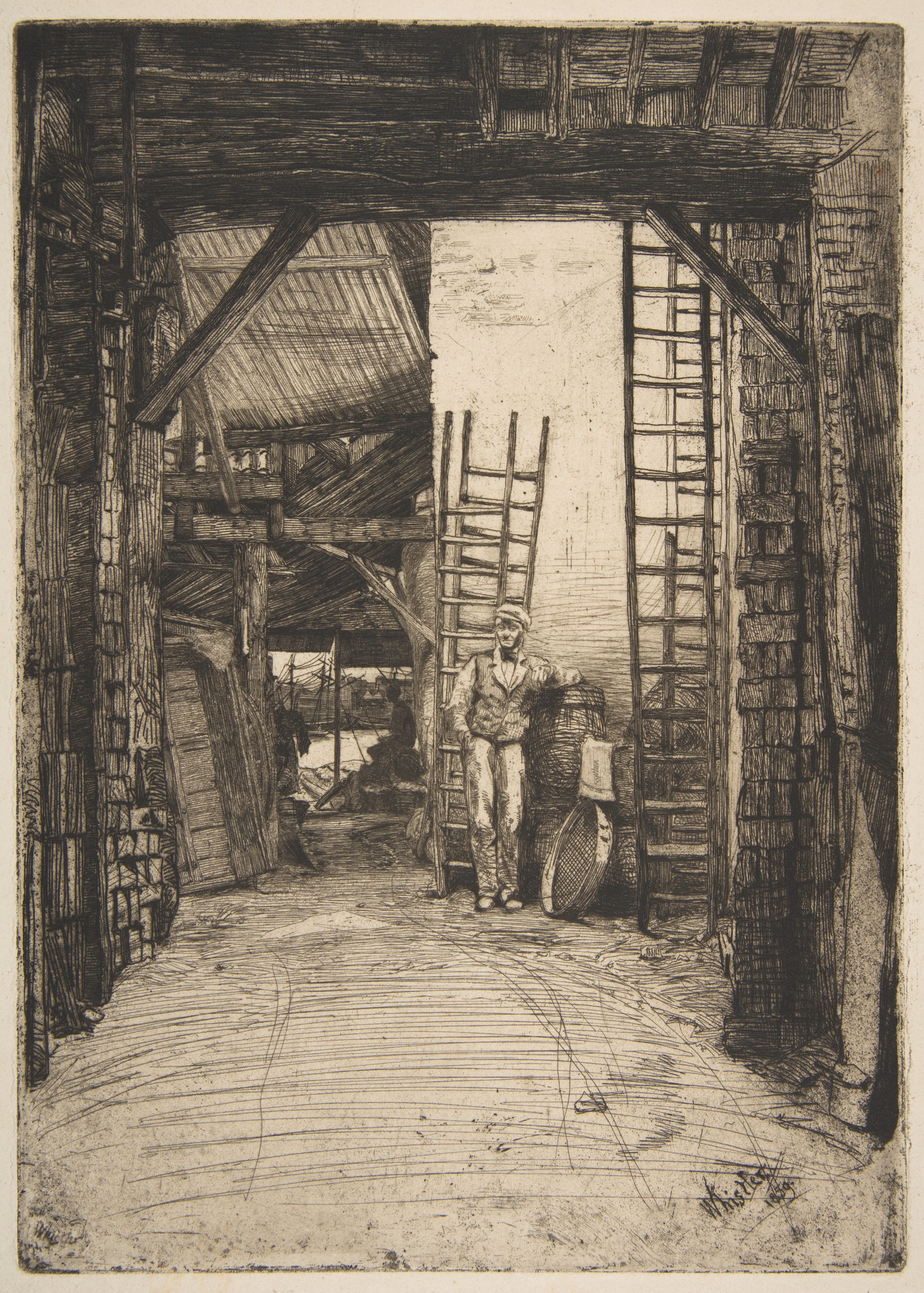
James McNeill Whistler's The Lime-Burner turns a Wapping work yard into a sequence of openings. A timber entrance surrounds an open foreground; ladders rise against a pale wall; barrels, a sieve and the pieces of a cart crowd the sides. Near the centre, a man rests against a barrel. Behind him, a darker passage leads to another worker, a barge, a sliver of river and distant masts. The plate joins a named person to a place without making either incidental scenery.[1][5]
Whistler etched and dated the copper in 1859, first exhibited it in 1860 and published its second state in the Thames Set in 1871. The present specialist catalogue records 103 impressions, two states before cancellation and a surviving scored copper. That history requires three distinctions: the design on the plate, changes made between states, and the ink, paper, wiping, marks and custody of each printed sheet.[4][6][8][9]
At a Glance
- Plate cataloguesGlasgow 55 / K.46 / M.45 / T.38 / W.44
- Date1859
- MediumEtching and drypoint on copper
- Plate size255 × 179 mm
- Featured impressionMet 17.3.39 / K0460111, state 1/2
- Ink and paperWarm black ink on heavy ivory wove paper
- Sheet size31.4 × 25.6 cm (Met)
- States and impressionsTwo states before cancellation; 103 known impressions
- PublicationThames Set no. 9, Ellis & Green, 1871
- DisplayMet: not on view on 26 August 2026; verify current status
Contents
- Plate identity and preferred title
- The identifying Royal Academy title
- A title between portrait and trade
- The featured Met impression
- A tall plate at intimate scale
- Current location and open images
- Entering the yard
- William Jones at work
- Ladders, barrel and sieve
- Cart pieces and unstable timber
Plate identity and preferred title
The plate is record 55 in the University of Glasgow Whistler Etchings Project and K.46 in Edward Kennedy's catalogue; its other concordances are M.45, T.38 and W.44. Glasgow gives the general copper dimensions as 255 by 179 millimetres. The surviving matrix at the Freer Gallery measures 25.4 by 17.9 centimetres. An etched signature and the date `1859` appear at lower right.[4][7][13]
Its preferred title, The Lime-Burner, comes from Ellis & Green's 1871 publication and has been adopted by most later cataloguers. Whistler and exhibitors also used Thames Limeburners, The Limeburner's Yard and plural variants. Those names all refer to the same plate; they register different emphases on a person, an occupation and a working place rather than separate compositions.[5][9]
The identifying Royal Academy title
The earliest exhibition title is more specific. At the Royal Academy in 1860, catalogue 943 called the print W. Jones, Lime-burner, Thames Street. The name and occupational address give the central figure an identity unusual enough to govern interpretation. He is not simply an invented emblem of industry or an anonymous body supplied to enliven architecture.[5][9]
The Met expands the initial to William and calls Jones the proprietor. A London postal directory places William Jones & Co. at 241 and 242 Wapping High Street, backing onto East London Lime Wharf. The evidence securely connects person, firm and premises, but it does not provide a full personal biography. The article can name Jones without inventing his age, opinions, family or exact relationship to every object in the yard.[1][5]
A title between portrait and trade
The difference between the exhibition and publication titles is interpretively useful. W. Jones, Lime-burner, Thames Street directs attention to one identified individual at an address. The Lime-Burner retains the occupation but removes the name and street from the headline. The shorter form is not evidence that Jones ceased to matter; it is the title under which a particular portrait-place entered a published portfolio.[5][9]
Neither form licenses a generic account of `the Victorian worker`. Jones belongs to a documented Wapping business, and the equipment belongs to a particular yard. At the same time, the sources do not record his speech or personal circumstances. Holding those facts together avoids two opposite errors: erasing him into an occupational type and filling documentary silence with an imagined life story.[1][5]
The featured Met impression
The featured sheet is Metropolitan Museum of Art 17.3.39, catalogued by Glasgow as K0460111. It is a first-state impression printed in warm black ink on ivory wove paper. The Met measures the plate at 24.8 by 17.8 centimetres and the sheet at 31.4 by 25.6 centimetres. Glasgow records 24.9 by 17.7 for the plate mark and 31.8 by 25.6 for the paper; the current holder's figures govern this summary.[1][10]
This sheet is not a transparent substitute for all 103 impressions. It is untrimmed, on heavy paper that the specialist record describes as darkened or browned, with no watermark and no added pencil work by Whistler. Tone gathers more strongly at the bottom. Extensive foul biting remains visible, and collector marks on the reverse connect the sheet with Tracy Dows and Harris Brisbane Dick.[1][10]
A tall plate at intimate scale
The plate is roughly twenty-five centimetres high, so the timber portal and yard occupy a surface smaller than many reproductions suggest. Jones's face, the distant seated worker and the riverside masts depend upon close inspection. The vertical format magnifies the sensation of standing under beams, but the actual sheet remains a handheld print whose detail unfolds across a short viewing distance.[1][4]
Its proportions also distinguish it from the horizontal wharf plates nearby in the 1859 sequence. Here the breadth of the river is withheld. Height belongs to posts, ladders and the pale wall, while recession travels through a narrow opening. The portrait orientation is therefore not merely a container for the same Thames view turned upright; it makes the work yard and its passage the principal spatial event.[4][5][7]
The larger paper around the plate changes that encounter again. On the full-sheet Met photograph, the printed rectangle occupies only part of the support and later numbers sit in the lower margin. The yard no longer fills the viewer's entire field as it does in a close crop. Plate edge, blank paper and handling marks make its status as a portable impression unmistakable.[1][2]
Current location and open images
On 26 August 2026 the Met listed 17.3.39 as not on view. That status is mutable and should be checked again before a visit. The print entered the Department of Drawings and Prints through the Harris Brisbane Dick Fund in 1917. The current provenance tab names Dick and the Dick estate; Glasgow adds Dows, probable handling by Frederick Keppel and a Wunderlich stock number.[1][10]
The Met supplies two exact Public Domain images. `DP813318` gives a close view of the printed field at 2,658 by 3,720 pixels, while `DP813328` shows the larger sheet and its margins at 3,004 by 3,722 pixels. The API confirms public-domain status. Under the museum's Open Access terms, either file may be reused for commercial or non-commercial purposes without a separate request or charge. The close view is the preferred later feature; the full-sheet file preserves evidence about this impression as an object.[1][2][3]
Entering the yard
The composition is upright, but it does not behave like a simple vertical portrait. Heavy posts rise at both sides and a broad beam crosses the top, establishing an outer timber portal inside the plate rectangle. Beyond it, an angled roof or shuttered structure descends from the left. A pale wall and narrow right-hand opening divide the middle. The spectator looks into, through and past several constructed frames.[1][5]
That sequence makes the foreground feel temporarily available rather than empty. Long, light strokes spread across the floor while dense hatching accumulates above. The open lower area gives the eye room before the architecture narrows. Jones does not stand at the nearest edge; he occupies a middle threshold from which the passage continues towards the Thames.[1][5]
William Jones at work
Jones stands right of centre with his feet close and his body turned towards the viewer. He wears a flat cloth cap, a waistcoat over a shirt and loose trousers. One hand gathers near his waist while the other arm reaches towards a barrel. His pose reads as a pause within the premises, not a staged demonstration of a manufacturing step.[1][5]
The Met calls the image a focus on a humble business; the Smithsonian describes the Freer comparison sheet as a respectful portrait of a working man. Both readings recognise dignity without supplying testimony from Jones himself. His level gaze and relaxed stance can be described, but character words such as proud, resigned or content would go beyond the surviving documentation.[1][11]
Ladders, barrel and sieve
Ladders multiply around the figure. Shorter examples lean against the bright wall behind him; a longer ladder climbs through the narrow bay at right; other rungs and rails emerge from darker structures. Their repeated verticals answer the timber posts, while uneven spacing prevents the design from becoming a regular grid.[1][5]
Jones rests beside barrels and a large circular sieve or screen. The barrel's staves curve against the wall, and the sieve leans forward, presenting a mesh of crossed lines. These rounded forms interrupt the architecture's rectangles. They also keep the occupational title grounded in equipment, even though the catalogue does not assign a precise task to each vessel or tool.[1][5]
Cart pieces and unstable timber
At left, a dismantled cart and wheel sit among boards, supports and sloping roofs. The forms overlap so heavily that they cannot be read at one glance. A diagonal brace crosses the left opening; layered planks turn the area behind it into a dark lattice; a tilted panel narrows the passage below.[1][5]
Whistler did not tidy the yard into an industrial diagram. Uprights lean, boards interrupt one another and shadows obscure junctions. Yet the arrangement is not vague. Changes in hatch direction distinguish some beams, walls and surfaces. The result combines site-specific disorder with selective precision, allowing a viewer to understand construction without pretending to inventory every piece of timber.[5][8]
The passage to East London Lime Wharf
A corridor opens to the left of Jones and travels towards the water. Its floor contracts, successive posts overlap and a seated figure appears beneath partly raised shutters. Beyond that person, the catalogue identifies a barge at the wharf and a glimpse of the river, with masts and warehouses on the opposite side.[1][5]
The water occupies very little paper, but it changes the meaning of the yard. This is not an enclosed workshop detached from circulation. The passage reaches a riverside landing where bulk materials and finished products could move. The view therefore links labour inside the premises to Wapping's transport network without turning the narrow opening into a general panorama of the Thames.[5]
A second worker in the distance
The seated person at the passage's end is much smaller than Jones and faces left in shade. No name is recorded in the sources used here. His position helps measure depth: the central proprietor belongs to the middle ground, while this figure sits closer to the river beyond several structural thresholds.[5]
The two men should not be treated as equivalent symbols. Jones is named in the 1860 title; the farther worker is not. Nor does the print reveal whether either is waiting, resting or engaged in a particular operation at that instant. Their difference in scale and documentation is part of the plate's structure, not an invitation to invent a shared anecdote.[5][9]
What lime burning produced
Historic England defines a lime kiln as a structure that fires calcium carbonate above 900 degrees Celsius to make calcium oxide, usually called quicklime or unslaked lime. Limestone and chalk were common raw materials, with shells used in some circumstances. Adding water, or slaking, converts quicklime into hydrated lime, calcium hydroxide, used in mortar and plaster.[14]
This terminology corrects a sentence in the Glasgow subject page that accidentally reverses the names of quicklime and slaked lime. The correction is narrow: it does not undermine Glasgow's identification of Jones, the address or the etched equipment. It simply prevents an art-historical description from reproducing a chemical error in a passage intended to explain the trade.[5][14]
What the image does not show
The title establishes a lime-burner's premises, but no source used here identifies the kiln itself within the visible architecture. Barrels, ladders, sieve, cart, timber entrance and river passage can be named because they are visible and catalogued. A complete sequence from loading stone and fuel to drawing quicklime is not depicted.[1][5][14]
That limit matters. Industrial context helps explain why the yard stood beside the water and why particular materials accumulated there, but the etching is not a technical manual. Whistler selected a threshold, a proprietor and a view through the premises. Accurate process history should clarify the occupation without forcing every dark aperture to become a furnace or every barrel to hold a specified product.[5][14]
Frames within frames
The Glasgow catalogue relates the composition to an arrangement Whistler had explored in his earlier French subjects: one opening leads into another, with alternating enclosed and exposed spaces. It also records Katharine Lochnan's comparison with interiors by Pieter de Hooch, where doors and passages carry the eye progressively deeper.[5]
This is a formal comparison, not proof that Whistler copied a particular Dutch painting. The Wapping yard retains its own beams, tools, workers and river access. The usefulness of de Hooch lies in explaining how light and architecture can build recession. It does not turn Jones's premises into a disguised seventeenth-century domestic interior.[5]
Light as construction
The brightest expanse is the wall behind and above Jones. Dark beams cross its edges; ladders score it with thin verticals; scattered marks keep it from becoming blank. To the left, deeper shadow encloses the passage and wooden structures, yet a small opening of daylight appears near the river.[1][5]
Light therefore arrives in stages. The open foreground is pale, the upper portal is dark, the middle wall is illuminated and the distant corridor alternates again between shade and river brightness. These changes make depth legible even where perspective lines are entangled. Jones's body sits at the most forceful boundary between bright wall and dark equipment.[1][5]
Etched line and experimental surface
Glasgow describes a mixture of etched outlines, shading, cross-hatching, foul biting and possibly open bite or related experiments. Fine parallel strokes organise boards and walls, while grainier textures resemble cloth in places. More irregular spots and patches have another origin in the copper's exposure to acid.[8]
It would be misleading to call every soft or broken passage drypoint. Etching supplies most of the image's structure. Drypoint is important for the faint lower-left signature in the first state and for specific additions in the second, but the plate's textural range also depends on biting, overlapping hatch and ink left during printing.[6][8]
Foul biting as accident and resource
Foul biting occurs when acid reaches copper outside the intended drawn lines. In The Lime-Burner it appears as granular fields and haphazard flecks, notably on walls and around the entrance. The specialist record for the Met sheet calls it extensive; the Freer comparison has heavy granular effects on the doorway walls.[8][10][12]
The marks began as a technical irregularity, but their survival matters visually. They roughen pale surfaces and resist a clean separation between solid wall and atmosphere. Wiping can make them more or less prominent in a given impression. A patch that appears clear on one sheet may therefore reflect surface ink decisions rather than a change cut into the plate.[6][8]
State 1: complete from the beginning
The specialist catalogue calls state 1 compositionally complete. It carries the etched `Whistler.` and `1859.` at lower right plus a faint drypoint `Whistler.` at lower left. On the wall between Jones and the longer ladders, the lines are horizontal or slightly slanting. The principal figures, openings and equipment are already present.[6]
One impression has sometimes been proposed as an earlier state because the patch of light left of Jones looks unusually clean. Glasgow judges that selective wiping is more likely. This is a useful boundary between state and impression: absence of surface ink in one area does not prove that the underlying copper lacked the same etched marks.[6][8]
The Met sheet within state 1
The Met impression shows the lower-left drypoint signature as well as the etched signature and date. Its sheet also carries later evidence. Brown-ink numbers `47` and `48` appear upside down on recto and verso, leading the museum to suggest that the paper came from a ledger. A graphite title is not in Whistler's hand.[1][10]
The full-sheet image makes these marginal and collecting traces visible. Stamps for Tracy Dows and Harris Brisbane Dick sit on the reverse, while other numbers document handling. None changes the etched composition, but each belongs to the surviving object's history. Cropping to the plate field gives a clearer design; retaining the sheet reveals how that design travelled.[1][2][10]
A Freer first-state comparison
Freer Gallery F1898.277 is also state 1/2, but it is materially different. Glasgow records dark-brown ink on ivory modern laid paper, an untrimmed 35.7-by-22.5-centimetre sheet and a 25.1-by-17.6-centimetre plate mark. Some tone remains on the doorway's beams and walls, and granular foul biting is substantial.[11][12]
The Smithsonian connects the sheet with Francis Seymour Haden; Glasgow traces it from Haden through Wunderlich to Charles Lang Freer's November 1898 purchase. Its first-state drypoint signature helps distinguish it from the later state. Comparison with Met 17.3.39 shows that state identity does not eliminate differences of ink colour, paper structure, margins, wiping and custody.[10][11][12]
The Haden connection
Haden was Whistler's brother-in-law and an important etcher, but the connection relevant here is object-specific. The Smithsonian label interprets the lower-left pencil association as evidence that Whistler gave this impression to him. Glasgow is more cautious in its provenance wording, saying Haden probably acquired it from Whistler, and records that earlier `S.H.` and `S.Haden` inscriptions were erased in 1924.[11][12]
Those records should be read together rather than compressed into a certainty stronger than either provides. The sheet passed through Wunderlich and, via Thomas Wilmer Dewing, to Freer in 1898. Its Haden history helps explain why a materially distinctive early pull attracted later connoisseurial attention, but ownership does not itself prove that every mark, tone or rough bite was preferred by Whistler.[11][12]
What comparison can establish
Placing the Met and Freer sheets side by side establishes some stable features: the nested yard, Jones's pose, the first-state wall lines and the faint lower-left drypoint signature. It also exposes variables. The Met records warm black ink on wove paper; Glasgow calls the Freer ink dark brown and its support laid. The margins, inscriptions and surface tone differ.[1][10][11][12]
Comparison cannot recover one ideal printing against which all others are defective. It can show which marks belong to the shared matrix, which changes define a later state and which effects arise from an individual printing and subsequent history. That method is more precise than choosing the darker, cleaner or more famous sheet as automatically superior.[6][8][10][12]
State 2: small changes with clear consequences
For state 2 Whistler mostly removed the faint lower-left drypoint signature, cleaned the lower edge of the plate and added light perpendicular drypoint lines to the right of Jones's shoulder. The changes do not rearrange the yard. They refine local marks and the copper's border while leaving the composition recognisable.[6]
Ellis & Green used this state for the 1871 Thames Set. A viewer encountering a published sheet therefore sees a later matrix condition than the featured Met and Freer impressions. The difference is not a simple scale of rough first idea to finished design: state 1 was already complete, and state 2 alters selected details rather than supplying the subject.[6][9]
Cancellation and the surviving copper
After ordinary printing, the plate was crossed with diagonal cancellation lines. Pulls bearing those strokes document the matrix's retirement and should not be called normal second-state impressions. The physical copper survives as Freer Gallery F1896.8, an object classified by the Smithsonian as a tool rather than a print.[6][13]
The plate bears a Hughes & Kimber stamp naming Red Lion Square and Fleet Street. Glasgow notes the same manufacturer's mark on several Thames-related coppers, while also observing that none of the other plates from this date has exactly this size. Freer bought it from Frederick Keppel & Co. in 1896; the Gallery received it with his collection in 1920.[7][13]
Paper across 103 impressions
Early impressions were often printed in black on Western papers, including cream, ivory and buff wove sheets, modern and antique laid papers, and leaves carrying several watermarks. Asian supports form a smaller but real part of the first-state record. A paper description belongs to a particular sheet, never automatically to the copper.[8]
The second state includes many modern laid papers with De Erven de Blauw, D & C Blauw and related marks, but it also appears on other European and Asian stocks. Some sheets came from older books or ledgers. The corpus shows selection and availability rather than one mandatory edition paper, which is why the Met's ivory wove support must remain specific to 17.3.39.[8][10]
An unusually successful print
Glasgow calls the etching immensely successful and notes that more than one hundred impressions have been located. A first-state sheet sold in 1861, while a second-state impression was sold by Ellis & Green in 1871. The quantity does not imply mechanically identical results: papers, tone, ink and foul biting vary across the recorded corpus.[8]
Whistler marked some early sheets with evaluations such as `Fine proof` or `early proof`. Those inscriptions belong to individual impressions and to his management of them. They cannot be used to rank every first-state pull above every second-state one. The Met and Freer examples instead demonstrate how close material reading complicates a simple early-versus-late hierarchy.[8][10][12]
From the Royal Academy to the Thames Set
The Royal Academy displayed the plate in 1860 under Jones's identifying title. A contemporary Athenaeum notice praised the group of etchings by an artist new to the reviewer. In 1861 the work appeared with other Thames plates at Edmund Thomas's London print shop, a decade before their formal publication as a set.[9]
Ellis & Green issued The Lime-Burner as number 9 in the 1871 portfolio. F. G. Stephens responded to the ladders, beams, bright spaces, shadows and textures, calling the plate Rembrandt-like and ranking it highly. That period comparison belongs to reception history; it should not replace the documented Wapping site or make Whistler's technique a copy of Rembrandt's.[9]
Gifts, museums and collectors
An early first-state impression entered the South Kensington Museum in January 1861 within a group of sixteen prints sold by Francis Seymour Haden. Whistler gave other early sheets to his mother and James Reeves Traer, inscribed examples for George Aloysius Lucas and William Cleverly Alexander, and saw one enter Edgar Degas's collection.[9]
The British Museum acquired an impression in 1874, Berlin followed in 1882, and American and British institutions continued to receive sheets through gifts, purchases and bequests. Dealer exhibitions, international displays and the large memorial shows of 1904–05 extended its visibility. The circulation joins personal exchange, connoisseurship and public collecting rather than one single 1871 edition event.[9]
Why The Lime-Burner stands apart
The plate's distinct identity rests on more than its place in the Thames Set. The 1860 Royal Academy title names W. Jones and his trade, directory evidence identifies the riverside premises, and the image joins that person to an unusually deep sequence of beams, ladders, tools and openings. No other plate combines these facts in the same spatial problem.[5]
Its material history is equally particular. Extensive foul biting coexists with controlled etched hatch, the two normal states make local rather than structural changes, and first-state impressions on different papers reveal divergent tone and custody. The surviving copper, corrected lime chemistry and full-sheet Met evidence allow close reading that a general account of Thames etching cannot replace.[2][3][8][13][14]
How to look at The Lime-Burner
Begin with the outer portal and follow its beams towards the pale wall. Count how often ladders, posts and braces repeat or break vertical movement. Then find Jones between the wall and barrel, the sieve beside him, the cart fragments to the left and the seated person deep in the passage. The river appears only after the yard has directed the eye through several thresholds.[1][5]
Finally, look at the print as a sheet. Locate the two plate signatures on a first-state impression, compare orderly hatch with granular foul biting, and notice where tone deepens. The plate's achievement lies in holding several things together: a named worker, an exact commercial site, a forceful spatial construction, experimental copper texture and a material history that changes from one impression to another.[5][6][8][10]
Discussion
How does Whistler turn a working lime yard into a deep sequence of frames, light and material texture?
Follow the timber portal, ladders, barrel, sieve, cart pieces, W. Jones, distant worker and river glimpse while separating visible evidence from the chemistry and plate history supplied by documents.
Reader Insights
How do nested openings guide the eye into the yard?
What makes Jones a named worker rather than picturesque texture?
How do etched hatch, drypoint and foul biting remain distinct?
Join the Conversation
Share a close observation.
References
- Metropolitan Museum of Art, “The Lime-Burner (W. Jones, Lime-Burner, Thames Street),” accession 17.3.39, live object record, including object data, interpretation, markings, provenance, current display and Public Domain notice, checked 26 August 2026, https://www.metmuseum.org/art/collection/search/372510.
- Metropolitan Museum of Art Collection API, object 372510, including structured fields and Open Access images DP813318 and DP813328, checked 26 August 2026, https://collectionapi.metmuseum.org/public/collection/v1/objects/372510.
- Metropolitan Museum of Art, “Open Access,” current policy for public-domain collection images, https://www.metmuseum.org/about-the-met/policies-and-documents/open-access.
- University of Glasgow, Whistler Etchings Project, The Lime-Burner, K.46 / record 55, “Date,” https://www.etchings.arts.gla.ac.uk/catalogue/plate/display/index.php?catno=K046&xml=dat.
- University of Glasgow, Whistler Etchings Project, K.46, “Subject,” including title, description, W. Jones, site and critical discussion, https://www.etchings.arts.gla.ac.uk/catalogue/plate/display/index.php?catno=K046&xml=sub.
- University of Glasgow, Whistler Etchings Project, K.46, “States,” https://www.etchings.arts.gla.ac.uk/catalogue/plate/display/index.php?catno=K046&xml=sta.
- University of Glasgow, Whistler Etchings Project, K.46, “Plate,” surviving copper and manufacturer stamp, https://www.etchings.arts.gla.ac.uk/catalogue/plate/display/index.php?catno=K046&xml=pla.
- University of Glasgow, Whistler Etchings Project, K.46, “Printing,” technique, papers, ink and impression distribution, https://www.etchings.arts.gla.ac.uk/catalogue/plate/display/index.php?catno=K046&xml=pri.
- University of Glasgow, Whistler Etchings Project, K.46, “History,” publication, exhibitions, reception, sales and collectors, https://www.etchings.arts.gla.ac.uk/catalogue/plate/display/index.php?catno=K046&xml=mar.
- University of Glasgow, Whistler Etchings Project, impression K0460111, Metropolitan Museum of Art 17.3.39, https://www.etchings.arts.gla.ac.uk/catalogue/etchings/etching/?filename=K0460111.
- Smithsonian National Museum of Asian Art, “The Lime-Burner,” Freer Gallery F1898.277, current object record, https://asia.si.edu/explore-art-culture/collections/search/edanmdm:fsg_F1898.277/.
- University of Glasgow, Whistler Etchings Project, impression K0460103, Freer Gallery F1898.277, https://www.etchings.arts.gla.ac.uk/catalogue/etchings/etching/?filename=K0460103.
- Smithsonian National Museum of Asian Art, “Etching plate: The Lime-burner,” Freer Gallery F1896.8, current object record, https://asia.si.edu/explore-art-culture/collections/search/edanmdm:fsg_F1896.8/.
- Historic England, Pre-industrial Lime Kilns: Introductions to Heritage Assets, 2018, https://historicengland.org.uk/images-books/publications/iha-preindustrial-lime-kilns/.


