


 by Tom Gurney
Tom Gurney BSc (Hons) is an art history expert with over 20 years experience
Published on June 19, 2020 / Updated on November 6, 2026
Email: tomgurney1@gmail.com / Phone: +44 7429 011000
James McNeill Whistler began The Artist in his Studio in London in 1865, returned to it during the early 1870s and altered the seated woman's head in 1895. The University of Glasgow catalogue identifies the work as YMSM 063. It belongs to the Art Institute of Chicago as 1912.141.[1][4]
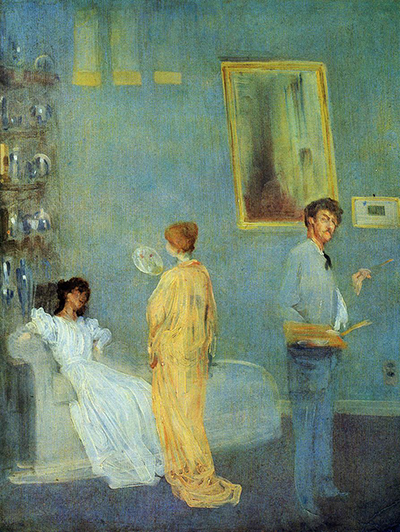
Whistler stands at the right with palette and brush. Joanna Hiffernan sits on a white sofa at the left, while a second woman turns her back in a trailing flesh-pink robe. Porcelain, wall hangings and a tilted mirror turn the room into a carefully staged claim about the modern artist and his materials.[1][5]
The picture is neither a literal record of one sitting nor the monumental group Whistler planned for the 1866 Salon. Infrared imaging reveals an earlier man beneath the standing woman, and the surface combines campaigns separated by decades. Its incompletion is historical evidence, not a defect that must be explained away.[2][6]
At a Glance
- CatalogueYMSM 063
- Dates1865/early 1870s; head revised 1895
- SupportOil on paper mounted on wood panel
- FiguresWhistler, Joanna Hiffernan and an unidentified model
- SignatureButterfly in cartouche; no inscription
- YMSM dimensions62.9 × 46.4 cm
- AIC measurementsBoard 62 × 46.5 cm; overall 63 × 47.3 cm
- CollectionArt Institute of Chicago, 1912.141
- FrameWhistler-style, c.1911; not original
- DisplayNot on view; no gallery assigned
Contents
- The painting at a glance
- Which studio painting is this?
- A title with a long afterlife
- Why the date is not simply 1865–66
- Whistler's five-person plan
- What infrared imaging found
- Joanna Hiffernan on the sofa
- Who is the standing woman?
- The 1868 diary and its limits
- A vertical choreography
The painting at a glance
The catalogue raisonné describes oil on paper mounted on wood panel, measuring 62.9 × 46.4 centimetres. The Art Institute's current record gives the board as 62 × 46.5 centimetres and the overall mounted object as 63 × 47.3. These attributed measurements concern the same small vertical painting.[1][4]
Whistler wears a pale-grey jacket above a white shirt and short black cravat, with darker-grey trousers below. He looks out while holding a compact palette and brush; the easel or canvas at which he works lies beyond the right edge. His pose makes painting present without showing its immediate product.[1][15]
At left, Hiffernan sits in white on a white sofa and looks towards the standing woman. The second model, seen mostly from behind, raises a white fan towards her face. Her pale robe descends in a long train against the light-brown floor, bridging the seated figure and painter.[1]
Which studio painting is this?
This is YMSM 063, the Chicago picture now titled The Artist in His Studio by its museum. It is not YMSM 062, The Artist's Studio, a separate oil sketch at Dublin City Gallery the Hugh Lane. Similar people and purpose do not make the two supports one object.[1][8]
Both paintings relate to a far larger composition Whistler intended for the Paris Salon of 1866. A letter of 16 August 1865 says that he had made a sketch and planned a vertical work around ten feet high and six or seven feet wide. The proposed scale dwarfed both surviving studies.[2][7]
No secure evidence shows that this monumental canvas was completed. Hugh Lane later claimed that the Chicago picture was painted from the Dublin sketch, which would make it the second and more developed version. Because both remain unresolved and the claim is retrospective, their precise order should stay open.[2][8]
A title with a long afterlife
YMSM now prefers The Artist in his Studio (Whistler in his Studio). The parenthetical phrase helps distinguish YMSM 063 from the Dublin work. The Art Institute uses The Artist in His Studio, a historically grounded title that appeared in an 1889 description.[1][3]
Whistler called it Studio in 1892. David Croal Thomson referred to the “Atelier” picture in 1893, and the Society of Portrait Painters exhibited it as An Interior that year. Goupil used In the Studio in 1898; the 1905 memorial exhibition called it Whistler in his studio.[1][17]
Those names successively stress place, genre or self-portrait. They do not mark a chain of different paintings. Retaining both “Artist” and “Whistler” is useful because the image is at once a general performance of artistic work and a recognisable self-representation.[1][3]
Why the date is not simply 1865–66
Whistler's August 1865 letter supplies the first firm checkpoint. It describes a studio sketch with chosen colours and named people. The Art Institute's short public display date, 1865–66, captures that initial campaign but not everything visible or documented in the object.[4][7]
The catalogue raisonné dates YMSM 063 “1865/1872, 1895.” Its butterfly signature is compatible with attention in the early 1870s. A possible 1868 sitting, if connected with this picture, also warns against compressing every passage into the first two years.[1][2][9]
In July 1895 Whistler changed the seated woman's head in Paris. The Art Institute scholarly catalogue accordingly uses 1865/66, 1895. A responsible account keeps all three temporal layers visible: inception in 1865, continuation around the early 1870s and the documented late intervention.[1][5][10]
Whistler's five-person plan
The letter to Henri Fantin-Latour proposed a group of fellow artists and models. Whistler would appear in light grey, Fantin and Albert Moore in black, Joanna Hiffernan in a white dress, and a back-view woman he called “la Japonaise” in a flesh-coloured garment.[7]
Grey studio walls and porcelain would surround the figures. This is already close to Chicago's palette, but the extant surface contains only Whistler and two women. Fantin and Moore must not be inserted into the final arrangement merely because the letter says they belonged to the earlier ambition.[1][2][7]
Whistler announced that the project was his turn—“à mon tour”—to make a gathering of their circle. Fantin had included him in Hommage à Delacroix and Le Toast. The planned studio portrait answered those group statements while moving authorship, collection and costume into Whistler's own room.[7][13]
What infrared imaging found
Infrared reflectography has exposed a seated male figure immediately left of centre. He wears a dark jacket and a black cap or low, round-brimmed hat. Leaning an elbow on the end of the sofa, he turns towards Hiffernan rather than towards the spectator.[2][6]
The standing woman was added later and largely conceals him. Her body does not merely fill a vacant place; it revises the social composition. A male participant in conversational relation with Hiffernan became a back-view model who divides the sofa from Whistler.[2][6]
Fantin-Latour and Moore are obvious candidates because of the letter, yet imaging cannot identify the concealed man. No trace of the other planned male or an alternative position for the standing woman survives. Thorough scraping is possible, but a possible erasure is not evidence of a particular person.[2][6][7]
Joanna Hiffernan on the sofa
The seated woman is Joanna Hiffernan. Whistler's 1865 plan calls her Jo and specifies her white dress, while catalogue scholarship confirms her place on the sofa. Her identity is much firmer than that of either the standing figure or the infrared man.[1][7][14]
Hiffernan was an Irish-born adult partner, model and collaborator. She sustained poses, managed practical affairs and participated in the artistic life around Whistler. Calling her only a “mistress” turns one relationship label into a substitute for the labour and agency relevant to the painting.[14]
Here she is neither an anonymous white accent nor a straightforward portrait sitter. Her face is small, and Whistler revised it late, but her body anchors the sofa and the exchange of gazes. She looks up towards the standing model, binding two different posing roles within the studio.[1][5]
Who is the standing woman?
Whistler's phrase “la Japonaise” names a theatrical role within the colour plan. It does not document a Japanese sitter. The figure's light-brown hair, local studio context and costume show that nationality cannot be read directly from the back-view pose or robe.[1][7][14]
Emelie “Millie” Eyre Jones is a plausible identification. Jones posed for Whistler and other artists in this period, and the Pennells later associated the two women with the models for Symphony in White, No. 3. Nevertheless, plausible overlap is weaker than a named contemporary identification.[1][9][15]
The safest description therefore separates person and role. A currently unidentified model performs the figure Whistler called “la Japonaise”; she may have been Millie Jones. This wording preserves the period evidence without turning costume into ethnicity or probability into fact.[1][7][9]
The 1868 diary and its limits
Mary Glenn Perine visited Whistler's mother in July 1868 and recorded a model posing in Chinese drapery. She identified the woman through a husband described with a period entertainment label. The sitting may relate to YMSM 063 and may point towards Millie Jones.[1][9]
Perine's phrase “Ethiopian minstrel” belongs to the history of blackface performance, not to Ethiopian nationality. Millie was married to performer Frederick Henry Robson, who worked in minstrel entertainment. Explaining that context is necessary because neutral repetition would preserve the diary's racial fiction.[9][14]
Even this biographical fit does not close the identification. Perine did not supply a catalogue number, and “Chinese drapery” differs from Whistler's earlier “Japonaise” vocabulary. The diary is valuable evidence for studio modelling and unstable costume labels, but only conditional evidence for this exact figure.[1][9]
A vertical choreography
The small panel divides its people into three unequal zones. Hiffernan's low seated body stretches horizontally at left; the standing woman's robe rises through the middle; Whistler forms a narrower upright at right. Their heads ascend in steps, while the robe's train brings the central vertical back to the floor.[1][5]
The standing figure faces away, Hiffernan looks across, and Whistler looks outward. These directions prevent a single legible conversation. Instead, the viewer encounters a chain of attention whose missing endpoint may be the unseen canvas beyond the frame or the mirror-mediated position from which Whistler watched himself.[1][15]
The composition is therefore organised, not casually observed. Models hold assigned poses, props occupy selected shelves, and Whistler stages his own act of making. “In the studio” names a constructed performance of work rather than an unfiltered glimpse behind the scenes.[5][14]
The mirror and the absent easel
A large mirror hangs behind Whistler, tilted forward and rendered with streaky reflections. Unlike the shelves, it does not offer a neat inventory of the room. Its uncertain image makes the studio seem deeper while reminding viewers that representation can turn, reverse and obscure what it records.[1][5]
The Pennells said Whistler painted himself from the mirror because the brush appears in his left hand. A reflected self-image reverses apparent handedness. The detail should not be used to diagnose how he usually painted; it is evidence for the picture's optical construction.[2][15]
The easel remains outside the image. Viewers see painter, instruments and mirror but not the painted surface receiving his touch. This absence makes us occupy something like the canvas's place, even as the reflected brush warns that the geometry cannot be solved as one transparent viewpoint.[5][15]
Whistler's clothing and tools
Pale-grey jacket, white shirt and darker trousers place Whistler inside the room's restrained key. The short black cravat punctuates his torso. He does not dress as a labourer in paint-stained clothes; his appearance joins work with controlled self-presentation.[1][5]
The Pennells remembered a small palette with raised edges capable of retaining very liquid paint. That practical design suits the thin applications visible across the picture. As retrospective biography, the recollection should support rather than replace the Art Institute's material examination.[6][15]
Brush and palette identify professional activity, yet Whistler's gaze gives the pose a second task. He is both maker within the image and author presenting himself to viewers. The work displays mastery less through a completed canvas than through his command of people, colour, objects and reflection.[5][12]
Porcelain on the shelves
Four wall shelves carry blue-and-white Chinese porcelain behind the sofa. Their repeated light bodies and dark-blue marks extend the room's grey-white structure while also displaying Whistler's collecting practice. The vessels are material possessions, not a generic symbol detached from trade and ownership.[1][5]
Porcelain helped make Lindsey Row into an Aesthetic interior. A later photograph reproduced by the Pennells shows related wall arrangements, though it cannot prove that every surviving object occupied the exact painted position in 1865. Studio decoration was revised just as the composition was.[1][15]
Calling the shelves merely “Oriental” would erase useful distinctions. These objects are identified as Chinese blue-and-white wares. The back-view robe received Japanese and Chinese labels in different sources, while the narrow wall forms remain less securely classified.[1][5][14]
Frames or hanging scrolls?
Three tall narrow forms hang high on the left wall. An older Art Institute label called them Japanese scrolls, but the catalogue raisonné describes picture frames or hanging scrolls. Their shape supports either possibility more securely than their internal detail supports a national attribution.[1][4]
The uncertainty is productive. It shows how quickly a staged studio can be converted into a checklist of “Eastern” signs. Close description should not make an object more specific than the surface allows merely to complete a familiar account of Japonisme.[1][14]
A small framed image also hangs just beyond Whistler's head. It may be an etching, photograph or picture. Its unresolved content matters less than its scale: a tiny image sits beside the living painter and beneath the much larger mirror, creating three distinct modes of representation.[1][5]
Beyond “East meets West”
An earlier museum label described Whistler harmonising Western and Eastern artistic elements. The formulation recognises his deliberate combination of Velázquez, Chinese porcelain and Asian-associated costume, but its clean binary conceals how these things reached a London household.[4][5]
Porcelain, fabrics and images circulated through commercial networks bound to empire and uneven access. The standing model was most probably European or British, performing an invented role for a male artist and market. The studio did not contain two self-contained civilisations meeting as equals.[9][14]
Formal harmony remains real: blue-white ceramics, grey walls and the robe interact beautifully. Yet beauty does not neutralise provenance, naming or labour. Reading material history alongside colour relations produces a richer account than either condemnation without looking or looking without context.[5][14]
The example of *Las Meninas*
Whistler's standing pose invites comparison with Velázquez in Las Meninas: both artists hold palette and brush amid figures in an interior where a mirror complicates seeing. The flash of Whistler's shirt also echoes the light accent across Velázquez's darker figure.[1][5][12]
Whistler had not seen the Madrid painting itself, but he owned a photograph of a detail. Photographic knowledge could transmit pose and composition while changing scale, tone and cropping. The comparison therefore depends on mediated looking, which suits YMSM 063's own interest in mirror and absent canvas.[1][12]
This is not a claim that Whistler copied every part of Velázquez's design. The seventeenth-century court picture and the nineteenth-century Lindsey Row studio organise different social worlds. Invoking the precedent helped place an American-born artist in a European lineage and advertised ambition through recognisable visual authority.[5][12]
Fantin-Latour and the artist group
Fantin-Latour's Hommage à Delacroix assembled artists and writers around a portrait of the dead painter. Le Toast staged another gathering, and Whistler appeared in Fantin's group imagery. The 1865 “my turn” letter makes this exchange more direct than a general resemblance.[7][13]
Whistler's proposed picture would have relocated the group into his own studio and integrated two women, porcelain and costume. Men in black would join Whistler in grey; Hiffernan's white and the other model's flesh pink would widen the colour scheme beyond the sober fraternity.[7]
The surviving Chicago version changed that social claim. The artist colleagues vanished from the visible surface, while a concealed man survives only under imaging. What remains is less an artists' assembly than a self-image built through the posed and partly anonymised labour of women.[2][6][14]
Gendered work in the studio
Whistler stands and paints. Hiffernan sits, the central woman models from behind, and both wear arranged dresses. Their poses supplied the bodies, colour fields and sustained physical work that allowed him to perform artistic authority.[1][14]
This division does not require invented suffering or psychological story. It is visible in roles and supported by the documentary record of sittings. Naming Hiffernan and grading the Jones hypothesis restores some history without pretending the picture gives equal biographical access to every participant.[9][14]
The composition also turns one woman away and makes the other's face a late revision. Whistler's identity is comparatively stable while theirs is vulnerable to labels such as “Japonaise” or “model.” Formal analysis should notice how this asymmetry helps the artist's self-representation function.[5][14]
The prepared red foundation
Art Institute analysis found a red ground containing iron-oxide red mixed with lead white. Although little of this foundation reads as an obvious red field, it sits beneath the greys and browns and changes their optical warmth.[6]
Whistler then applied a relatively substantial pale-grey layer in long vertical strokes. Some passages received a darker bluish grey. These broad applications remain exposed to different degrees, supplying much of the final studio atmosphere rather than serving only as hidden preparation.[2][6]
The method makes “grey wall” an accumulation, not a single flat colour. Ground, vertical body colour and local bluish adjustment create a responsive base on which thinner brown passages and sharper details could operate.[6]
The wiped brown veil
Once the grey layers were dry, Whistler spread very thin, medium-rich translucent brown over much of the surface. He wiped it back so that lighter paint emerged more strongly in some places than others. Subtraction helped generate the final distribution of light.[2][6]
This veil binds the interior without making every object identical. Where brown remains, it warms or dims the grey; where it was removed, pale structure comes forward. The room's muted unity is therefore a product of layered opacity and transparency.[6]
The process also explains why the panel can look both atmospheric and physically worked. Long grey strokes, rubbed translucent colour and later discrete marks remain legible at once. Smooth harmony does not mean the surface lacks sequence or resistance.[2][6]
Pigments and paint consistency
The analysed palette includes lead white; red, yellow and brown iron oxides or earths; vermilion; cobalt and ultramarine blues; and bone black. These findings belong to YMSM 063 and should not be treated as an automatic recipe for every Whistler painting.[6]
Added medium made parts of the paint very fluid. Elsewhere Whistler used more bodied colour in deliberate strokes with ridges of low impasto. The difference between liquid spread and creamy accent lets a restricted palette describe cloth, skin, ceramic shine and frame edges.[2][6]
Material restraint is not material simplicity. Reds underlie greys; two blues coexist; black and earth colours adjust temperature; and transparent brown changes exposed pale paint. The subdued visual result depends on multiple pigments and consistencies working in relation.[6]
How the figures were built
The figures were generally painted rapidly in wet-into-wet sessions. Their abbreviated bodies belong to a sketch process, yet the sequence was not instantaneous. The sofa paint dried before Whistler laid in the seated woman's dress, and the standing figure arrived later.[6]
That order supports the infrared account. Hiffernan, sofa and concealed man belonged to an earlier configuration; the central back-view body changed both design and social emphasis. Revision was structural rather than a final cosmetic correction.[2][6]
Creamier separate strokes pick out the women's folds, Whistler's shirt and faces. Related touches sharpen porcelain highlights and gold-coloured frame edges. The same kind of concentrated mark moves between human clothing and collected object, tying the room together without confusing their materials.[2][6]
The unfinished sofa head
A reproduction in the Pall Mall Budget on 2 February 1893 records the seated woman's head before its last campaign. The image shows that the problem remained visible after decades of ownership, proposed sale and intermittent attention.[2][5]
Edward G. Kennedy noted on 12 July 1895 that Whistler was to “put a head” on the sofa woman. Whistler then told his brother that he had touched up the little head in Paris. These statements identify the late hand as the artist's.[10]
The intervention should not be called routine conservation. It altered the representation, whereas a separate 1893 treatment addressed dirt and varnish. Authorship, purpose and date distinguish Whistler's head from both old retouching and later museum care.[6][10][11]
What changed in 1895?
Kennedy wanted the woman's face and hands finished while preserving tonality. Whistler resisted the language of improvement, insisting in effect that the picture's artistic quality did not need enhancement. Their exchange sets market legibility against the artist's defence of an unresolved aesthetic.[10]
Technical examination shows the head is more densely painted than the other figures. Its relatively matte, fluid paint appears solvent-thinned and overlaps the neck of the dress. The physical boundary confirms that the face sits on top of the earlier costume campaign.[6]
“Finished in 1895” would still be misleading. Whistler revised one conspicuous area, but earlier paint and unresolved passages remain integral. The long date describes accumulated decisions; it does not turn the late head into a certificate that every part had reached a final state.[1][5][6]
Cleaning and varnishing in 1893
On 4 May 1893 Whistler instructed restorer Stephen Richards to clean the “Studio” very delicately, remove dirt and varnish it beautifully. His anxious wording shows concern for a thin and vulnerable surface, although it is an artist's instruction rather than a complete treatment report.[11]
Francis Prange wrote later that month that the picture had spent a week with Richards, was certainly improved and was being advertised for sale. Improvement here is interested testimony from a commercial context, not a measured account of what material was removed or added.[11]
Keeping 1893 and 1895 apart prevents a common confusion. Richards cleaned and varnished the object; Whistler subsequently repainted the woman's head. One campaign altered surface coating and appearance, the other changed the image through new artist paint.[6][10][11]
The present surface
The Art Institute reports an overall natural-resin varnish. Yellowed resin residues remain in recesses of the paint texture from an earlier cleaning, and an additional varnish applied later contributes to an even, satiny sheen.[2][6]
Minor paint loss, damage and retouching are also present. Nevertheless, the museum's technical assessment describes the painting as in good condition overall. This balanced account is more useful than either declaring an untouched surface or implying that treatment has ruined it.[6]
Varnish inevitably affects the colours now seen, particularly the transparent browns and pale greys. Conservation history is therefore part of interpretation: today's tonal unity contains Whistler's layers, ageing resin, cleaning residues and subsequent care.[6][11]
Signature and frame
A butterfly in a cartouche appears on the wall at the middle or lower right. The Art Institute records it as the artist's insignia, while YMSM lists no inscription. The mark belongs to Whistler's developing signature practice rather than supplying a written title or date.[1][4]
The butterfly's form supports attention in the early 1870s, but it cannot date every stroke. It is one checkpoint within the longer technical and documentary sequence. The 1895 head, for example, remains later even though no new signature advertises it.[1][2]
The present Whistler-style frame dates to about 1911. “Whistler-style” describes its relationship to frames associated with the artist; it does not prove that he designed, selected or saw this example. It should not be called the original 1865 frame.[1][2]
Exhibitions under changing names
The picture was described as The Artist in his Studio in connection with an 1889 retrospective at the College for Working Men and Women. In 1893 the Society of Portrait Painters showed An Interior, while the Goupil Gallery used In the Studio in 1898.[3][17]
Bradford returned to The Artist in his Studio in 1904. The 1905 International Society memorial exhibition preferred Whistler in his studio. These appearances made the small, long-worked object public through titles emphasising interior, action or identity.[3][17]
Exhibition does not prove final completion. The 1893 display coincided with an image showing the unresolved head, and Whistler altered it two years later. Public presentation and continued making could coexist.[2][5][17]
Sale attempts and the artist's brother
William McNeill Whistler, the artist's brother, was associated with the picture and attempts to sell it by the early 1890s. Correspondence places it with Goupil in 1893 before its return, but the exact early transfer from James to William is not documented securely enough for an unqualified gift date.[3][10]
James continued assisting with sale efforts. In 1894 he hoped Théodore Duret might find a buyer, while the 1895 head intervention occurred amid Kennedy's concern that the figure should read more completely. Commercial circulation formed part of the painting's late revision history.[10]
The correspondence annotation records a sale to Goupil for £400 in December 1896. Douglas William Freshfield owned the work by 1897. The sequence is firmer than the precise circumstances under which the artist or his brother first relinquished title.[3][10]
From London dealers to Chicago
Brown and Phillips handled the picture in London in 1911. It was then associated with Henry Reinhardt's New York exhibition in November of that year. This transatlantic dealer route brought the studio self-image into the market from which Chicago patrons acquired it.[3][17]
The Friends of American Art had formed to obtain significant paintings for the Art Institute. The museum's annual report records The artist in his studio as presented by the group on 24 January 1912. Its accession number preserves that history: Friends of American Art Collection, 1912.141.[4][16]
The Art Institute remains the secure owner. Its current API, checked on 25 August 2026, reports that the painting is not on view and assigns no gallery. Visitors should consult the museum again before travelling rather than relying on an invented permanent room.[4]
Why the picture matters
YMSM 063 condenses an ambitious unrealised group into a small object that never stopped changing. The hidden man, added standing woman, early-1870s signature and 1895 head make revision visible as a social as well as material history.[1][2][6]
It also stages the artist's identity through other people's work and collected things. Hiffernan's named presence, the unknown model's held pose, Chinese ceramics, imported clothing and a reflected self allow Whistler to appear as the organising intelligence of a cosmopolitan studio.[5][14]
The painting's restraint should not be confused with simplicity. Red ground, grey body layers, wiped brown glaze, creamy accents, varnish and late paint create the muted room. Formal harmony, cultural traffic, gendered labour and artistic self-fashioning occupy the same surface.[6][14]
Route and image status
The retained local route is `/james-whistler/whistler-in-his-studio/`. It currently redirects to the paintings hub, although a local HTML shell preserves its title and canonical structure. A later implementation should restore the artwork as a standalone page rather than discard its route identity.[18]
The local image file resolves as `Whistler in his Studio James Abbott McNeill Whistler.jpg`. Resolution means the asset exists and belongs with the route; it does not settle reproduction rights, image quality or final publication treatment.[18]
No inherited prose has been carried into this account because the local body is empty. The research-led article supplies the missing public substance while remaining an editorial artifact. No live HTML, redirect, canonical, sitemap, hub, search record or image file has been changed.[18]
Frequently Asked Questions
It belongs to the Art Institute of Chicago as Friends of American Art Collection 1912.141. The museum's live object data checked on 25 August 2026 says it is not currently on view and gives no gallery.[4]
Discussion
What makes this studio image feel constructed rather than simply observed?
Trace the mirror, absent easel, palette, shelves, sofa and three figures, then ask how reflection and revision reorganise the apparent snapshot.
Reader Insights
How does reflection explain the brush in Whistler's apparent left hand?
Which visible passages suggest the red ground, pale grey structure and wiped brown veil?
How are painter, seated partner and back-view model assigned different studio positions?
Join the Conversation
Share a close observation or an object-history question.
References
- Margaret F. MacDonald and Grischka Petri, “The Artist in his Studio (Whistler in his Studio),” YMSM 063, The Paintings of James McNeill Whistler: A Catalogue Raisonné, University of Glasgow, 2020. https://www.whistlerpaintings.gla.ac.uk/catalogue/display/?mid=y063&xml=sub
- Margaret F. MacDonald and Grischka Petri, “The Artist in his Studio (Whistler in his Studio): Technical Description,” YMSM 063, University of Glasgow, 2020. https://www.whistlerpaintings.gla.ac.uk/catalogue/display/?mid=y063&xml=tec
- Margaret F. MacDonald and Grischka Petri, “The Artist in his Studio (Whistler in his Studio): History and Bibliography,” YMSM 063, University of Glasgow, 2020. https://www.whistlerpaintings.gla.ac.uk/catalogue/display/?mid=y063&xml=his
- Art Institute of Chicago, “The Artist in His Studio,” artwork 65709, Friends of American Art Collection 1912.141, API record checked 25 August 2026. https://www.artic.edu/artworks/65709/the-artist-in-his-studio
- Stephanie L. Strother, “Cat. 8 The Artist in His Studio, 1865/66, 1895: Curatorial Entry,” in Whistler Paintings and Drawings at the Art Institute of Chicago, Art Institute of Chicago, 2020. https://publications.artic.edu/whistlerart/reader/paintingsanddrawings/section/76/76_anchor/p-76-2
- Kimberley Muir, “Cat. 8 The Artist in His Studio, 1865/66, 1895: Technical Summary,” in Whistler Paintings and Drawings at the Art Institute of Chicago, Art Institute of Chicago, 2020. https://publications.artic.edu/whistlerart/reader/paintingsanddrawings/section/76/76_anchor/p-76-12
- James McNeill Whistler to Henri Fantin-Latour, 16 August 1865, GUW 11477, The Correspondence of James McNeill Whistler, University of Glasgow. https://www.whistler.arts.gla.ac.uk/correspondence/people/display/?cid=11477
- Margaret F. MacDonald and Grischka Petri, “The Artist's Studio,” YMSM 062, University of Glasgow. https://www.whistlerpaintings.gla.ac.uk/catalogue/display/?mid=y062&xml=sub
- Mary Glenn Perine, diary entry, 20 July 1868, Maryland Historical Society Library, as documented in YMSM 063 and Art Institute catalogue scholarship.
- James McNeill Whistler, Edward G. Kennedy and William McNeill Whistler correspondence, 1893–95, including GUW 09732, 07017, 07257 and 07258, University of Glasgow.
- James McNeill Whistler to Stephen Richards, 4 May 1893, GUW 10718; Francis Gerard Prange to Whistler, 27 May 1893, GUW 05032, University of Glasgow.
- Diego Velázquez, Las Meninas, Museo Nacional del Prado; albumen detail photograph owned by Whistler, Glasgow University Library PH3/8. https://www.museodelprado.es/en/the-collection/art-work/las-meninas/9fdc7800-9ade-48b0-ab8b-edee94ea877f
- Henri Fantin-Latour, Hommage à Delacroix and Le Toast, Musée d'Orsay collection records. https://www.musee-orsay.fr/en/artworks/hommage-delacroix-1123
- Margaret F. MacDonald et al., Whistler, Women and Fashion, New Haven and London, 2003; MacDonald, ed., The Woman in White: Joanna Hiffernan and James McNeill Whistler, Washington and New Haven, 2020.
- Elizabeth Robins Pennell and Joseph Pennell, The Life of James McNeill Whistler, revised ed., London and Philadelphia, 1911, p. 129; The Whistler Journal, Philadelphia, 1921.
- Art Institute of Chicago, Thirty-third Annual Report for the Year 1911–12, p. 62; Sarah Kelly Oehler, “A Chicago Boy: The Second City Meets James McNeill Whistler,” Art Institute of Chicago, 2020. https://www.artic.edu/files/aa94558c-aa50-436b-9035-456e2683b692/N530_.A3_1911-12.pdf
- College for Working Men and Women retrospective, 1889; Society of Portrait Painters, 1893; Goupil Gallery, 1898; City of Bradford Exhibition, 1904; Whistler memorial exhibition, New Gallery, 1905, as catalogued in YMSM 063.
- James McNeill Whistler Waterhouse+ route, redirect, image, carryover, inherited-prose and protected-live inventories, frozen 25 August 2026.


