


 by Tom Gurney
Tom Gurney BSc (Hons) is an art history expert with over 20 years experience
Published on November 6, 2026 / Updated on November 6, 2026
Email: tomgurney1@gmail.com / Phone: +44 7429 011000
In November 1878 James McNeill Whistler brought John Ruskin before a special jury in the Queen's Bench Division of the High Court. The artist objected to language published by Britain's most influential art critic after the first Grosvenor Gallery exhibition. Ruskin had linked Whistler's work and price to impudence, ill education and something approaching imposture. Whistler argued that the attack crossed the boundary between severe criticism and professional defamation.[1][3][8]
The jury found for Whistler but awarded one farthing, then the smallest British coin and one quarter of a penny. That combination produced the case's durable ambiguity. Whistler could claim that Ruskin's language was libellous; he could not claim substantial compensation or recover the expense that had made the action worthwhile. Ruskin's supporters treated the nominal award as a moral victory, while Whistler turned the trial into a publication and eventually a founding episode in his public legend.[1][12][14]
The familiar story is often compressed into a duel between old criticism and modern art. The evidence is more exacting. Ruskin was absent through illness. Several paintings, not just Nocturne in Black and Gold: The Falling Rocket, entered the argument. Witnesses disagreed about finish, labour, originality and price without forming two perfectly unified camps. The court's task was civil libel, not the permanent certification of an artistic movement.[1][2][11][14]
The financial aftermath is also routinely simplified. Trial costs contributed to Whistler's collapse, but the White House, building accounts, unstable income and accumulated liabilities were already pressing. Bankruptcy came in May 1879; the sale of effects followed in February 1880. A documentary account must keep legal victory, nominal damages, financial damage, publicity and artistic afterlife separate.[10][16][17]
At a Glance
- Criticism published2 July 1877
- PublicationFors Clavigera, Letter 79
- ActionCivil libel
- Trial25–26 November 1878
- CourtQueen's Bench Division, High Court
- JudgeBaron Huddleston
- VerdictFound for Whistler
- DamagesOne farthing
- Immediate publicationArt & Art Critics, December 1878
- Featured paintingThe Falling Rocket, Detroit 46.309
Contents
- The Grosvenor Gallery in 1877
- What Ruskin wrote in Fors Clavigera
- From adverse review to libel action
- Delay, illness and an absent defendant
- The court, counsel and surviving record
- Whistler explains a nocturne
- Witnesses for Whistler
- Ruskin's defence and its witnesses
- What the jury decided
- One farthing, costs and the hollow victory
The Grosvenor Gallery in 1877
Sir Coutts Lindsay's Grosvenor Gallery opened in New Bond Street as an alternative to the Royal Academy's selection and display system. Its first summer exhibition in 1877 brought together artists associated with Aestheticism and newer modes of decorative or poetic painting. The gallery's group hang gave Whistler unusual visibility, but it also made repeated titles, restricted palettes and unconventional finish easy targets for comparison.[3][20]
Modern catalogue work reconciles seven Whistler oils in the exhibition, with Arrangement in Grey and Black, No. 2: Portrait of Thomas Carlyle shown outside the main catalogue in the entrance gallery. The group included several nocturnes, a portrait of Henry Irving, and arrangements in black, amber and brown. Whistler's own first-day testimony described eight works because he counted the Carlyle portrait among what viewers encountered.[2][20]
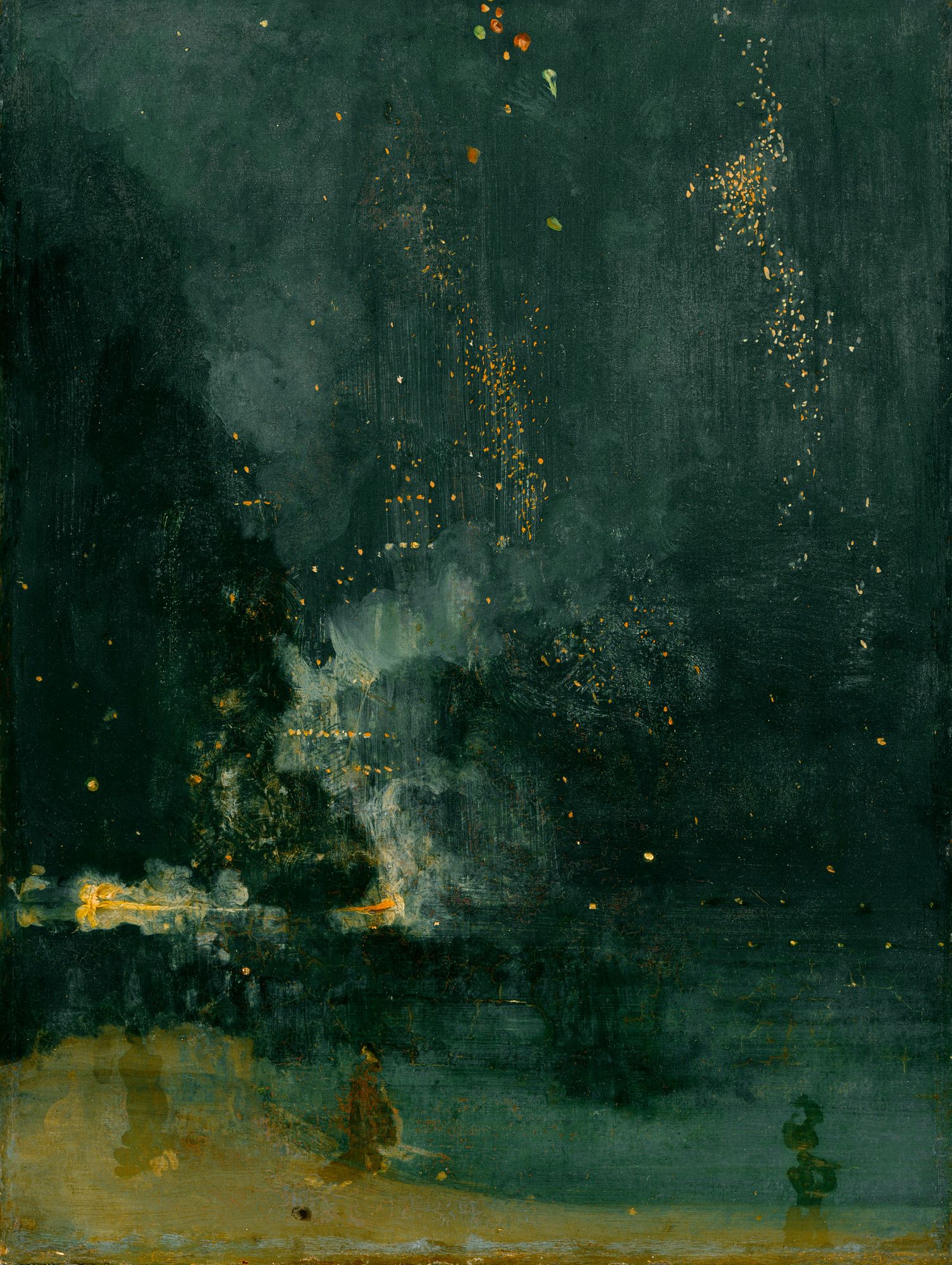
The nocturnes were not one interchangeable series. Nocturne in Blue and Silver (YMSM 113), Nocturne: Blue and Gold—Old Battersea Bridge (YMSM 140), Nocturne: Grey and Gold—Westminster Bridge and The Falling Rocket had different subjects, owners and sales histories. Some had already been sold, exchanged or given; The Falling Rocket remained Whistler's and was offered for 200 guineas.[2][4][6][7]
That price became legally and rhetorically important. A guinea was twenty-one shillings, so 200 guineas equalled £210. In the courtroom Whistler called it a “stiffish” price but maintained that it was fair. The charge was not that every Whistler picture carried the same figure. The exhibited Falling Rocket was the unsold nocturne offered at that amount.[2]
The painting now belongs to the Detroit Institute of Arts, accession 46.309. The museum records oil on panel, dated 1875, measuring 60.3 by 46.7 centimetres unframed. Sparks and smoke emerge from the darkness of Cremorne Gardens, but the painting does not present a detailed topographical inventory. That difference between a subject and a descriptive view became explicit under cross-examination.[4][5]
The new gallery also changed the politics of attention. Its comparative rooms placed Whistler near Edward Burne-Jones and other artists whose work the Royal Academy system did not adequately frame. Critics could treat that concentration as evidence of a coherent new tendency, even where the exhibitors held different ideas. Ruskin's review addressed not only isolated surfaces but the institution's claim to improve public art knowledge.[3][20]
Whistler had designed frames and titles to make his group read as arrangements rather than as unrelated commodities. That display strategy helped viewers see recurring colour and form, but it also invited the charge of repetition that Ruskin raised against grouping one artist's habitual devices together. The exhibition context therefore shaped both Whistler's aesthetic advantage and Ruskin's objection.[3][20]
Ruskin and Whistler did not meet at the gallery or confront each other afterwards. Indeed, they had never met. The dispute travelled through images, prices, publication, solicitors, witnesses and newspapers. Representing it as a personal scene in front of the canvas gives drama at the cost of the documentary record.[1][3]
What Ruskin wrote in Fors Clavigera
Ruskin published his response in Letter 79 of Fors Clavigera, dated 2 July 1877. Fors was a serial of letters addressed to the workers and labourers of Great Britain, not a conventional newspaper review column. Its criticism of the Grosvenor Gallery sat inside a broad argument about honest work, artistic education, patronage, price and the moral organization of society.[3]
He did not reject the gallery wholesale. Ruskin acknowledged its founder's wish to assist artists, praised work he considered serious and questioned the building's upholstery, management and hanging. His standard joined visual judgment to moral economy. Repeated facility could look like habitual fault; commerce could reward dexterity detached from patient knowledge.[3]
Within that framework Whistler became Ruskin's negative example. The celebrated sentence accused a “coxcomb” of charging 200 guineas for “flinging a pot of paint” at the public. The surrounding paragraph was more damaging than the isolated joke suggests. It characterized Whistler's conceit as ill educated and brought his work close to wilful imposture.[3][8]
The distinction matters in law and history. A reader might dismiss “pot of paint” as hyperbolic ridicule. An assertion approaching imposture could imply conscious deception and therefore attack professional character. Whistler's legal team focused on the cumulative passage, its circulation and Ruskin's authority, not merely on injured feelings about one colourful phrase.[1][8]
Ruskin's criticism addressed the displayed Whistler group, but the price remark gave it a specific anchor in The Falling Rocket. Later accounts sometimes assign the attack instead to Old Battersea Bridge, partly because several nocturnes were produced in court and the titles have been confused. Current catalogue identities and the trial transcript keep YMSM 113, YMSM 140 and YMSM 170 distinct.[2][4][6][7]
Ruskin's position was not simply that art required many visible brushstrokes. He connected price to labour, training, truth and service, and suspected a market that rewarded fashionable audacity. That philosophy had supported his long defence of Turner and the Pre-Raphaelites in other circumstances. Its application to Whistler was severe, but caricaturing Ruskin as an enemy of all innovation misses the values he believed he was protecting.[1][3][15]
From adverse review to libel action
Whistler did not claim that artists should be free from negative criticism. He later testified that pictures placed in exhibitions invited judgment and that he would not complain merely because another person took a different view. His case was that Ruskin had passed from technical or aesthetic criticism to degrading personal imputation.[1][2]
Professional injury was central. Ruskin was Slade Professor of Fine Art at Oxford and the author of Modern Painters and The Stones of Venice. His judgments carried unusual cultural and commercial weight. Whistler's solicitors gathered evidence that newspapers repeated the passage and reported the intended lawsuit, amplifying the criticism beyond subscribers to Fors Clavigera.[8]
Publication also had a distinctive paper trail. Ruskin controlled the distribution and pricing of his writings through George Allen. Whistler's lawyers investigated authorship, supply and the circulation of the particular number. In a libel claim, proving that the defendant was responsible for words communicated to others mattered alongside demonstrating harmful meaning.[8]
The action began in 1877. Pleadings and preparatory notes show lawyers asking how to frame injury to an artist whose reputation affected sales, invitations and commissions. The amount eventually awarded should not be read backward as proof that no plausible risk existed. It records what the jury concluded after trial, not what was irrational to allege beforehand.[1][8]
Whistler also pursued a public objective. A lawsuit could force a prominent critic's wording into a forum where witnesses, pictures and press reports met. It offered the possibility of legal vindication and publicity. That strategy carried a serious risk: cross-examination would expose his prices, working time, sales history and claims about finish to ridicule.[1]
The defence relied on the privilege traditionally afforded fair criticism of publicly exhibited works. The question was not whether Ruskin had to praise the pictures. It was whether the impugned language remained an honest critical judgment on matters offered to the public or became actionable abuse of the artist. Victorian doctrine and courtroom practice should not be collapsed into a present-day social-media standard.[1][14]
Libel translated aesthetic speech into legal elements. The words had to be published, understood as referring to Whistler and capable of injuring him; the defence could contest meaning, damage and the protection due to comment on a public exhibition. Lawyers accordingly cared about the physical Fors issue, newspaper repetition, ownership of the paintings and the standing of witnesses. The case was built from circulation and reputation as much as from brushwork.[1][8]
Malice in this setting did not mean that a jury had to diagnose personal hatred. It concerned whether the defendant's privilege for criticism protected the language under the circumstances pleaded and proved. Because historical legal vocabulary carries technical meanings, modern summaries should avoid turning “fair comment” into a blanket licence or “libel” into proof of a criminal lie.[1][14]
Delay, illness and an absent defendant
The case did not move directly from July 1877 to a prompt hearing. Ruskin became severely ill in 1878, and his solicitors repeatedly sought postponement. Medical certificates and Rose's accounts document delay across the spring and summer. His health was not a convenient fiction added after an adverse verdict.[9][10][15]
On 12 June 1878 Whistler's solicitor James Anderson Rose told Walker Martineau and Company that the artist was sorry to hear of Ruskin's continued illness. Whistler would be unwilling for the cause to be tried without him and agreed to postponement until he could attend. That instruction complicates the later picture of opponents rushing toward theatrical confrontation.[9]
Legal business continued around the delay. Solicitors discussed when Ruskin might recover, arranged production of pictures and prepared witnesses. Rose's bill records lengthy consultations with Whistler, searches, subpoenas and correspondence. In September there were overtures involving costs and an apology, but no settlement removed the need for trial.[10]
By November Ruskin still could not attend. His lawyers said that he had instructed them to proceed without further delay. The distinction is important: he was the defendant and his counsel put the case, but he did not sit in the courtroom to hear Whistler, enter the witness box or personally conduct cross-examination.[1][10][15]
Ruskin's condition must be described at the level the evidence supports. Contemporary records document a grave episode of illness and medical advice against excitement. Later biographers have interpreted his mental and physical state in various ways. A page about the trial has no warrant to offer a retrospective diagnosis or use illness as a metaphor for aesthetic conservatism.[1][9][15]
Absence affected the theatre of the case. Ruskin's published words were present, and witnesses defended the permissibility or substance of his judgment, but the critic could not explain tone or intention directly to the jury. Whistler, by contrast, made his career, methods and personality visible through extensive testimony.[2][14]
The court, counsel and surviving record
The hearing began on 25 November 1878 in the Queen's Bench Division of the High Court and continued the next day. Sir John Walter Huddleston, commonly styled Baron Huddleston, presided with a special jury. This was a civil libel action. Descriptions that say Ruskin was prosecuted, convicted or found guilty import criminal language that does not fit the proceeding.[1][2]
Serjeant John Humffreys Parry and William Comer Petheram appeared for Whistler. Attorney General Sir John Holker and Charles Synge Christopher Bowen represented Ruskin. Their questions made professional reputation, price, labour, finish, critical licence and damage into courtroom issues.[2]
A court-official transcript survives for the first day in the Pennell-Whistler Collection at the Library of Congress and is published by the University of Glasgow correspondence edition. It records Whistler's examination and cross-examination, his supporting witnesses and the opening of the defence before adjournment. It is invaluable, but it is not a complete verbatim record of both days.[2]
Linda Merrill reconstructed the fuller action from this document, legal papers, correspondence and numerous contemporary newspaper reports. Reports vary in compression and phrasing. The famous dialogue familiar from Whistler's own pamphlets sometimes differs from the first-day transcript. Source labels must therefore accompany quotations rather than presenting every memorable line as shorthand taken down in court.[1][2][12][14]
Pictures were brought into court. The Falling Rocket, Old Battersea Bridge and another blue-and-silver nocturne were discussed or shown, alongside portraits and arrangements used to establish Whistler's career. Lighting, distance and eyesight complicated evaluation. The court was not a museum installation designed for the paintings' optimal conditions.[2][6][7]
The judge allowed the defence to amend its pleading so that privilege for criticism covered the pictures exhibited at the Grosvenor Gallery. That procedural move reinforced the group context of Ruskin's paragraph. It did not erase the price-specific focus on the black-and-gold nocturne.[2]
Whistler explains a nocturne
Whistler began by establishing professional standing: training, exhibitions, sales and etching. He described the 1877 works and their ownership. Under pressure from the Attorney General, the biography became evidence that he was a practising artist whose work had a market and a critical history rather than an unknown claimant demanding respect by assertion.[2]
He explained “nocturne” as an arrangement of line, form and colour. Regarding The Falling Rocket, he called it a night picture representing fireworks at Cremorne but “not a view of Cremorne.” That distinction condensed his aesthetic position. The subject prompted the arrangement, while exact topographical information was not the work's governing purpose.[2][4]
The Attorney General examined the 200-guinea price and visible finish. Whistler maintained that the painting was complete and that he intended no further labour. The surviving transcript reports that the main work took a day and that he finished it afterwards. Elsewhere it gives a day to make and another to finish, reflecting compressed note-taking rather than a stable stopwatch account.[2]
His defence of price shifted from duration to expertise. The transcript records him grounding the figure in approximately twenty years of knowledge and calling the way of painting the study of his life. Whistler's December pamphlet sharpened this into the memorable assertion that he charged for the “knowledge of a lifetime.” The idea is continuous; the exact polished formula belongs to publication.[2][12]
That source difference is not pedantry. Whistler understood the publicity value of dialogue. In print, a messy exchange became a precise contest between time-clock labour and accumulated artistic intelligence. The pamphlet's wording has often been returned to the courtroom as if untouched, strengthening the myth of spontaneous triumph.[1][12][13]
Whistler did not argue that rapidity alone guaranteed value. He said the instantaneous work of his hand depended on long study and an arrangement already formed in his mind. Speed was evidence of trained selection, not an excuse for whatever resulted. Whether the jury accepted that valuation is another matter.[2]
He also conceded the public's right to disagree. Exhibiting invited criticism, and he would not object to a different opinion. His narrower complaint concerned language that imputed dishonest or contemptuous conduct. This qualification prevents the trial from becoming an artist's demand to silence everyone who disliked his paintings.[1][2]
Witnesses for Whistler
William Michael Rossetti, a critic and long acquaintance of Whistler, offered support with qualifications. He admired the blue nocturnes and considered the black-and-gold work the product of a conscientious artist, but did not call it an exquisite gem. He thought 200 guineas a full price and, in principle, worth it, while joking that he was too poor to buy.[2]
Rossetti's testimony is valuable because it was not unqualified advocacy. He could defend the painting's artistic status and the legitimacy of its price without pretending every viewer must find it beautiful. That middle position mattered to the libel question: a work could be debatable without being an imposture.[2]
Albert Moore was more emphatic. He regarded Whistler's handling of air and fireworks as exceptionally accomplished and considered 200 guineas reasonable. Moore was himself an exhibiting artist at the Grosvenor Gallery, so the defence could point to shared aesthetic interests. Yet shared context does not invalidate his observation; it identifies the standpoint from which he spoke.[2]
William Gorman Wills combined theatrical writing with painting and had known Whistler for years. He praised the blue-and-silver nocturnes and distinguished fair, honourable criticism from the attack at issue. He had not previously seen The Falling Rocket, which limited the reach of his evidence about that specific canvas.[2]
The three did not form a perfectly synchronized school. Rossetti's restraint, Moore's enthusiasm and Wills's more general defence of originality differ. Their testimony established respectable aesthetic disagreement around Whistler rather than universal acclaim.[2]
Whistler's legal team had sought other supporters, some of whom were reluctant or unavailable. Subpoenas and correspondence expose the social discomfort of turning artistic friendship into sworn evidence. A trial assigns adversarial roles more sharply than studios, galleries and periodicals usually did.[10][11]
Ruskin's defence and its witnesses
The defence case opened at the end of the first day and continued on 26 November. Because the surviving official transcript stops at adjournment, second-day accounts depend heavily on newspaper reports and Merrill's comparison of them. Variations in quoted wording should be acknowledged rather than silently harmonized.[1][2][14]
Edward Burne-Jones, William Powell Frith and Tom Taylor appeared for Ruskin. They did not simply state that Whistler was talentless. The defence explored whether the nocturnes showed sufficient form and finish, whether the price related reasonably to labour and achievement, and how far vigorous criticism of publicly displayed art could go.[1][11][14]
Burne-Jones was close to Ruskin but also an artist central to the Grosvenor Gallery. His evidence recognized qualities in Whistler while questioning completion and value. That ambivalence resists a neat division between progressive Whistler and reactionary opponents. Both men occupied overlapping art-world networks even when their standards differed.[1][14]
Frith represented a more narrative and elaborately finished tradition, making his judgment a useful contrast to the nocturne's economy. Whistler's preparation notes anticipated hostility and tried to expose taste as partisan: artists who detested Frith's subjects and finish might judge him as severely as Ruskin judged Whistler. The point was not that all criticism is bias, but that no witness stood outside artistic preference.[11]
Tom Taylor was an artist, critic, dramatist and editor of Punch. His experience strengthened the defence's argument for critical latitude. At the same time, the case asked whether editorial authority permitted language suggesting that an artist was cheating the public. The jury could defend freedom of criticism yet find a particular imputation excessive.[1][14]
Ruskin himself supplied no testimony. His published paragraph, instructions and reputation structured the defence, but counsel and witnesses had to carry his position. It is therefore unsafe to attribute every courtroom argument directly to him or imply that he personally debated Whistler over the painting's surface.[1][9][14]
The defence witnesses were also judging objects under courtroom constraints. A nocturne designed for a coordinated gallery wall appeared amid legal argument, handling and imperfect viewing. Burne-Jones reportedly found some works more complete than others; Taylor and Frith brought critical standards shaped by their own institutions and practices. Their evidence should be read as positioned evaluation, not as an early referendum with known modernist consequences.[1][14]
Counsel's emphasis on labour made visible a larger Victorian anxiety. If rapid execution could command a high sum, traditional signs of diligence no longer provided a reliable moral index of price. Whistler answered with trained judgment; Ruskin's side insisted that the public could condemn apparent insufficiency. The disagreement was economic as well as optical, which is why the 200 guineas never remained a mere catalogue number.[1][3]
What the jury decided
The special jury found for Whistler. In civil terms, the plaintiff succeeded: the challenged publication was actionable against Ruskin. This legal fact should not be rewritten as a defence verdict merely because the damages were tiny.[1][14][15]
The award was one farthing. Nominal damages recognized a wrong while assigning little measurable compensatory injury. The jury did not give Whistler the substantial sum that would demonstrate a large proven loss to sales or reputation. Nor did the farthing mean that the words became lawful after all.[1][14]
The mixed result allowed immediate competing narratives. Whistler's allies emphasized that Britain's pre-eminent critic had crossed the line. Ruskin's supporters emphasized that a special jury valued the injury at the smallest coin. Newspapers could call it a victory, a rebuke or a warning to both parties depending on which half they foregrounded.[1][14]
The verdict did not ask whether The Falling Rocket would enter a museum, whether abstraction would shape twentieth-century art, or whether Ruskin's whole critical career was obsolete. Those are retrospective stories. The jury addressed a specific published passage under the evidence and law presented in 1878.[1][3][14]
It also did not set a general market price for paintings. Whistler remained free to ask 200 guineas; a buyer remained free to refuse; a critic remained free to call the work poor. The actionable boundary concerned defamatory character and privilege, while damages concerned injury proved. Treating the farthing as a judicial valuation of the panel itself confuses property price with civil remedy.[1]
No party received a clean cultural monopoly. Whistler gained a finding and a phrase he could publicize. Ruskin avoided substantial damages, and his admirers funded the expense. The law clarified one dispute without resolving the aesthetic and economic disagreement that produced it.[1][12][14]
One farthing, costs and the hollow victory
The amount mattered partly because costs dwarfed it. Whistler had paid for more than a year of solicitors' work, picture transport, subpoenas, consultations and counsel. The nominal verdict did not yield useful recovery of those expenses. Legal success therefore arrived as a financial loss.[1][10][14]
Ruskin also incurred costs, but supporters organized a subscription to meet them. The contrasting support structures became part of the case's social meaning. Ruskin possessed a public community ready to defend the critic; Whistler's friends offered testimony and encouragement without an equivalent financial rescue.[1][14]
It is tempting to say the judge made each side pay half, but historical summaries use varying shorthand. The safer documentary conclusion is that Whistler did not obtain the costs recovery that a substantial award might have brought and remained responsible for a crushing burden. The precise allocation is a legal-history question governed by the judgment and contemporary rules, not by the coin alone.[1][10][14]
The farthing itself became a visual and rhetorical object. Whistler could display it as proof that he had won, while opponents could hold it up as the measure of his grievance. Its minute value made it unusually memorable. A conventional damages award might have produced less durable cultural theatre.[12][13]
Financial outcome and reputational effect do not move in parallel. The trial exposed Whistler to mockery, but it also broadcast his account of labour, expertise and artistic arrangement. The claim that price rewarded accumulated knowledge entered later debates far beyond the original pleading. A hollow legal victory could still become a productive publicity asset.[1][12][19]
That longer reach should not be romanticized. Publicity did not pay the immediate bills, and notoriety did not restore every patron. Whistler faced creditors while managing a large new house and irregular income. Myth begins when later fame is projected backward as protection he did not possess in 1878.[1][16]
Nor did nominal damages operate as a fine imposed on Ruskin for possessing the wrong taste. Civil damages addressed Whistler's injury, and their slight amount marked the jury's restrained assessment of that injury. The farthing's symbolism grew because legal finding and monetary measure pointed in different directions. Any account that reports only one side of that relation reverses the form of the verdict.[1][14]
Whistler publishes the trial
Within weeks Whistler issued Whistler v. Ruskin: Art & Art Critics through Chatto & Windus. The brown-paper pamphlet appeared in December 1878 and made the proceeding part of his authored public campaign. Publication moved him from plaintiff answering questions to editor selecting the exchange readers would remember.[12][15]
The text is a primary source for Whistler's immediate interpretation, not a neutral court transcript. It compresses, polishes and arranges. Messy qualifications disappear; dialogue acquires timing; the “knowledge of a lifetime” answer emerges with epigrammatic force. Comparing it with the first-day official record shows how self-fashioning worked at sentence level.[1][2][12]
Whistler included the trial again in The Gentle Art of Making Enemies. The book first appeared in 1890; an altered edition followed two years later. By then the case sat among letters, disputes and attacks that presented the artist as a witty combatant against incompetent criticism. The collection transformed contingent quarrels into a coherent persona.[13]
This does not make the famous lines false. The transcript supports the underlying argument: Whistler did invoke about twenty years of knowledge against a calculation based on time spent at the canvas. What changes is form. A longer courtroom explanation became a portable axiom about artistic value.[2][12][13]
Ruskin's passage underwent a parallel compression. Its moral and institutional context faded, leaving the pot of paint. The two most quotable fragments then appeared to answer one another: pot versus lifetime. That pairing is powerful because it turns a complex libel case into rival slogans. It is also incomplete.[1][3]
Reading the pamphlet critically means holding two facts at once. Whistler was an interested editor who improved his own performance, and his publication is itself part of the historical event. The myth did not merely obscure the trial from outside; the victorious plaintiff began constructing it immediately.[1][12]
Format helped. A cheaply produced brown-paper booklet could circulate beyond the courtroom and keep the controversy available after newspapers moved on. Chatto & Windus gave the artist a commercial publishing vehicle, while the compact title joined the litigants' names to a broader claim about “Art & Art Critics.” Whistler was not simply preserving evidence; he was enlarging the constituency of the dispute.[12]
Bankruptcy was not caused by one farthing alone
Whistler was declared bankrupt in May 1879, about six months after the verdict. Trial expenditure contributed substantially, but documentary research rejects a single-cause story. The White House, ambitious living, weak cash flow, disputes with patrons and numerous outstanding accounts had created a broader crisis.[1][16]
The White House on Tite Street was designed by Edward William Godwin and occupied in 1878. Its construction produced conflicts, overruns and debts before the case ended. Builder Benjamin Ebenezer Nightingale served a writ shortly before the trial. Those dates alone disprove the claim that the farthing suddenly created every liability.[16][17]
Whistler's assets and income were uneven. Paintings might command high asking prices but did not provide regular cash; gifts, exchanges and works retained for exhibition complicated the market. The transcript itself shows that several 1877 nocturnes were no longer available or had not been straightforward sales. A 200-guinea label cannot be multiplied into secure annual earnings.[2][16]
Legal expense nevertheless removed flexibility at the worst moment. Without meaningful damages or costs recovery, Whistler added the action's bills to house and trade debts. Reputation after the trial did not immediately translate into enough sales to meet creditors. The case was a major accelerant within an already unstable structure.[1][10][16]
Bankruptcy involved a receiver, claims, protected or deposited works and contested inventories. Whistler placed some canvases with his brother William with the receiver's approval. The eventual sale of effects at Sotheby's took place on 12 February 1880. It should not be telescoped into the day after the verdict.[16]
The broader view does not soften the severity of the collapse. Whistler lost control of the house and possessions and had to reconstruct his working life. It instead assigns causation responsibly. One trial, one creditor or one patron cannot explain an economy built from architecture, art, credit, performance and irregular payment.[1][16][17]
Bankruptcy records also caution against treating all possessions as immediately liquid. Pictures deposited with relatives, unfinished work, household objects and intellectual property occupied different legal and market positions. Auction estimates could not reproduce an artist's asking prices, and forced timing depressed control over sales. The crisis involved ownership and agency as well as an arithmetical shortage of cash.[16]
Venice and professional reconstruction
The Fine Art Society commissioned Whistler to make twelve Venetian etchings in 1879. He travelled in September and remained about fourteen months, producing a much larger body of prints and works on paper. The commission offered paid work, distance from London and a basis for renewed exhibitions.[18][19]
Venice was not a sentence imposed by the court and not simply flight from a farthing. The commission had its own institutional logic, and Whistler's long stay created problems and opportunities that could not have been predicted at Westminster. The 1880 First Venice Set, later pastels and Second Set belong to a separate publication history.[18]
Still, the chronology connects. After bankruptcy, small etchings and pastels could be printed, shown and sold within formats different from costly paintings and architecture. Whistler's control of paper, printing and gallery arrangement helped rebuild a market. The artist who had defended accumulated expertise in court now staged that expertise through selective impressions and coordinated displays.[18][19]
His polemical identity also continued. Art & Art Critics had made combat with reviewers part of his brand before Venice. Later catalogues and exhibitions quoted or mocked critics, and The Gentle Art gathered those engagements. The Ruskin case did not invent Whistler's wit, but it supplied his most legible courtroom origin story.[12][13]
Ruskin's trajectory should not be treated merely as the loser exiting the story. His writings remained influential, and the values behind the dispute—labour, truth, social responsibility and market price—continued to matter. The trial changed how one clash circulated; it did not abolish his intellectual world.[1][3][15]
Professional reconstruction was therefore uneven and relational. Institutions, printers, dealers, patrons and friends made future work possible. Whistler's later success cannot be used to prove that nominal damages were secretly sufficient compensation, just as bankruptcy cannot prove that the jury endorsed Ruskin's whole criticism.[1][18][19]
Four myths the evidence corrects
The first myth says Ruskin saw one strange painting, insulted Whistler to his face and was dragged immediately into court. In fact the criticism followed a group exhibition, appeared in a serial, circulated through the press and produced litigation delayed for more than a year. The men had not met, and Ruskin did not attend the hearing.[1][3][9]
The second says the case decided whether The Falling Rocket was art. The painting's status and quality permeated testimony, but the legal question concerned libel and privileged criticism. A civil jury did not establish a universal definition of modern art or certify every later interpretation of the nocturne.[1][2][14]
The third treats the verdict as total victory or total defeat. Whistler won the finding and one farthing, lost the hope of meaningful compensation and failed to recover the financial position the action required. Ruskin lost the legal issue but avoided substantial damages and received subscriber support. Each side possessed a usable half of the outcome.[1][12][14]
The fourth makes the trial the sole cause of bankruptcy. It was a major expense, yet house construction, credit, irregular sales, spending and earlier liabilities formed the crisis. Bankruptcy followed in May 1879; the Sotheby's sale occurred in February 1880. Exact dates resist melodrama.[16][17]
A fifth, subtler myth imagines the famous courtroom phrases as transparent stenography. Whistler's “knowledge of a lifetime” is faithful to his argument but belongs in its polished form to his post-trial text. Ruskin's pot of paint belongs to a longer paragraph about economy and imposture. Quotation without source history turns editorial skill into accident.[2][3][12]
These corrections do not make the episode less significant. They show why it mattered. Art, labour, price, criticism, reputation, legal privilege and publicity collided in one evidentiary setting. The ambiguity of the result allowed successive generations to re-stage the conflict according to their own ideas about modernity.[1][19]
How to read the trial evidence
Start by naming the source type. Ruskin's Fors letter is the original publication at issue. The Glasgow court document is a first-day official transcript. Newspaper reports reconstruct both days with varying compression. Solicitors' papers reveal strategy and expense. Whistler's pamphlet is an immediate but shaped public version. These documents cannot be merged silently.[1][2][3][8][12][14]
Next preserve the picture identities. The 1877 hang included several nocturnes and portraits; courtroom discussion moved among them. Current catalogue numbers and holder records prevent a blue-and-silver Thames panel from becoming the black-and-gold Cremorne work merely because both were called nocturnes.[4][5][6][7]
Treat prices as transactions, not abstract values. The 200-guinea figure applied to The Falling Rocket at the exhibition. Other works had owners, exchanges or gifts. Witnesses assessed whether the price was defensible, but the jury's farthing measured damages, not the market value of the painting.[2]
Distinguish testimony from fact. Rossetti, Moore, Wills, Burne-Jones, Frith and Taylor offered judgments situated in particular careers and relationships. Their opinions are evidence about the dispute and its standards, not laboratory results proving beauty or fraud.[1][2][14]
Finally, keep later consequences on their own dates. The December 1878 pamphlet, May 1879 bankruptcy, 1879 Venice commission, 1880 effects sale and 1890 Gentle Art are afterlives, not parts of the verdict. Once chronology is stable, connections can be argued without inventing inevitability.[12][13][16][18]
Frequently Asked Questions
The lasting importance of Whistler v. Ruskin lies in its unresolved combination. Ruskin forced the price and apparent speed of Whistler's art into a moral argument. Whistler forced critical authority to answer for language that implied deception. The jury gave the artist a finding and almost no money.[1][3][14]
Whistler then made that ambiguity work. He published the trial, refined its dialogue and built the knowledge of a lifetime into his public identity. Yet rhetoric could not erase creditors or substitute for costs. Bankruptcy and Venice followed through a chain of material circumstances, not a single triumphant epigram.[12][13][16][18]
Reading the case well therefore requires restraint: exact pictures, exact dates, named witnesses and clearly labelled documents. The farthing was neither nothing nor enough. It is memorable because it holds vindication and rebuke in the same tiny coin.[1][2][14]
Discussion
What does the farthing clarify—and what does it leave unresolved?
Separate the legal finding, nominal damages, professional reputation, financial consequences and later publicity.
Reader Insights
Which claim comes from transcript, newspaper, legal paper or later polemic?
Where does criticism become an imputation about professional honesty?
How did Whistler edit ambiguity into a durable public story?
Join the Conversation
Share a source-specific observation or question.
References
- Linda Merrill, A Pot of Paint: Aesthetics on Trial in Whistler v. Ruskin, Smithsonian Institution Press in association with the Freer Gallery of Art, 1992.
- High Court of Justice, Whistler v. Ruskin, first-day transcript, 25 November 1878, GUW 11991, University of Glasgow correspondence edition, https://www.whistler.arts.gla.ac.uk/correspondence/recno/display/?cid=11991
- John Ruskin, “Letter the Seventy-ninth,” Fors Clavigera, 2 July 1877, pp. 181–213, https://the-ruskin.co.uk/wp-content/uploads/2025/07/27-29ForsClavigera.pdf
- University of Glasgow, Nocturne in Black and Gold: The Falling Rocket, YMSM 170, The Paintings of James McNeill Whistler, https://www.whistlerpaintings.gla.ac.uk/catalogue/display/?mid=y170
- Detroit Institute of Arts, Nocturne in Black and Gold, the Falling Rocket, 46.309, https://dia.org/collection/nocturne-black-and-gold-falling-rocket/64931
- University of Glasgow, Nocturne: Blue and Gold—Old Battersea Bridge, YMSM 140, https://www.whistlerpaintings.gla.ac.uk/catalogue/display/?mid=y140
- University of Glasgow, Nocturne in Blue and Silver, YMSM 113, https://www.whistlerpaintings.gla.ac.uk/catalogue/display/?mid=y113
- University of Glasgow, Whistler–Ruskin legal preparation and statement-of-claim records, The Correspondence of James McNeill Whistler, https://www.whistler.arts.gla.ac.uk/correspondence/
- James Anderson Rose to Walker Martineau and Company, 12 June 1878, GUW 05227, https://www.whistler.arts.gla.ac.uk/correspondence/recno/display/?cid=05227
- University of Glasgow, James Anderson Rose's legal bill and November 1878 Whistler–Ruskin records, The Correspondence of James McNeill Whistler, https://www.whistler.arts.gla.ac.uk/correspondence/
- University of Glasgow, Whistler–Ruskin witness-preparation records, The Correspondence of James McNeill Whistler, https://www.whistler.arts.gla.ac.uk/correspondence/subject/display/?indexid=972
- James McNeill Whistler, Whistler v. Ruskin: Art & Art Critics, Chatto & Windus, 1878, Smithsonian Libraries and Archives, https://library.si.edu/digital-library/book/whistlervruskin00whisa
- James McNeill Whistler, The Gentle Art of Making Enemies, London, 1890; revised edition, 1892, https://archive.org/details/gentleartmaking00whisgoog
- The Times, The Examiner and other contemporary November 1878 trial reports, as collated and analysed in Merrill, A Pot of Paint.
- University of Glasgow, biographies of James McNeill Whistler and John Ruskin, https://www.whistler.arts.gla.ac.uk/correspondence/biog/display/?bid=Whis_JM and https://www.whistler.arts.gla.ac.uk/correspondence/biog/display/?bid=Rusk_J
- University of Glasgow, “Bankruptcy: 1879–1880,” The Paintings of James McNeill Whistler, https://www.whistlerpaintings.gla.ac.uk/catalogue/essaydisplay/?eid=bankruptcy
- University of Glasgow, White House, Benjamin Ebenezer Nightingale and creditor records, The Correspondence of James McNeill Whistler, https://www.whistler.arts.gla.ac.uk/correspondence/
- University of Glasgow, “The First Venice Set,” and Whistler biography, https://etchings.arts.gla.ac.uk/catalogue/sets_texts/?eid=venice1 and https://www.whistler.arts.gla.ac.uk/correspondence/biog/display/?bid=Whis_JM
- H. Barbara Weinberg, “James McNeill Whistler (1834–1903),” Heilbrunn Timeline of Art History, Metropolitan Museum of Art, https://www.metmuseum.org/essays/james-mcneill-whistler-1834-1903
- University of Glasgow, First Summer Exhibition, Grosvenor Gallery, 1877, exhibition and paintings-catalogue records, https://www.whistlerpaintings.gla.ac.uk/catalogue/


