 by Tom Gurney
Tom Gurney BSc (Hons) is an art history expert with over 20 years experience
Published on June 19, 2020 / Updated on August 21, 2026
Email: tomgurney1@gmail.com / Phone: +44 7429 011000
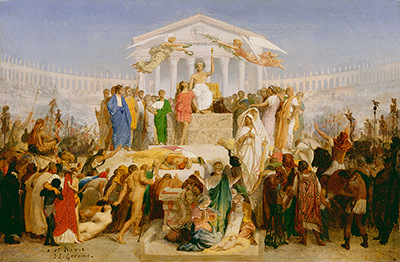
Augustus sits enthroned above a vast assembly of rulers, poets, peoples and personifications. At the lower edge, almost detached from the imperial spectacle, Mary bends over the newborn Christ. Jean-Léon Gérôme's The Age of Augustus: The Birth of Christ joins two kinds of sovereignty within one enormous canvas: Roman rule at the centre and Christian salvation at the margin.
Completed for the Exposition Universelle of 1855, the painting was commissioned by Napoleon III. Its vision of peace under Augustus offered the French emperor a useful analogy for his own regime. Gérôme transformed ancient history and Christian providence into Second Empire political theatre.[1]
At 6.2 metres high and more than ten metres wide, the work is not the small oil study in the Getty Museum. It is the monumental state canvas now deposited at the Musée de Picardie in Amiens, accession RF 1983 92.[1][2]
At a Glance
- ArtistJean-Léon Gérôme
- TitleThe Age of Augustus: The Birth of Our Lord Jesus Christ
- Date1855
- MediumOil on canvas
- Dimensions620 × 1,014 cm (approximately 20 ft 4 in. × 33 ft 3 in.)
- CollectionMusée d'Orsay, deposited at the Musée de Picardie, Amiens
- AccessionRF 1983 92
- CommissionNapoleon III for the Exposition Universelle of 1855[1]
An Empire Arranged around Augustus
The canvas is organised by a strong vertical axis. Augustus occupies the central height, idealised and elevated above the assembled world. Figures gather symmetrically on either side, and architectural forms stabilise the enormous width.
The Musée de Picardie identifies political and cultural figures associated with the Augustan age, including Tiberius, Agrippa, Maecenas, Horace, Virgil, Propertius, Livy and Ovid.[1] Gérôme gives imperial civilisation both military and literary authority.
The Temple of Janus appears above. In Roman tradition, its closed doors signified peace. The detail supports an image of the Pax Romana: Augustus as the ruler beneath whom conflict has been contained and culture can flourish.
Around this centre, Gérôme gathers figures intended to represent the extent and variety of Roman power. The museum's older language refers to racial “types” and imperial “protectorates.”[1] Those terms should not pass into modern prose without criticism. The assembled bodies are nineteenth-century visual classifications, used to make Roman—and by analogy French—empire appear universal.
The emperor's centrality is therefore manufactured on two levels. Augustus rules the ancient gathering inside the painting; Napoleon III's commission turns that order into a message for modern France.
Christ at the Edge
The Nativity is easy to miss. Mary, Joseph and the infant occupy the lower foreground, separated from the imperial assembly in scale, position and attention. Nothing within the crowd visibly acknowledges Christ's birth.
This marginal placement creates the painting's central theological argument. Worldly power sits in splendour while spiritual transformation begins almost unseen.
Augustus and Christ form a distant parallel. One is enthroned at the vertical centre; the other lies below in infancy. Roman peace prepares the historical world in which Christianity emerges, but the eventual reach of Christ's authority will exceed the emperor's.
The Musée de Picardie describes the Nativity as offset from the rest of the composition and connected chiefly through this parallel.[1] The separation can initially look like a failure to integrate two subjects. It is also the means by which Gérôme distinguishes temporal and spiritual power.
The eye must choose between spectacle and quiet revelation. Augustus commands attention immediately; Christ changes the meaning of the whole from a place of apparent weakness.
Bossuet and Providential History
Gérôme based the programme on a passage from Jacques-Bénigne Bossuet's Discours sur l'histoire universelle, published in 1681.[1][3] Bossuet understood universal history through divine providence: empires rise and fall within a Christian account of time.
Within that framework, the reign of Augustus mattered because Christ was born during the Roman peace. Political order unknowingly prepared the stage for a spiritual event that would transform history.
Gérôme makes this philosophy visible by collapsing different times, regions and kinds of figure into one allegorical assembly. The canvas is not a literal moment that could have been witnessed. Poets, rulers, conquered peoples, symbolic figures and the Holy Family coexist because the argument requires them to.
The picture should therefore not be judged as though Gérôme attempted one archaeological snapshot. It belongs to the tradition of universal allegory, where historical recognisability supports a structure of ideas.
That structure also made Bossuet's providential history available for modern politics. If Augustus' peace prepared a new religious age, Napoleon III could present the Second Empire as another period of order and renewal.
Napoleon III and the 1855 Exposition
The Exposition Universelle was a major international display of French industry, culture and imperial ambition. Napoleon III's government used it to present national prosperity and political stability to domestic and foreign audiences.
Gérôme's commission belonged to that programme. The Age of Augustus offered a flattering historical mirror: a strong emperor gathers nations, closes the doors of war and presides over artistic achievement.[1]
The analogy should not be treated as a hidden private meaning. The scale, patron and exhibition context make politics intrinsic to the work. Viewers entered a modern imperial spectacle and encountered an ancient one.
Yet the Nativity complicates total identification between emperors. Christ's marginal presence implies that political rulers do not control history's deepest transformation. The canvas flatters temporal authority while placing it within a Christian sequence that will outlast Rome.
Whether contemporary viewers experienced that as a limit on Napoleon III or as further divine sanction for his order could vary. Gérôme built both possibilities into the hierarchy.
Ingres, Delaroche and the Grand Tradition
The Musée de Picardie identifies important compositional precedents: Paul Delaroche's mural cycle at the École des Beaux-Arts and especially Jean-Auguste-Dominique Ingres's The Apotheosis of Homer of 1827.[1]
Ingres had arranged artists and writers of the Western tradition around an enthroned Homer. Gérôme adapts the model to political and sacred history. A central authority becomes the axis around which cultural greatness is displayed.
The reference announced Gérôme's ambition. Only a few years after his Néo-Grec breakthrough, he entered the largest scale of official history painting. Intimate antiquity gave way to an encyclopedic world-stage.
Delaroche's influence also mattered. Gérôme's former teacher had shown how recognisable historical figures could be brought together in a grand institutional statement. Gérôme borrowed that clarity while increasing the allegorical and imperial reach.
The result is less an individual dramatic incident than a painted system. Every figure receives meaning through distance from the throne, place within the crowd and relation to the quiet Nativity below.
The Monumental Canvas and the Getty Study
The Getty Museum owns a much smaller oil-on-canvas version, dating from about 1852–54 and measuring 37.2 × 55.2 cm, accession 85.PA.226.[2] It belongs to the preparation and development of the monumental commission.
The two objects must not be confused. The Getty canvas can be seen at close range as an intimate design; the Amiens work surrounds the viewer with a state spectacle more than one hundred square metres in area.
Scale changes meaning. In the small version, the entire assembly can be grasped quickly. Before the monumental work, individual figures may need to be discovered over time. Augustus' hierarchy becomes physical because viewers must look upward.
The study helps reveal planning, but the finished canvas owns the public history: 1855, Napoleon III, the Exposition Universelle and the Musée de Picardie.
Empire and the Modern Viewer
The painting asks viewers to admire order. Symmetry, hierarchy and accumulation turn political control into visual coherence. Diverse peoples appear meaningful because Augustus occupies the centre.
That structure deserves scrutiny. Roman empire depended on conquest, extraction and enslavement as well as peace. French Second Empire expansion likewise made universal claims from a position of force. Gérôme's allegory presents empire from the throne, not from those compelled into its order.
The Nativity creates a different centre of value, but it does not dismantle the imperial display. The two coexist. Modern interpretation can recognise the painting's extraordinary ambition while examining the politics served by its harmony.
Its scale makes such examination especially important. Monumentality can cause ideology to feel like atmosphere. Gérôme's achievement was to make a theory of history occupy a wall.
Artist Up Close
Begin with Augustus and follow the vertical axis down to Christ. The greatest contrast is between visible authority and almost hidden transformation.
Then scan the figures on either side. Notice how symmetry makes imperial diversity appear ordered around one ruler.
Finally, imagine the physical scale: the canvas is more than ten metres wide. Reproduction makes the composition easy to survey, but the original requires bodily movement and an upward gaze.
Frequently Asked Questions
Discussion
Which detail in The Age of Augustus: The Birth of Christ most changes how you read Gérôme's balance of spectacle, evidence and invention?
Reader Insights
Which detail in The Age of Augustus: The Birth of Christ most changes how you read the scene's balance of evidence, staging and spectacle?
Set this page beside the Gérôme biography, paintings overview and related works to test how travel, studio practice and the Salon shaped the image.
What should a careful modern reading preserve, question or leave uncertain when looking at this work today?
Join the Conversation
Share a thoughtful observation about The Age of Augustus: The Birth of Christ, Gérôme's method, or the wider context that would help another reader look more carefully.
References
- Musée de Picardie, Amiens Métropole. “Jean-Léon Gérôme, Siècle d'Auguste: naissance de N.-S. Jésus-Christ.” Collection notice, RF 1983 92 View source.
- J. Paul Getty Museum. “The Age of Augustus, the Birth of Christ.” Collection record, 85.PA.226 View source.
- Jacques-Bénigne Bossuet. Discours sur l'histoire universelle. Paris, 1681. Bibliothèque nationale de France, Gallica View source.