 by Tom Gurney
Tom Gurney BSc (Hons) is an art history expert with over 20 years experience
Published on June 19, 2020 / Updated on August 21, 2026
Email: tomgurney1@gmail.com / Phone: +44 7429 011000
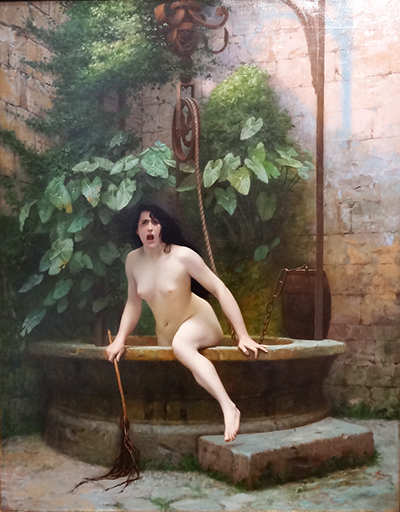
Truth does not wait to be discovered. She climbs out of the darkness, fixes the viewer with an open-mouthed cry and raises a whip. Jean-Léon Gérôme's Truth Coming Out of Her Well turns an abstract virtue into an angry physical presence advancing across the threshold of the picture.
The image is easy to remember and difficult to explain. Its full title promises punishment, but does not identify one crime. Gérôme's hostility to Impressionism, the contemporary Dreyfus Affair and his later defence of photography have all shaped interpretations. None, by itself, securely supplies the painting's complete programme. The most responsible reading begins with what the 1896 canvas makes visible and then keeps its possible meanings in evidence order.
At a Glance
- ArtistJean-Léon Gérôme
- TitleTruth Coming Out of Her Well
- Full French titleLa Vérité sortant du puits armée de son martinet pour châtier l'humanité
- Date1896
- MediumOil on canvas
- Dimensions91 × 72 cm
- CollectionMusée Anne-de-Beaujeu, Moulins
- Accession78.1.1[1][2]
The longer title can be translated as Truth Emerging from Her Well, Armed with Her Whip, to Chastise Humanity.[3] Its force lies in the final word. Truth is not coming for one liar, critic or institution. Humanity as a whole is placed under accusation.
A Confrontation at the Picture's Edge
The figure is nude, front-facing and almost life-sized within the vertical canvas. Her weight drives forward. One foot remains close to the well while the other enters the shallow foreground. The stone rim behind her marks where she has come from, but Gérôme gives very little space for where she is going. The viewer occupies that destination.
Her face resists the smooth calm expected of a classical personification. The mouth is open, the eyes direct and the hair disordered. She appears to shout rather than pose. In her raised hand, the whip converts revelation into threatened action.
Gérôme intensifies the encounter by simplifying the setting. The deep darkness of the well and background pushes the pale body forward. Hard stone contrasts with skin and moving hair. There is no crowd inside the picture to receive the warning for us. As a result, the spectator cannot remain a neutral observer of someone else's punishment.
The nudity has an allegorical logic: Truth is “naked” because she is without disguise. Gérôme, however, refuses to let the familiar phrase settle into a passive emblem. This body is exposed but not helpless. The figure looks back, advances and carries an instrument of correction.
The painting therefore reverses a common structure of looking. Gérôme's highly finished nudes can invite prolonged inspection while appearing unaware of the audience. Here, the nude sees us first. Her gaze and shout turn viewing into being addressed.
Why Is Truth in a Well?
The well belongs to a long family of sayings and images in which truth is hidden at a depth, difficult to reach or concealed by falsehood.[3] In Gérôme's canvas, emergence gives that tradition a dramatic sequence: Truth has been out of sight, rises into visibility and comes to judge the world that left her buried.
The 1896 work was not Gérôme's only treatment of the theme. During the 1890s he returned to Truth and the well in several compositions, varying the figure's position, action and title. The Moulins exhibition catalogue La vérité nue examines the picture within this broader allegorical family.[3] Those variations matter because they show sustained interest rather than a single topical reaction.
They must also be kept distinct. A title attached to one version cannot automatically explain another, and later anecdotes about a Truth painting found in Gérôme's studio do not establish that the Moulins canvas was the exact object concerned. The securely identified work here is the 1896 oil in the Musée Anne-de-Beaujeu.
Its whip changes the old image of concealed knowledge. Discovery is only the first stage. Truth will now impose consequences. Yet the canvas does not tell us what humanity has done, who suppressed her or what judgment will follow. The allegory gains power from that missing indictment.
An Argument About Art
By the 1890s, Gérôme was a celebrated painter, sculptor, teacher and member of the French artistic establishment. He was also a determined opponent of Impressionism and of the institutional recognition it increasingly received. His resistance became especially visible during controversy over the French state's acceptance of Gustave Caillebotte's collection of Impressionist paintings.
Art historian Bertrand Tillier places Gérôme's statements within a wider campaign in which artistic disagreements were expressed as claims about truth, skill, order and national culture.[4] In that context, an avenging Truth can plausibly be understood as Gérôme's defence of the artistic standards he believed modern painting had betrayed.
This interpretation fits both his public position and the allegory's aggressive tone. It also helps explain why Truth appears as an authority rather than a victim. She has risen to correct error.
But the painting does not name Impressionism. No brush, palette, exhibition label or recognisable opponent fixes the target. An anti-Impressionist reading should therefore be attributed to the historical context and to scholars such as Tillier, not presented as the only meaning visible on the canvas.
There is an additional complication. Gérôme's own immaculate illusionism could claim to reveal visible truth while depending on selection, staging and invention. The painting looks emphatically real, but Truth herself is a fiction. Gérôme uses artifice to personify honesty.
That paradox is productive. The work does not offer truth as an unmediated fact. It constructs a body, a well, a gesture and a title that make an invisible principle appear present. Its claim to truth depends on the very craft of representation that any theory of realism must examine.
Was the Painting About the Dreyfus Affair?
The Dreyfus Affair began before the painting was made. Captain Alfred Dreyfus was convicted of treason in 1894, and doubts about the secret evidence and the conduct of the case entered public discussion in 1896, while Gérôme was developing his Truth imagery.[6] A picture of Truth rising to punish humanity can understandably seem connected to that crisis.
Chronology makes the association possible; it does not prove a commission, statement of intent or one-to-one political programme. The most famous public phase of the Affair, including Émile Zola's “J'accuse…!” intervention, followed in 1898.[6] The 1896 canvas should not be labelled definitively as Gérôme's Dreyfus painting without direct evidence.
The political context may still affect how the work was seen. In a culture arguing over forged evidence, military secrecy, justice, nationalism and antisemitism, the emergence of punitive Truth carried obvious resonance. That is different from claiming that each pictorial element encodes a named participant or event.
The distinction protects the painting from a seductive shortcut. If “Dreyfus Affair” becomes the answer, the wider accusation in the title—humanity—shrinks to one case. Gérôme's image is capable of entering that history while remaining less specific and more troubling.
Photography and Gérôme's Later Statement
In 1902, six years after this canvas, Gérôme wrote a preface to Émile Bayard's photographic study Le Nu esthétique. He praised photography for forcing artists to abandon old routines and look at things previously unseen. He concluded, in translation: “Thanks to it, Truth has finally come out of her well. She will not go back.”[5]
This is an authentic, published link between Gérôme's idea of truth and photography. It matters because photography occupied an important place in his artistic world. Photographs could function as visual resources, records and means of reproducing works for wider circulation.
The statement also complicates any simple picture of Gérôme as an artist opposed to all modern media. He could attack Impressionism while praising photography as an instrument that changed how artists looked.
Yet the date remains decisive. A 1902 preface cannot automatically become the original explanation of a painting made in 1896. Gérôme may have extended an existing allegory to a new argument, or the verbal image may reveal a continuing association in his thinking. What it proves is that he later connected Truth's emergence with photography. It does not prove that the Moulins canvas was painted to illustrate that claim.
One Image, Several Claims to Truth
The principal interpretations are not mutually exclusive. Gérôme could use a familiar allegory because it served more than one battle. Artistic judgment, public justice, photographic vision and the moral exposure of falsehood all converge on the idea of Truth leaving concealment.
What holds them together is confrontation. This is not a quiet revelation in which truth becomes available to a patient seeker. The figure is furious. Her whip suggests that seeing the truth creates responsibility and that past ignorance may deserve punishment.
The ambiguity of her target keeps that responsibility close to the viewer. We may arrive expecting to identify whom Gérôme opposed. The painting instead places us in the path of the accuser. Its question is not only “What did the artist mean?” but “Why is Truth coming toward us?”
Artist Up Close
Begin with the well. Its dark opening establishes the depth from which the figure has risen and makes the pale body appear abruptly exposed.
Then follow the forward step. Gérôme compresses the space between Truth and the picture plane, so the action feels directed out of the painted world.
Finally, look at the face and raised hand together. The cry and whip perform the long title before the viewer reads it. Truth arrives as voice, gaze and threatened touch.
Frequently Asked Questions
Discussion
Which detail in Truth Coming Out of Her Well most changes how you read Gérôme's balance of spectacle, evidence and invention?
Reader Insights
Which detail in Truth Coming Out of Her Well most changes how you read the scene's balance of evidence, staging and spectacle?
Set this page beside the Gérôme biography, paintings overview and related works to test how travel, studio practice and the Salon shaped the image.
What should a careful modern reading preserve, question or leave uncertain when looking at this work today?
Join the Conversation
Share a thoughtful observation about Truth Coming Out of Her Well, Gérôme's method, or the wider context that would help another reader look more carefully.
References
- Musée Anne-de-Beaujeu. Museum press dossier, including La Vérité sortant du puits, 1896 View source.
- Boletín Oficial del Estado, Spanish Ministry of Culture. Order CUL/3433/2010, state-guarantee schedule for the exhibition Jean-Léon Gérôme, entry for La Vérité, accession 78.1.1 View source.
- Judith Henon and Maud Leyoudec, eds. La vérité nue: enquête autour d'une allégorie. Moulins: Musée Anne-de-Beaujeu and Maison Mantin, 2012. Bibliothèque nationale de France catalogue record: View source.
- Bertrand Tillier. “Gérôme et la ‘cochonnerie’ impressionniste.” Revista de História da Arte e Arqueologia 16 (July–December 2011): 57–70 View source.
- Jean-Léon Gérôme. Preface to Émile Bayard, Le Nu esthétique: l'homme, la femme, l'enfant. Paris: E. Bernard, 1902. Bibliothèque nationale de France catalogue and digitised holdings: View source.
- Bibliothèque nationale de France. “Zola dans l'Affaire Dreyfus.” Educational dossier and chronology View source.