 by Tom Gurney
Tom Gurney BSc (Hons) is an art history expert with over 20 years experience
Published on August 14, 2026 / Updated on August 14, 2026
Email: tomgurney1@gmail.com / Phone: +44 7429 011000
Circe I (1911): Introduction
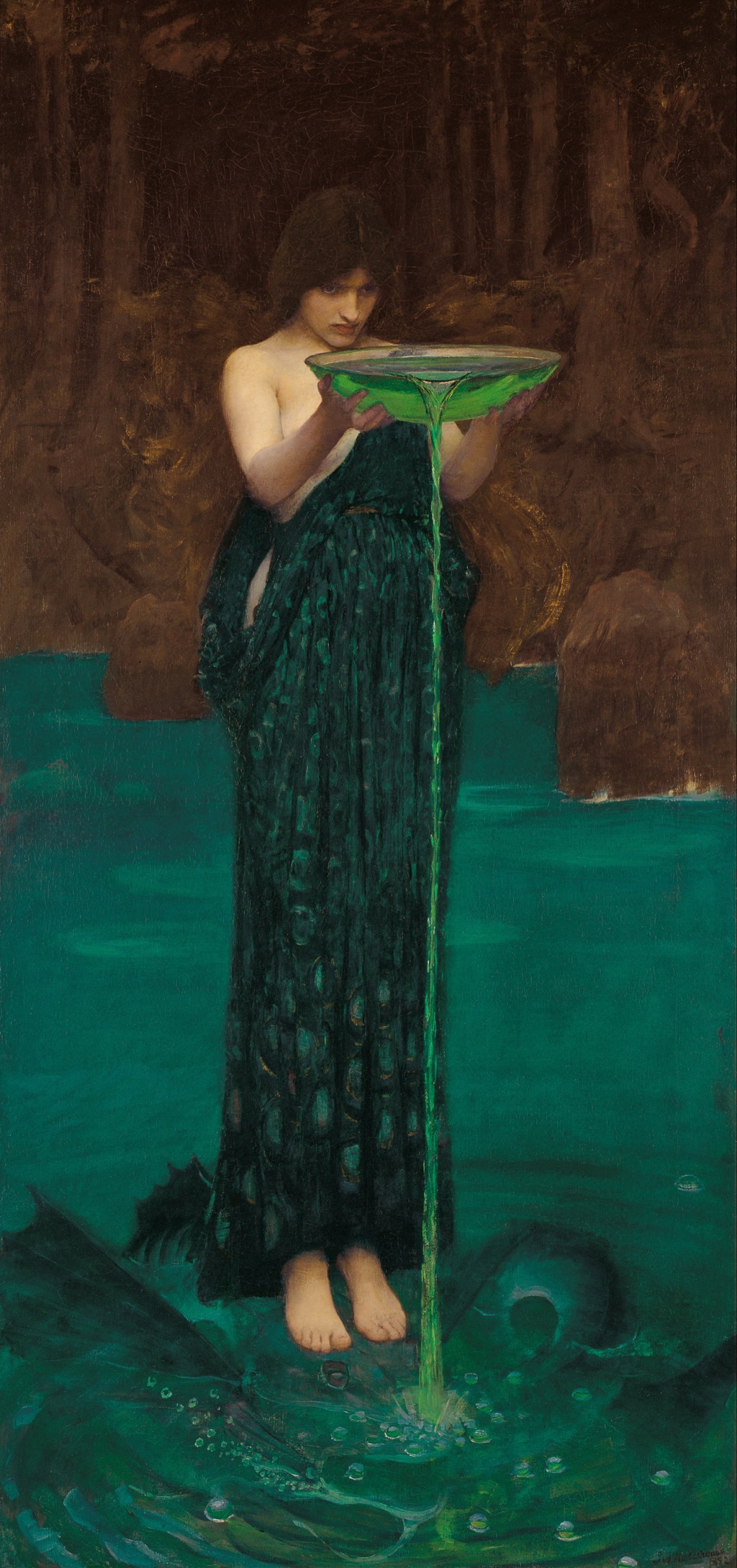
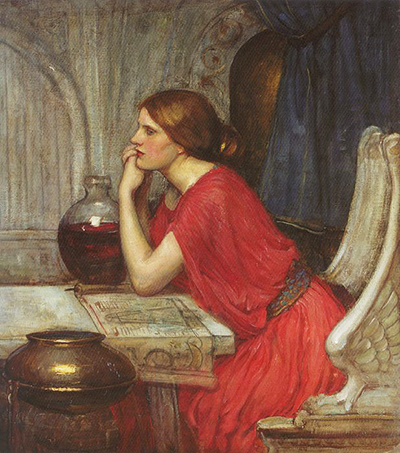
In John William Waterhouse’s Circe of about 1911, the enchantress no longer raises a cup against Ulysses or pours poison into Scylla’s water. She sits at a table with her hands gathered beneath her chin, surrounded by the residue of knowledge and appetite. The picture turns a spectacular magician into a woman thinking after the event. [1] [2]
The route title distinguishes this work as Circe I. The most useful object record calls it simply Circe: an oil on canvas measuring 86.3 × 77.2 cm, probably dispersed after Waterhouse’s death and later recorded in a private collection. [1] It must be distinguished from the larger, unfinished The Sorceress, also inscribed “Circe,” whose similar pose, animals and woven image make it a companion rather than the same canvas. [1] [2]
At a Glance
- ArtistJohn William Waterhouse (1849–1917)
- Route titleCirce I
- Authoritative object titleCirce [1]
- DateAbout 1911 [1] [2]
- MediumOil on canvas [1]
- Dimensions86.3 × 77.2 cm [1]
- CollectionPrivate collection; present location not publicly confirmed [1]
- Possible provenanceArtist’s studio sale, Christie's, London, 23 July 1926, lot 19; Mr Tellwright [1]
- Related workThe unfinished The Sorceress or Circe II, also about 1911 [1] [2]
- Primary literary contextHomer’s Odyssey, especially Circe’s reception of Odysseus and her advice about the Sirens [3]
Contents
- Introduction
- A Sorceress in Thought
- Establishing Which Circe This Is
- Circe in the Odyssey
- Table, Vessel and Interrupted Action
- The Seated Pose and Inward Gaze
- From 1891 and 1892 to 1911
- The Finished and Unfinished Versions
- Model, Colour and Late Technique
- A Late Portrait of Knowledge
A Sorceress in Thought
Circe sits rather than stands. Her elbows rest on a table and her joined or overlapping hands support her chin. [1] [2]
The posture belongs to contemplation. It compresses physical energy into the space between hands, face and objects.
This is a striking change within Waterhouse’s Circe sequence. In 1891 she confronts Ulysses frontally, cup raised and wand ready. In 1892 she stands above a pool, actively pouring the poison that will transform Scylla. [4] [5]
The 1911 figure has already acted or has paused before acting. A tipped vessel and scattered or arranged implements suggest that process exists around her, but the image’s true action is mental.
Her power does not disappear when the wand is lowered. Knowledge remains embodied in the person who can choose how to use it.
The quiet pose also makes the scene harder to moralise at a glance. A raised poisoned bowl identifies threat; a thoughtful face asks what has produced thought.
Waterhouse gives no answer in words. The viewer must read relationships between woman, table, vessels and the absent story that may appear in the related tapestry.
The image can therefore sustain several emotional registers: memory of Ulysses, calculation of magic, fatigue after ritual, frustrated desire or simple concentration.
None should be declared exclusive. The surviving catalogue evidence connects the related works with Circe imagining Ulysses’ later encounter with the Sirens, but a painting can retain more than one mood. [2]
Her stillness is not passivity. It is the stillness of someone to whom instruments, animals and imagined events belong.
Establishing Which Circe This Is
Waterhouse painted Circe repeatedly, and inconsistent online titles make version control essential.
The object discussed here is the oil sold by Christie's in June 2000 as Circe. It measures 34 by 30 3/8 inches, or 86.3 by 77.2 cm. [1]
The catalogue describes it as clearly related to The Sorceress, an unfinished canvas of about 1911. Both use almost the same attitude. [1]
The unfinished canvas bears “Circe” on its reverse and includes two transformed animals at the left. Its wider proportions and more developed surrounding narrative separate it from the present work. [1] [6]
The labels Circe I and Circe II are navigation titles rather than secure lifetime titles. They keep the works separate, while museum and market records supply the documented object names.
The 1911 Circe must also be kept distinct from Circe Offering the Cup to Ulysses of 1891, owned by Gallery Oldham, and Circe Invidiosa of 1892, owned by the Art Gallery of South Australia. [4] [5]
All four works concern the same mythological enchantress, but they do not illustrate one continuous storyboard commissioned as a set.
Chronology creates a retrospective series. Waterhouse returns after roughly two decades and asks what remains when theatrical confrontation gives way to memory.
The object’s provenance is cautious. Christie's says it was possibly in the 1926 studio sale as lot 19, bought for 46 guineas by Sampson, and later belonged to Mr Tellwright. [1]
“Possibly” must remain visible. Auction-lot identification is not strengthened by repeating it as certainty.
This page accordingly uses Circe I (1911) for user clarity and Circe when referring to the documented object title.
Circe in the Odyssey
In Homer’s Odyssey, Circe lives on Aeaea in a house amid woodland. Wolves and lions, transformed or enchanted, move around her dwelling without attacking visitors. [3]
Odysseus’ men hear her singing at a great loom. She receives them, mixes a potion and changes them into swine.
Odysseus approaches with protection supplied by Hermes. The magical herb moly prevents Circe’s drug from mastering him.
When her spell fails, he threatens her with a sword and makes her swear not to harm him. She restores his companions and becomes host, lover and adviser. [3]
The episode is morally complex. Circe is dangerous, but she is not defeated and discarded like a simple monster. Odysseus and his men remain for a year.
When departure comes, she directs them towards the underworld and later explains the hazards ahead, including the Sirens, Scylla and Charybdis. [3]
This later advisory role is crucial for the 1911 pictures. Christie's interprets the woven scene in The Sorceress as Odysseus’ future encounter with the Sirens imagined by Circe. [2]
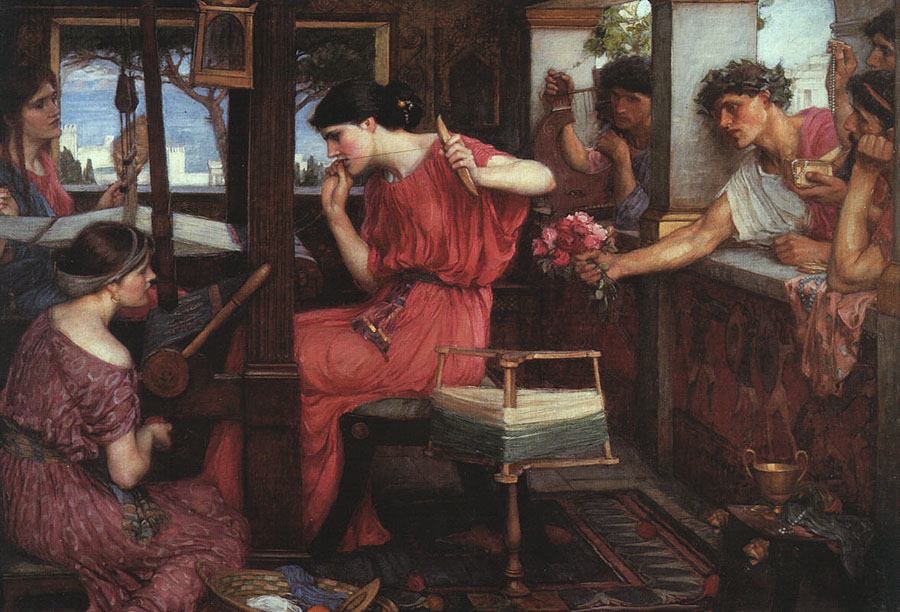
The loom belongs to the Homeric text, where song and weaving introduce her before the men enter. Waterhouse can therefore turn textile into both attribute and prophetic picture.
The smaller Circe may abbreviate that surrounding story, but comparison with its companion supplies a narrative horizon. Her thought extends beyond the table to a voyage she will not share.
The Odyssey does not say that Circe sits grieving over a tapestry after Odysseus leaves. That is a modern pictorial synthesis, not a quoted Homeric scene.
Waterhouse joins several elements—loom, beasts, potion, absent hero and Sirens—to imagine interiority the epic does not pause to describe.
The result humanises Circe without turning her into a harmless victim. The same person who advises the voyage earlier transformed men who entered her house.
Table, Vessel and Interrupted Action
The table makes magic domestic and intellectual. It is a working surface rather than a stage altar.
Objects on or near it may include a vessel, book or tools associated with herbs and potions. In the closely related The Sorceress, the material field expands to vessels, animals and textile. [2] [6]
A tipped glass is especially suggestive. Liquid has moved from containment into spill, changing a prepared substance into evidence of something already done.
It should not be labelled a specific potion unless the object record proves that use. The painting provides an association, not chemical identification.
Books and vessels give Circe knowledge that has matter. She does not cast magic through beauty alone; she reads, mixes, measures and transforms.
This emphasis connects her with Waterhouse’s Medea, another ancient woman whose expertise makes a male hero’s quest possible.
The tabletop also imposes a horizontal stability against the figure’s vertical head and shoulders. It holds the clutter of action while her face holds consequence.
Her elbows anchor the body. Hands that could raise wand or cup now support thought.
The viewer is positioned across the table but is not necessarily another character. We encounter the scene as an observer of absorption.
Unlike the mirror in the 1891 Circe Offering the Cup, no reflected Ulysses needs to certify her confrontation. His absence becomes meaningful.
The table creates distance as well as proximity. It brings Circe near, then places a barrier of objects between her and the viewer.
That barrier protects ambiguity. We can inspect the evidence of magic but cannot enter the thought that ordered it.
The Seated Pose and Inward Gaze
Waterhouse’s seated pose draws the composition inward. Forearms, hands and face form a compact structure of repeated bends.
Christie's notes that a surviving chalk drawing gives the model a softer brow and neckline closer to Circe than to The Sorceress. [2]
In the unfinished companion, the brow tightens and the jaw becomes more angular and slightly protruding. Small changes of physiognomy shift the emotional pressure. [2]
That comparison shows why preparatory studies matter. Waterhouse did not treat one model’s expression as fixed; he revised it for different versions.
The hands under the chin are familiar as a sign of thinking, but they also close the body. Circe’s mouth is near or behind them, and speech yields to interior monologue.
Her gaze does not meet ours. The direction may be downward, outward past the table or towards an imagined distance.
If the related tapestry shows Odysseus and the Sirens, looking becomes temporal. She sees or thinks of an event elsewhere and later.
This is an extraordinary use of prophetic knowledge. Circe can advise the future but cannot accompany the hero into it.
The image thus turns omniscience into separation. Knowing what will happen does not grant possession of the person to whom it happens.
Yet romantic melancholy should not consume every reading. The seated magician may be reflecting upon her own work rather than pining for a man.
Waterhouse offers no inscription of motive. The strength of the pose lies in the way it makes thought visible while leaving thought’s object partly unknown.
From 1891 and 1892 to 1911
The three dated moments reveal a major transformation in Waterhouse’s treatment of power.
In Circe Offering the Cup to Ulysses (1891), Circe occupies a throne-like chair and confronts the hero. A circular mirror behind her shows his approach while placing her at the centre of reflection. [4]
Cup and wand make intention explicit. She believes the potion will transform him as it transformed his men.
In Circe Invidiosa (1892), Waterhouse chooses Ovid rather than Homer. Circe poisons the water where Scylla will bathe because Glaucus loves the younger woman. [5] [7]
The narrow canvas intensifies her downward action. Blue liquid joins dress, water and threatened metamorphosis.
The 1911 Circe abandons upright command. The heroine sits among things rather than towering above an action.
This is not necessarily a decline from power to weakness. It may be a shift from external effect to internal consequence.
Waterhouse’s own career has also changed. The later paintings use softer passages, a favourite red-haired model and a more elegiac approach to classical narrative. [2]
The time between works encourages viewers to imagine Circe ageing emotionally even though each uses a youthful model. A mythological being is painted through different contemporary bodies.
The early canvases turn magic outward: drink offered, poison poured. The late image turns it inward: knowledge remembered.
This sequence also revises the femme fatale label. Dangerous beauty is present, but contemplation resists reducing Circe to a trap for male desire.
She becomes a figure who acts, advises, loses, imagines and thinks.
The Finished and Unfinished Versions
The relationship between Circe and The Sorceress is unusually close. The figure’s attitude is almost identical, and both belong around 1911. [1] [2]
One possibility is that Waterhouse explored alternative completions of a single idea. The smaller canvas concentrates the seated woman and table; the unfinished companion opens the setting and narrative.
The unfinished work’s animals recall Circe’s transformed victims. Its loom or tapestry can refer both to Homer’s weaving sorceress and to the Sirens she tells Odysseus how to survive. [2] [3]
That expansion gives The Sorceress more iconographic evidence. It also risks dispersing the psychological pressure concentrated in Circe.
The smaller painting’s relative finish should not automatically make it the “final” version in a linear process. Artists can work on related canvases concurrently or abandon a larger ambition after completing another treatment.
No surviving statement from Waterhouse explains the exact sequence. Catalogue language such as “clearly related” is more responsible than inventing a commission history. [1]
The two works also demonstrate how titles change reception. The Sorceress sounds generic and potentially sinister. The inscription “Circe” restores a named ancient character with a specific narrative range. [1]
The label Circe II preserves page separation but can reinforce a false numbered series. The works remain linked while retaining object-level distinctions.
Comparison is not optional background. Each canvas helps decode the other: the larger explains the animals and textile; the smaller clarifies the seated figure’s emotional centre.
Together they show Waterhouse approaching myth through variation rather than repetition.
Model, Colour and Late Technique
A Christie’s study record reports that the red-haired model has been suggested as Beatrice Ethel Hackman, also known as Beatrice Ethel Flaxman, who may have sat for Waterhouse between 1906 and 1916. [2]
This remains a suggestion. Model identification in Waterhouse’s late work is difficult, and resemblance alone cannot close the question.
What can be discussed securely is type. Red hair, pale flesh and richly coloured surroundings connect Circe to other late heroines while distinguishing her from the dark-haired sorceresses of 1891 and 1892.
The change softens first impressions. Waterhouse no longer relies on severe dark hair to signal dangerous knowledge.
Colour and finish likely move unevenly through the canvas, with the face and hands carrying greater definition than surrounding passages. That hierarchy supports contemplation: thought becomes visually dense while atmosphere stays open.
Late Waterhouse often lets landscape, cloth or interior dissolve through freer handling around carefully observed flesh. The technique combines academic modelling with a modern sensitivity to broken colour.
Reproduction can exaggerate or suppress these differences. Exact claims about pigment, underdrawing or alteration require technical examination rather than online images.
The unfinished companion makes process more visible, but even the finished Circe retains an air of experiment because its narrative is not sealed.
The picture belongs to a period when Waterhouse’s health was declining, yet biography should not be used as a shortcut to melancholy. A contemplative figure is not proof of the artist contemplating death.
The late date matters historically, not diagnostically. In an Edwardian art world moving through Post-Impressionism and modernism, Waterhouse continued to renew an ancient sorceress through intimate psychological painting.
A Late Portrait of Knowledge
Circe’s most persistent attribute is not a particular cup, animal or garment. It is knowledge that other people need and fear. Homer’s Odysseus initially encounters that knowledge as a threat, then depends upon it for navigation. [3]
Waterhouse’s late painting makes this reversal visible without restaging either episode. The implements on the table recall danger, while the contemplative pose belongs to counsel, recollection and foresight.
The picture therefore asks how learned women are represented. If Circe is shown only casting spells, expertise appears irrational and spectacular. If she is shown thinking among material tools, magic begins to resemble a discipline with memory, method and consequence.
This resemblance should not modernise her into a scientist. Homeric enchantment and Edwardian science follow different systems of explanation. The point is visual: Waterhouse gives intellectual labour a body.
The domestic scale sharpens that achievement. A monumental history painting can make power depend upon size, gesture and public action. Here power survives within a room and inside a pause.
The viewer is also denied the comfort of seeing Circe punished. Many tales of threatening female knowledge end by restoring male control. Homer instead allows Odysseus to negotiate, remain, learn and depart. [3]
The 1911 image inhabits what follows departure. Its emotional charge comes from unequal mobility: the traveller continues towards home and glory, while the adviser remains on the island associated with what she knows.
That reading can be expressed without turning Circe into a conventional forsaken maiden. She owns the house, the animals and the apparatus. Her position is stationary but not powerless.
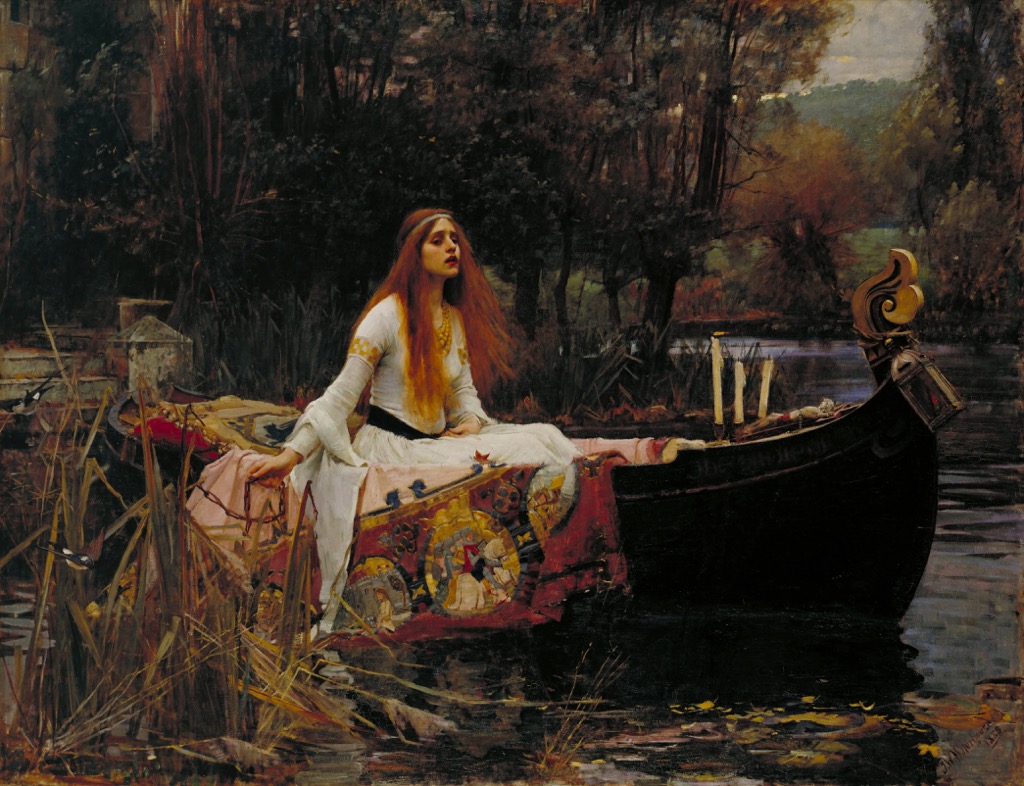
The ambiguity distinguishes her from Waterhouse’s visibly doomed heroines. The Lady of Shalott moves towards a death readers can predict; Ophelia occupies a story whose end is fixed. Circe’s future after Odysseus is comparatively open.
She may remember, foresee, resume work or direct attention elsewhere. The painting suspends all four possibilities.
This openness explains why the late version is not merely a quieter reprise of the 1891 and 1892 canvases. It subjects the earlier image of dangerous beauty to time. Gesture becomes reflection, confrontation becomes absence, and a named mythological type becomes almost a portrait without surrendering her supernatural identity.
Related Pages
- The Lady of Shalott: Compare Waterhouse's best-known literary composition.
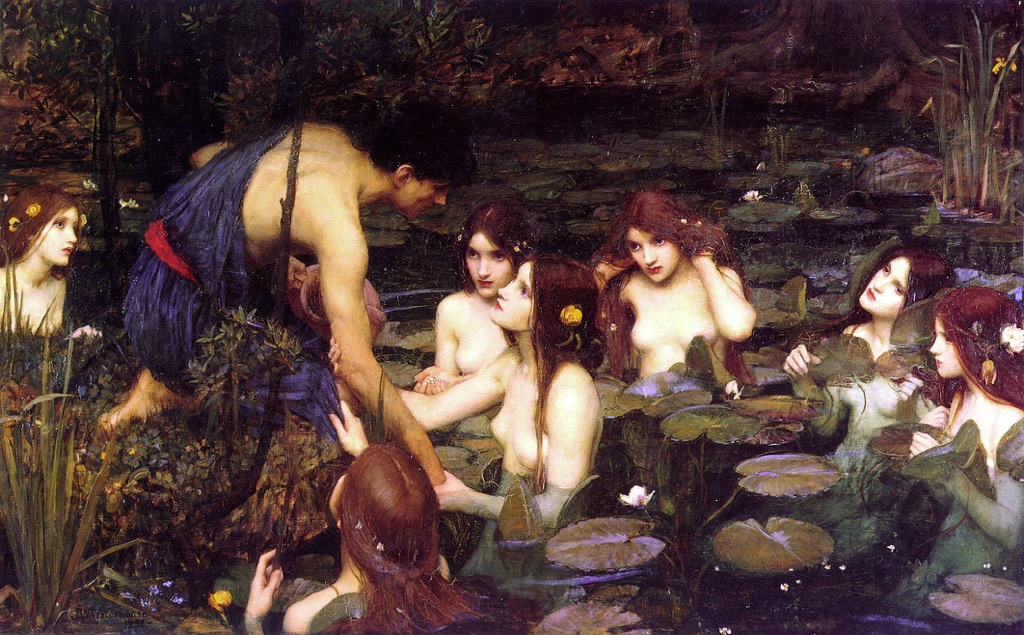
- Hylas and the Nymphs: Compare another major mythological scene.
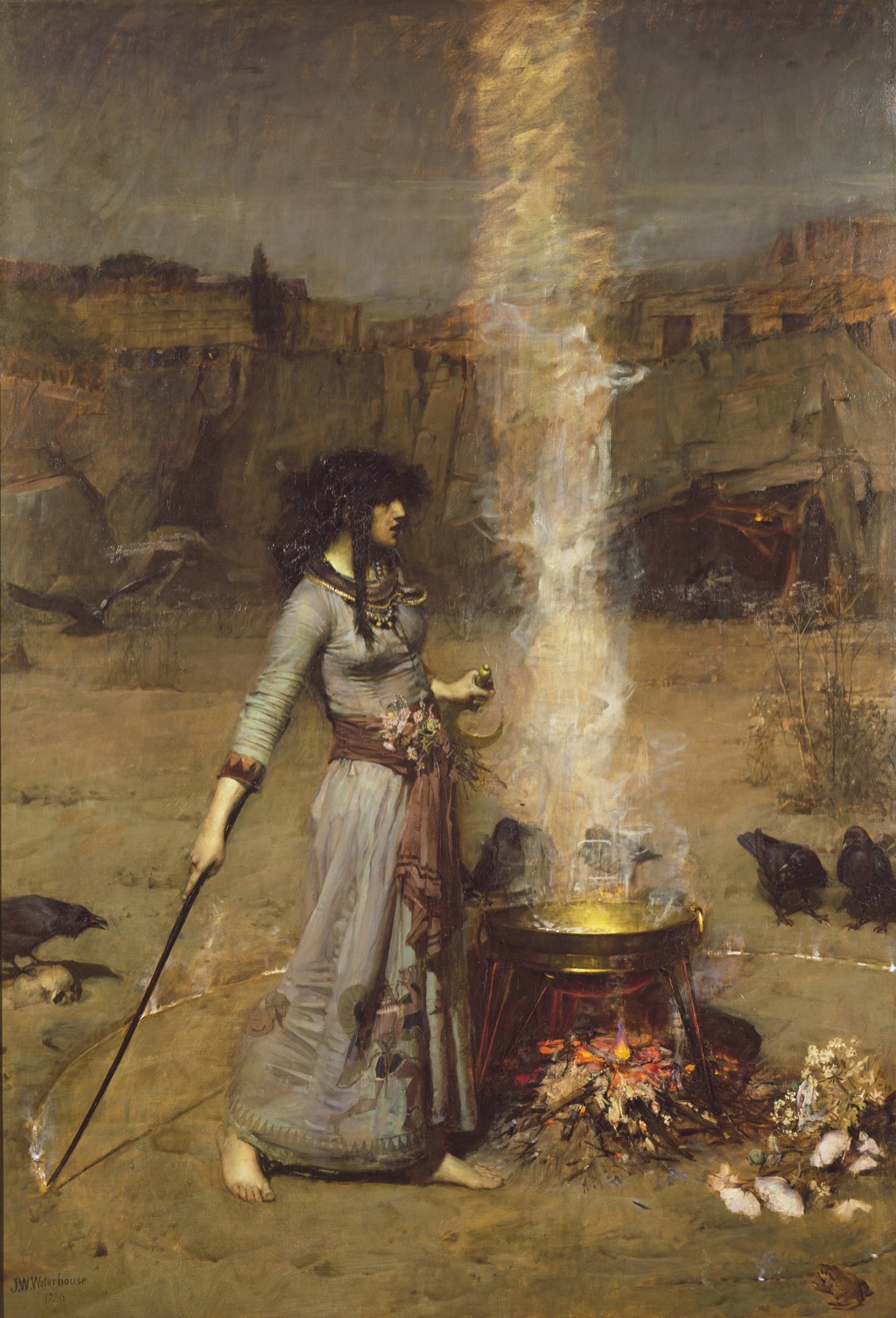
- The Magic Circle: Compare Waterhouse's treatment of ritual and symbolism.
Frequently Asked Questions
The route label uses Circe I to distinguish it from a related work. Christie's catalogued the 86.3 × 77.2 cm canvas simply as Circe. [1]
It is generally dated to about 1911 because of its close relation to The Sorceress and the surviving preparatory drawing. [1] [2]
It is privately owned or presently unlocated in public documentation. [1]
No. Circe Invidiosa is the tall 1892 painting in the Art Gallery of South Australia. [5]
The related imagery suggests Odysseus’ encounter with the Sirens, but the smaller picture does not make one interpretation compulsory. [2]
Beatrice Ethel Hackman or Flaxman has been proposed for the related drawing and paintings, but the identification is not conclusive. [2]
Discussion
The 1911 Circe completes no simple moral arc. Waterhouse does not show punishment for enchantment or redemption through love. He shows an interval in which power has become thought.
That interval transforms the familiar sorceress. Vessels, animals and Homeric memory remain nearby, but none can explain her entirely. She is dangerous without performing danger, abandoned without being reduced to abandonment, and knowledgeable without displaying a spell for the spectator.
Reader Insights
Which visible detail most changes the way you read this page?
Which source or comparison helps the work feel less familiar and more specific?
What question would you bring back to the painting after reading?
Join the Conversation
Share your reading of this page below.
References
- Christie's, “John William Waterhouse: Circe,” lot record, 13 June 2000. View source.
- Christie's, “John William Waterhouse: Study for ‘Circe’,” drawing record and catalogue essay, 6 June 2007. View source.
- Homer, Odyssey, Books X–XII, translated by A. T. Murray, Perseus Digital Library. View source.
- Art UK, “Circe Offering the Cup to Odysseus,” Gallery Oldham collection record. View source.
- Art Gallery of South Australia, “J. W. Waterhouse: Circe Invidiosa,” collection record. View source.
- The Victorian Web, “Circe by John William Waterhouse,” object note for the wider unfinished version inscribed “Circe.” View source.
- Ovid, Metamorphoses, Book XIV, translated by Brookes More, Perseus Digital Library. View source.