 by Tom Gurney
Tom Gurney BSc (Hons) is an art history expert with over 20 years experience
Published on August 14, 2026 / Updated on August 14, 2026
Email: tomgurney1@gmail.com / Phone: +44 7429 011000
The Crystal Ball: Introduction
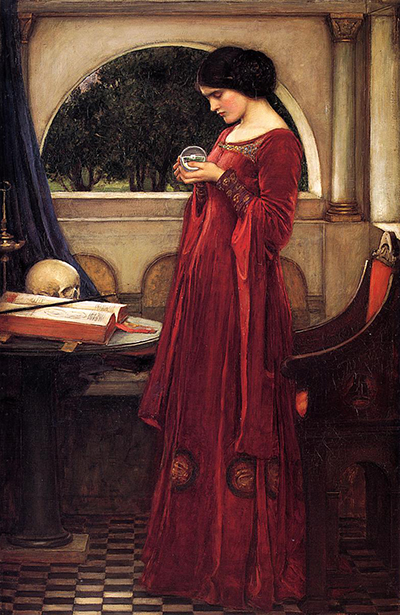
A woman in a deep red dress holds a transparent sphere at eye level. Around her, arches, columns and patterned stone establish an enclosed Renaissance world. On the table lie a book, a slender wand and a skull. John William Waterhouse offers the apparatus of magic but withholds its result: the crystal reflects light, yet tells viewers nothing certain.
Painted and exhibited in 1902, The Crystal Ball is one of Waterhouse's most concentrated images of solitary female knowledge. Its meaning depends upon looking—her gaze into the sphere, our gaze at her, and a former owner's attempt to change what later viewers could see by covering the skull.
At a Glance
- ArtistJohn William Waterhouse (1849–1917)
- TitleThe Crystal Ball
- Date1902 [1]
- MediumOil on canvas [1]
- Dimensions120.7 × 78.7 cm [1]
- SignatureSigned and dated “J. W. Waterhouse 1902” [1]
- First exhibitedRoyal Academy, London, 1902, no. 181 [1]
- CollectionPrivate collection; shown in 2011 as part of the Pérez Simón Collection, Mexico [2]
- Original ownerF. H. Pyman [1]
- Companion at the Royal AcademyThe Missal [1]
- Key objectsCrystal ball, book, wand and skull [1]
- Important conservation historyThe skull was overpainted after Waterhouse's original composition; technical examination found it intact beneath the later paint [1]
Contents
- Introduction
- A Vision Withheld from the Viewer
- Seer, Scholar or Sorceress?
- Crystal, Book, Wand and Skull
- The Skull That Disappeared and Returned
- Circles in a Renaissance Interior
- Red Dress and Controlled Attention
- Magic in a Sceptical Age
- The Crystal Ball and The Missal
- Destiny, Circe and Women Who Know
A Vision Withheld from the Viewer
The woman can see into the crystal ball, or believes that she can. The spectator sees only its glassy surface.
That asymmetry creates the painting's mystery. Waterhouse shows an act of seeking knowledge without illustrating a vision, prophecy or supernatural apparition.
The sphere is held close enough to dominate her attention but far enough from her face to remain a separate object. Her hands support it carefully, turning divination into a precise physical action.
No second figure confirms what is happening. She has no client, assistant or witness inside the room. The image is less a public performance of fortune-telling than an encounter between one mind and an object.
The title identifies the sphere but does not name the woman, a story or the knowledge she wants. Unlike Circe Offering the Cup to Ulysses or Medea, this picture provides no mythological character through which the action can be decoded.
Waterhouse therefore makes uncertainty part of the subject. She may be seeing a future, summoning an image, testing a ritual or simply concentrating. The surrounding objects encourage a magical reading, but none supplies a complete narrative.
Her stillness differs from passivity. Shoulders, hands and gaze are organised around a deliberate task. The room seems to pause while she directs attention into the sphere.
Viewers are placed just outside her knowledge. We can inspect every material clue and still cannot enter the crystal's imagined depth.
Seer, Scholar or Sorceress?
Christie's catalogue describes the figure as apparently a sorceress working in a private sanctuary with a book, wand and skull. [1] “Apparently” matters: Waterhouse provides the attributes but no stated identity.
The book suggests study as much as incantation. Its contents are not legible, so calling it a particular grimoire, spell book or work of ceremonial magic would exceed the visible evidence.
The woman's conduct is disciplined. She is not startled by an apparition, carried away by frenzy or performing theatrical gestures. The steadiness of her hands makes occult practice resemble concentrated reading.
Her Renaissance-style surroundings move the scene away from contemporary dress and everyday London. This historical distance permits magic to appear beautiful, serious and safely indeterminate.
Yet the room is neither ruin nor fantasy cavern. Architecture, table, textiles and furniture are materially credible. Waterhouse lets the supernatural possibility enter an ordered domestic interior.
The word “witch” can flatten the image. It may suggest moral wickedness, while the painting neither shows harm nor identifies a victim. “Seer” emphasises vision, “scholar” the book and “sorceress” the group of ritual objects; each names only one aspect.
Her anonymity is productive. Without a literary heroine, the painting becomes an image of the desire to know what ordinary sight cannot reach.
It also changes the viewer's role. A named Circe arrives with a history of transformation and revenge; an unnamed woman must be judged from pose and objects alone. The refusal of a story exposes how quickly attributes produce character.
Book, wand and skull may persuade us that she is dangerous even though the painting shows no harmful act. Waterhouse lets iconography create suspicion and composure resist it.
Crystal, Book, Wand and Skull
Four objects organise the work's intellectual field. Each offers a different relation to knowledge.
The crystal ball promises vision without words. It concentrates light and reflection, but any image within it remains unavailable to viewers.
The open book offers knowledge through text. Its pages lie exposed, yet the writing cannot be read. Both sphere and book are visible containers whose contents are withheld.
The wand implies action. Its slender linear form contrasts with the sphere and may suggest that knowledge can be produced or directed rather than merely received. Christie's identifies it as part of the apparent magical apparatus. [1]
The skull gives bodily certainty. Unlike the unknown future in the crystal, mortality requires no prophecy. Its empty eye sockets form a severe counterpart to the woman's living gaze.
Together, the objects move between different modes: seeing, reading, acting and remembering death. Waterhouse does not specify a ritual sequence, but their arrangement lets those meanings interact.
The sphere and skull also present two kinds of head. One is perfectly rounded, transparent and apparently full of possible images; the other is irregular, opaque and emptied of individual thought.
The woman's own head lies between those poles. Her conscious gaze tries to extract knowledge from the ideal sphere while the skull marks the body's ultimate limit.
The sphere is also a reflective object within a painting—a medium that gathers appearances on a curved surface. Waterhouse can represent that optical effect while leaving any supernatural content undecided.
This creates a productive double meaning in the word “vision.” It can mean what the eye sees, a mental image or a prophetic revelation. The painting demonstrates the first and invites the other two.
It is tempting to invent the exact future she sees, perhaps love or death. The painting gives no secure basis for choosing. Its power lies in making the need to know visible while keeping the answer private.
The Skull That Disappeared and Returned
The skull has a documented history inside the physical life of the painting.
It appears in a photograph published in the 1909 Christmas issue of The Art Journal, which surveyed Waterhouse's career. That evidence establishes that the skull belonged to the composition within the artist's lifetime. [1]
By the time the painting was catalogued for sale at Christie's, the skull had been painted out. The catalogue suggested that a previous owner may have found it distasteful, but did not claim proof of who ordered the alteration. [1]
Nor could the catalogue determine whether Waterhouse himself applied the covering paint. It could establish something more material: X-rays and paint samples showed the skull intact beneath the new surface and protected by a layer of varnish. [1]
That varnish separation meant the image had not simply been scraped away. The overpainting changed appearance while preserving the earlier design below.
The skull was subsequently uncovered, and the version now exhibited and widely reproduced shows it again. [2] [3] Precise popular accounts of the restoration's date or the altering owner's motive are less securely documented than the 1909 photograph and technical evidence.
The episode is not a footnote detached from interpretation. Removing the skull shifts the woman from a practitioner surrounded by ritual and mortal symbols towards a more purely romantic figure contemplating a beautiful object.
Restoring it reintroduces narrative pressure. The sphere may contain a desired future, but death already occupies the room.
The alteration also demonstrates that a painting's meaning can be edited after it leaves the studio. One owner apparently preferred less macabre ambiguity; later conservation recovered Waterhouse's more difficult balance.
The sequence creates two historically real versions without creating two paintings. Viewers of the overpainted surface encountered a different relation between beauty and knowledge from viewers who see the skull.
The covered object did not disappear materially. It remained present but inaccessible, much like the image imagined inside the crystal ball. Conservation made the hidden content visible without inventing it.
This parallel should not be mistaken for Waterhouse's intention—he could not plan the later alteration—but it now belongs to the work's reception. Its material history has come to echo its subject.
Circles in a Renaissance Interior
The crystal ball is not the only circular form. Rounded arches, architectural curves and the woman's own enclosing hands repeat its geometry.
Those circles are held within strong verticals and horizontals: columns, window edges, table and floor. Curved vision meets constructed order.
The Renaissance character of the setting is general rather than archaeologically specific. Christie's describes Waterhouse's later single-figure works as occupying vaguely medieval or Renaissance interiors. [1]
The distinction matters because the painting mixes periods. Crystal divination, humanist study, medieval romance and late Victorian occult interest are not reconstructed as a precise historical room. They become one poetic past.
The window opens a narrow relation to the external world. Architecture otherwise encloses the woman, making her investigation private.
Light reaches the red dress, hands, face and sphere more clearly than the darker table area. The crystal seems capable of receiving the room while revealing nothing beyond it.
The sphere's perfect shape can imply totality: a small world held in two hands. That meaning is interpretive, not a documented statement of Waterhouse's intention.
Repeated arches make the interior feel ordered around centres and enclosures. The woman stands inside one architectural frame while holding another compact, spherical field before her.
The room consequently offers several degrees of access. The exterior is glimpsed through a window, the table's book is open but unreadable, and the ball is transparent but inscrutable.
Because the picture is tall and narrow, the standing figure and architecture reinforce one another. She does not dissolve into the room; she becomes its central column of attention.
Red Dress and Controlled Attention
The dress provides the painting's strongest field of colour. Its red fabric gives bodily warmth to an interior governed by stone, wood and shadow.
Full sleeves enlarge the woman's silhouette while leaving her hands delicately exposed around the ball. Costume makes the act ceremonial without identifying a particular office.
The folds descend from shoulder and waist, while her gaze and arms create a counter-movement upward towards the sphere.
Her profile is clear, but her expression is restrained. Waterhouse avoids the opened mouth, widened eyes or violent motion that would announce a spectacular vision.
Concentration is communicated through alignment. Face, sphere and hands occupy one compact area, so posture directs the viewer before any symbol is interpreted.
Red can suggest passion, danger, power or ritual, but no single symbolic definition is compulsory. Its most secure function is visual: it separates the living figure from the architectural interior and dark objects.
The dress also transforms when the skull is noticed. Before that discovery, red may feel sumptuous; afterwards it can carry associations with blood and mortality. The pigment has not changed, but the viewer's network of meanings has.
Waterhouse relies on this delayed re-reading throughout the picture. The scene is first beautiful, then potentially occult, then mortal. None of those stages cancels the others.
The costume also contrasts with The Missal, its 1902 companion. Although both paintings show women absorbed by an object in historical interiors, their emotional temperatures differ.
Magic in a Sceptical Age
Waterhouse painted The Crystal Ball at the beginning of the twentieth century, after decades in which spiritualism, séances and psychical investigation had become both popular and controversial in Britain.
Oxford University Museum of Natural History describes Victorian spiritualism as a mid-nineteenth-century movement whose believers claimed communication with spirits. It attracted devotees, casual experimenters and sceptics across social groups, including scientists and writers. [4]
That context does not prove that Waterhouse practised spiritualism or that his figure is a medium. No such biographical claim is needed.
It does show why a contemporary audience could recognise supernatural inquiry as more than a remote fairy-tale motif. Claims about invisible realities circulated alongside public attempts to test, expose or explain them.
Crystal gazing also carried a much older history. A rock-crystal sphere associated with the Elizabethan scholar John Dee entered Sir Hans Sloane's collection and is now in the British Museum. [5] The association connects the crystal with learned magic as well as popular fortune-telling.
The Ashmolean's history of magical practice describes crystal balls and magic mirrors among objects used to manage uncertainty and imagine control over fate. [6]
Waterhouse's historical interior allows these old and modern associations to overlap. The woman can look Renaissance to the eye while addressing a very late Victorian problem: how to distinguish knowledge, belief and desire when the evidence is opaque.
The painting neither endorses nor debunks her practice. Because no vision appears, sceptical and enchanted viewers receive the same surface.
The Crystal Ball and The Missal
Waterhouse exhibited The Crystal Ball at the Royal Academy in 1902 as catalogue number 181. The Missal appeared in the same exhibition as number 195. [1]
Both were acquired by F. H. Pyman, and Christie's notes that they were evidently treated as pendants or companion pictures. [1]
In The Missal, a kneeling woman studies an illuminated religious book at a prayer desk. Beyond her, a window opens towards a formal garden.
In The Crystal Ball, the woman stands and gazes into a divinatory object while book, wand and skull occupy the table. The pairing sets two forms of invisible knowledge beside one another: sanctioned devotion and suspect magic.
Christie's cautiously proposes that they may have represented something like spiritual and sensual life. [1] That is a catalogue interpretation rather than a surviving title for an intended allegorical pair.
The opposition is not entirely simple. Both women read signs; both inhabit beautiful old interiors; both direct their attention away from viewers. Prayer and sorcery share the visible discipline of concentration.
The pair therefore invites comparison without resolving hierarchy. One object is a sacred text, the other a silent sphere, yet Waterhouse grants each absorbed woman dignity.
Their postures create a further distinction. The woman with the missal kneels before text; the crystal gazer stands and raises her object. One bodily relation suggests devotion, the other active inquiry.
This does not prove that Waterhouse condemned one and praised the other. If anything, the careful parallel makes the boundary between sanctioned and forbidden knowledge a question for the audience.
The fact that one owner bought both strengthens the historical connection. Their later separation makes comparison dependent upon photographs and records rather than a shared wall.
Destiny, Circe and Women Who Know
Christie's compares The Crystal Ball with Waterhouse's Destiny of 1900. In that earlier work, a half-length woman raises a cup while a mirror behind her reflects departing ships. [1]
Both paintings organise a solitary woman around a circular object and a world beyond ordinary direct sight. The mirror in Destiny provides legible distance; the crystal provides an illegible future.
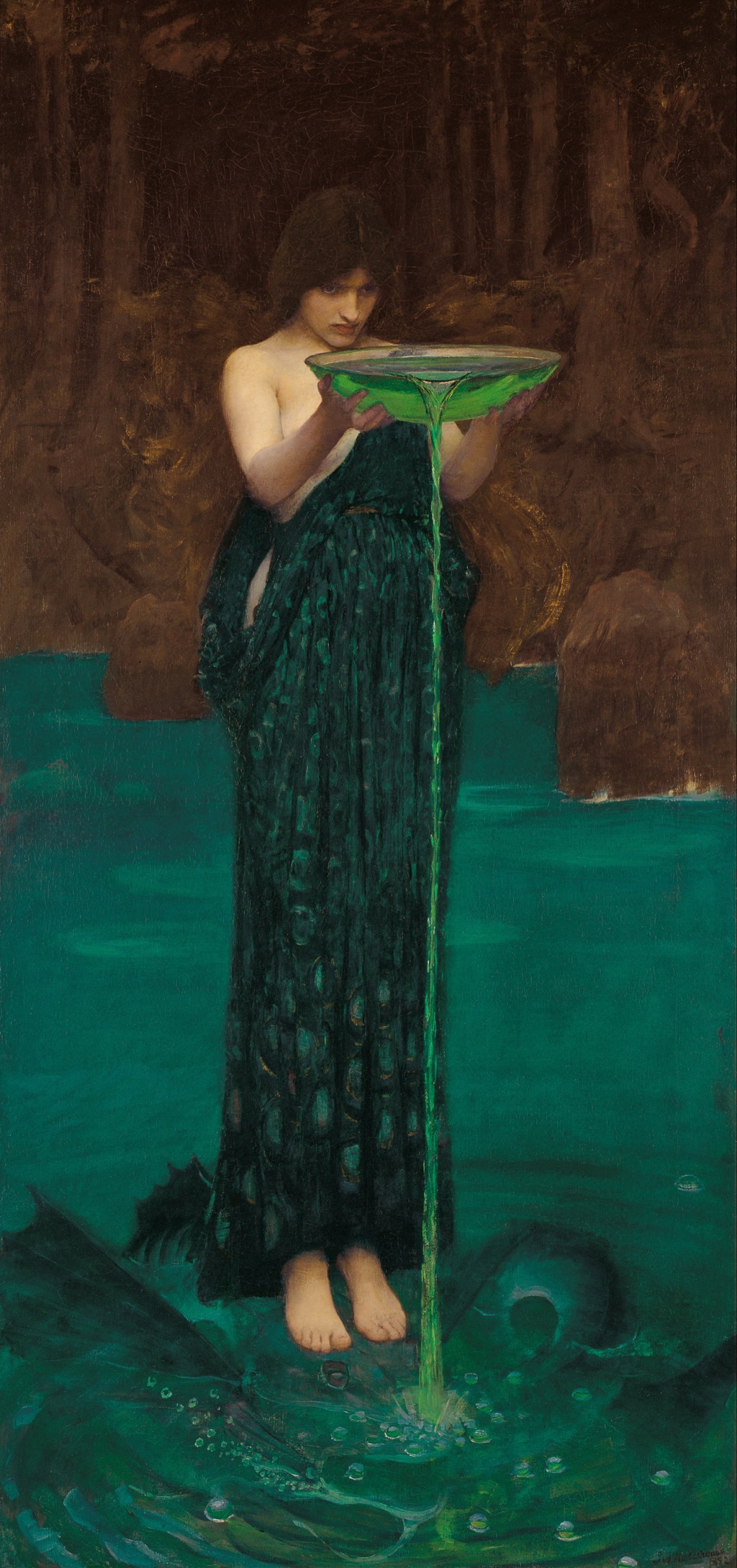
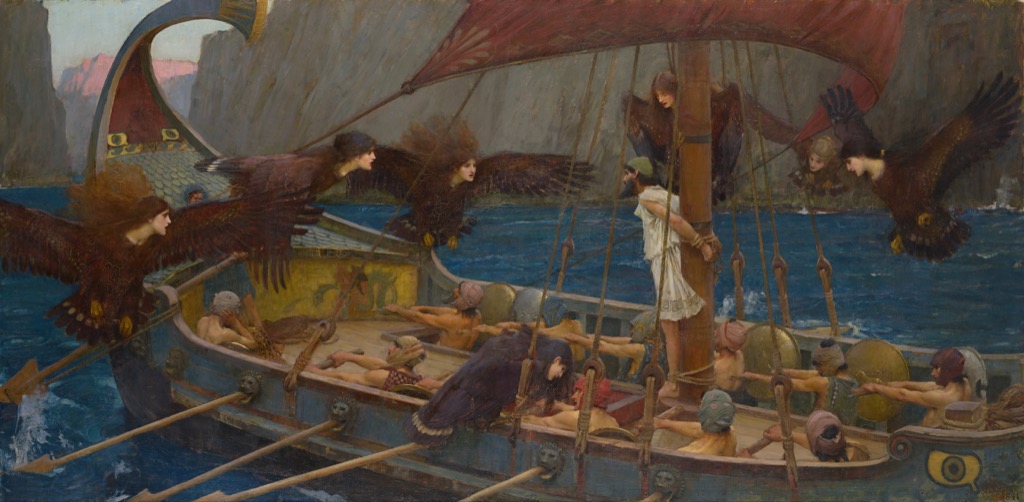
Waterhouse's Circe pictures offer another comparison. Circe stands among magical attributes and possesses knowledge that threatens or transforms men. Unlike her, the woman in The Crystal Ball has no named myth, opponent or narrated deed.
The absence of a victim shifts emphasis from female danger to female concentration. Nothing in the scene proves that her knowledge will be used against anyone.
Across these works, Waterhouse repeatedly gives women command of cups, mirrors, potions, books and reflective surfaces. Such objects externalise mental states that painting cannot otherwise show.
The circular object can also stage self-containment. A mirror normally returns an image of the viewer or room; a crystal ball is expected to hold a world not visibly present. It gives the woman a focus that excludes the spectator.
That exclusion is central to the painting's dignity. She is not posed to meet our gaze. Her activity would continue if no one watched.
They also make looking reciprocal. The viewer examines a woman whose own vision is directed elsewhere, denying easy access to her inner life.
How to Look at the Painting
Begin with the sphere. Ask what it actually reveals rather than what a crystal ball is expected to reveal.
Follow the woman's gaze and the shape of her hands. Concentration is built through posture before it is explained through symbols.
Move to the table and distinguish the objects. The book cannot be read, the wand is inactive, and the skull offers the clearest fact.
Compare the skull and sphere as two rounded containers—one transparent and full of possibility, the other emptied by death.
Then trace the architectural circles and verticals. The interior turns an occult act into an ordered composition.
Finally imagine the skull absent. Its documented overpainting is an unusually direct way to test how one object changes an entire image.
Related Pages
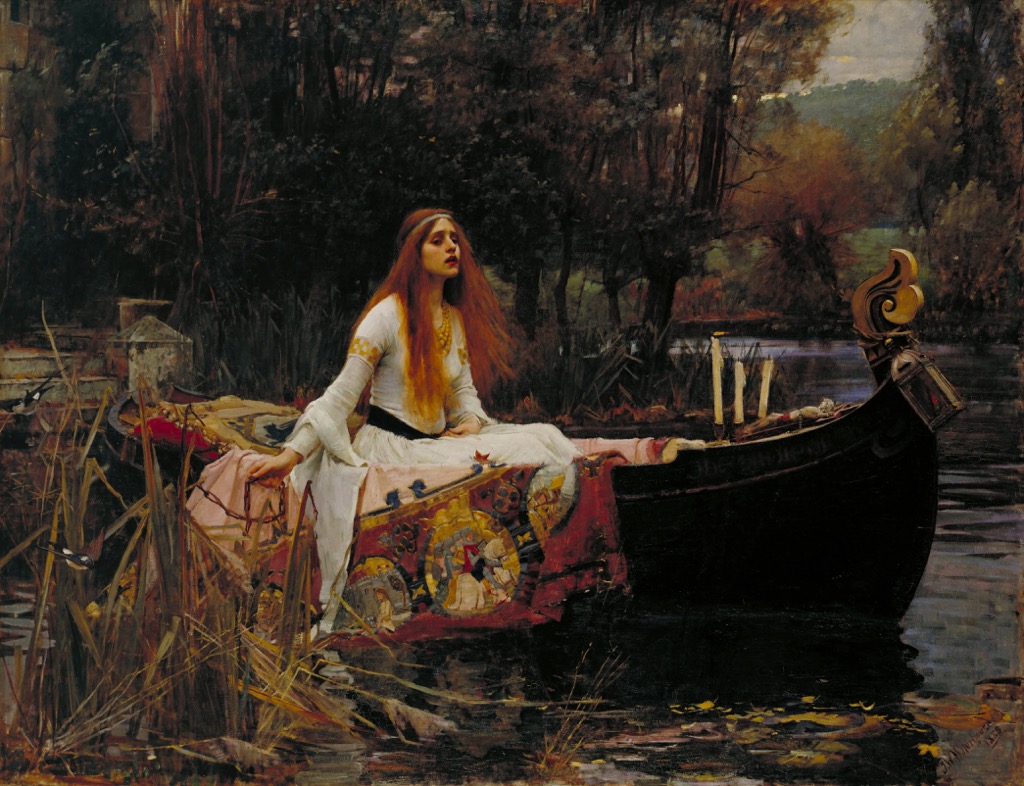
- The Lady of Shalott: Compare Waterhouse's best-known literary composition.
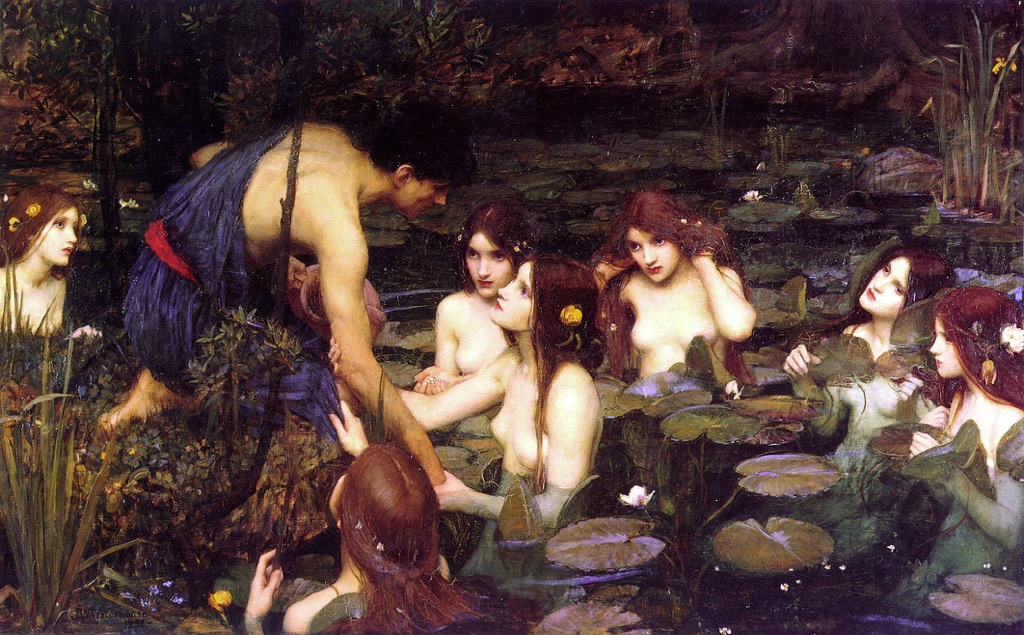
- Hylas and the Nymphs: Compare another major mythological scene.
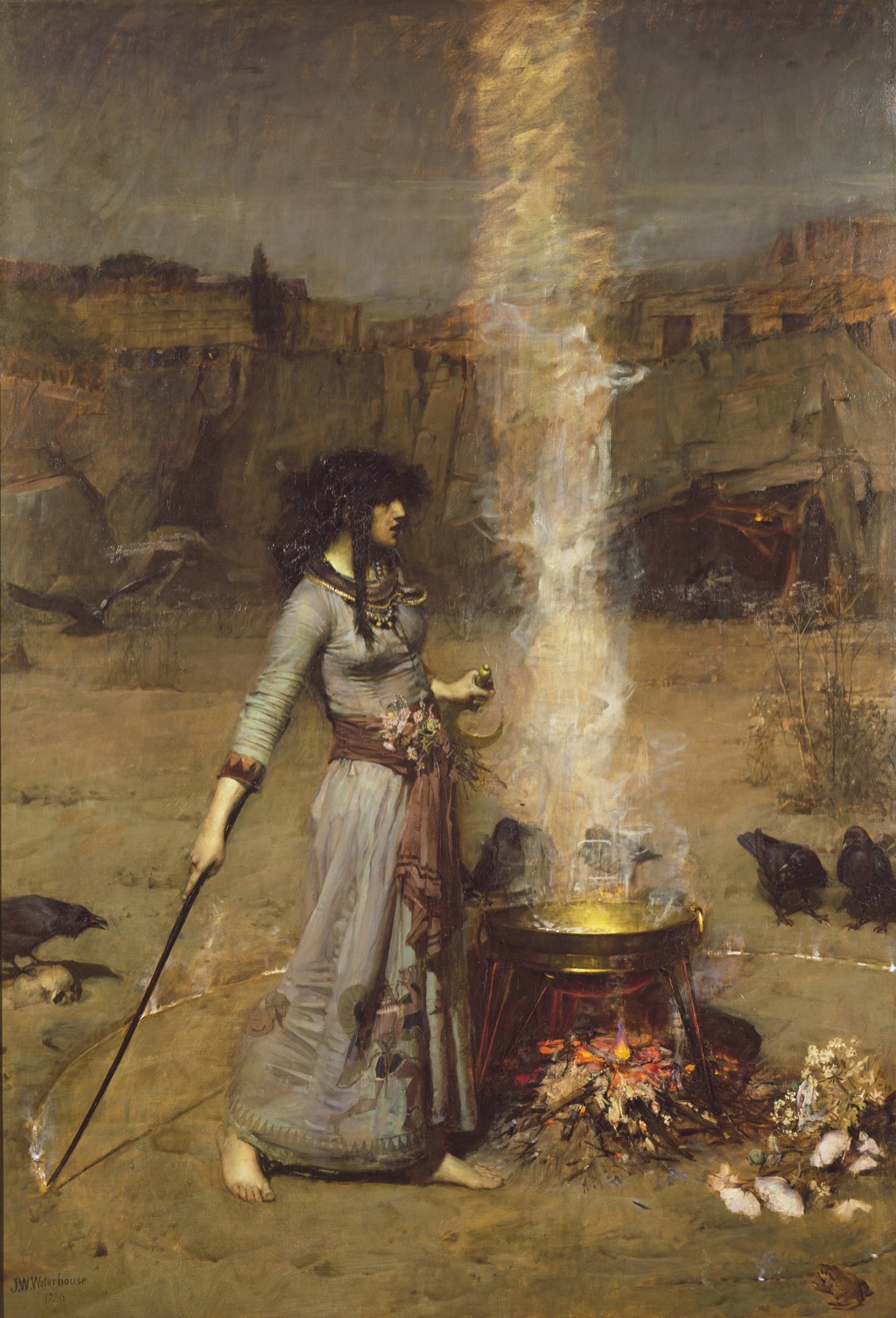
- The Magic Circle: Compare Waterhouse's treatment of ritual and symbolism.
Frequently Asked Questions
She is gazing into a crystal ball, apparently as part of a magical or divinatory practice. Waterhouse does not reveal what she sees. [1]
No character is named in the title or documented exhibition record. Comparisons with Circe are useful, but identifying her as Circe would be unsupported.
An open book, a slender wand and a human skull accompany the crystal ball. [1] The precise text and ritual are not identified.
Christie's suggested that a former owner may have disliked it, but the responsible person and motive were not proved. A 1909 photograph confirms the skull was part of the early composition. [1]
No. Technical examination found it intact beneath later paint and separated by varnish, allowing it to be uncovered. [1]
It was exhibited with The Missal at the Royal Academy in 1902, and F. H. Pyman acquired both. They have been interpreted as pendants. [1]
It is privately owned. The Museo Thyssen-Bornemisza recorded it as part of the Pérez Simón Collection for the 2011 exhibition Heroines. [2]
The painting does not decide. It shows a serious act of gazing but no verifiable vision, allowing belief, doubt and aesthetic fascination to coexist.
It certainly introduces mortality, but calling the entire work a conventional memento mori may be too narrow. The skull operates with book, wand and crystal inside a scene of inquiry rather than as an isolated reminder of death.
Discussion
The Crystal Ball is a picture about the limits of pictures. Waterhouse can show a woman looking, a transparent object and every sign of a ritual, but he cannot—or chooses not to—show the future she seeks. The imagined vision occurs where paint remains silent.
The skull opposes that silence with certainty. Mortality needs no occult revelation, yet someone later tried to remove even that visible fact. Its concealment and recovery repeat the painting's central action: knowledge is covered, sought and partially disclosed.
Reader Insights
Which visible detail most changes the way you read this page?
Which source or comparison helps the work feel less familiar and more specific?
What question would you bring back to the painting after reading?
Join the Conversation
Share your reading of this page below.
References
- Christie's. “John William Waterhouse, The Crystal Ball,” object record and catalogue essay covering dimensions, Royal Academy exhibition, provenance, companion picture and technical evidence concerning the overpainted skull. View source
- Museo Thyssen-Bornemisza and Fundación Caja Madrid. “Heroines: Sorceresses,” 2011 exhibition record identifying The Crystal Ball and the Pérez Simón Collection. View source
- J. W. Waterhouse.net. “The Crystal Ball 1902,” secondary object page reporting the later uncovering of the skull. View source
- Oxford University Museum of Natural History. “Presenting… Victorian Spiritualism,” historical overview of the movement's practices, appeal and scientific controversy. View source
- British Museum. “Crystal ball,” collection record for the rock-crystal sphere associated with John Dee. View source
- Ashmolean Museum. “Spellbound: Magic, Ritual and Witchcraft,” exhibition overview placing crystal balls and magic mirrors within the material history of magical belief. View source