 by Tom Gurney
Tom Gurney BSc (Hons) is an art history expert with over 20 years experience
Published on August 14, 2026 / Updated on August 14, 2026
Email: tomgurney1@gmail.com / Phone: +44 7429 011000
Spring (The Flower Picker): Introduction
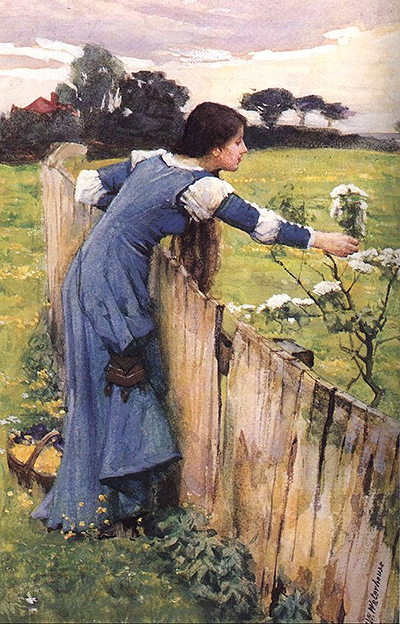
A dark-haired woman in blue leans across a low fence or wall into a flowering garden. Her body forms a long diagonal, and the soft background seems to move around the precision of her face and hands. John William Waterhouse’s Spring, commonly called The Flower Picker, transforms one modest act into an image of reach, season and suspended attention. [1]
The page requires unusual care because several related versions survive and online records conflict. The widely reproduced vertical work is catalogued as a watercolour and gouache of about 1900 measuring 23 × 15.2 cm, not securely as the 1895 oil described in older web copy. [1] Waterhouse repeated the pose in small oils, watercolours and studies, so medium and size must remain attached to the specific image.
At a Glance
- ArtistJohn William Waterhouse (1849–1917)
- Preferred titleSpring (The Flower Picker) [1]
- Alternative titleThe Flower Picker [1]
- DateAbout 1900; some secondary pages give 1895 [1]
- MediumWatercolour and gouache for the widely reproduced 23 × 15.2 cm version [1]
- Dimensions23 × 15.2 cm [1]
- CollectionPrivate collection [1]
- FormatSmall vertical composition
- SubjectA dark-haired woman in blue leaning over a garden boundary towards flowers [1]
- Related worksOther versions and preparatory studies of the flower-picker pose [2]
- Essential distinctionNot the later ancient subject sometimes called Woman Picking Flowers and connected with Phyllis and Demophoön [2]
Contents
- Introduction
- A Body Shaped by Reaching
- Sorting out Title, Date and Medium
- Fence, Flowers and the Unseen Hand
- Watercolour Intimacy and Selective Finish
- Spring without a Fixed Story
- The Flower-Picker Versions
- From Contemporary Garden to Mythic Motif
- Beauty, Labour and Possession
- How Small Scale Changes the Image
A Body Shaped by Reaching
The woman leans forward from the waist. Her torso and arm carry attention towards flowers beyond or below a low boundary.
This pose creates movement without showing walking. Weight shifts through the body while feet or lower dress stabilise the reach.
Her dark hair gathers around a profile or three-quarter face. She looks away from the viewer and towards the task.
That directed gaze is essential. The figure does not present herself as a formal portrait; she belongs to an action.
The blue dress creates a strong vertical mass, then bends with her body. White or pale clothing beneath it catches light around sleeve and neckline.
The fence or wall is not merely scenery. It makes reaching necessary.
Without the obstacle, she could stand directly among the flowers. With it, her body must cross space while remaining rooted on one side.
This produces both intimacy and separation. The garden is close enough to touch but not fully entered.
Her hands may be near the edge of the visible image or partly obscured by growth. The exact instant—before picking, during picking or after—can remain open.
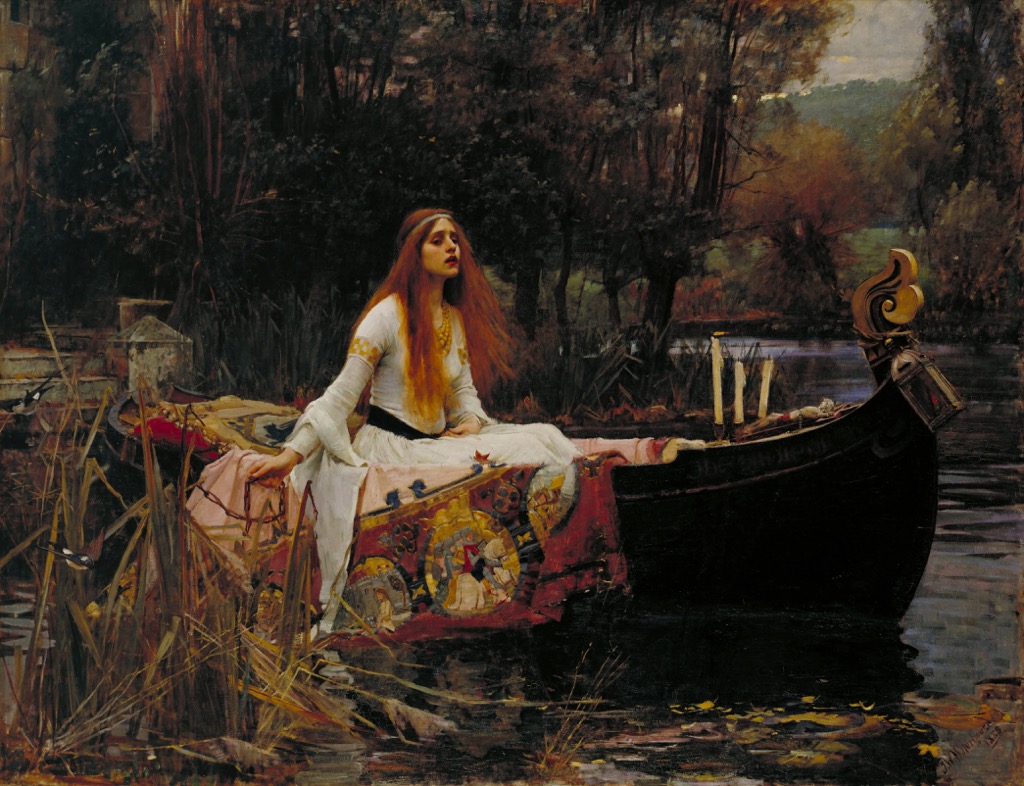
Waterhouse frequently chose thresholds: a door into Cupid’s garden, a wall carrying Pyramus’s voice, a mirror separating the Lady of Shalott from the world.
The flower picker’s boundary is smaller and non-literary, but it performs a related task. Desire becomes spatial.
No other figure answers the gesture. The scene is solitary, though not necessarily lonely.
The woman’s absorption protects her from the spectator. We watch a reach not made for us.
Sorting out Title, Date and Medium
The image has circulated under The Flower Picker and older 1895 metadata, while the object record supports the c.1900 watercolour and gouache identification. [1]
The Wikimedia object summary for the widely reproduced image identifies Spring (The Flower Picker), about 1900, in watercolour and gouache, measuring 23 × 15.2 cm. [1]
These are materially different claims. A manuscript must not combine them into one apparently certain object record.
The discrepancy may arise because Waterhouse produced multiple versions of the flower-picker subject. A date attached to one version can migrate to another when images circulate without provenance.
Peter Trippi’s account, quoted in a later catalogue discussion, confirms a series of pictures around the medieval-flavoured flower-gathering maiden, including a highly finished watercolour titled Spring – The Flower Picker, a small oil and a related sketch. [2]
That evidence makes version control more important than choosing whichever date appears most often.
The present page should centre the 23 × 15.2 cm watercolour and gouache because its image and object data form a coherent match. [1]
The older 1895/oil description can remain in a note about historical web metadata, not in the At a Glance facts.
If a different high-resolution source image is later supplied, its support and dimensions must be rechecked before publication.
The preferred title Spring also changes interpretation. It identifies season and renewal rather than defining the woman by an occupation.
The Flower Picker makes the figure a type. Spring makes her action part of a cycle.
Both titles are useful, but their relationship should be disclosed rather than treated as two unrelated paintings.
Fence, Flowers and the Unseen Hand
The garden boundary cuts across the lower or middle field in irregular, weathered colour.
Its browns, whites and greenish marks suggest wood, stone or a surface affected by outdoor growth.
Exact material should follow the best image. Popular descriptions call it a fence, but its painted texture may allow wall-like readings.
What matters compositionally is the edge. It separates cultivated growth from the figure’s standing place.
The flowers are small, distributed accents rather than large botanical portraits. Waterhouse uses them to pull the eye towards the reaching hand.
Their species should not be forced into a Victorian flower dictionary. Reproduction is insufficient for confident botanical identification.
The hand is where intention becomes material. Fingers select, gather or hover.
If partly hidden, that incompleteness intensifies the action. The viewer sees the body’s commitment before seeing the exact result.
The garden beyond contains trees and perhaps a house with a reddish roof.
Those forms are softened so the environment feels luminous rather than architecturally surveyed.
The pale sky and warmer roof prevent the green background from becoming monotonous. Blue clothing then provides a controlled contrast.
Movement is generated through diagonal repetition: leaning torso, arm, fence and drifting foliage.
Waterhouse does not require wind to make the scene move. The woman’s reach activates the whole vertical format.
Watercolour Intimacy and Selective Finish
Watercolour and gouache create different possibilities from oil. Transparent washes can describe atmosphere; opaque gouache can restore light and body over them. [1]
At 23 cm high, the image is intimate. It asks for close viewing rather than monumental confrontation.
Small scale suits a single gesture. A large canvas might demand narrative expansion, additional figures or more elaborate setting.
Waterhouse can concentrate finish on face, hair and costume while allowing garden colour to remain broken.
This hierarchy resembles his oil practice, where carefully modelled flesh often stands against freer landscape.
The difference is material speed and luminosity. Watercolour can let paper participate in the light.
No pigment analysis is available in the public sources, so exact colourants or layering sequences should not be asserted.
Visible softness does not mean careless execution. The body’s balance and relationship to the fence require careful planning.
Nor should the work be dismissed as an illustration because of medium and size. Waterhouse exhibited watercolours and belonged to a culture in which works on paper could carry substantial finish and value.
The small sheet may have been created for private ownership rather than public Academy display. That destination remains a question unless provenance proves it.
Its intimacy changes the viewer’s relation to the woman. We approach a private action on a scale closer to a book or album than a gallery wall.
The garden does not surround our body; it opens within our hands and attention.
Spring without a Fixed Story
The word Spring supplies a season but not a plot. Flowers appear, growth returns and human activity moves outdoors.
Waterhouse does not attach the figure to a poem, legend or named goddess in the surviving title. [1]
That absence is meaningful. By about 1900 he could create suggestive female subjects whose emotional effect did not depend upon a viewer knowing Tennyson, Homer or Ovid.
Spring carries familiar associations: renewal, youth, desire, colour and temporary abundance.
The image can activate these without assigning one allegorical equation. The woman is not “Spring personified” merely because the work bears the season’s name.
She performs a seasonal act. That is enough to link body and calendar.
Picking also contains loss. A flower is enjoyed through removal from the plant that sustains it.
This tension prevents spring from becoming pure optimism. Growth produces the possibility of gathering, and gathering begins decay.
Waterhouse would later explore this relation through Gather Ye Rosebuds While Ye May, The Soul of the Rose and the Persephone-associated flower women. [3]
The small Spring precedes or accompanies that mature sequence as a non-narrative experiment.
Its medieval flavour, noted in specialist discussion, comes through costume and idealised setting rather than a documented story. [2]
The image therefore occupies invented time. A modern model, historicising dress and timeless garden meet without demanding archaeological consistency.
This openness is part of the work’s purpose, not a lack of research.
The Flower-Picker Versions
At least several treatments of the pose are known. Specialist discussion mentions the finished watercolour, a small oil version and a related sketch. [2]
Later cataloguing has expanded the group into multiple variants, but every claimed number should be verified against a published catalogue raisonné or handled object record.
The versions may differ in crop, background, degree of finish, medium and exact inclination of the body.
Such differences are not decorative trivia. They change the image’s emotional balance.
A more detailed house can make the setting contemporary. A more generic wall and costume can make it medievalising.
A visible hand holding flowers closes the action; a hovering hand keeps it prospective.
Waterhouse often allowed compositions to emerge through repeated studies. He moved figures and tested relations rather than executing one fixed design mechanically.
The flower-picker group should be treated as a family of solutions, not a sequence in which every smaller work is simply inferior.
This principle also protects search quality. A reader looking for one reproduction should find its correct medium and dimensions rather than a blended composite.
The Flower Picker remains a familiar alternate title, while the object record identifies the featured small work as Spring. [1]
Future image captions should identify version-specific facts. Where the version is uncertain, caption language should be cautious.
The existence of repetition demonstrates Waterhouse’s sustained interest in one leaning body. He returned because the gesture could support several contexts.
From Contemporary Garden to Mythic Motif
The leaning flower picker later became entangled with Waterhouse’s treatment of Phyllis. A picture once called Woman Picking Flowers appears to be a study connected with Phyllis and Demophoön rather than a simple garden subject. [2]
In Ovidian tradition, Phyllis is transformed into an almond tree after abandonment. Waterhouse’s finished painting shows her emerging from blossom towards the returning Demophoön. [4]
The related figure leans from a tree, and the familiar flower-picker pose helped shape that supernatural emergence. [2]
This migration is a powerful example of studio memory. A body first used for an unnamed seasonal action can become a mythological woman crossing plant and human form.
The pose was therefore not locked to one title. Waterhouse kept visual solutions available for later narrative use.
The change also reveals how myth grows from observation. Phyllis becomes believable because her weight and reach were studied through ordinary bodily action.
Conversely, the small Spring acquires retrospective strangeness. A woman leaning into vegetation can look as though she might merge with it.
That does not prove she is a dryad, Flora or Persephone. Comparison should enrich the image without renaming it.
Waterhouse’s repeated association of women and plants deserves critical attention. Nature can express vitality and transformation, but it can also make female identity seem passive, cyclical or available for visual consumption.
The figure’s active reach resists complete passivity. She is not merely a flower; she chooses among flowers.
The page should therefore hold both structures: woman linked to seasonal nature, and person exerting intention within it.
Beauty, Labour and Possession
Flower picking can be leisure, domestic work, commercial labour or symbolic action. The image does not securely identify which.
The woman’s clean, idealised dress and solitary setting make hard agricultural labour unlikely as the primary reading.
Yet the action still involves body and effort. She leans, balances and reaches rather than standing as a decorative ornament.
Calling her “innocent” because of pale skin and flowers imports a Victorian beauty stereotype, not object evidence.
Her face is focused, and her action has purpose even if the purpose is unknown.
Picking asserts temporary possession. The chosen flower moves from common garden to personal hand.
The fence complicates that possession. Does she own the garden, reach into a neighbour’s plot or tend a boundary? The painting does not say.
This uncertainty gives the small scene quiet narrative pressure. The reach may be permitted, playful or transgressive.
Waterhouse contains that pressure within beauty. Soft colour prevents the gesture from appearing furtive or violent.
The viewer also takes possession through looking. A private act becomes a reproducible image.
Responsible interpretation resists turning the woman herself into another picked object. Her averted gaze and physical absorption help maintain distance.
The work’s pleasure comes from following her attention, not capturing it.
How Small Scale Changes the Image
Dimensions are never a neutral catalogue detail. A work 23 cm high creates a different bodily encounter from Waterhouse’s life-size Academy paintings. [1]
The viewer must approach. Garden, figure and fence enter a compact field that can be absorbed almost at once, then revisited through details.
This intimacy suits watercolour. Subtle changes of wash may disappear at distance and become visible only when the eye is close to the sheet.
The relation can feel private, but it is not voyeuristic by necessity. The figure’s averted gaze and self-directed task prevent her from performing directly for us.
Smallness also alters the meaning of landscape. Waterhouse cannot offer a panoramic garden with deep recession. He selects a few signs—green growth, pale sky, roof, boundary—and lets them stand for a complete environment.
This economy keeps the figure dominant without isolating her against an empty ground.
The scale may have practical implications. A small work is easier to frame in a domestic interior, transport through the market and live with as a private object.
Those possibilities should not be converted into a documented commission. No accessible provenance establishes the original buyer or intended room.
They nevertheless explain why Waterhouse could revisit one pose in several small forms. Each version might circulate independently while allowing further experimentation.
Repetition also tests memory. A collector familiar with another flower picker could notice changed dress, crop or background and enjoy recognition without requiring a new story.
The small format makes the woman’s reach proportionally large. Her diagonal fills much of the sheet, so a minor movement becomes compositional architecture.
At monumental scale, the same lean might appear theatrical or physically strained. Here it remains light and momentary.
The fence’s rough marks become especially important. A few touches must communicate surface, age and obstacle without detailed masonry.
Flowers similarly operate as colour signals rather than botanical specimens. The viewer completes abundance from limited evidence.
This cooperation between painter and viewer gives the image durability. It is specific enough to guide imagination and open enough to avoid exhaustion.
Reproduction obscures the relationship. Online, the image may expand to the same screen size as a two-metre canvas, making all paintings seem equivalent.
Restoring dimensions restores intention. Brush or wash marks that look loose at high magnification may be precise at their actual scale.
It also corrects status assumptions. Small does not mean preliminary, and work on paper does not mean unfinished.
The featured Spring is a finished, intimate treatment within a family of variants. Its refinement lies in compression: one body, one boundary, one seasonal gesture.
This compression distinguishes it from larger flower compositions in which multiple women and landscape distribute attention. The small sheet never loses sight of the hand reaching across.
The page should therefore encourage viewers to imagine the physical object, not only its floating digital image. Scale is part of close looking.
Related Pages
- The Lady of Shalott: Compare Waterhouse's best-known literary composition.
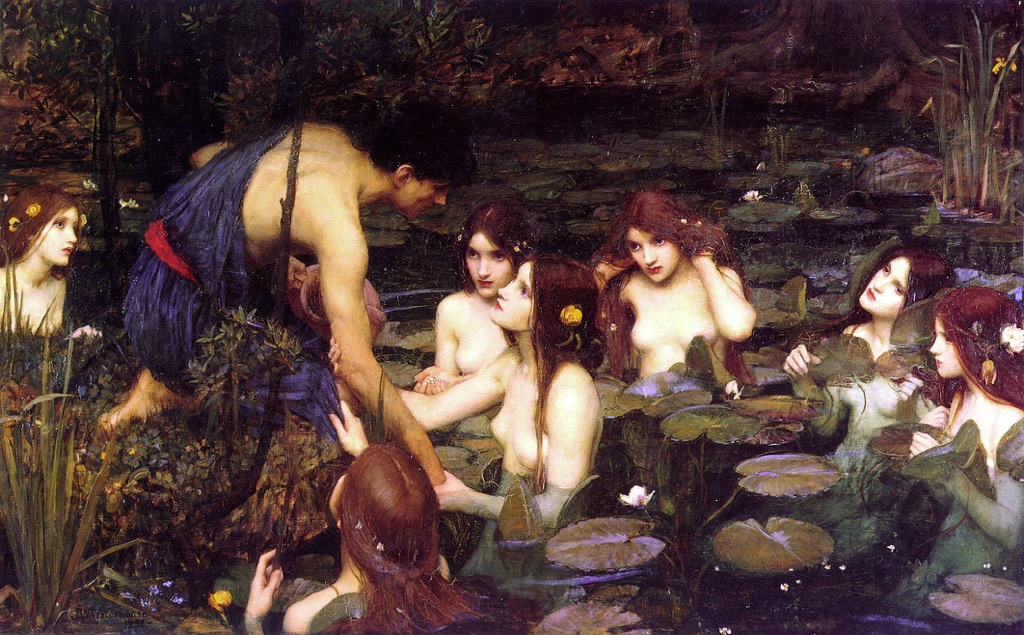
- Hylas and the Nymphs: Compare another major mythological scene.
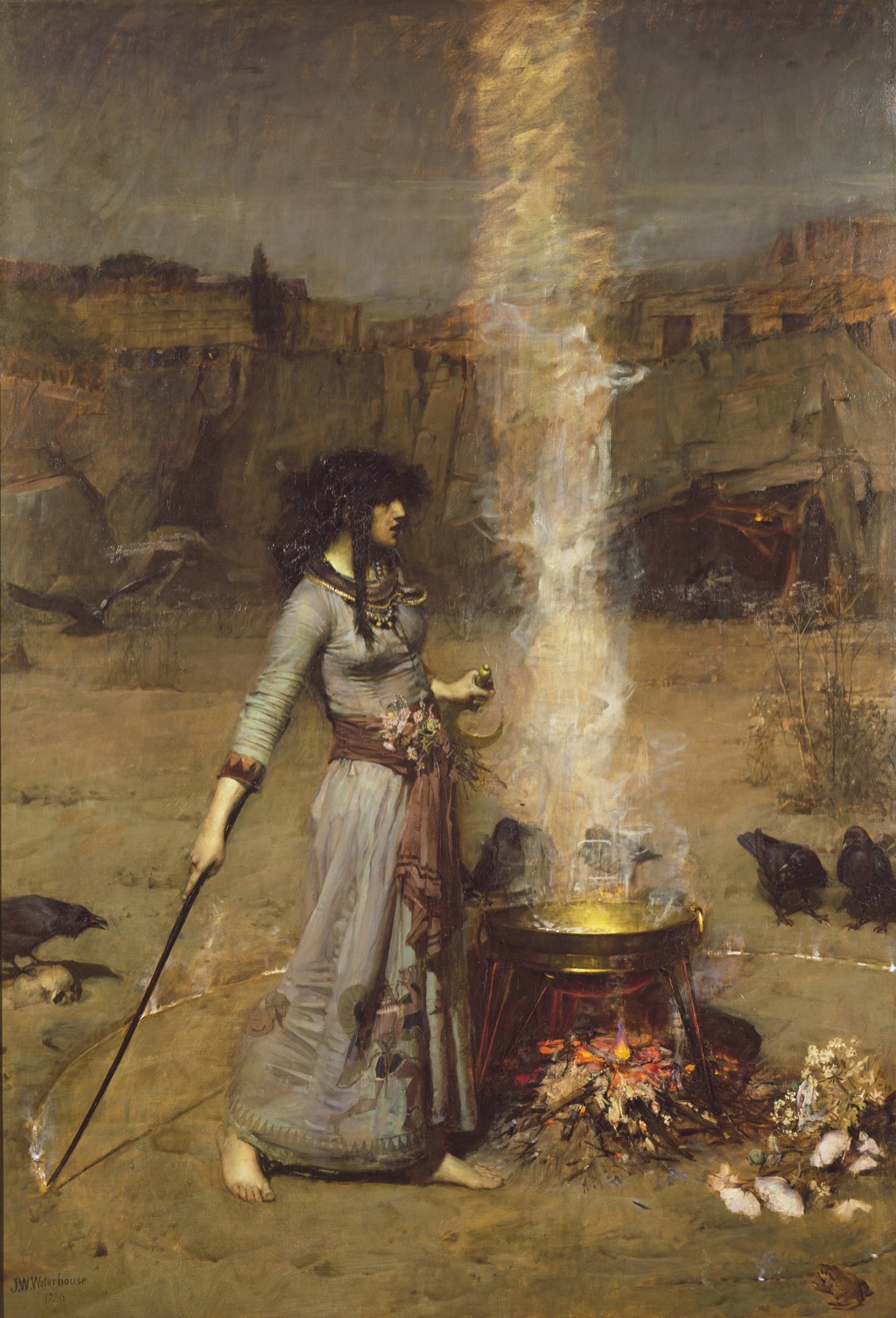
- The Magic Circle: Compare Waterhouse's treatment of ritual and symbolism.
Frequently Asked Questions
The featured small watercolour and gouache is best dated to about 1900. The 1895 date appears in secondary descriptions and may refer to variant or legacy metadata. [1]
The widely reproduced 23 × 15.2 cm version is catalogued as watercolour and gouache. Related oil versions exist. [1] [2]
It is in a private collection. [1]
No secure source identifies her. Spring is seasonal rather than a documented character name.
Waterhouse repeated and revised the leaning flower-picker pose across finished works and studies, testing medium, setting and narrative potential. [2]
Discussion
Spring (The Flower Picker) is built around a simple imbalance: the body stays on one side of a boundary while attention and arm cross towards growth. Waterhouse makes that imbalance graceful without eliminating effort.
The disputed date and medium reveal a second lesson. Repeated subjects demand object-level care. A page that merges the 1895 oil description with the c.1900 watercolour would erase the very working process that makes the image interesting.
Reader Insights
Which visible detail most changes the way you read this page?
Which source or comparison helps the work feel less familiar and more specific?
What question would you bring back to the painting after reading?
Join the Conversation
Share your reading of this page below.
References
- Wikimedia Commons, “John William Waterhouse: Spring (The Flower Picker),” object summary for the c.1900 watercolour and gouache. View source.
- “Woman Picking Flowers,” catalogue discussion quoting Peter Trippi on Spring – The Flower Picker and related versions. View source.
- Sotheby's, “John William Waterhouse: Gather Ye Rosebuds While Ye May,” catalogue essay on Waterhouse’s late flower-women. View source.
- Christie's, “John William Waterhouse: Study for ‘Phyllis and Demophoön’,” object record and catalogue essay. View source.