 by Tom Gurney
Tom Gurney BSc (Hons) is an art history expert with over 20 years experience
Published on August 14, 2026 / Updated on August 14, 2026
Email: tomgurney1@gmail.com / Phone: +44 7429 011000
Gathering Summer Flowers in a Devonshire Garden: Introduction
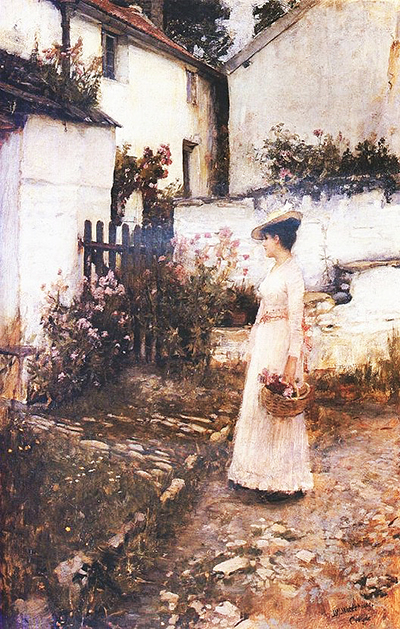
A woman stands in a bright cottage garden, placing freshly gathered flowers into a basket. Pale dress, sunlit wall and dense growth turn a private Devon visit into one of John William Waterhouse’s rare contemporary domestic landscapes. Nothing in the scene announces myth, martyrdom or literary tragedy; its drama is the ordinary abundance of a summer garden. [1]
The painting is best dated about 1892–93 and measures 76.2 × 50.7 or 50.8 cm. It is privately owned. [1] [2] The setting has been connected with the Croyde home of landscape painter Peregrine Feeney and Waterhouse’s sister-in-law Emily. The woman may be Esther Kenworthy Waterhouse, but that attractive identification rests on resemblance and family context rather than a documented sitting. [1]
At a Glance
- ArtistJohn William Waterhouse (1849–1917)
- TitleGathering Summer Flowers in a Devonshire Garden
- Alternative shortened titleGathering Flowers in a Devonshire Garden [1]
- DateAbout 1892–93; a broader 1893–1910 range appears in some secondary discussions [1]
- MediumOil on canvas [1] [2]
- DimensionsApproximately 76.2 × 50.8 cm [1] [2]
- CollectionPrivate collection [1] [2]
- Probable settingThe Feeney family cottage at Croyde, North Devon [1]
- Possible sitterEsther Kenworthy Waterhouse, not conclusively identified [1]
- Subject typeContemporary domestic garden scene rather than literary or mythological narrative
Contents
- Introduction
- A Quiet Act of Gathering
- Croyde, the Feeneys and a Family Setting
- Is the Woman Esther Waterhouse?
- Basket, Flowers and Garden Labour
- Cottage, Wall and Summer Light
- From Naturalism to Flower-Women
- Victorian Flower Meanings: Use with Care
- Private Painting and Uncertain Provenance
- Esther Kenworthy Waterhouse and the Art of Flowers
A Quiet Act of Gathering
The figure stands upright or gently inclined within a tall garden composition. A basket hangs from or rests against her left arm while the other hand reaches towards flowers.
Her action is ongoing. She has already gathered some blossoms and continues to select others.
This produces a cycle within the image: garden, hand, basket.
The basket makes purpose visible without explaining the flowers’ later use. They may be arranged indoors, given away, painted by another artist or simply enjoyed.
Waterhouse does not introduce a viewer within the scene. The woman is not offering flowers to us.
Her attention remains with plants and task. This absorption gives privacy to a picture that may have begun in family surroundings.
The title names place and season but not identity. “A Devonshire Garden” is specific enough to resist timeless myth and broad enough to avoid one exact address.
“Summer” changes colour into duration. Growth is at or near abundance, yet seasonal knowledge tells us it will pass.
Unlike Gather Ye Rosebuds While Ye May, the title does not quote a carpe diem command. No poem urges the woman to act.
Gathering can therefore remain practical. Symbolic readings arise from the image but do not control it.
The work’s quietness should not be confused with emptiness. Waterhouse coordinates weight, reach, basket and surrounding growth in a moment where no gesture is theatrical.
The woman is part of the garden without dissolving into it. Pale clothing distinguishes her from leaves while shared light joins body and place.
Croyde, the Feeneys and a Family Setting
Emily Kenworthy, Esther Waterhouse’s sister, married the landscape painter Peregrine Feeney. [1]
Feeney left the Primrose Hill area and established a home at Croyde in North Devon. Peter Trippi places the relevant cottage at Baggy Point and dates its construction or family settlement around 1892. [1]
John and Esther Waterhouse visited the couple. These journeys offered Waterhouse a domestic rural setting different from his London studio and Italian travel scenes.
The garden was associated with roses and cottage planting, while specialist discussion connects the setting with the Feeneys’ home. [1]
This context makes the painting biographically plausible without turning it into a photographic document of one afternoon.
Artists can combine on-site studies, posed figures and studio completion. A named garden does not prove every wall, plant and light effect was copied simultaneously.
The title’s “Devonshire” uses the older county form still common in the period. Modern readers would normally say Devon.
Croyde lies on the north coast, near dramatic headlands and Atlantic light. Waterhouse chooses the enclosed garden rather than marine panorama.
That choice turns travel inward. The family cottage becomes as worthy of paint as Capri or Camelot.
Peregrine Feeney’s own work as a landscape painter adds another layer. Waterhouse was visiting an artist’s household, not merely borrowing a picturesque property.
Esther was also an exhibiting flower painter. A garden shared among artists could support observation, conversation and separate work. [3]
The manuscript should not claim a documented collaboration. It can recognise a creative family environment in which flowers mattered as living subjects and painted subjects.
Is the Woman Esther Waterhouse?
The figure has traditionally been identified as Esther Kenworthy Waterhouse, the artist’s wife. [1]
The proposal rests on resemblance to portraits associated with Esther and on the likelihood that she accompanied her husband to her sister’s home.
It is plausible, but no known inscription or letter confirms the sitting. [1]
The distinction matters because model identifications often grow firmer through repetition. “May be Esther” becomes “is Esther,” then biographies use the painting as proof of the claim that began as inference.
Waterhouse’s secure portrait of Esther in Sheffield provides a point of comparison, though that work itself requires careful attribution history because a separate studio portrait by William Logsdail has sometimes been confused with it. [3]
Age, pose, hat or distance can limit facial comparison. The garden figure is not a close head study.
Family context remains the strongest support. Esther was present in Waterhouse’s life, had relatives at Croyde and understood flowers as an artist.
If she is the sitter, the work becomes unusually intimate: one painter represents another gathering subjects in her sister’s garden.
If she is not, the painting remains a rare contemporary garden scene. Its quality does not depend upon solving the name.
The figure should therefore be called “the woman” or “possible Esther” throughout.
No further romantic narrative is needed. The painting does not document a private message from husband to wife unless provenance or inscription proves one.
Responsible uncertainty protects Esther’s identity as an artist in her own right. She should not appear only as a beautiful anonymous extension of her husband’s career.
Basket, Flowers and Garden Labour
The basket defines gathering as work with an intended result. It receives what the hand removes.
Its woven texture differs from petals, cloth and masonry, adding a compact pattern near the body.
Waterhouse does not show dirt, tools or heavy exertion. The action appears gentle and may belong to leisure or domestic tending rather than commercial horticulture.
Yet it still requires selection. A flower garden must be planted, weeded, watered and cut.
The image risks making maintenance disappear behind abundance. Close looking can restore the work implied by healthy growth.
If the figure is Esther, gathering might connect with her flower painting. She may be collecting specimens or arrangements, but no document confirms that purpose.
Flowers move through several possible states: living plant, cut object, domestic decoration, gift and painted motif.
Waterhouse captures the transition between the first two.
The basket prevents the moment from becoming mere smelling or reverie. Accumulation is visible.
Her white or pale dress creates an idealised contrast with practical garden work. It may reflect middle-class leisure rather than labouring dress.
That social distinction should remain cautious. Clothing suggests circumstance but cannot establish a full class identity.
The act also differs from Waterhouse’s later mythic gathering. There is no companion, classical drapery or threatened abduction.
Modern domesticity deserves its own reading before Persephone enters.
Cottage, Wall and Summer Light
The garden includes a pale cottage or wall, roof and layered vegetation. [2]
Architecture encloses the scene and reflects light. Its whiteness helps the figure’s dress remain visible among green growth.
The vertical format accommodates standing body and climbing plants. Unlike a broad landscape, it creates an intimate slice of garden.
Sunlight appears warm but diffused. Hard shadow does not divide the image into theatrical zones.
Waterhouse’s handling likely varies between more resolved figure and looser foliage, a method he explored through French-related naturalism in the 1880s and his Italian genre scenes. [1]
Leaves do not require individual botanical finish to create abundance. Changes of green, light and edge are sufficient.
Flowers provide smaller bright marks. The basket gathers those scattered accents into one carried mass.
The cottage prevents the garden from becoming wilderness. Growth is cultivated beside human shelter.
This relation supports the painting’s domestic tone. Nature is not a dangerous forest or mythological threshold.
At the same time, dense vegetation can partially conceal architecture, allowing garden life to soften human structure.
Waterhouse often used steps, walls and windows to regulate narrative access. Here such elements regulate light and intimacy rather than forbidding a heroine’s movement.
The visual pleasure comes from balance: pale against green, upright figure against irregular growth, basket weight against reaching hand.
No element announces itself as a symbol, but every material contributes to seasonal mood.
From Naturalism to Flower-Women
Peter Trippi places the Devon garden after Waterhouse’s Capri experiments with women gathering fruit and before the large late sequence of women gathering or carrying flowers. [1]
This chronology makes the painting a bridge.
The figure belongs to contemporary life, yet the motif—woman harmonised with plant growth—will become increasingly poetic and mythic.
In An Orange Garden, multiple local models gather fruit across steep Capri architecture. In Devon, one possible family sitter gathers flowers within a cottage enclosure. [1]
Later, flower women inhabit medievalising interiors, ideal gardens and landscapes associated with Persephone.
The action remains similar while context changes identity.
Waterhouse’s skill lies in retaining observed bodily credibility across those transformations. Mythic gatherers lean and hold because modern models first performed comparable acts.
This connection should not reduce the Devon painting to preparatory material. It has an independent contemporary subject and emotional register.
Nor should every flower image be forced into Persephone. The ancient goddess is relevant when title, composition and scholarly argument support her.
Here family setting and modern dress point elsewhere.
The transition instead shows Waterhouse testing how ordinary action can carry poetic feeling without explicit literature.
Season, abundance and solitary attention are already enough.
The painting also preserves a route he did not fully pursue. Waterhouse might have developed more scenes of contemporary rural domestic life; his reputation moved towards idealised myth instead.
Its rarity within his career increases historical value.
Victorian Flower Meanings: Use with Care
Nineteenth-century Britain produced popular books assigning meanings to flowers. Bouquets could participate in courtship, mourning, friendship and domestic display.
That culture provides context, but it does not create a universal code.
Highly specific romantic messages, including the idea that the flowers might be sent to a lover, go beyond what the image securely shows.
The painting supplies no recipient, exchange or securely identified species to support that narrative.
Meanings varied between dictionaries, dates and arrangements. The same flower could carry different associations.
A modern page should therefore avoid sentences such as “the tulip means a declaration of love” unless the picture shows an identifiable tulip and Waterhouse’s source is documented.
The broader symbolic field is defensible. Cut flowers can evoke beauty, care, season and impermanence.
In a family garden, they may also carry ordinary use: table arrangement, painting subject or gift within the household.
These possibilities are richer when left open.
The basket holds a mixed gathering rather than an encoded single bloom. Variety itself may be the point.
Waterhouse’s later literary flower pictures invite symbolism because titles introduce poems and myths. The Devon title remains descriptive.
Interpretation should follow that difference. Context can inform looking without replacing it.
The safest question is not “What secret message does each flower spell?” but “How does gathering transform living abundance into a portable human arrangement?”
That question grows directly from the visible action.
Private Painting and Uncertain Provenance
The painting remains in a private collection, and no comprehensive public sale history is securely attached to it. [1] [2]
One family tradition suggests it stayed with or near the Feeney circle. This is plausible but requires documentary verification before being presented as complete provenance.
The work may not have been publicly exhibited during Waterhouse’s lifetime. Again, absence from accessible lists is not absolute proof of no exhibition.
Private status affects scholarship. Dimensions, surface, signature and colour are often repeated from photographs rather than rechecked against the object.
Published records differ slightly between 50.7 and 50.8 cm in width, an ordinary rounding difference that should be disclosed rather than exaggerated. [1] [2]
Date ranges vary more significantly. Specialist recent discussion favours about 1892–93 because of the Croyde chronology, while some sources allow later completion. [1]
The manuscript uses the narrower date and notes the broader range.
An obscure provenance is not permission to invent ownership. It is a reason to distinguish object fact, family tradition and inference.
The painting’s private scale and subject may explain why it attracted less early critical attention than Waterhouse’s Academy canvases.
That imbalance in the archive can distort reputation. Public monumental myths accumulate reviews; intimate domestic pictures disappear into family rooms.
Recovering the Devon garden broadens Waterhouse without falsely monumentalising it.
Its importance is qualitative: it reveals a contemporary, familial and landscape-based part of his practice.
Esther Kenworthy Waterhouse and the Art of Flowers
The possible identification of Esther matters most when it restores her profession rather than simply supplying a wife’s name.
Esther Kenworthy trained within an artistic family and exhibited flower paintings at the Royal Academy and other venues before and after her marriage. [3]
Flower painting was sometimes placed low in academic hierarchies because it lacked the grand narratives of history painting. It nevertheless required botanical observation, colour control and sophisticated arrangement.
If Esther posed in the Croyde garden, Waterhouse may be showing an artist among the living materials of her own genre.
The basket would then carry more than domestic decoration. Gathered blossoms could become visual studies or components of a still life.
This remains interpretation, not documented purpose. It is valuable because it grows from Esther’s actual career rather than a generic fantasy of romantic femininity.
Her presence could also change authorship dynamics. John controls the surviving canvas, but the garden belongs to a family of practising artists and the possible sitter possesses specialist knowledge of its subject.
The image would be less “artist observes beautiful wife” than “one artist observes another carrying out a familiar act.”
Even if the sitter is someone else, Esther’s work supplies relevant household context. Waterhouse did not encounter flower painting only as a male symbolic tradition.
He lived with an exhibiting practitioner who arranged and represented blooms professionally.
The historical record has often subordinated artist-wives. Their own works disappear, and their labour is folded into a husband’s studio story as modelling, hospitality or estate management.
Esther did perform important custodial work after Waterhouse’s death, including the dispersal and preservation of studio material. That later role should not erase the earlier exhibiting artist. [3]
The uncertainty of the garden sitter offers a chance to model responsible biography. We can state what Esther did securely and what the painting may show separately.
This distinction is better than either extreme: declaring her identity certain or excluding her because proof is incomplete.
It also changes how flowers are interpreted. Rather than relying on a simplistic language-of-flowers code, viewers can consider flowers as professional subjects with problems of colour, form, freshness and arrangement.
The woman’s selecting hand becomes curatorial. She decides what will enter the basket and how living diversity will become a portable group.
That act resembles painting. The artist also selects from the garden, choosing which forms to include within a bounded support.
Waterhouse’s composition contains a basket inside a canvas: one arrangement nested within another.
The analogy should not be forced into a hidden allegory. It identifies a visible structural relation between gathering and picture-making.
The pale dress against foliage further suggests selection. Waterhouse isolates the human arranger while allowing leaves and flowers to retain irregular growth.
If Esther is the model, her own flower paintings would be the missing third stage: plant becomes basket, then painted arrangement.
No known surviving work needs to be matched to the flowers in this scene. The conceptual sequence is enough.
This perspective also tempers the idea that the picture is merely a private token. Domestic intimacy and professional art can occupy the same garden.
Victorian women artists often worked from home and with subjects available within socially acceptable spaces. A cottage garden could be both family environment and serious studio resource.
Waterhouse’s image, intentionally or not, records that overlap.
The painting therefore deserves connection to the cluster’s models-and-sitters page and to Esther’s portrait, but those links should point readers towards her agency rather than use her as an explanatory accessory.
Whether or not she is visible, Esther changes what the garden can mean.
Related Pages
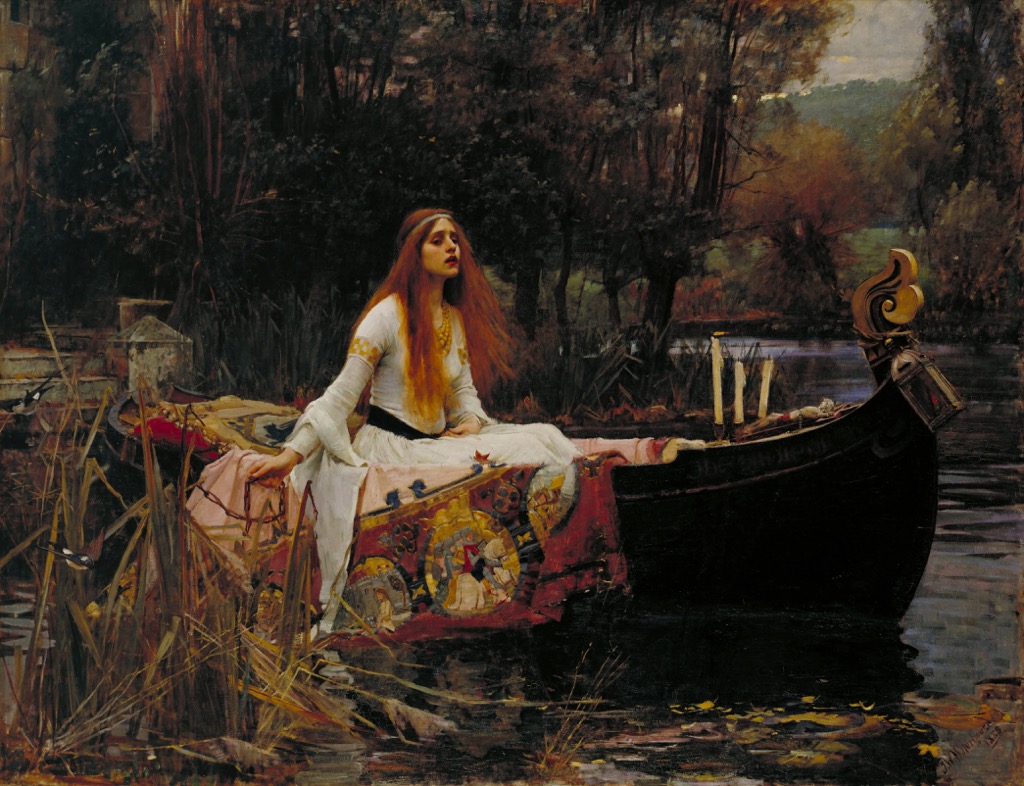
- The Lady of Shalott: Compare Waterhouse's best-known literary composition.
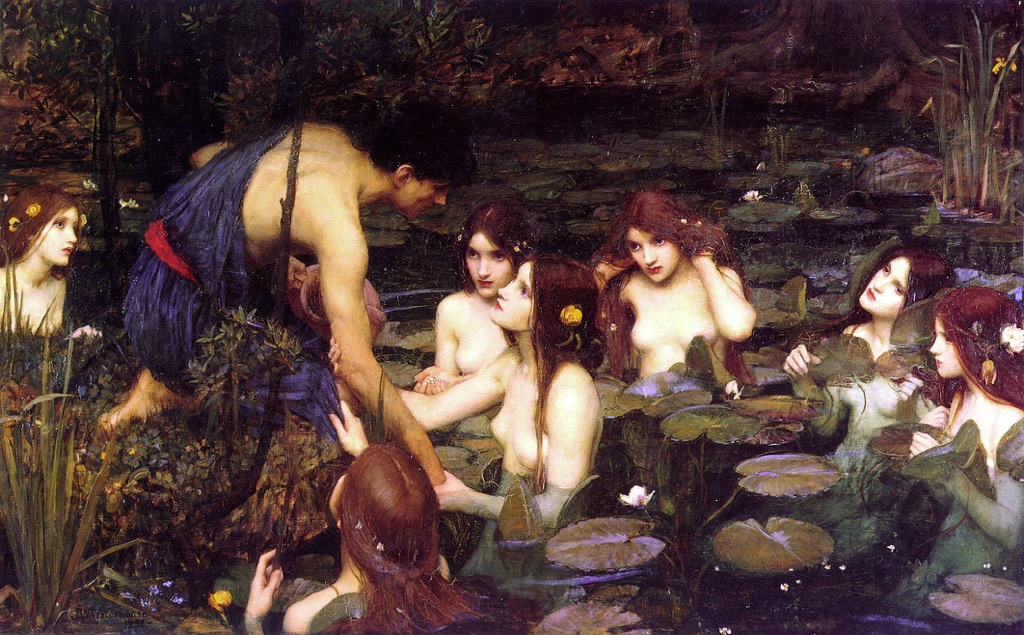
- Hylas and the Nymphs: Compare another major mythological scene.
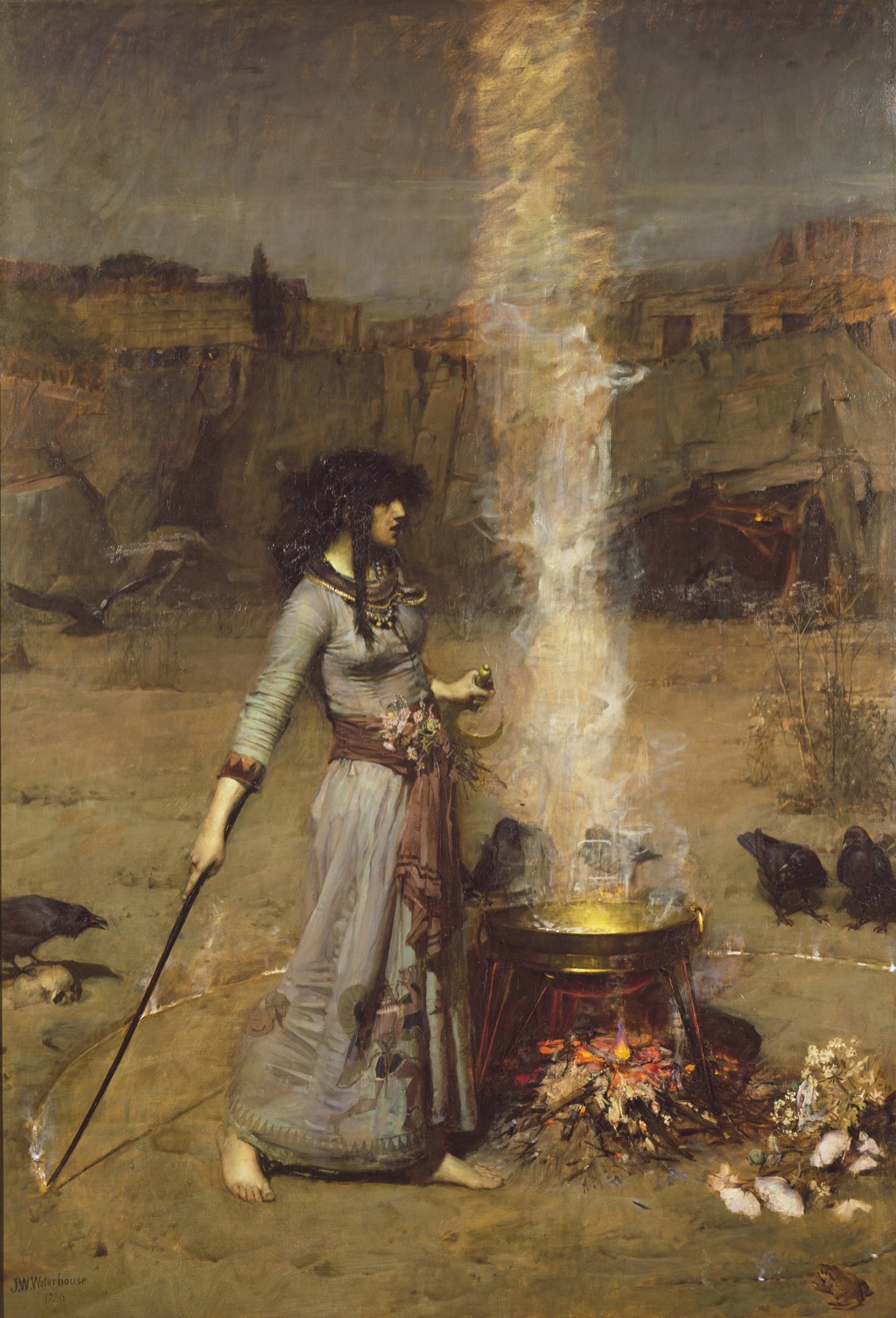
- The Magic Circle: Compare Waterhouse's treatment of ritual and symbolism.
Frequently Asked Questions
It is best dated to about 1892–93, although a broader range has appeared in secondary sources. [1]
It is probably the Feeney family garden at Croyde in North Devon. [1]
She may be Esther Kenworthy Waterhouse, but the identification is plausible rather than documented. [1]
No specific code is proven. Victorian flower symbolism offers general context, but species and intended message are not documented.
Discussion
The Devon garden painting is valuable because nothing catastrophic happens. A woman gathers flowers beside a cottage, and Waterhouse gives seasonal domestic life the same sustained attention he brought to enchanted mirrors and ancient sorceresses.
Its possible family identities deepen but do not determine that achievement. Croyde and the Feeneys are well-supported context; Esther remains an attractive, properly qualified proposal.
Reader Insights
Which visible detail most changes the way you read this page?
Which source or comparison helps the work feel less familiar and more specific?
What question would you bring back to the painting after reading?
Join the Conversation
Share your reading of this page below.
References
- Peter Trippi, “John William Waterhouse: An Orange Garden,” Kilgore Gallery research catalogue, including discussion of Gathering Flowers in a Devonshire Garden. View source.
- Wikimedia Commons, “John William Waterhouse: Gathering Summer Flowers in a Devonshire Garden,” object summary and public-domain image record. View source.
- Sheffield Museums, “John William Waterhouse: Mrs Waterhouse,” collection context for Esther Kenworthy Waterhouse. View source.