 by Tom Gurney
Tom Gurney BSc (Hons) is an art history expert with over 20 years experience
Published on August 14, 2026 / Updated on August 14, 2026
Email: tomgurney1@gmail.com / Phone: +44 7429 011000
Lamia: Introduction
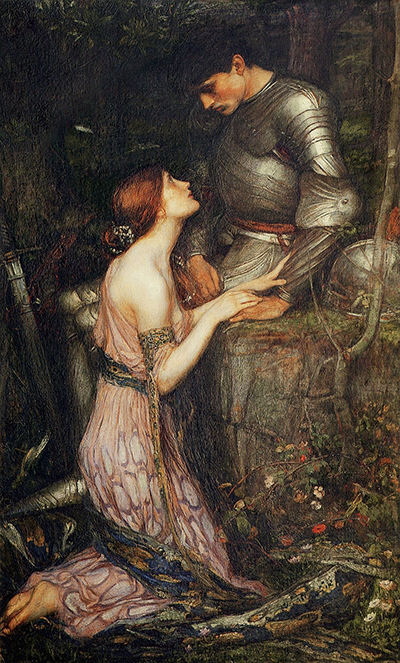
A woman kneels at an armoured man's feet in a shadowed wood. One hand lies over his; the other touches the hard plate at his thigh. Their gaze is so concentrated that the surrounding landscape seems to disappear. Only a lustrous snakeskin beside her dress reveals that this meeting is not what it first appears.
John William Waterhouse's Lamia of 1905 transforms John Keats's long narrative poem into a single moment of dangerous recognition. Keats's Lycius meets Lamia after she has exchanged her serpent body for the appearance of a beautiful woman. Waterhouse gives viewers knowledge that the young man lacks, placing the clue to her transformation low in the painting while allowing tenderness to dominate its human drama.
At a Glance
- ArtistJohn William Waterhouse (1849–1917)
- TitleLamia
- Date1905 [1]
- MediumOil on canvas [1]
- Dimensions144.7 × 90.2 cm, unframed [1]
- CollectionAuckland Art Gallery Toi o Tāmaki, New Zealand [1]
- Accession number1930/18/1 [2]
- Credit lineGift of Moss Davis, 1930 [1]
- First exhibitedRoyal Academy, London, 1905 [3]
- Literary sourceJohn Keats's Lamia, written in 1819 and published in 1820 [4] [5]
- Important distinctionThis is the two-figure Auckland painting, not Waterhouse's one-figure Lamia exhibited in 1909 [6]
Contents
- Introduction
- A Meeting Suspended Between Love and Danger
- Keats's Serpent Woman and the Young Corinthian
- What Waterhouse Changes in the Story
- The Snakeskin as Evidence
- Gaze, Touch and Unequal Knowledge
- Armour and the Invented Knight
- Colour, Woodland and Vertical Design
- Sympathy, Deception and the Fatal-Woman Label
- Two Paintings Called Lamia
A Meeting Suspended Between Love and Danger
Waterhouse does not paint Lamia as a monster. Her body is entirely human, her face is attentive and her kneeling position can initially suggest vulnerability. Lycius, standing above her in armour, appears to possess greater physical strength.
The emotional balance reverses when the snakeskin is noticed. Its presence means that Lamia knows the nature of the encounter while Lycius does not. The man who seems dominant in height and equipment is the less informed figure.
This difference between visible position and hidden power drives the painting. Waterhouse offers the surface language of courtship—joined hands, locked eyes and bodily closeness—then places contrary evidence at its edge.
The chosen instant is quiet. There is no attack, chase or overt spell. Lamia's power operates through attention, and Lycius participates by returning it.
Keats's readers know that the relationship will end at a wedding feast, when the philosopher Apollonius identifies Lamia as a serpent. The painting's present tenderness therefore carries a future catastrophe. Beauty and loss occupy the same encounter.
Yet Waterhouse does not make the outcome visible in either face. Lycius has not received a warning; Lamia does not smile in triumph. The tragedy gains force because the beginning appears emotionally credible.
The work belongs beside Waterhouse's La Belle Dame sans Merci of 1893, where another armoured man enters the influence of a beautiful supernatural woman. In both pictures the decisive action is intimate rather than violent. The later Lamia, however, gives its heroine a material trace of a previous body and makes transformation, not merely enchantment, central.
Keats's Serpent Woman and the Young Corinthian
Keats begins Lamia on Crete, where the god Hermes searches for a hidden nymph. He encounters a brilliantly coloured serpent with a woman's mouth and voice. Lamia promises to reveal the nymph if Hermes will restore her to human form. [4]
The serpent is described through unstable splendour: vermilion, gold, green and blue, zebra stripes, leopard-like marks, peacock eyes and silver moons. Her beauty is dazzling but difficult to classify. She seems at once a suffering woman, an enchanted creature and a possible demon. [4]
Hermes agrees to the exchange. Lamia reveals the nymph, and the god changes the serpent into a woman. She then travels to the road outside Corinth because she has already watched and desired Lycius, a young Corinthian. [4]
Their meeting takes place at evening. Lycius first passes without seeing her because supernatural beings can choose to remain unseen. Lamia calls to him, becomes visible and persuades him to accompany her into Corinth. [4]
The lovers withdraw into a magnificent house that others cannot remember existing. Lycius eventually insists upon a public marriage. Lamia fears his former teacher Apollonius and asks that he not be invited, but Lycius's friends bring the philosopher to the feast. [4]
Apollonius fixes his gaze upon the bride. Under that scrutiny the feast's magical splendour vanishes. He names Lamia as a serpent; she disappears, and Lycius dies. [4]
Keats adapted a story he found in Robert Burton's Anatomy of Melancholy, but his poem greatly expands its emotional and imaginative conflict. The Poetry Foundation describes the result as deliberately divided between beautiful but destructive enchantment and harsh public reality. [5]
That division prevents a simple moral. Apollonius rescues Lycius from deception, yet his sight is figured as cold and destructive. Lamia lies about what she is, yet Keats grants her desire, fear and suffering.
Keats also complicates the authority of reason. Apollonius correctly identifies the serpent, but the poem compares his gaze with a spear and calls it keen, cruel and piercing. Truth arrives as an act that destroys the person it exposes. [4]
The Poetry Foundation's account emphasises that sympathy is divided not only between Lamia and Lycius but between enchantment and the solid public world represented by the philosopher. [5] Waterhouse removes that debate from the wedding hall and embeds it in the viewer's first look.
We can respond like Lycius by seeing only the woman, or like Apollonius by treating the skin as decisive proof. The painting then asks whether either kind of vision is sufficient.
What Waterhouse Changes in the Story
Waterhouse's painting is not a literal transcription of a single group of lines. It is a visual condensation of meeting, seduction and revelation.
Keats calls Lycius a young Corinthian and associates him with a chariot; he does not introduce him as a medieval knight. Waterhouse gives him plate armour, shifting the scene towards the romantic visual world familiar from his Arthurian and Keatsian subjects. [4]
The change is immediately legible. Armour identifies a man prepared for material danger while demonstrating the uselessness of that preparation against desire and disguise.
Keats's Lamia has already shed or dissolved her serpent form when Lycius encounters her. The poem describes the transformation as intense and complete; it does not leave a cast skin beside her. Waterhouse invents the snakeskin so that a static image can hold past and present together. [4]
He also makes Lamia kneel and touch the man's armour. Keats provides persuasive speech, magical invisibility and an invitation to the unseen house, but not this exact pose. The painting replaces a sequence of language and movement with a circuit of hand, metal and gaze.
The scene's wooded setting evokes the poem's supernatural landscapes without precisely locating the meeting. Keats places Lamia's initial serpent form in a Cretan brake and her encounter with Lycius on the road near Corinth. Waterhouse fuses forest, road and romantic enclosure rather than mapping either site archaeologically.
This freedom is purposeful. A painter cannot easily show that Lycius fails to see a woman who is present, or that her voice suddenly gives her visibility. Waterhouse instead lets viewers see too much: Lamia, Lycius and the discarded evidence simultaneously.
The result places the audience in a position closer to Apollonius than to Lycius. We can identify the deception. Unlike the philosopher, however, we see Lamia at close, sympathetic range rather than from across a public feast.
The Snakeskin as Evidence
The Auckland Art Gallery identifies the glimmering moulted skin as the only visual clue to Lamia's nature and connects its peacock tints to Keats's description. [1]
Its low placement matters. The skin can be overlooked while the faces command attention, allowing viewers to repeat Lycius's error before correcting it.
Once discovered, it changes the surrounding colour. Lamia's richly patterned dress no longer appears merely decorative; it recalls the poem's rainbow serpent body without turning her flesh into reptile anatomy.
The skin also proposes a particular kind of transformation. A snake normally sheds an outer layer yet remains a snake. Lamia appears to have stepped out of an entire identity. Waterhouse makes metamorphosis look like moulting while leaving uncertain whether the human body is essence, disguise or wish.
Because the clue lies next to her, it functions like evidence at a scene. The spectator can connect woman and serpent even though Lycius looks only at her face.
Its crumpled form contrasts with the upright man and composed woman. A past body has become an object, apparently empty and powerless, but knowledge of it governs the picture.
The serpentine element does not invade Lamia's features. Waterhouse avoids scales, fangs or a hybrid tail. The moral uncertainty of the work depends upon her complete human beauty.
This is different from illustrating a monster concealed beneath a mask. Keats's Lamia longs for a human life, and her transformation is granted through divine power. The discarded skin can therefore signify liberation as well as deception.
It is also the only part of the serpent that Lycius could in principle discover without supernatural insight. Waterhouse replaces Apollonius's penetrating recognition with ordinary visible evidence, then explains its failure through the direction of the young man's gaze.
The clue is not hidden behind a curtain or beneath clothing. It is hidden by attention. This makes the painting's deception psychological rather than mechanically concealed.
The skin's peacock colour matters because Keats gives the serpent peacock-like eyes among many shifting marks. [4] Waterhouse does not attempt a zoological translation of that impossible body. He condenses verbal excess into one lustrous remnant.
Gaze, Touch and Unequal Knowledge
The figures' eyes establish the strongest connection. Lycius inclines his head; Lamia looks upward. Their attention creates a private vertical axis inside the taller rectangle.
Waterhouse makes the gaze reciprocal but not equivalent. Lamia knows whom she has sought and what she has been. Lycius sees a beautiful stranger whose history is hidden.
Joined hands give that imbalance a tender form. Her hand does not seize his. It rests against or over it, so the contact can be read as appeal, reassurance or possession.
Her other hand meets his armoured thigh. Flesh touches metal at the point where their different kinds of power become clearest. He has equipment; she has access.
The armour stops direct bodily contact but does not prevent emotional intimacy. Indeed, its hard surface makes her soft hand more conspicuous.
Lycius's lowered face reduces the authority implied by his height. He bends into the relationship, as Waterhouse's knight does in La Belle Dame sans Merci. Desire is represented as an action, not merely something inflicted upon a passive victim.
Lamia's kneeling pose remains ambiguous. It can place her in apparent submission, but it also allows her to direct his gaze and occupy the pictorial centre. Waterhouse separates social posture from narrative power.
No third figure interrupts them. Apollonius, guests and city are absent. The privacy Lycius later tries to make public appears here as a complete world of two.
Their joined hands also anticipate marriage without showing ceremony. What looks like a compact freely made in the wood will eventually become the public union Lycius demands in Corinth.
Lamia's fear of that demand makes the early touch poignant. She wants Lycius but understands that social recognition will expose the conditions under which their private happiness exists. [4]
That enclosure invites sympathy. Whatever one concludes about Lamia's morality, Waterhouse makes the contact feel serious enough that its destruction will count as tragedy rather than successful monster-hunting.
Armour and the Invented Knight
Calling the male figure a knight is convenient because Waterhouse dresses him as one, and Auckland's account uses that description. [1] Calling Keats's Lycius a knight, however, would misstate the poem.
The armour is Waterhouse's interpretive addition. It pulls an ancient Corinthian story into the visual language of medieval romance, where encounters in woods routinely test identity, loyalty and perception.
It also recalls La Belle Dame sans Merci. In the 1893 painting, metal cannot protect Keats's knight-at-arms from a faery woman. In Lamia, Waterhouse applies the same contrast to a poem whose hero possesses no armour in the text.
The repetition is more than a costume habit. It lets hardness signify a false idea of safety. Lycius is prepared for a blade but not for an appearance that may be both sincere and deceptive.
His sword, armour and standing height can make him seem the more dangerous body. Lamia's kneeling vulnerability complicates any account in which male victim and female predator are visually obvious from the start.
At the same time, his equipment belongs to a public identity. Armour implies the world outside the lovers' private enclosure—the social world to which Lycius will insist on returning through marriage.
Lamia needs no weapon. Her power lies in controlling visibility and in the beauty Hermes has restored. The contrast between their resources gives physical form to incompatible realities.
Colour, Woodland and Vertical Design
The canvas is nearly one and a half metres high but just over ninety centimetres wide. [1] Its tall format accommodates the standing man while keeping the encounter compressed.
Lycius forms an upright armoured column. Lamia's body rises diagonally from the ground, and her gaze completes the movement towards his face.
The wooded background is subordinate to that figure design. Trunks and shadow close the distance behind them, reducing landscape to an intimate chamber without walls.
Rich colour concentrates in Lamia's clothing and the snakeskin. The association is interpretive but grounded in Keats's chromatic serpent: Waterhouse transfers reptilian splendour into fabric and discarded surface rather than painting it on her human body. [1] [4]
Metal supplies colder, broken highlights. Its articulated plates divide Lycius into protected sections, while Lamia's dress and hair flow continuously.
This contrast is not a claim about specific pigments or technique. It can be seen directly in the opposition of hard reflective armour, soft textiles and organic surroundings.
The figures are close enough to dominate the field but not so close that the clue disappears. Waterhouse reserves the lower zone for the material fact Lycius fails to read.
The painting rewards two viewing distances. From afar it is an emotionally charged couple; from closer range it becomes a metamorphosis narrative.
Sympathy, Deception and the Fatal-Woman Label
Lamia is often grouped with the late Victorian “femme fatale”: a beautiful woman whose sexuality or supernatural power destroys a man. The category describes one aspect of the subject but not its full complexity.
Keats does not present a simple predatory creature. His Lamia wants bodily life and a relationship with Lycius. She fears exposure, suffers under Apollonius's stare and disappears only when he publicly names her. [4]
She nevertheless deceives Lycius about her nature and isolates him in an enchanted environment. His death shows that the private dream cannot survive its collision with public knowledge.
Lycius also makes consequential choices. He follows Lamia, withdraws from ordinary life and later insists on the public wedding she does not want. His desire for social display helps bring Apollonius into their world. [4]
Apollonius speaks truth, but Keats makes truth violent. His eye is compared with a piercing weapon, and the magical feast vanishes under sustained rational scrutiny. [4]
Waterhouse removes the philosopher and gives viewers the problem of sight. We recognise the snakeskin, yet the lovers' faces resist the emotional certainty that recognition might seem to provide.
Lamia can be simultaneously dangerous, deceptive, desiring and doomed. Lycius can be simultaneously deceived and willing. The painting's strength lies in refusing to simplify either person into a moral emblem.
Its quieter question is whether love founded on concealment is wholly unreal. The human connection looks persuasive even when one participant's identity is not what the other believes.
Two Paintings Called Lamia
Waterhouse returned to Lamia in 1909, and the two works are easily confused online.
The Auckland painting is the 1905 two-figure composition: Lamia kneels before an armoured man, and the snakeskin lies beside her. It measures 144.7 × 90.2 cm and entered the Auckland Art Gallery as Moss Davis's gift in 1930. [1] [2]
Christie's identifies the 1905 Royal Academy work as Waterhouse's first of two principal treatments and describes the knight gazing down at a red-haired temptress. [3]
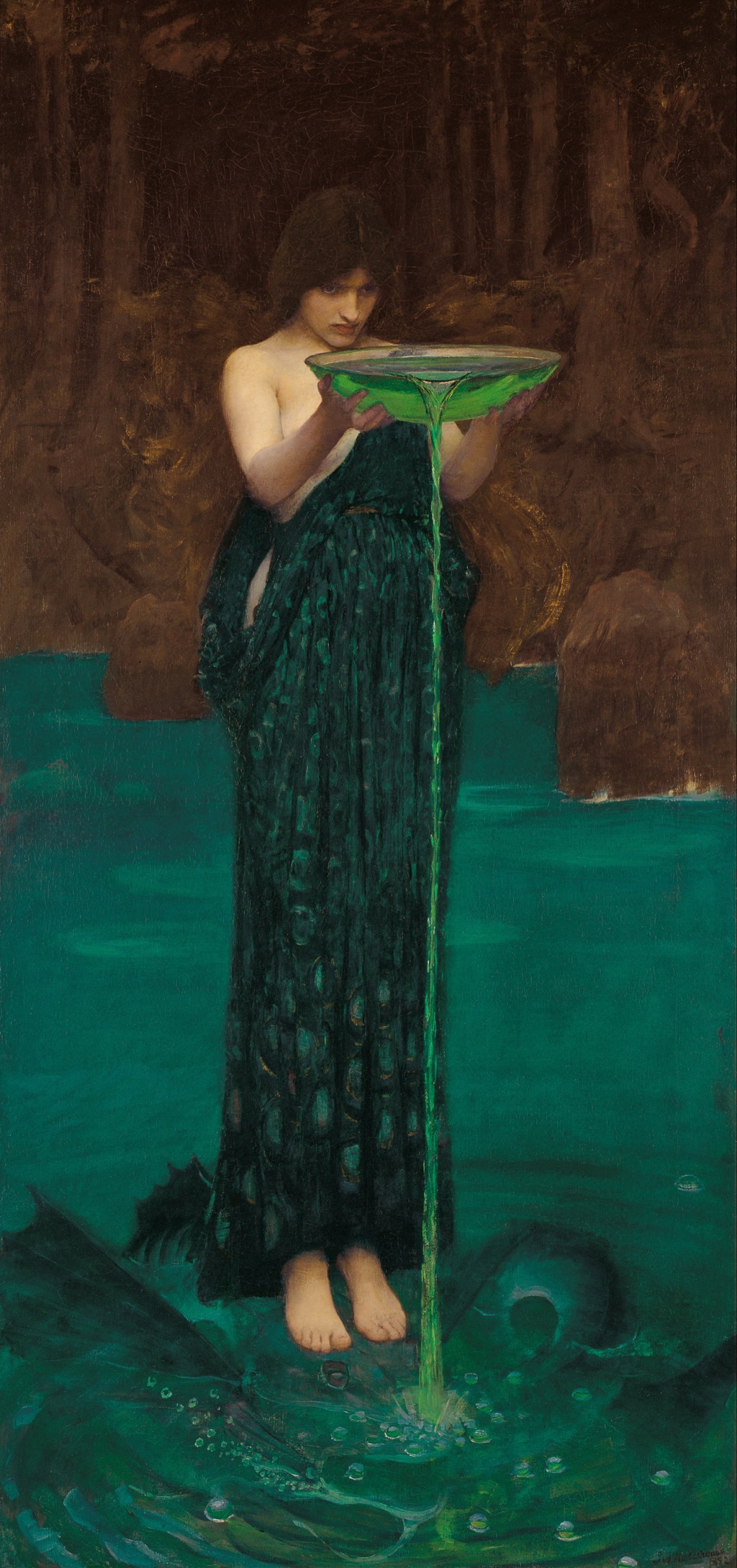
The 1909 painting is a smaller, one-figure conception in which Lamia sits by a woodland pool. Waterhouse exhibited that work at the Royal Academy with Thisbe. [6]
Related studies can add further confusion. The Necklace is an unfinished preparatory idea for the 1909 Lamia, not for the Auckland canvas. Its seated woman, casket and woodland pool belong to the later composition. [6]
The difference is not only numerical. The 1905 work concentrates on the first human relationship between Lamia and Lycius. The 1909 work withdraws the male figure and lets Lamia's solitary self-contemplation carry the subject.
The change also alters what the title asks viewers to identify. In 1905, relation reveals danger: Lamia's body, the armoured man and the cast skin form a narrative triangle. In 1909, identity must be carried by the lone woman and the literary title.
The later picture should not be treated as a corrected or final version of the Auckland work. It is a new composition that selects a different emotional problem from the same poem.
For a page about the Auckland painting, images and captions should always be checked for the standing armoured man and kneeling woman. A lone seated figure indicates the later version.
Collection, Preparation and Close Looking
The painting was exhibited at the Royal Academy in 1905. [3] Auckland's records give its medium as oil on canvas, its unframed size as 144.7 × 90.2 cm and its accession number as 1930/18/1. [1] [2]
Moss Davis gave the work to the Auckland Art Gallery in 1930. [1] That public collection history distinguishes it from the privately owned 1909 version.
The gift occurred twenty-five years after the Royal Academy exhibition and thirteen years after Waterhouse's death. Its Auckland location has consequently shaped the international afterlife of a work first addressed to London's exhibition public.
The accession number, 1930/18/1, is a useful safeguard against title confusion because “Lamia” alone can refer to several Waterhouse paintings and studies. [2]
A pencil study for the head of the 1905 Lamia survives, but claims about the model require caution. An inscription has encouraged the name Muriel Foster, while later scholarship quoted by Christie's treats the identity as unresolved rather than certain. [7]
Begin looking at the finished painting with the faces. Their gaze explains why every other part of the scene can be missed.
Next follow the hands: one links person to person, while the other links skin to armour. The two contacts express intimacy and difference at once.
Then locate the snakeskin. Compare its colour and pattern with Lamia's clothing and with Keats's many-coloured serpent.
Step back to notice the vertical hierarchy. Lycius stands, Lamia kneels, yet knowledge moves in the opposite direction.
Finally imagine the absent public world: Corinth, Apollonius and the wedding guests. The painting shows a private reality before exposure changes everything.
Then reverse the exercise and cover the snakeskin mentally. The couple becomes easier to romanticise, demonstrating how much interpretive labour Waterhouse assigns to one easily missed object.
Related Pages
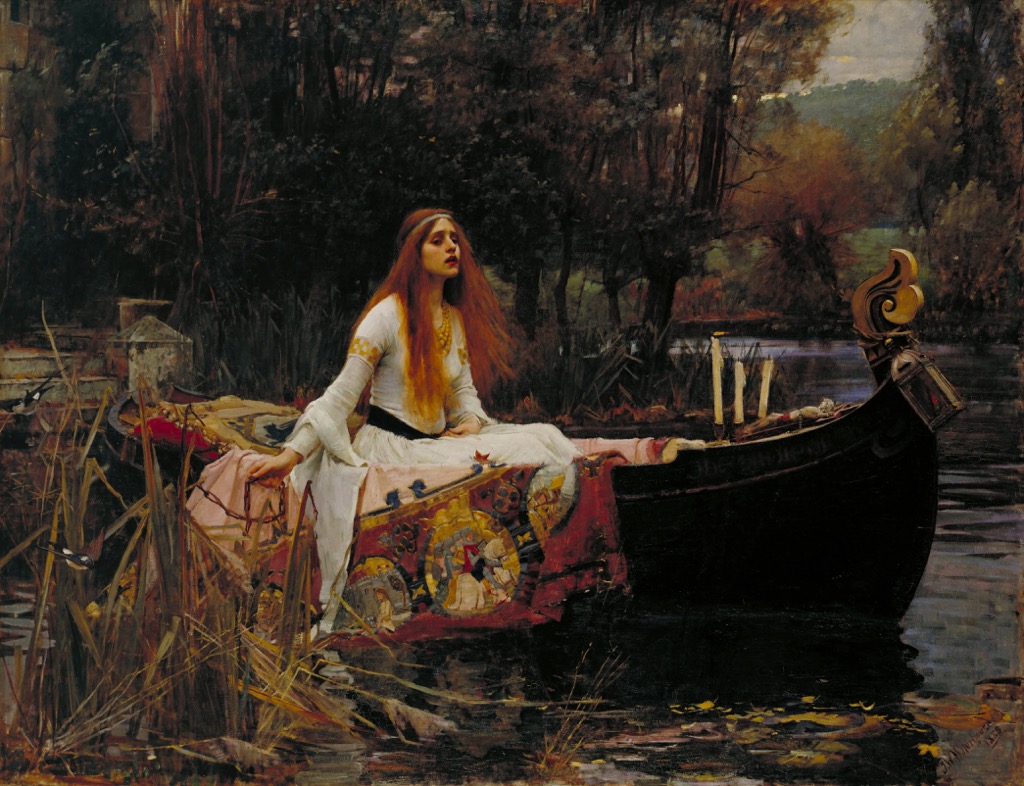
- The Lady of Shalott: Compare Waterhouse's best-known literary composition.
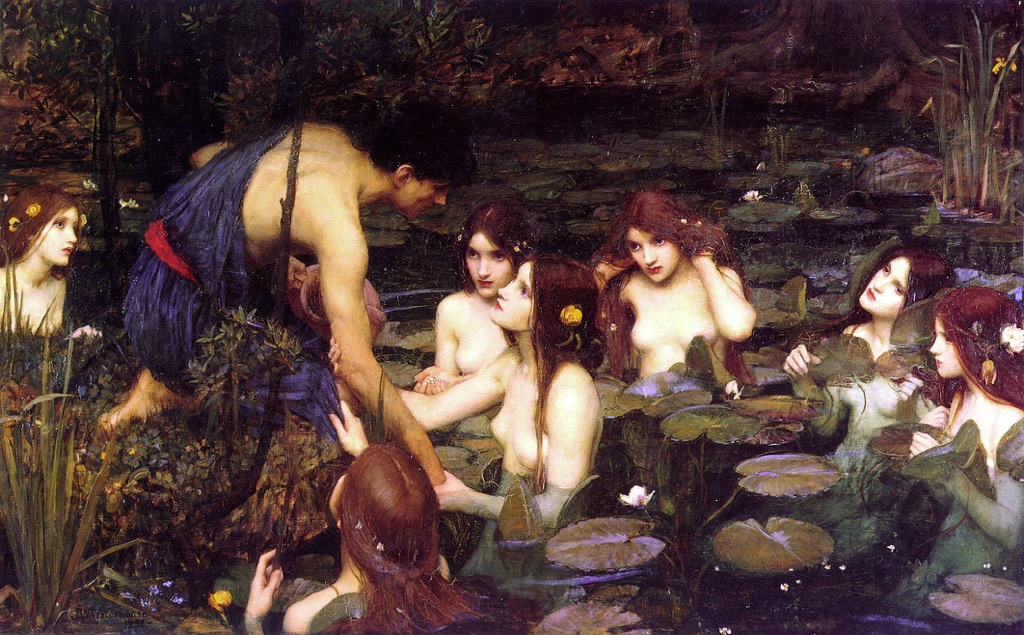
- Hylas and the Nymphs: Compare another major mythological scene.
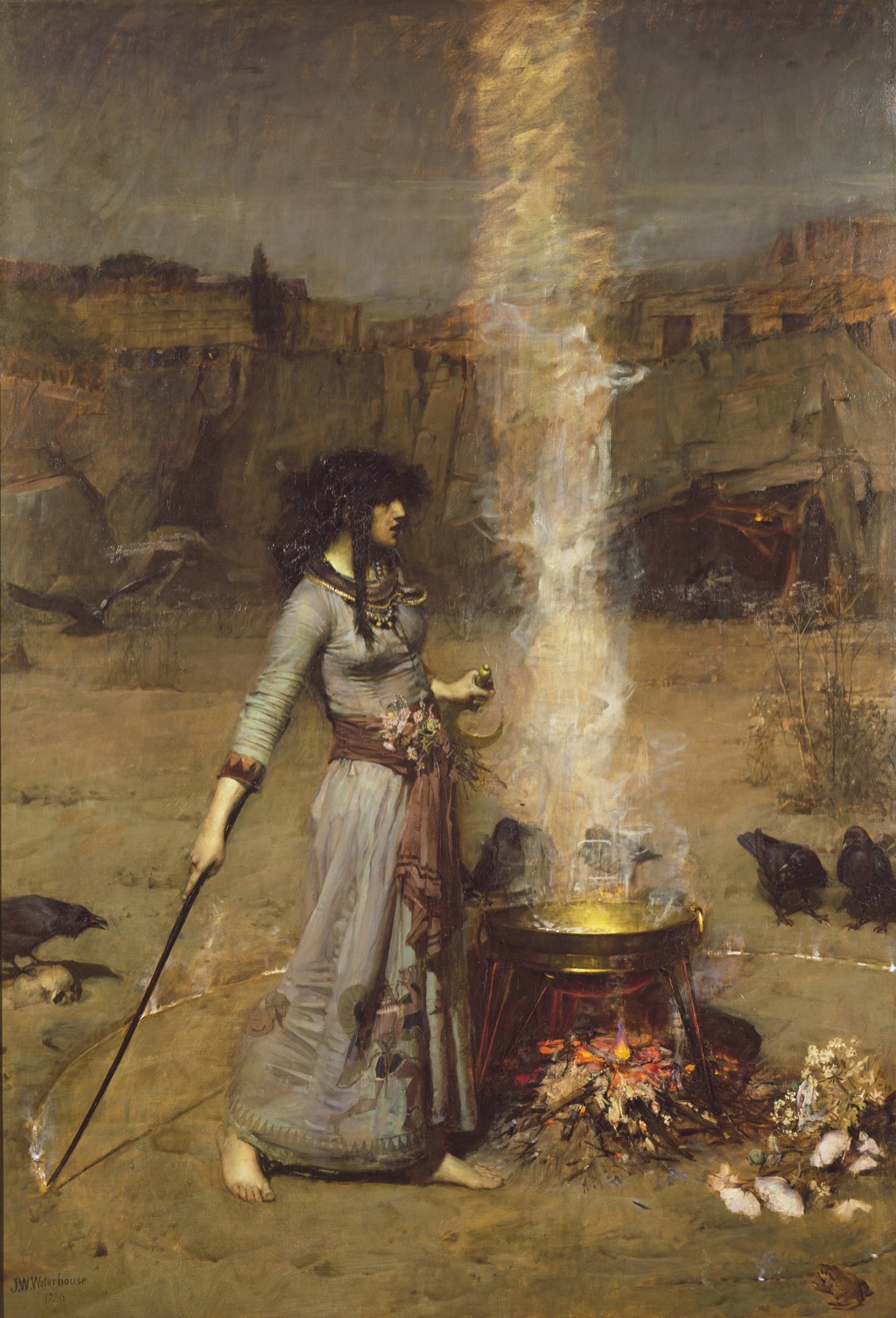
- The Magic Circle: Compare Waterhouse's treatment of ritual and symbolism.
Frequently Asked Questions
In Keats's poem she is a brilliantly coloured serpent who persuades Hermes to grant her a woman's form. She then seeks Lycius, the young Corinthian she loves. [4]
The painting condenses Lamia's first meeting with Lycius after her transformation. The exact kneeling pose, armour and discarded skin are Waterhouse's inventions rather than a literal transcription of one passage.
It reveals Lamia's previous form to the viewer while Lycius remains absorbed by her face. Its peacock-like colour echoes Keats's description of the serpent. [1] [4]
No. Keats identifies Lycius as a young Corinthian. Waterhouse dresses him in armour and thereby recasts the meeting through medieval-romantic imagery. [4]
No. The Auckland two-figure work dates from 1905. The solitary seated Lamia was exhibited in 1909 and is privately owned. [6]
It is in the Auckland Art Gallery Toi o Tāmaki, where it entered as the gift of Moss Davis in 1930. [1]
Keats does not show her physically attacking him. Apollonius exposes her at the wedding feast; she vanishes, and Lycius is found dead. The poem distributes responsibility across deception, desire and destructive exposure. [4]
Discussion
Waterhouse makes knowledge the hidden drama of Lamia. Lycius sees a woman; the viewer sees a woman and a snakeskin; Lamia knows the history connecting them. Three different versions of the same encounter occupy one canvas.
The painting does not ask viewers to ignore deception, but it refuses the comfort of an obvious monster. Lamia's human appearance is complete, her contact is tender and her position seems exposed. The evidence against her is displaced onto an empty skin.
Reader Insights
Which visible detail most changes the way you read this page?
Which source or comparison helps the work feel less familiar and more specific?
What question would you bring back to the painting after reading?
Join the Conversation
Share your reading of this page below.
References
- Auckland Art Gallery Toi o Tāmaki / Google Arts & Culture. “Lamia,” collection description, medium, dimensions and credit line. View source
- Auckland Art Gallery Toi o Tāmaki. British Painting and Drawing from the Reign of George III to the Present Day (1978), collection catalogue entry for Lamia, including dimensions, inscription, gift and accession number. View source
- Christie's. “John William Waterhouse, Isabella and the Pot of Basil,” catalogue essay noting Waterhouse's first Lamia at the Royal Academy in 1905 and describing its two-figure subject. View source
- Project Gutenberg. John Keats, Lamia, full text. View source
- Poetry Foundation. “John Keats,” biography and critical discussion of Lamia, its composition, publication and divided sympathies. View source
- Christie's. “John William Waterhouse, The Necklace,” catalogue essay distinguishing the 1909 Lamia and its related study from the 1905 Auckland painting. View source
- Christie's. “John William Waterhouse, Study of a Girl's Head,” catalogue essay discussing the uncertain identification of Waterhouse's recurrent model and the inscribed drawing for the 1905 Lamia. View source