by Tom Gurney
Tom Gurney BSc (Hons) is an art history expert with over 20 years experience
Published on June 19, 2020 / Updated on November 20, 2026
Email: tomgurney1@gmail.com / Phone: +44 7429 011000
Introduction
A pale figure lies horizontally across a brilliant blue patterned cloth. Dark circles, red hills, narrow trees and repeated floral shapes gather around the body. Kazimir Malevich’s Shroud of Christ takes its title and basic idea from the Orthodox funeral cloth that shows Christ laid out for burial. Yet its intense colour and ornamental rhythm make it feel like an imaginative transformation of that form rather than a literal illustration of a woven church textile. The saved image on this page matches the scene described in the State Tretyakov Gallery’s accessioned record and the National Gallery of Art’s teaching packet. [1] [2]
The Tretyakov Gallery catalogues the work as 1908, gouache on cardboard, 23.4 × 37.7 cm, with inventory number Р-4351. Its record says George Costakis gave it to the gallery in 1977 and calls it Malevich’s earliest graphic work in that collection. This makes “painting” a loose everyday label here: the physical object is a small gouache on card. The National Gallery of Art packet gives the same height but a 34.3 cm width. Because the present owner’s figure is 37.7 cm, that value leads the summary; the discrepancy is noted rather than concealed. [1] [2]
At a Glance
- ArtistKazimir Malevich
- TitleShroud of Christ / Плащаница
- Date1908
- Material and techniqueGouache on cardboard
- Owner dimensions23.4 × 37.7 cm
- Inventory numberTretyakov Gallery Р-4351
- Recorded acquisitionGift of George Costakis, 1977
Contents
- A shroud reimagined
- Colour and pattern
- Symbolism and modern style
- What the sources disagree on
- Pattern around the central figure
A shroud reimagined
In Orthodox worship, a shroud or epitaphios is a decorated cloth depicting Christ in the tomb. The Tretyakov Gallery explains that traditional examples often use gold embroidery and fabric appliqué, with a border of ornament surrounding the central body. Malevich borrows the long horizontal arrangement and the sense of a patterned textile. He changes the conventions: his body rests in a landscape-like field of colour, and the surface behaves as a drawing made from pigment rather than actual stitched cloth. [1]
The figure stretches across a blue oval, its tiny yellow motifs repeated almost like sewn emblems. A lighter band below frames the scene, while the red mass above gives it a second, rising contour. The body is simplified: the outline is more important than anatomy, and its scale dominates the small card. The Tretyakov describes this as a fantasy on the form of a shroud. That phrasing is useful because the image does not follow all the usual iconographic details of a burial scene. [1]
The National Gallery of Art reads the dark disk near Christ’s head as an eclipsed sun and sees other dark celestial bodies around the image. Its text also identifies flowers, lotus leaves and a jagged mountain horizon. These details support a reading of nature mourning the death of Christ while suggesting renewal. The same museum cautions that the precise meanings of the work’s many symbols are not fully understood. A visible dark circle can therefore be described confidently, while its theological role should be attributed to the museum’s reading. [2]
Colour and pattern
The eye moves first along the figure and the blue cloth, then up through the repeated red and black edges. Dark pointed peaks cut against the orange field; delicate narrow trunks rise near either side. These parts have different sizes and textures, but their repetition makes a coherent decorative surface. The image offers little conventional perspective. Its space comes mainly from overlapping bands and the contrast between warm red and gold and cool blue. [1] [2]
The cloth’s pattern also affects how the body is seen. It does not recede quietly beneath the figure. Its bright dots and blue ground demand their own attention, bringing surface design close to the subject. The National Gallery connects that handling with Art Nouveau’s flowing line and repeated forms. The Tretyakov similarly emphasises silhouette, wavelike contours, local colour patches and a decorative rhythm. Both accounts help explain the work’s visual form; neither requires treating it as a straightforward realist scene. [1] [2]
The small size matters. A gouache on cardboard only a few dozen centimetres across can still suggest the scale and ceremony of a textile hung or laid out in a church. The effect comes from a compressed format: a central body, a strong ornamental border and a dense field of symbolic signs. Malevich did not need to imitate the material texture of embroidery precisely to invoke its patterned arrangement. [1]

Symbolism and modern style
The Tretyakov situates the work in the interests of Russian Symbolism and Art Nouveau, including mystical themes, stylisation and a renewed interest in decorative art. It also points to the Blue Rose circle as a context for Malevich’s early experiments with dreamlike and spiritual subjects. The National Gallery similarly places the work between Symbolist religious concerns and the influence of Russian icon traditions. Those are historical interpretations of his 1908 phase, not evidence that he belonged to every movement or copied a single particular icon. [1] [2]
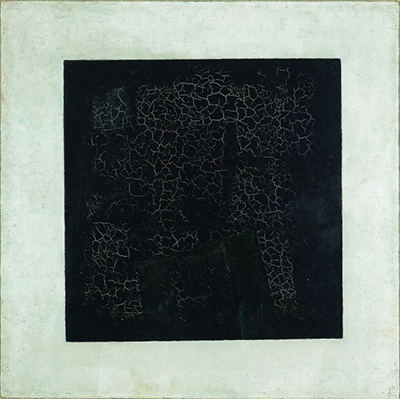
This route is a reminder that Malevich’s art did not begin with geometric abstraction. Earlier works examined landscapes, religious imagery, colour, line and the possibility of making an image expressive without naturalistic depth. The later Black Square presents a very different solution in 1915: a nonobjective form without Christ, mountains or narrative signs. Comparing the two makes the scope of Malevich’s experimentation visible, while the works remain separate objects with different material, date and purpose. [1] [2]
A broader account of his career should therefore avoid reading this shroud as a disguised Suprematist painting. The Tretyakov explicitly discusses its relationship to early twentieth-century style and sacred textile form. The National Gallery sees its flatness and spiritual subject as early indications of later concerns. Those are connections across time, but the 1908 image still belongs to its own Symbolist and decorative context. [1] [2]
What the sources disagree on
The accessioned Tretyakov record gives 23.4 × 37.7 cm. The 1990 National Gallery of Art teaching packet gives 23.4 × 34.3 cm. Both call it gouache on cardboard and place it in the Tretyakov Gallery. The 3.4 cm width difference is not explained in the accessible source text; it might reflect a recording, transcription or reproduction issue, but none of those explanations can be established from these documents. The current owner measurement is used for this page’s object summary. [1] [2]
There is also a difference in emphasis. The Tretyakov calls it a graphic work and concentrates on the form of the Orthodox shroud and decorative art. The National Gallery calls attention to a symbolic landscape, eclipse motifs and a possible Tree of Life. Both readings concern the same picture, but the latter’s symbolic claims are interpretations. Presenting them with attribution lets a reader see the picture and the evidence separately. [1] [2]
Pattern around the central figure
The Tretyakov’s account of liturgical shrouds describes ornament around the central scene and notes that such motifs could continue into the composition. That gives the viewer a way into Malevich’s picture. Follow the blue pattern beside the reclining figure and watch how it directs attention back towards the outline of the body. The shapes along the edge of the cloth are small enough to hold together as a rhythmic band. Places of broad red or dark colour interrupt that rhythm and can be read at once from farther away. The museum connects this alternation of small detail and broad colour to the decorative practices of the period. [1]
Frequently Asked Questions
Where is the work?
It is in the State Tretyakov Gallery, Moscow, under inventory number Р-4351. The gallery records it as a 1977 gift from George Costakis. [1]
Is it a painting on canvas?
No. The owner record identifies gouache on cardboard. It describes the object within its graphic collection. [1]
What does the title refer to?
It refers to the Orthodox burial cloth bearing an image of Christ. Malevich adapts its horizontal body and decorative framing into an imaginative gouache composition. [1]
Why are two widths published?
Discussion
Which forms in the shroud do you recognise before learning its religious title?
How do the blue cloth and warm red field balance the reclining figure?
Reader Insights
Trace the repeated border pattern and the line of the body.
Compare the simplified body with the elaborate surrounding pattern.
Keep the Tretyakov owner measurement separate from the different National Gallery teaching-packet width.
Join the Conversation
Share a close observation or an accession-specific source for this gouache.
References
- State Tretyakov Gallery, Shroud of Christ (Плащаница): Owner record for Р-4351: date, gouache and cardboard, 23.4 × 37.7 cm, Costakis gift in 1977, and a discussion of Orthodox shroud imagery, Symbolism and Art Nouveau. Russian-language page inspected directly on 30 September 2026. View source.
- National Gallery of Art, Kazimir Malevich Teaching Packet (1990): Paula Wisotzki and Susan Freifeld, slide 3/text on PDF pages 15–16. Describes the same distinctive scene and reports 23.4 × 34.3 cm, conflicting with the current owner width. View source.