 by Tom Gurney
Tom Gurney BSc (Hons) is an art history expert with over 20 years experience
Published on August 21, 2026 / Updated on October 23, 2026
Email: tomgurney1@gmail.com / Phone: +44 7429 011000
About The Tree of Life
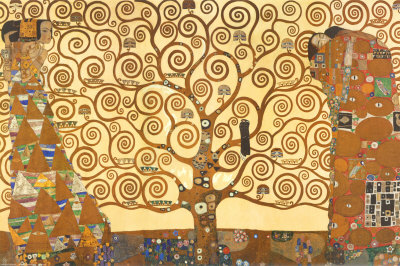
Gustav Klimt's tree looks alive, but nothing in it grows by accident. Its trunk rises as a constructed column. Branches coil into spirals so regular that they seem measured rather than windblown. Leaves, flowers, pale discs and dark birds interrupt the gold like pieces fitted into a vast mechanism. At the bottom, a coloured meadow suggests earth and water without opening into a natural landscape. The motif holds together two opposing ideas: organic continuity and the visible labour of fabrication.
Known as the Tree of Life, it is the central visual system of Klimt's mosaic design for the dining room of Palais Stoclet in Brussels. It was not conceived as an independent oil painting. The tree extends across the room's two long walls, surrounding the solitary figure of Expectation on one side and the embracing pair of Fulfilment on the other. The celebrated image encountered on posters, prints and decorative objects is usually a detail extracted from that larger architectural relation.[1]
Klimt developed the motif through sketches in 1907–08 and full-scale working drawings in 1910–11. The Vienna cartoons combine graphite and coloured pencil with pastel, gouache, applied pieces, gold, platinum, silver and bronze across a transparent paper support. They carry written instructions for the workshops that converted drawn patches into mosaic, enamel, glass, mother-of-pearl, chased metal and other materials. Leopold Forstner's Wiener Mosaikwerkstätte assembled the executed walls from specialised components in 1911–12.[1][2]
The title invites symbolic interpretation, and the tree's flowers, eyes and birds have attracted many confident explanations. The most responsible reading begins with the object. Klimt left no known statement assigning every motif a fixed theological meaning. The MAK connects the imagery with Egyptian, Byzantine and Japanese models and classifies one bird-bearing section through Horus and falcon iconography. These associations establish a field of reference, not a complete code.[1][3]
At a Glance
- Artist and designerGustav Klimt
- TitleTree of Life, the central motif of the Stoclet Frieze
- DateEarly composition development in 1907–08; full-scale working drawings in 1910–11; mosaic fabricated and installed in 1911–12[2][4]
- Original settingThe two long walls of the main dining room at Palais Stoclet, Brussels
- FormA mirrored or reversed tree-bearing field that links Expectation on one wall with Fulfilment on the opposite wall
- Working drawingsFive of the MAK set's nine sections are identified as parts of the tree; other sections contain Expectation, the rose bush, Fulfilment and the Knight[1]
- Central cartoonMAK part 4, mixed media on tracing paper, approximately 195.3 × 102.2 centimetres[5]
- Principal motifsVertical trunk, coiling branches, eye-like flowers, dark hawks or falcons, coloured ground, leaves and blossoms
- Executed materialsObject-specific passages include mosaic, enamel, coloured or crystal glass, mother-of-pearl and chased metal set into or against marble[2][5]
- Current locationsWorking drawings at the MAK in Vienna; executed mosaic in the privately owned Palais Stoclet
- Essential distinctionThe Vienna object is Klimt's full-scale mixed-media design. The Brussels image is its collaborative translation into architectural mosaic.
Not an Independent Painting
The Tree of Life is often reproduced as a self-contained rectangle with a central trunk and spirals spreading evenly towards the edges. That crop is visually satisfying, which helps explain its popularity. It is also incomplete.
In Palais Stoclet, the tree is distributed across the east and west dining-room walls. The west side includes the figure called Expectation or the Dancer, along with a rose bush and butterflies. On the opposite side, an embracing couple known as Fulfilment replaces the solitary woman. Much of the branching ground was transferred in reverse for the second wall.[2]
The tree therefore has more than one centre. Its trunk offers a vertical anchor within each long field, but the human groups pull attention laterally. A seated diner could look from solitary figure to couple, recognise related spirals and compare changed arrangements. No single crop preserves that exchange.
Calling the motif a panel can create another misunderstanding. The design does survive in multiple vertical paper sections, because Klimt cut a broad roll of tracing paper into workable strips. Those divisions belong to production. In the finished room, the aim was an extended field in which joints, materials and architecture served a continuous visual effect.[6]
The image should thus be understood in two ways at once. It is a powerful motif that can sustain close analysis, and it is an architectural component whose full meaning depends on walls, figures and movement. Its familiarity as an isolated design should not erase its original scale.
The Trunk as an Anchor
The trunk does not imitate bark. It rises as a broad pale-gold column broken by irregular discs, lozenges and patches. Some marks appear white, others silver, gold or dark. Their difference interrupts any sense of one continuous skin.
This fragmentation makes the trunk appear both ancient and newly assembled. It can suggest a weathered surface, a jewelled object or a wall within the wall. The parts do not dissolve into illusion. Each declares itself as a separate unit with its own colour and potential substance.
The vertical is crucial because the branches behave so differently. They divide, turn and coil, repeatedly bringing outward movement back towards itself. Without the trunk, the spiral field could become all-over pattern. With it, every deviation has an origin.
The tree is firmly placed but not botanically rooted. Its base enters a low field of coloured growth rather than exposing a root system. Flowers and leaves spread across this lower zone, while blue-green passages can suggest water or damp ground. The transition is decorative, not descriptive. Klimt gives the tree a place without constructing deep earth beneath it.
The trunk also establishes scale. It is wide enough to rival a human figure, yet its patches can be read like small precious objects. The eye shifts between monument and detail. That instability is central to the design: a tree large enough to fill architecture is made persuasive through things that could almost fit in the hand.
Branches That Return
Natural branches usually narrow as they divide and seek light. Klimt's branches behave like lines thinking through space. They extend, curve and roll into tight spirals. Some coils stand alone; others interlock with flowers, leaves or neighbouring turns. Growth becomes repetition with variation.
The spiral is among the simplest ornamental forms, but Klimt uses it to create complex tempo. Broad curves carry the eye across a large distance. Tight coils delay movement. A short offshoot may stop before it joins another path. The result alternates between expansion and containment.
Conservation study shows that this regularity was deliberately constructed. Klimt used a curve template while establishing the full-scale designs.[2] The instrument does not make the tree cold. It makes clear that its vitality comes from controlled recurrence, not from an attempt to imitate the unpredictable outline of a particular species.
The coils also bind separate materials. One branch may be understood as mosaic while a flower attached to it calls for glass, enamel or metal. A continuous line crosses discontinuous substances. Visually, growth seems unbroken; physically, it is assembled.
Because the opposite wall reverses much of the field, the spiral becomes capable of turning the room into a larger pattern. A curve that opens one way on the west can answer a reversed movement on the east. The diner is placed between corresponding rhythms rather than in front of one picture.
This structure gives the motif its unusual balance of repose and animation. Nothing rushes towards a climax. Every outward movement can curl back. Yet the sheer number of branches prevents complete stillness. The tree seems to continue without progressing, an apt form for recurrence, duration and life imagined outside ordinary narrative time.
Flowers That Look Back
Across the branches are forms that can be read simultaneously as blossoms and eyes. Coloured centres sit within pale or dark outlines; petal-like shapes open around them. Their repetition makes the tree appear watchful without turning it into a face.
The ambiguity is visual before it is symbolic. A circular flower naturally resembles an eye when a contrasting centre acts like a pupil. Klimt sharpens that resemblance through outline, spacing and colour. Yet not every blossom has the same structure, and not every circle needs to be assigned the same meaning.
Eye motifs had many possible associations in the visual culture available to Klimt. Ancient Egyptian objects, Mediterranean ornament, jewellery, textiles and modern decorative design all offered related forms. The MAK describes the frieze as drawing on Egyptian, Byzantine and Japanese models, while its exhibition scholarship stresses Klimt's active transformation of such material.[1][7]
The temptation is to identify every eye as a precise sacred symbol. That certainty exceeds the surviving evidence. Some may evoke watchfulness, protection or consciousness. Others may function primarily as rhythmic flower heads. Their power lies partly in refusing to settle. The viewer moves between vegetation and gaze.
The flowers also break scale. A bloom large enough to register across a dining room becomes closer to an emblem than a plant. When made from enamel, glass or raised metal, it acquires physical hardness. What appears to grow is in fact fired, cut, polished and fixed.
This contradiction gives the tree an alert presence. The branches do not merely fill space around the human groups. Their blossoms return attention. Viewers look at the wall and repeatedly encounter forms that seem capable of looking back.
The Dark Birds
Three dark birds punctuate the gold. Their compact bodies and angular profiles differ from the tree's rounded spirals. They sit within the branches like stops in a musical line, arresting the eye where the field might otherwise flow without interruption.[4]
Popular interpretations often call them ravens and declare them emblems of death. That reading is possible only at a very general level and should not be stated as Klimt's fixed intention. The institutional evidence is more specific and more cautious. The MAK's record for one tree section applies classifications for Horus and falcon, while the Klimt Database calls the forms black hawks and notes Klimt's use of Egyptian symbolism.[3][4]
Even “Horus” does not unlock the entire design. A falcon could evoke divine guardianship, royal power, the sky or protection within an Egyptian frame of reference. Klimt may also have valued the bird for its silhouette and the sharp contrast it introduced. Iconography and formal use can coexist.
The birds' colour matters. Black and dark grey enamel was specified for their execution, with small pale elements.[4] Against warm gold and floral colour, darkness acquires unusual weight. The birds are small compared with the trunk, but their contrast lets them control attention.
They also complicate any interpretation of the tree as uncomplicated abundance. Growth contains watchfulness and interruption. Whether the birds are understood as guardians, omens or concentrated formal accents, they prevent the gold field from becoming merely festive.
Their number establishes recurrence without crowding. A single bird might become an isolated emblem; many would form a flock. Three allows recognition across the branches. Each encounter reminds the viewer that the visual system includes hard, dark, animate presences as well as flowers and coils.
The Meadow Below
At the base of the tree, a low band of flowers, leaves and coloured units suggests a meadow. It is denser and more varied than the surrounding gold, but it does not create conventional foreground. There is no clear path into distance and no horizon beyond it.
Klimt had long experience of translating vegetation into close, patterned fields in his landscape paintings. The Stoclet ground shares their attention to repeated blooms, though its architectural medium changes the terms. A painted touch can imply a flower through colour alone. Here, a blossom may become a separate ceramic, glass or enamel component.
The working drawings distinguish carefully among kinds of making. Some leaves were designated as mosaic; others as slightly raised chased metal. Flowers could use enamel, coloured glass or cut crystal. Klimt objected when early flower samples lacked the desired colour and metal structure.[8]
This local variety prevents the meadow from reading as a uniform decorative border. It is a catalogue of surfaces. A dark leaf, reflective petal and opaque tessera occupy the same botanical fiction but return light differently.
The lower field also connects the tree with the human figures. Expectation appears to stand within or just above the decorated ground. The couple of Fulfilment belongs to the corresponding zone across the room. Nature does not lie behind them as scenery. It touches, frames and partially absorbs their bodies.
At the same time, the meadow supplies a visual base. Without it, figures and trunk might float within gold. Its horizontal density supports the verticals and gives the room a low continuous register against which the upper spirals can open.
From Small Sketch to Architectural Field
The tree emerged through change rather than one inspired drawing. Early designs around 1907–08 experimented with narrow vertical ornaments and relatively small figural scenes. In one version Klimt allowed the tree to expand across the wall, creating a more open relation among Dancer, rose bush and branches.[9]
A squared whiteprint records another intermediate state. The long composition contains the tree, Expectation and roses, with some forms overlapping as Klimt tested their balance. The grid indicates preparation for transfer to a larger scale. The design is sufficiently determined to enlarge, yet still visibly negotiable.[9]
Three 1908 sketches on tracing paper introduce gold, silver, bronze and gouache. Klimt explained that their colour could only be approximate because the final work would rely on gilding, stone, metal and enamel. Even at this reduced stage, representation and material planning were inseparable.[9]
By 1910–11 the working drawings reached one-to-one scale. The MAK identifies parts 1, 3, 4, 5 and 7 as tree sections. Their dimensions vary because they were cut as vertical strips and because the paper changed under wet media. Part 4, the central Tree of Life sheet, measures about 195.3 centimetres high by 102.2 wide.[5]
Scale altered how Klimt worked. A spiral could no longer be an approximate flourish. Its width, turn and relation to neighbouring components mattered to makers. A flower required enough definition to be cut or fired. The design needed to guide execution while preserving the impression of continuous growth.
The final cartoons are therefore more than enlargements of early ideas. They are a new stage in which image becomes instruction. Klimt had to decide what remained line, what became colour and what would ultimately be another substance.
Reading the Working Drawings
The MAK sheets are radiant objects in their own right. Graphite, coloured pencils, pastels, gouache, metallic powders, gold leaf and platinum give the tracing paper extraordinary variation. Yet their beauty can obscure their practical function.[1][2]
Klimt wrote across blank margins and sometimes within the design. He marked passages as mosaic or “material,” a term he used for details made in substances other than marble and ordinary tesserae. He named mother-of-pearl, enamel, glass, metal and colour. He indicated correct measurements and warned when workshop dimensions seemed wrong.[6]
On part 1, instructions distinguish very pale green mosaic leaves from chased greenish-gold metal leaves and propose enamel or coloured glass for tree flowers. A note explains that marble needed deeper excavation for mosaic than for applied flower and foliage components.[6]
Part 3 records dissatisfaction with trial flowers. Klimt wanted thinner chased gold surfaces, broader metal divisions and stronger colours. He suggested coloured glass in metal settings and cut mosaic plates for certain blue flowers. The bird was to use enamel with dark oxidised divisions.[8]
Part 4 treats the trunk. Some pale areas were to be smooth, raised and emphatically white rather than mosaic. Light silver patches could be mother-of-pearl; other areas might use silver mosaic interrupted by grey and white units. Flowers were assigned to other materials, while the green ground remained mosaic.[5]
Part 7 again separates mosaic leaves, chased metal leaves and non-mosaic flowers.[10] The recurrence of such notes demonstrates that material distinction was not added by makers after the composition was complete. It was one of the tree's organising principles.
The drawings also contain evidence of physical difficulty. Wet colour stretched the thin paper. Klimt mounted it to canvas, pressed lifting areas back with his fingers and acknowledged that dimensions could shift. The perfect spiral field arose from a fragile surface that would not remain perfectly stable.[2]
How the Tree Became Mosaic
The Brussels tree was realised as plate mosaic. Forstner's workshop assembled components on transportable plates, drawing on marble, ceramics, enamel, glass, chased metal, beads, gemstones and precious-metal effects. Fifteen plates served the complete dining-room frieze.[4]
Translation required choices at every level. A metallic patch on paper might indicate the desired temperature of light but not the exact alloy, thickness or attachment. A coloured-pencil flower could guide hue and outline but not firing conditions. The workshop had to turn pictorial relations into durable matter.
Klimt remained closely involved. Samples travelled to him, and his letters objected to certain golds and flowers. He specified that tree spirals should rely primarily on a warm gold mixed sparingly with greener, darker and rougher variants. Such directions sought variety without losing unity.[4]
The opposite wall added another task. Much of the tree-bearing composition was traced and mirror-reversed rather than redrawn independently. A specialist transferred the field, after which the figure of Fulfilment and its surrounding spirals were adapted. The executed room thus embodies copying as a creative process.[4]
Mirroring changes the motif without changing its vocabulary. A coil now turns the other way; the human interruption shifts from one figure to two. Light from windows may strike corresponding materials differently. Reversal produces recognition, not identity.
The completed tree is therefore neither a mechanical enlargement nor a wholly new workshop invention. It is the result of controlled translation. Klimt supplied the system and many local demands. Makers supplied technical intelligence, handwork and the physical joins that let the system stand.
Egyptian, Byzantine and Japanese Connections
Institutional accounts identify several broad visual traditions behind the frieze. Egyptian art informs profile, bird and eye associations. Byzantine and early Christian mosaics offer precedents for radiant matter, frontal presence and images bound to architecture. Japanese art contributes to Klimt's long engagement with flat pattern, asymmetry and the active interval around forms.[1][7]
These connections are strongest when attached to visible decisions. The falcon-like bird and eye-flower invite Egyptian comparison. The use of mosaic and gold within a room makes Byzantine luminosity materially relevant. The spreading branches, cropped by architectural edges and balanced asymmetrically around figures, can be discussed alongside Japanese design principles.
They become weaker when treated as a list of direct quotations. Klimt does not reproduce one Egyptian tree, one Ravenna mosaic or one Japanese screen. He combines elements from different periods and places in a modern Viennese design realised for a Belgian patron.
The idea of a tree linking realms appears across many religions and mythologies. That breadth makes “Tree of Life” resonant, but it also warns against certainty. Similar forms do not prove that Klimt adopted one complete belief system. He could use an archetypal motif without illustrating a specific doctrine.
The work's historical setting adds another complication. European artists and collectors encountered non-European objects through museums, publications, markets and exhibitions shaped by imperial power. Klimt's transformations are inventive, but the conditions under which motifs became available were not neutral. Recognising that history makes comparison more precise, not less appreciative.
The most persuasive account sees synthesis rather than code. Klimt sought a form capable of carrying growth, recurrence, protection, desire and decorative order. Several visual traditions helped him build it, while none alone explains the result.
What Does the Tree Mean?
At the broadest level, trees of life connect growth with continuity. A trunk joins earth and upward extension; branches divide without losing their common origin; flowers imply renewal. Klimt's design can sustain those associations.
The spiral adds recurrence. Its line moves out and returns, suggesting cycles rather than a straight path from beginning to end. The mirrored walls deepen that effect. Similar growth appears twice, altered by reversal and by the human figures embedded within it.
The dark birds introduce vigilance or limit. Eye-like flowers make the field attentive. The durable materials turn vegetation into something resistant to natural decay. Together, these features allow readings involving protection, watchfulness, permanence and mortality.
None should be mistaken for a fixed caption. Klimt did not leave a complete interpretation, and the titles themselves may reflect later descriptive convention as much as a single authored programme. The visual relationships remain available precisely because they are not exhausted by labels.
The position between Expectation and Fulfilment gives the tree an emotional role. It can be understood as the field through which solitude and union become comparable. Yet it does not simply narrate that one state causes the other. Both remain present on facing walls.
The room's use offers a further meaning. A permanently flowering artificial tree surrounds acts of nourishment, hospitality and social exchange. It makes life an environment rather than a distant allegory. The people dining beneath it complete the motif in ways no reproduction can preserve.
The strongest interpretation therefore begins with tension: living form made from hard pieces, continuous growth built through joints, natural abundance contained by strict geometry. Symbolic meanings can develop from that material fact without pretending to solve it.
The Tree and the Human Figures
Expectation interrupts the west wall as an upright patterned figure. Her profile and bent arms establish a concentrated pause amid the branches. The tree appears to spread around her, but it does not become a conventional background. Figure and ornament share the same shallow architectural field.
Opposite, Fulfilment creates a wider, denser human unit. The embracing bodies join visually beneath patterned clothing. Tree spirals approach and frame the couple, making union appear contained within the same system that surrounds solitude.[1]
The difference is formal before it is narrative. One narrow vertical contrasts with a fused pair. The Dancer's sharp profile faces laterally; the lovers close their attention inward. The tree remains the constant against which these bodily changes register.
That constancy prevents the work from dividing into isolated scenes. If the figures stood on unrelated grounds, comparison would depend only on their titles. Because their branches correspond, the room makes viewers feel relation through repeated form.
The tree also challenges human centrality. It occupies much more space than either group. Its flowers and birds have their own visual intensity. Human desire is important, but it unfolds within a larger field of growth and fabrication.
Close analysis of Expectation and Fulfilment reveals distinctions that a tree-centred reading need not absorb. Here it is enough to see how the motif mediates. It connects without erasing difference, surrounds without illustrating, and gives the room a shared visual climate.
Light, Time and the Artificial Garden
Gold is often described as timeless, but the Stoclet tree changes constantly in time. Daylight moves across the dining room. Electric light takes over after dusk. Viewers turn their heads, and mother-of-pearl, glass, enamel and metal respond at different angles.
A reproduction tends to equalise these substances. Printed gold becomes yellow-brown ink; glass becomes a coloured shape; relief becomes shading. In the room, each material has a distinct relation to illumination. The tree's unity is therefore experiential rather than uniform.
The motif also answers the garden outside the house. Living branches alter across seasons and eventually die. Klimt's tree remains in permanent bloom, but its appearance still depends on variable weather and light. It is artificial nature that has not abandoned change.
Dining introduces shorter cycles: arrival and departure, empty and laid table, daylight meal and evening gathering. The branching walls accompany repeated social rituals. The image of continuity is encountered through daily recurrence.
This setting keeps the tree from becoming a remote sacred emblem. However elevated its associations, it occupies a domestic interior. It surrounds bodies that eat, speak and age. Its durability gains meaning because human presence is temporary.
Reproduction and Recognition
The Tree of Life has become one of the most reproduced designs associated with Klimt. Its strong silhouette survives cropping, simplification and changes of scale. Spirals and circles can be transferred readily to prints, textiles, jewellery and household objects.
That adaptability confirms the design's clarity, but it can reverse the original relationship. A motif made to integrate with a unique room becomes a portable sign applied to unrelated surfaces. The collaborative mosaic is remembered as a free-standing “Klimt painting.”
The private nature of Palais Stoclet intensifies the process. Most viewers cannot compare reproductions with direct experience of the installed walls. The MAK cartoons offer the best material counterweight. They show joins, inscriptions, changing media and the enormous scale from which the familiar crop was taken.[1][2]
Recognition should therefore be the beginning of looking. After identifying the spirals, one can ask which object is actually present: a full-scale paper section, a photograph of the Brussels mosaic, a modern composite of several parts or a decorative adaptation. Each reveals and conceals something different.
Restoring context does not make reproductions illegitimate. It makes their operation visible. A crop may allow close study of the trunk. A diagram may clarify the sequence. A photograph may preserve installation evidence. Trouble begins only when one substitute is mistaken for the whole.
Artist Up Close
Klimt's handwritten instructions reveal how closely he connected form and substance. He did not write simply “make this gold.” He differentiated warm, greenish, dark and rough gold effects. He considered whether a white patch should be mother-of-pearl, silver mosaic or another raised material. He thought about the width of metal divisions between colours.[4][5][8]
Such distinctions show a designer looking beyond resemblance. The question was not how to copy a painted tree but how to make each element behave. A flower needed colour, edge, depth and a way to receive light. A branch needed continuity across separate plates. A bird needed enough darkness to stop the surrounding gold.
The drawings also preserve moments when control failed. Paper stretched under moisture, measurements shifted and pigment lifted. Klimt pressed the thin support back onto its canvas mounting, leaving fingerprints in fresh colour. A design famous for perfect coils was produced through physical instability.[2]
That contrast belongs to the finished image. Order was not given; it was made. The disciplined spirals represent repeated correction, transfer and craft. Their apparent inevitability is the result of decisions that could have gone otherwise.
The tree's deepest modern quality may lie here. It does not oppose nature to machine, feeling to geometry or art to craft. It makes growth out of templates, life out of fitted pieces and continuity out of collaboration.
Frequently Asked Questions
References
Accessed August 2026.
- MAK — Museum of Applied Arts, Vienna, “9 Working Drawings of the Execution of a Mosaic Frieze for the Dining Hall of Stoclet House in Brussels,” set description, sequence, materials and dimensions. View source.
- Beate Murr, MAK, “Made by Klimt, Reloaded by the MAK: A Technological View of the Design Drawings for Palais Stoclet,” paper structure, drawing method, material instructions and transfer between walls. View source.
- MAK — Museum of Applied Arts, Vienna, “Working Drawing … Part 5, Part of the Tree of Life,” material record and Horus/falcon classifications. View source.
- Gustav Klimt Database, “The Stoclet Frieze: Completion,” in Expressive Blaze of Colors, 1910–1913, full-scale drawings, wall arrangement, birds, material directions and execution. View source.
- MAK — Museum of Applied Arts, Vienna, “Working Drawing … Part 4, Tree of Life,” central-section dimensions, media and inscriptions. View source.
- MAK — Museum of Applied Arts, Vienna, “Working Drawing … Part 1, Part of the Tree of Life,” individual dimensions and section-specific instructions for leaves, flowers, mosaic depth, metal, enamel and glass. View source.
- MAK — Museum of Applied Arts, Vienna, “Gustav Klimt: Expectation and Fulfillment,” exhibition scholarship on the cartoons' genesis, material ideas, Japanese reception and Stoclet patronage. View source.
- MAK — Museum of Applied Arts, Vienna, “Working Drawing … Part 3, Part of the Tree of Life,” Klimt's flower, bird, glass, enamel and chased-metal instructions. View source.
- Gustav Klimt Database, “The Stoclet Frieze: Sketches,” in Gustav Klimt at His Zenith, 1907–1909, early designs, whiteprint and development of the expanded tree composition. View source.
- MAK — Museum of Applied Arts, Vienna, “Working Drawing … Part 7, Part of the Tree of Life,” section dimensions, media and execution notes. View source.
Discussion
The Tree of Life rewards close attention to source context, object identity and careful reproduction boundaries.